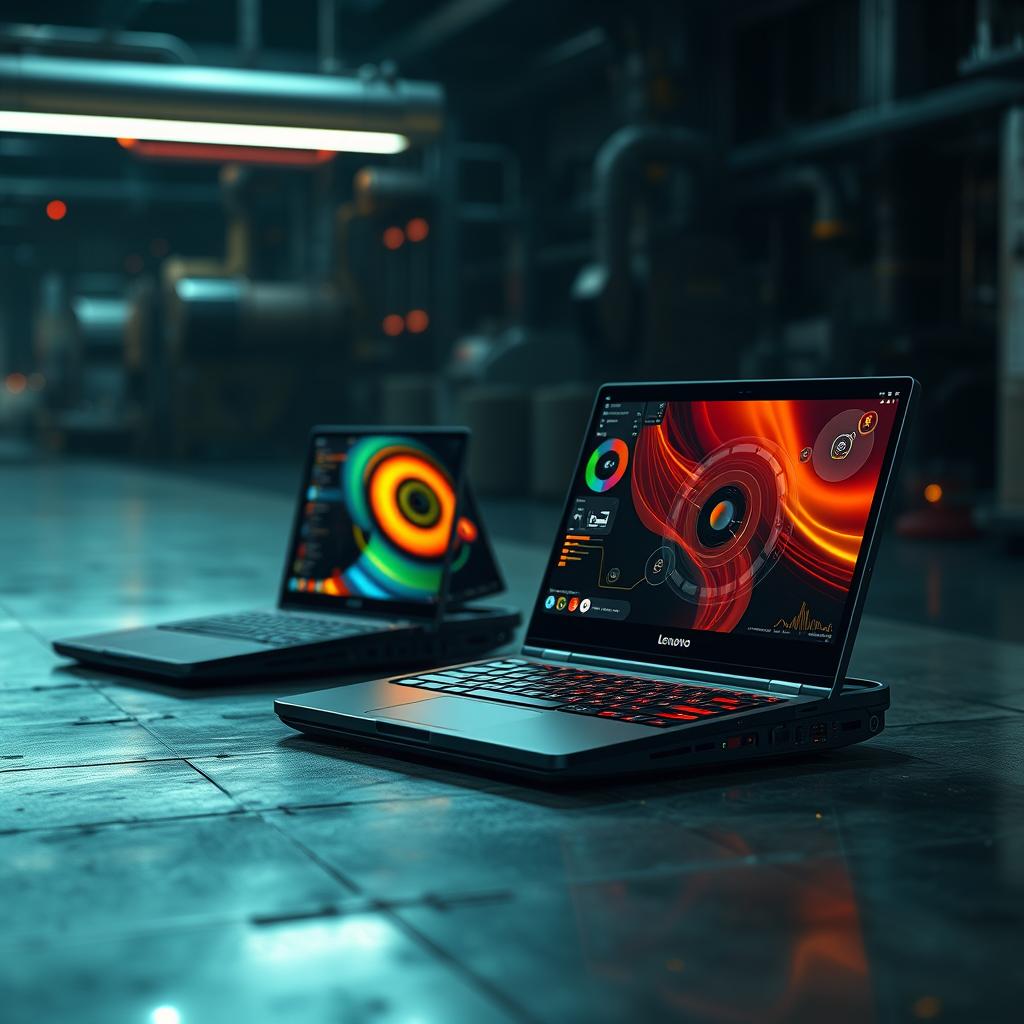
Lenovo’s Modular AI PC Concept Hints at Shape‑Shifting Laptops
At MWC 2026, Lenovo’s ThinkBook Modular AI PC concept and Qira assistant sketch a future where laptops physically reconfigure around AI workflows, from ambient agents to dual‑screen work.
Lenovo is using Mobile World Congress 2026 to sketch a very different future for the PC: one where the laptop physically rearranges itself around your AI workflows. Its new ThinkBook Modular AI PC concept pairs a detachable second display, a removable wireless keyboard, and hot‑swappable ports with Lenovo’s upcoming Qira “super agent,” pointing toward machines designed from the outset for ambient, multi‑screen AI computing. (theshortcut.com)
The ThinkBook Modular AI PC is, on paper, a 14‑inch ThinkBook. In practice, it behaves more like a portable, reconfigurable workstation. The main keyboard lifts out entirely, revealing a bay where a second screen can snap in to create a stacked dual‑display setup, echoing—but shrinking—the kind of workflow offered by Asus’s Zenbook Duo and Lenovo’s own Yoga Book 9i. The same extra panel can instead mount to the back of the lid for face‑to‑face sharing, or stand alone as a USB‑C external monitor via a built‑in kickstand. (theshortcut.com)
Modularity extends to connectivity. Two of the laptop’s ports are implemented as removable I/O blocks that can be swapped on the fly for USB‑C, USB‑A or HDMI modules, with Lenovo representatives suggesting further options such as Ethernet or SD card readers are feasible. Reviewers who handled the device reported that port swaps and display re‑arrangements worked without rebooting, unusual polish for a concept system shown on a trade‑show floor. (theshortcut.com)
On its own, that might look like an enthusiast‑friendly evolution of the modular ideas popularized by Framework. But Lenovo is positioning the design as an “AI PC” for a reason. The concept reportedly runs on Intel Core Ultra silicon with a built‑in NPU, while Lenovo has spent the past year pushing AI‑accelerated ThinkPad and ThinkBook lines and rolling out its Aura Edition software layer to tune performance, sharing and support around AI features. (findarticles.com)
The bigger story is Qira, Lenovo’s new cross‑device assistant that the company and early reviewers describe as an “ambient” AI agent spanning Lenovo PCs and Motorola phones. Unlike a single chatbot window, Qira is designed to live at the system level, track context across apps and devices, and act on a user’s behalf—within permission boundaries—using a mix of on‑device and cloud models, including infrastructure from Microsoft Azure and OpenAI. According to PCWorld and The Verge, the first wave of Qira‑equipped PCs and smartphones is due in the first quarter of 2026. (theverge.com)
That combination—shape‑shifting hardware plus a resident AI agent—matters because it hints at how PCs might adapt to daily life when AI is not a tab but a constant presence. A detachable second screen that can face a client, sit vertically for code, or live as a sidecar for agent‑generated dashboards makes more sense in a world where AI is summarizing meetings, monitoring workflows, or orchestrating tasks across devices. Swappable ports, meanwhile, quietly solve the physical friction of plugging in docks, cameras, or specialized sensors in cramped or temporary workspaces.
The ThinkBook Modular AI PC is still officially a concept, and Lenovo has told outlets it has no immediate plans to ship it as a retail product. But several reviewers noted that the device felt unusually refined and reliable for a lab demo, suggesting at least some of its ideas—like the hot‑swappable I/O—could migrate into future commercial systems. (engadget.com)
For the broader PC industry, Lenovo’s experiment underscores a strategic shift: as AI agents become a differentiator and a defense against hardware commoditization, vendors are rethinking both software stacks and industrial design. Microsoft’s Copilot+ PC push, Qualcomm’s NPU‑heavy chip roadmaps, and Apple’s on‑device generative models all aim to keep more AI inference on the client side; concepts like Lenovo’s suggest that the physical PC itself may also become more dynamic, tuned to whatever the AI—and the person using it—needs to do at any moment.
Whether buyers will pay for that flexibility is an open question. Modular designs can add cost and mechanical complexity, and Lenovo’s system still relies on proprietary components where fully open platforms might appeal more to repairability advocates. (gizmodo.com) What the ThinkBook Modular AI PC does show, though, is that the AI PC race is no longer only about NPUs and benchmark scores. It is also about how the chassis, screens and ports contort to make room for agents that increasingly want to be everywhere, all at once.
Tags