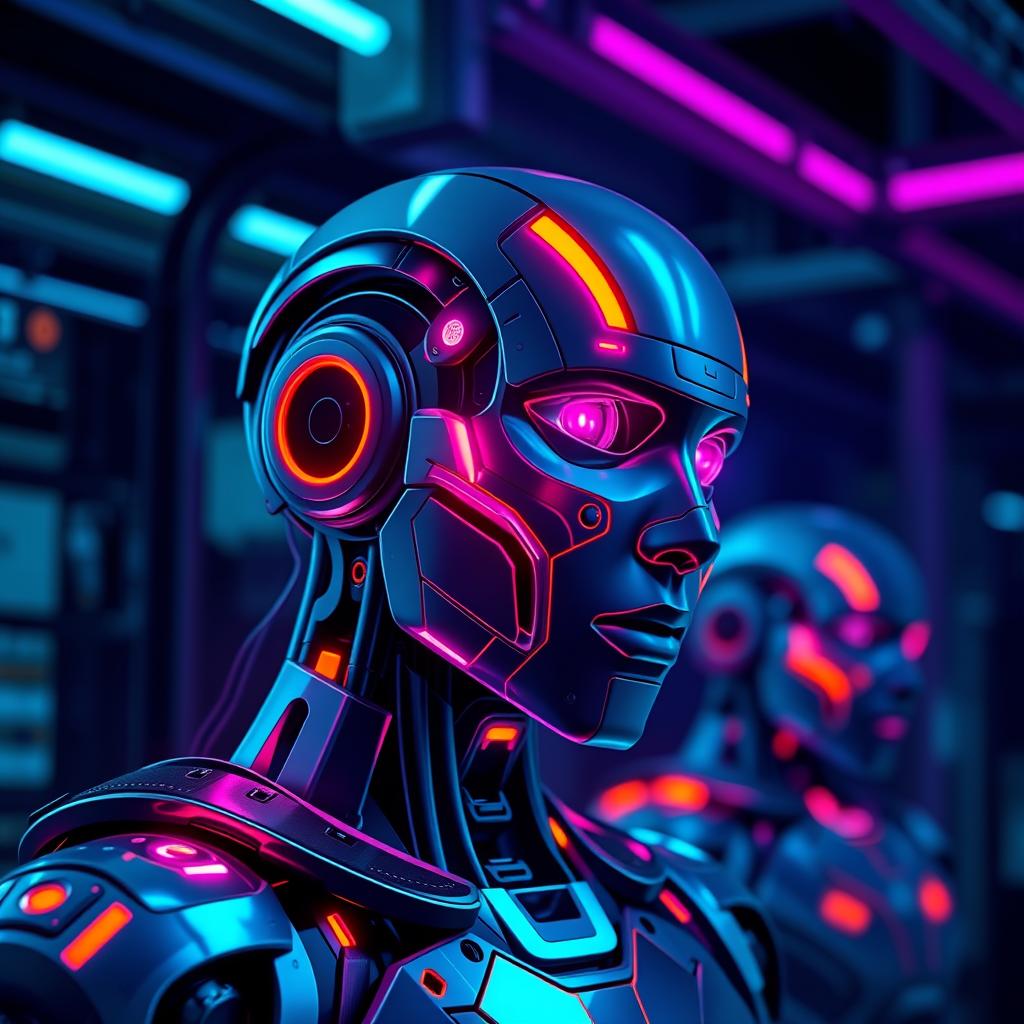
Robots That Reason: Foundation Models Leave the Lab
A new wave of vision-language-action and robotics foundation models is pushing large AI systems off chat screens and into factories, warehouses and homes—raising big economic and safety questions.
Foundation models are starting to leave the chat window and pick up physical objects. Over the past 18 months, companies from Google DeepMind to Nvidia, Microsoft and logistics startup Covariant have unveiled "robotics foundation models" that can understand language, see the world and control arms, grippers and even full humanoid bodies. These systems promise far more flexible automation across warehouses, factories and eventually homes—while concentrating power over the physical world in a handful of AI platforms.
At the heart of this shift is a new class of vision‑language‑action (VLA) models, which take in camera feeds and natural‑language instructions and output low‑level motor commands for robots. VLAs extend the multimodal language models that power today’s chatbots by directly coupling them to control policies. Recent research surveys track more than 80 such systems published in the last three years, arguing that VLAs are emerging as a unifying framework for “generalist” robotics able to reuse skills across tasks and environments.
In industry, the most aggressive push is happening in logistics. Covariant’s RFM‑1, launched in March 2024, is trained not just on internet text and images but on years of multimodal data from warehouse robots—videos, sensor streams and action traces from systems that routinely hit around 1,000 successful picks per hour at over 99% precision in production. RFM‑1 powers fleets that handle deformable, transparent and irregular items at scale, and Covariant pitches it as a template for extending the same foundation model across new robot form factors and industries.
Big tech players are now racing to bring the same idea to humanoids. Google DeepMind’s Gemini Robotics, announced in 2025, layers a robotics interface on top of the Gemini 2.0 family so robots can perform dexterous tasks such as folding paper or opening bottles and adapt to new scenarios with minimal task‑specific training, according to reporting by The Verge and others. Nvidia’s Isaac GR00T N1 model, unveiled at its 2025 GTC conference, uses a dual‑system architecture—fast reflexive control paired with a slower reasoning VLM—to help partner companies like Boston Dynamics, Agility Robotics and 1X Technologies build more general‑purpose humanoids.
Microsoft has joined the fray with Rho‑alpha, a robotics model derived from its Phi vision‑language series that targets “physical AI” in unstructured environments. As reported by TechRadar, Rho‑alpha focuses on complex bimanual manipulation and fuses language, perception and tactile feedback, trained on a mix of real‑world data, simulated experience in Nvidia Isaac Sim and human teleoperation corrections. The goal is to move robots beyond rigid production lines into more dynamic, collaborative work alongside humans.
Academia is pushing the frontier of physical reasoning. Work on 3D‑VLA proposes embodied world models that operate directly in 3D space, predicting future scenes to plan actions, while the newly introduced GeneralVLA architecture decouples perception, mid‑level 3D trajectory planning and low‑level control. GeneralVLA reports zero‑shot success across a range of manipulation tasks without any real‑world robot demonstrations, instead generating its own training trajectories—hinting at a path to scalable data creation for robotics without armies of human teleoperators.
The economic stakes are substantial. Amazon already operates hundreds of thousands of robots in its warehouses and is piloting humanoids for logistics, according to coverage by Le Monde and others. Analysts expect the robotics market to more than double by the end of the decade as labor‑intensive sectors—from e‑commerce fulfillment to manufacturing and elder care—search for automation that can cope with messy, changing conditions. If VLA‑powered robots can generalize across tasks the way language models generalize across prompts, the marginal cost of deploying a new industrial or service workflow could fall dramatically.
But the same shortcut to broad autonomy brings sharp safety and governance challenges. Embodied foundation models inherit all the failure modes of large language systems—hallucinations, brittle reasoning, exploitable prompts—then add moving parts and physical risk. Google DeepMind has stressed a layered safety approach for Gemini Robotics, including models that estimate the riskiness of proposed actions before execution. Nvidia has open‑sourced data and tools around GR00T N1 in part to enable independent evaluation. Yet there are no widely adopted standards for testing or certifying the physical reliability and alignment of such systems across edge cases.
Security and geopolitical concerns are close behind. The same models that help a humanoid pack boxes could, with modest adaptation, assist with dual‑use applications in defense and surveillance. Militaries already experiment with autonomous ground and aerial systems; a mature ecosystem of off‑the‑shelf robotics foundation models would lower the barrier to integrating sophisticated planning and manipulation into battlefield platforms. Policymakers so far have focused on text and image models, leaving embodied AI largely outside formal regulatory regimes.
The next few years are likely to determine whether reasoning‑capable robots remain confined to tightly supervised industrial pilots or spread into homes, hospitals and public spaces. For now, the technical trajectory is clear: large foundation models are no longer just talking about the world—they are beginning to act in it. The harder question is whether governance, labor policy and safety engineering can keep pace as software that once wrote emails starts quietly rearranging the physical economy.
Tags