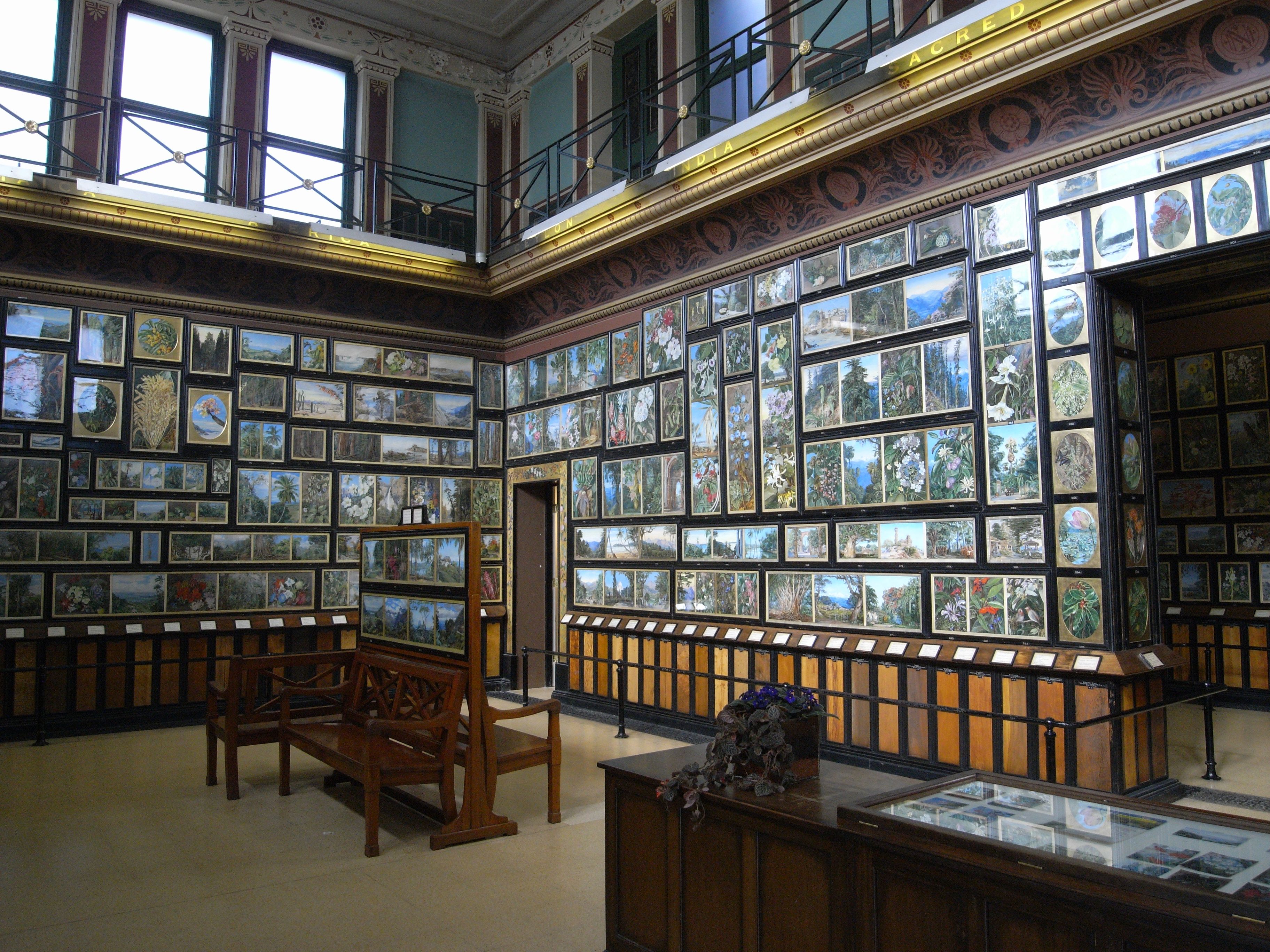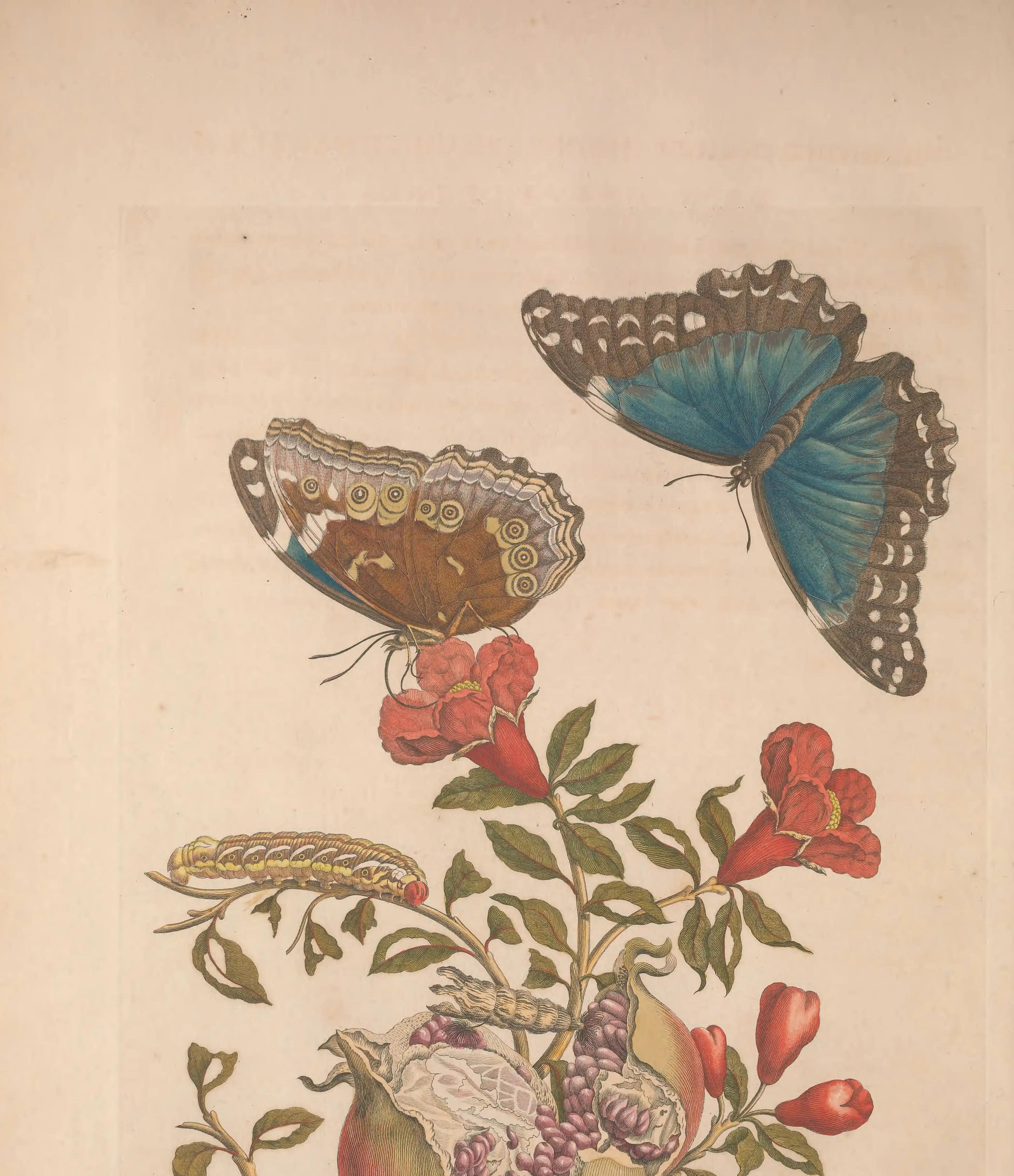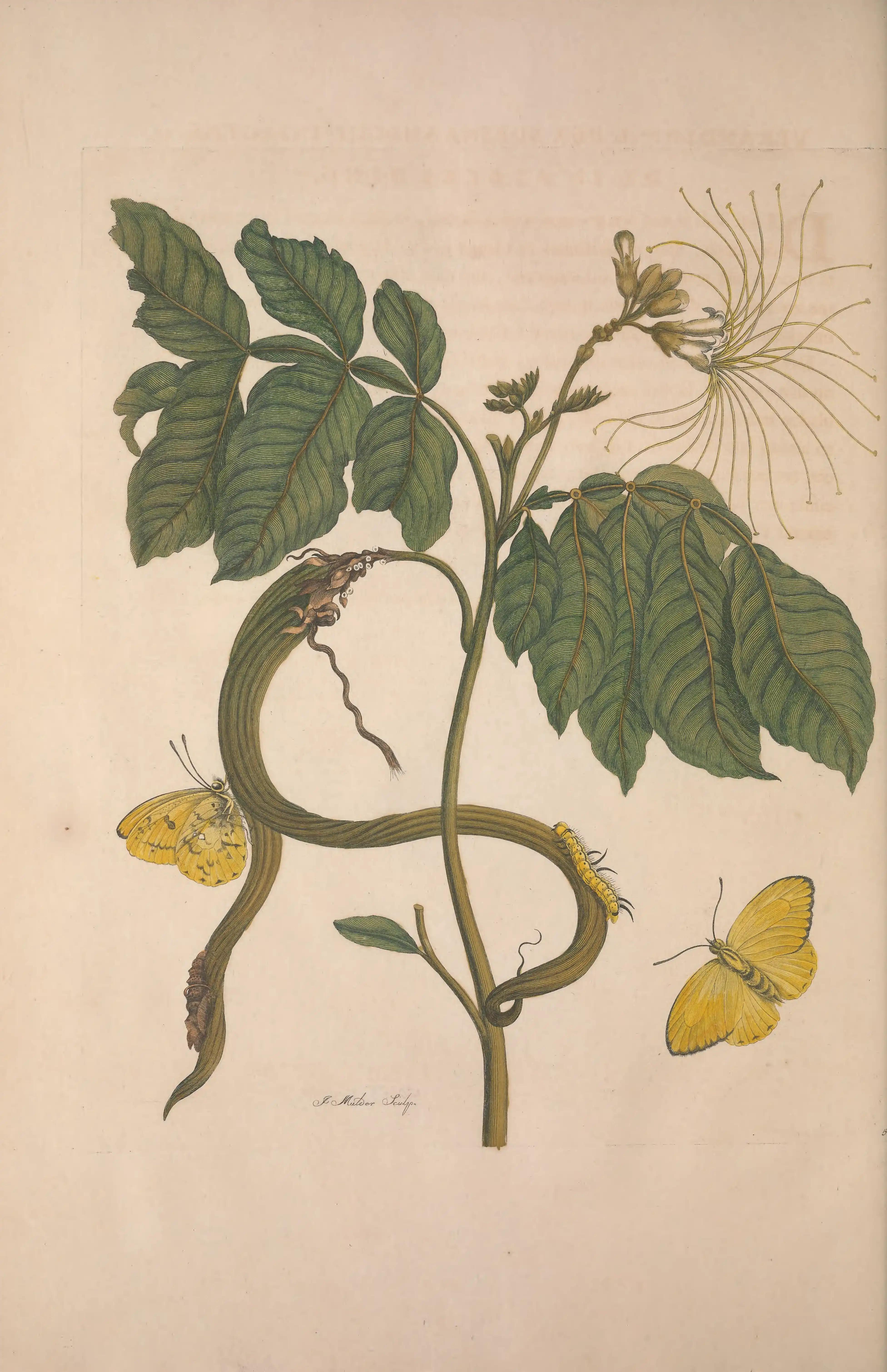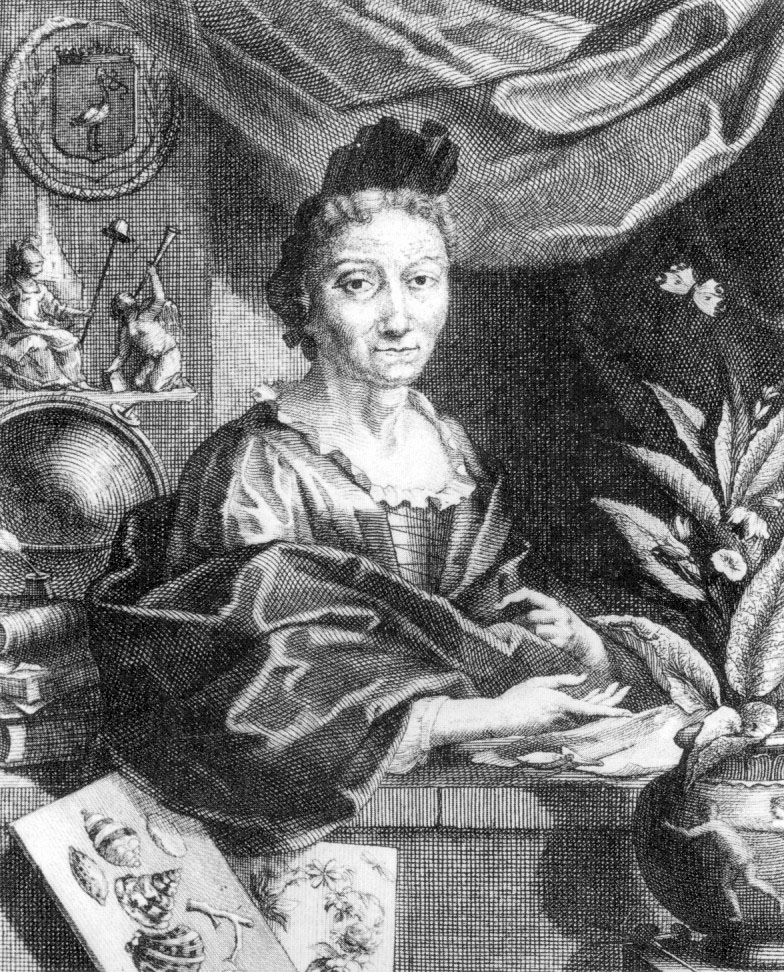
Images & sources

A good image has an origin.

The photographs and historical artworks that give the journal its atmosphere. Every image has an identifiable source and a documented licence.

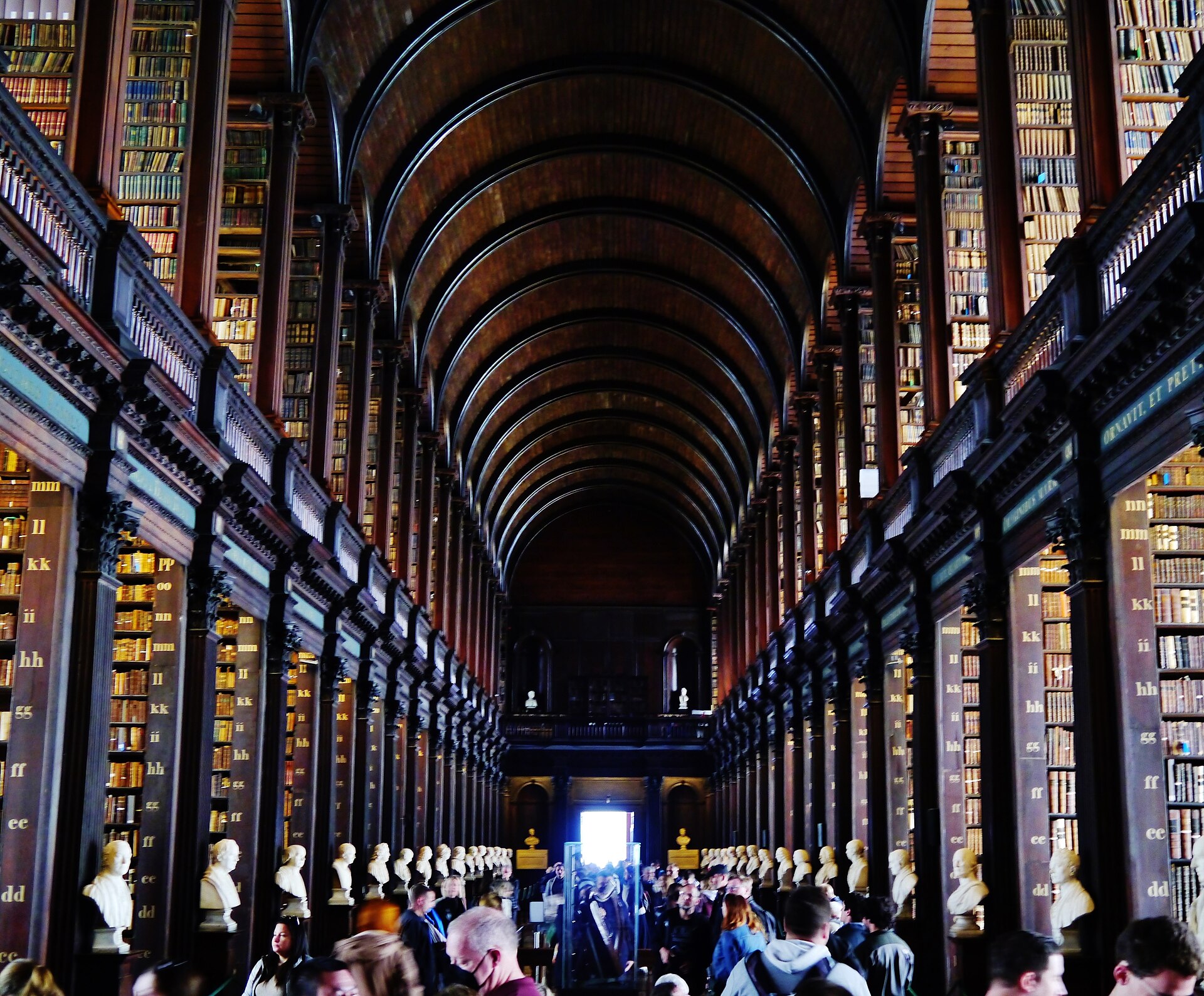
The Long Room at Trinity College Library, with dark bookshelves and a high vaulted ceiling

Long Room, Trinity College Dublin. Interior photograph from 2022.

Zairon / Wikimedia Commons

Licence: CC BY 4.0. The source image’s subject is preserved. Images are shown at web resolution, cropped, and may have a colour overlay in the layout. Visual adaptations of CC BY-SA images are shared under the same licence.

View the original and source details
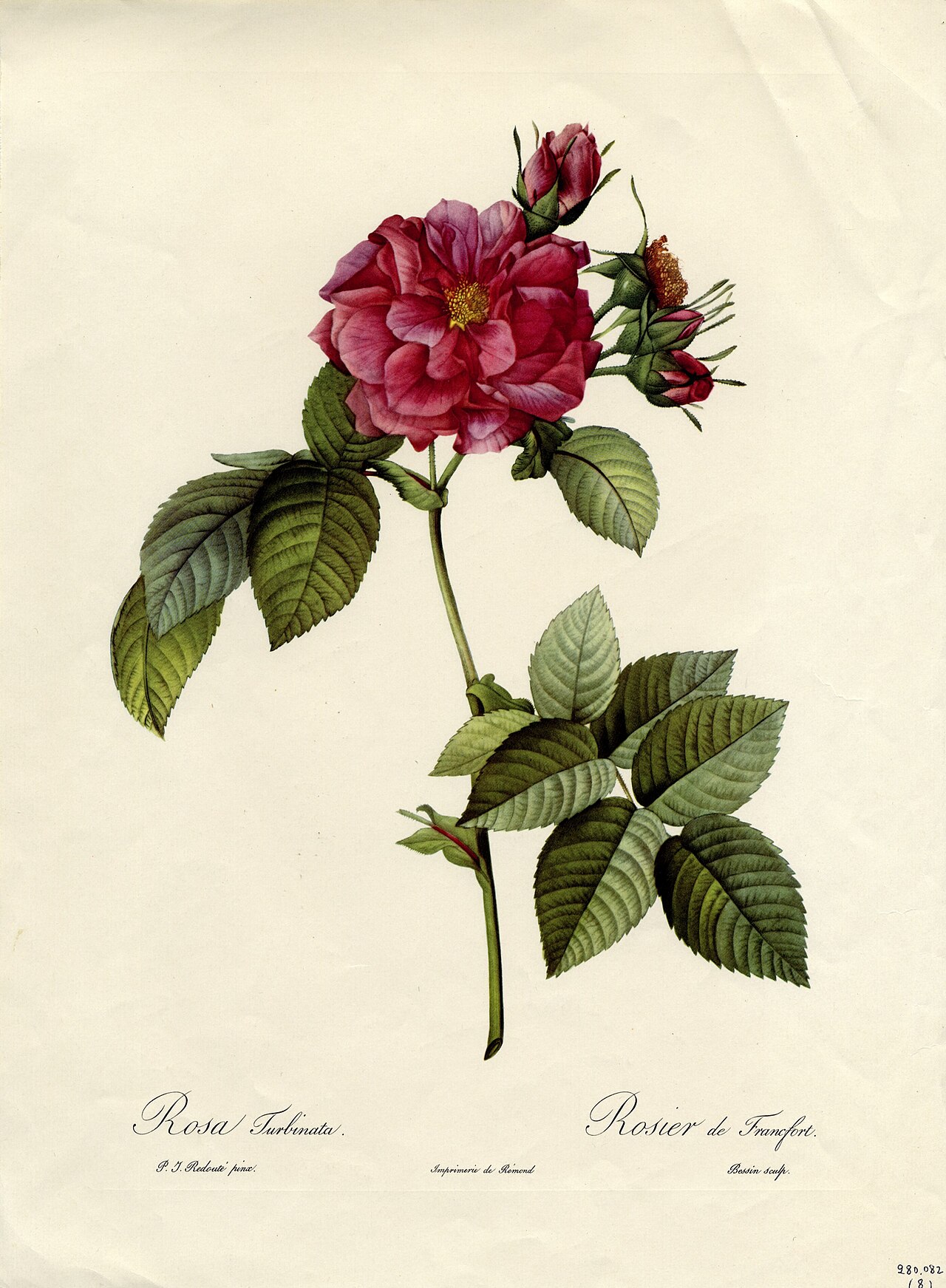
A historical botanical plate of a pink rose with green leaves by Pierre-Joseph Redouté

Rosa Turbinata (Rosier de Francfort), Pierre-Joseph Redouté. Engraver: Marie Joseph Bessin.

Pierre-Joseph Redouté / Bibliothèque nationale de France, via Wikimedia Commons

Licence: Public domain. The source image’s subject is preserved. Images are shown at web resolution, cropped, and may have a colour overlay in the layout. Visual adaptations of CC BY-SA images are shared under the same licence.

View the original and source details
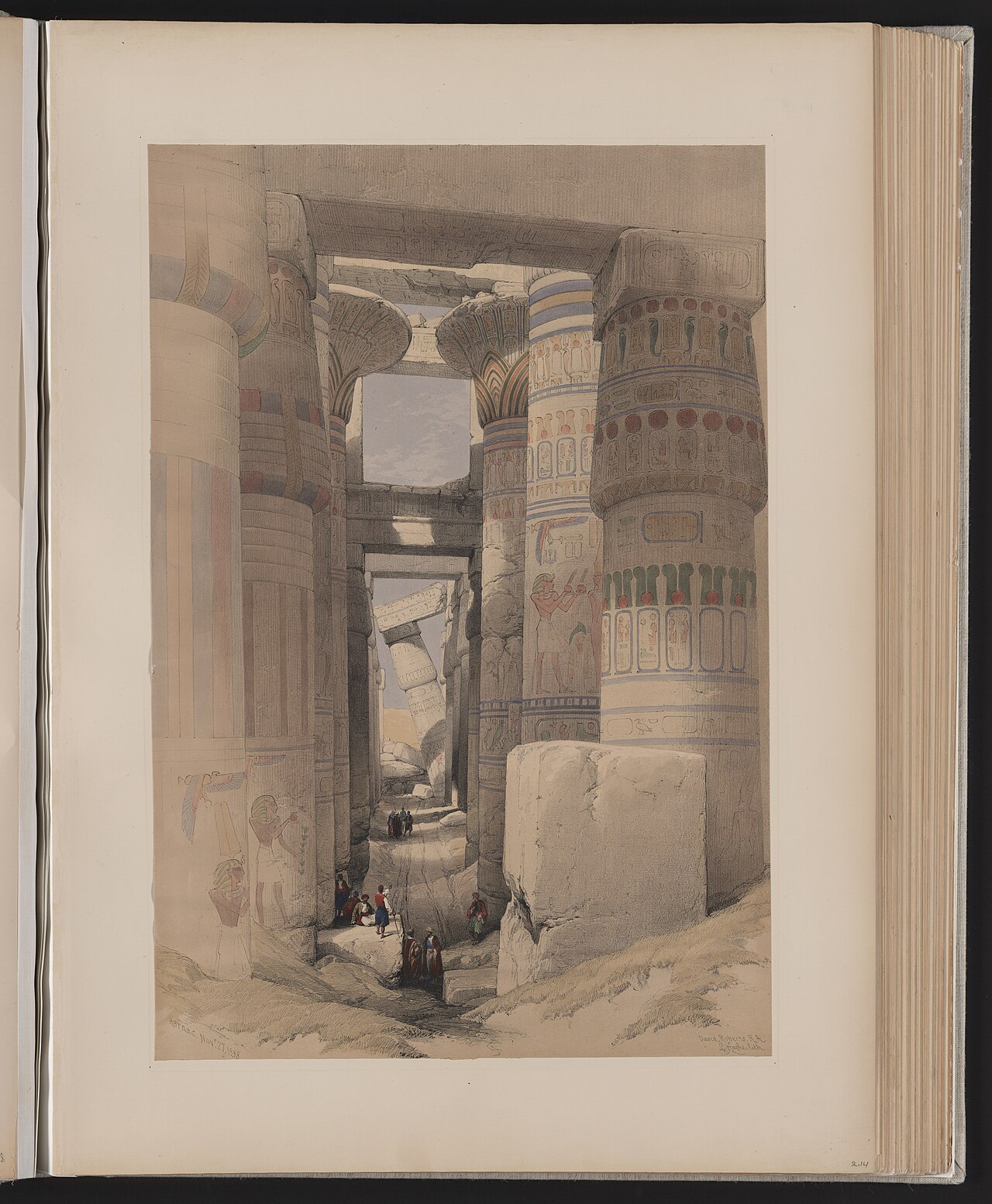
A historical colour lithograph of the great columned hall at Karnak, Egypt

Karnac, published in 1846. Louis Haghe after David Roberts. Library of Congress.

David Roberts / Louis Haghe / Library of Congress

Licence: Public domain. The source image’s subject is preserved. Images are shown at web resolution, cropped, and may have a colour overlay in the layout. Visual adaptations of CC BY-SA images are shared under the same licence.

View the original and source details
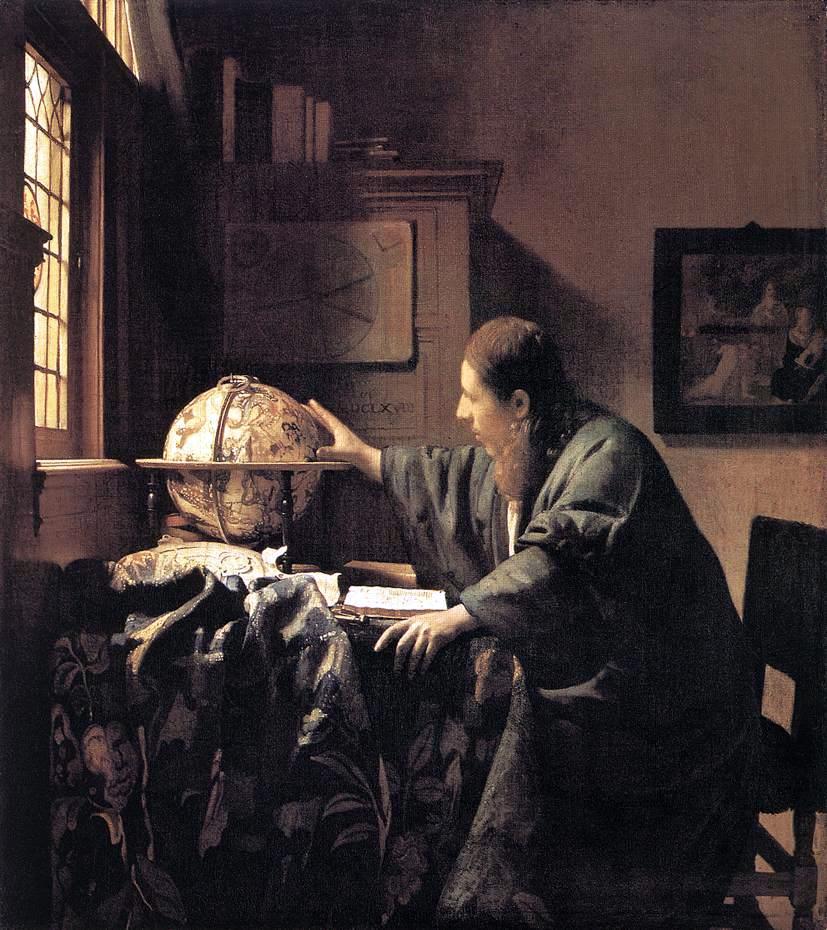
Vermeer’s astronomer leaning over a celestial globe beside a window in his study

Johannes Vermeer, The Astronomer, c. 1668. Louvre. Historical painting used as an atmospheric illustration.

Johannes Vermeer / Wikimedia Commons

Licence: Public domain. The source image’s subject is preserved. Images are shown at web resolution, cropped, and may have a colour overlay in the layout. Visual adaptations of CC BY-SA images are shared under the same licence.

View the original and source details
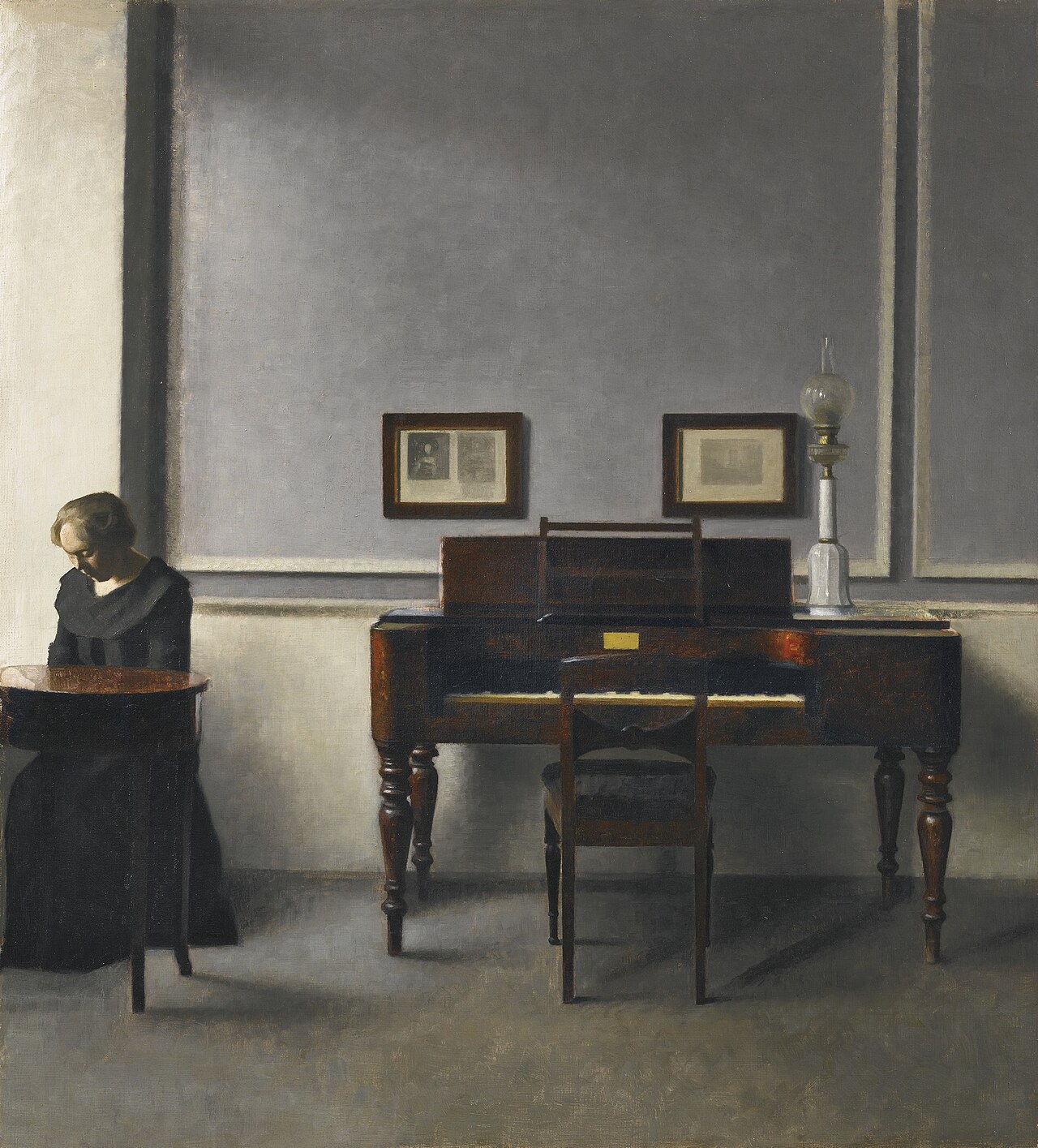
Ida at a piano in a quiet, light-filled interior painted by Vilhelm Hammershøi

Vilhelm Hammershøi, Ida in an Interior with Piano, 1901. Historical painting used as an atmospheric illustration.

Vilhelm Hammershøi / Wikimedia Commons

Licence: Public domain. The source image’s subject is preserved. Images are shown at web resolution, cropped, and may have a colour overlay in the layout. Visual adaptations of CC BY-SA images are shared under the same licence.

View the original and source details
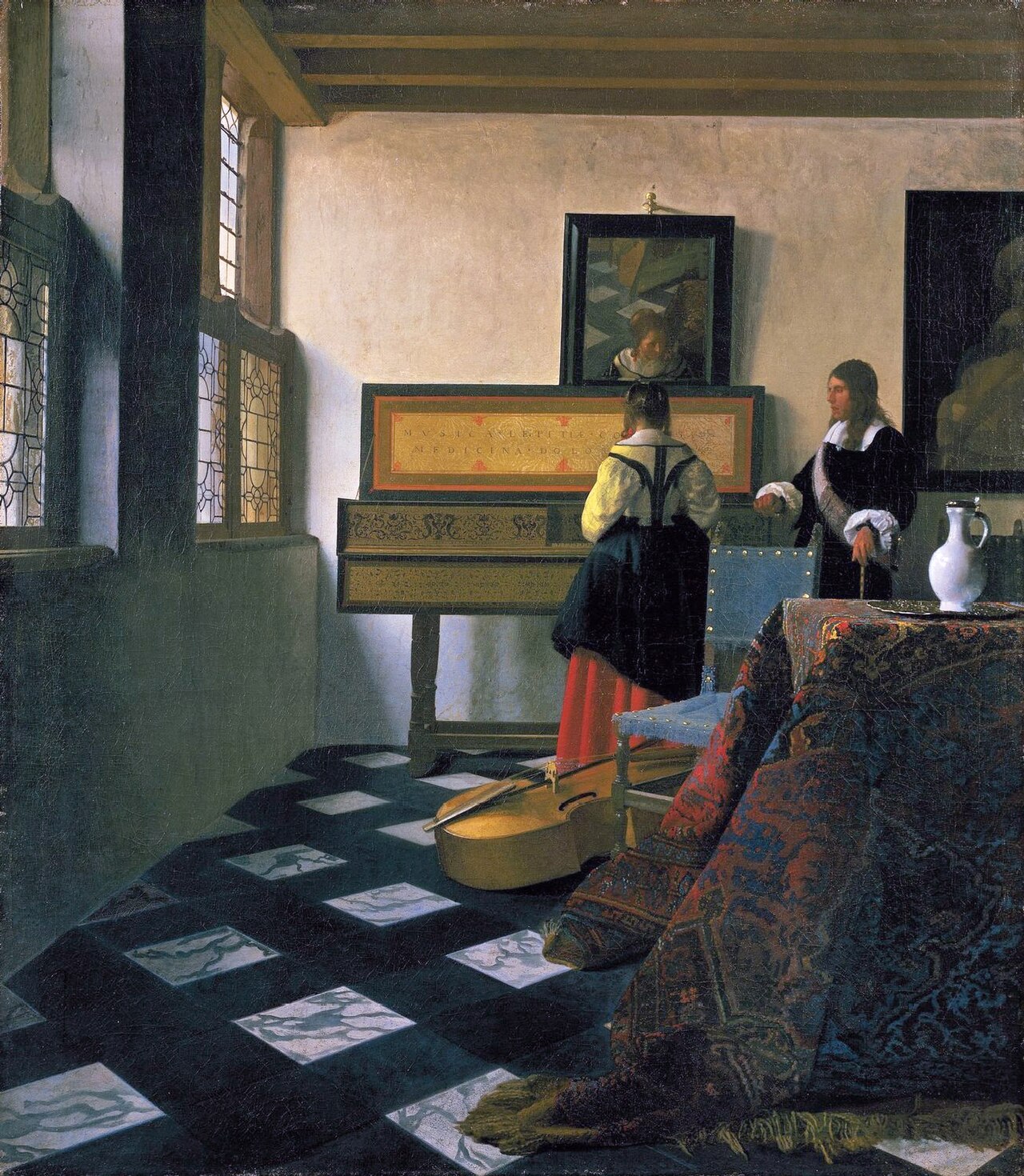
Vermeer’s The Music Lesson, showing a woman at a virginal and a man in a light-filled room

Johannes Vermeer, The Music Lesson, c. 1662–1665. Royal Collection.

Johannes Vermeer / Wikimedia Commons

Licence: Public domain. The source image’s subject is preserved. Images are shown at web resolution, cropped, and may have a colour overlay in the layout. Visual adaptations of CC BY-SA images are shared under the same licence.

View the original and source details
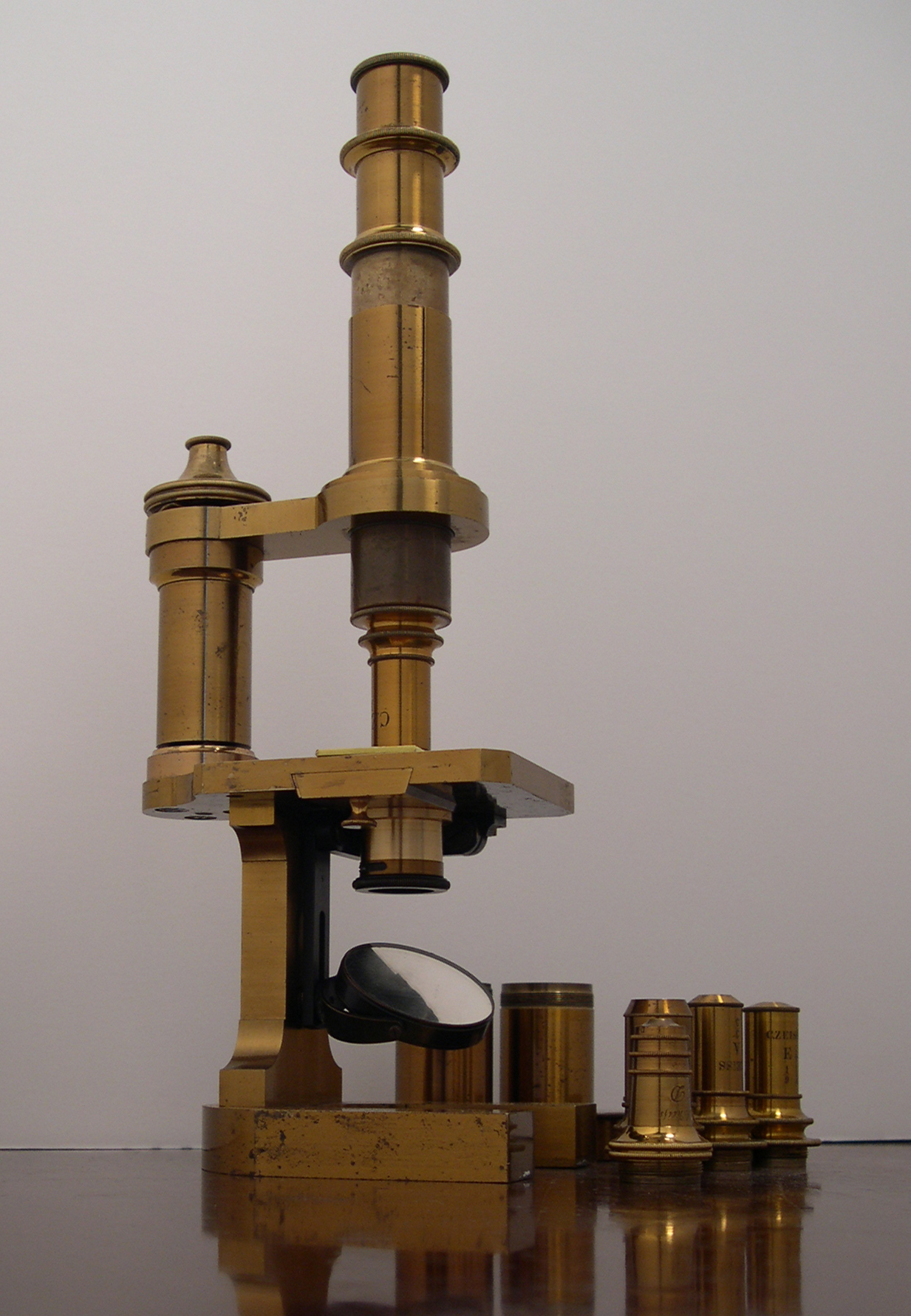
An authentic Zeiss brass microscope with accessories and a wooden case

Zeiss Stativ Vb, a model from the 1881 catalogue. Photograph: MikroSammler, 2017.

MikroSammler / Wikimedia Commons

Licence: CC BY-SA 4.0. The source image’s subject is preserved. Images are shown at web resolution, cropped, and may have a colour overlay in the layout. Visual adaptations of CC BY-SA images are shared under the same licence.

View the original and source details
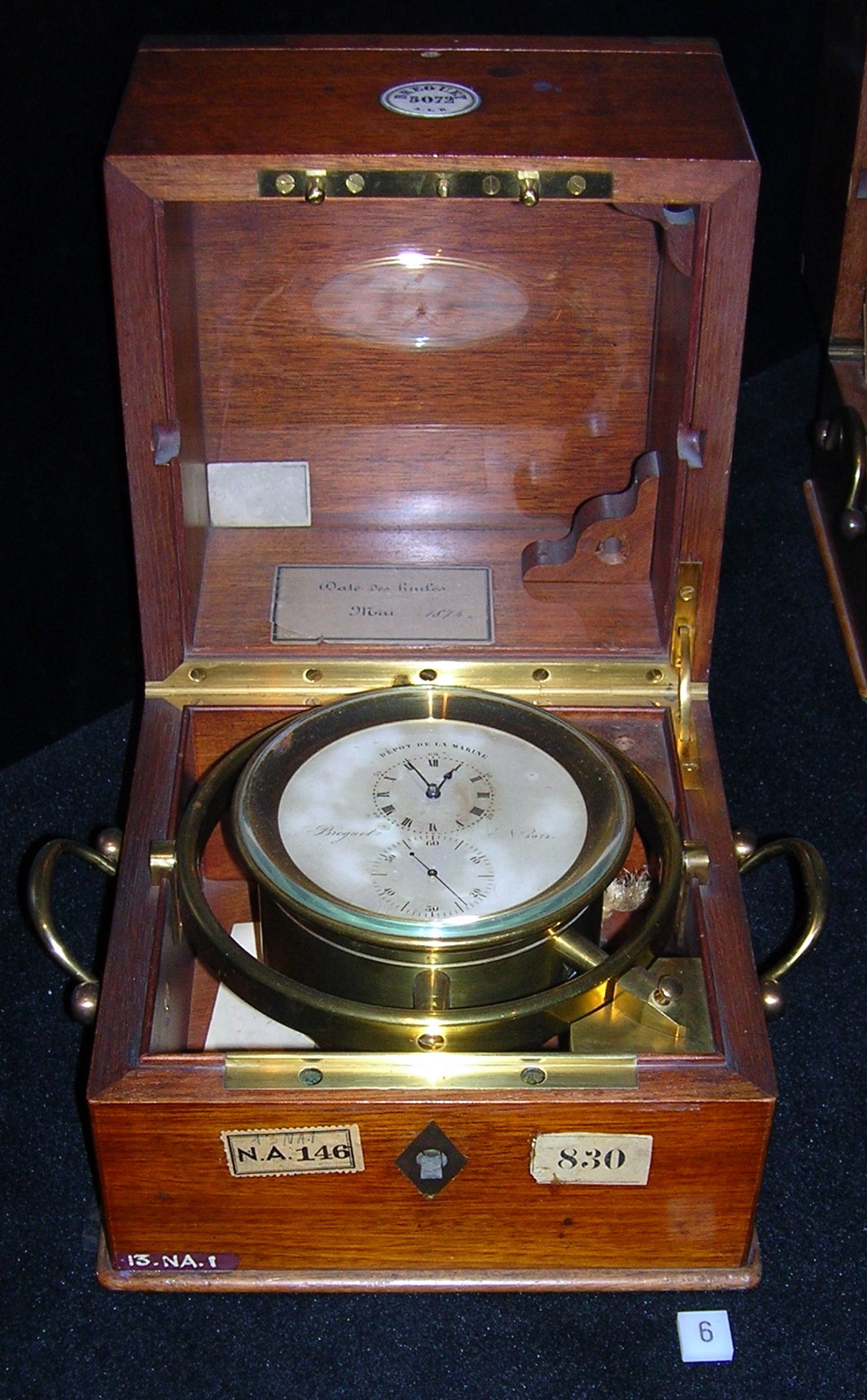
A historical Breguet marine chronometer in a wooden case with a brass suspension

Breguet marine chronometer, mid-nineteenth century. Musée national de la Marine, Paris.

Rémi Kaupp (Korrigan) / Wikimedia Commons

Licence: CC BY-SA 3.0. The source image’s subject is preserved. Images are shown at web resolution, cropped, and may have a colour overlay in the layout. Visual adaptations of CC BY-SA images are shared under the same licence.

View the original and source details
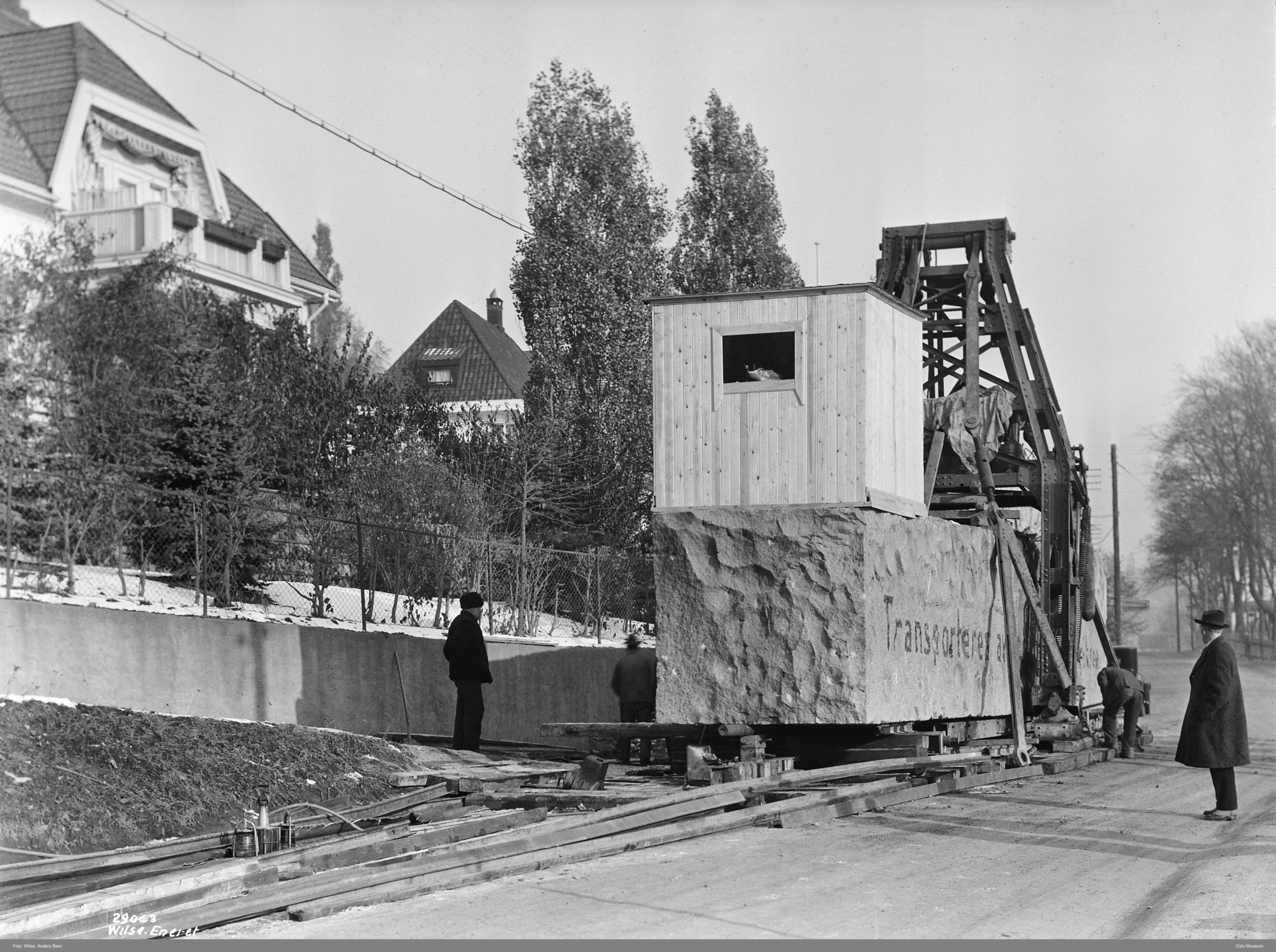
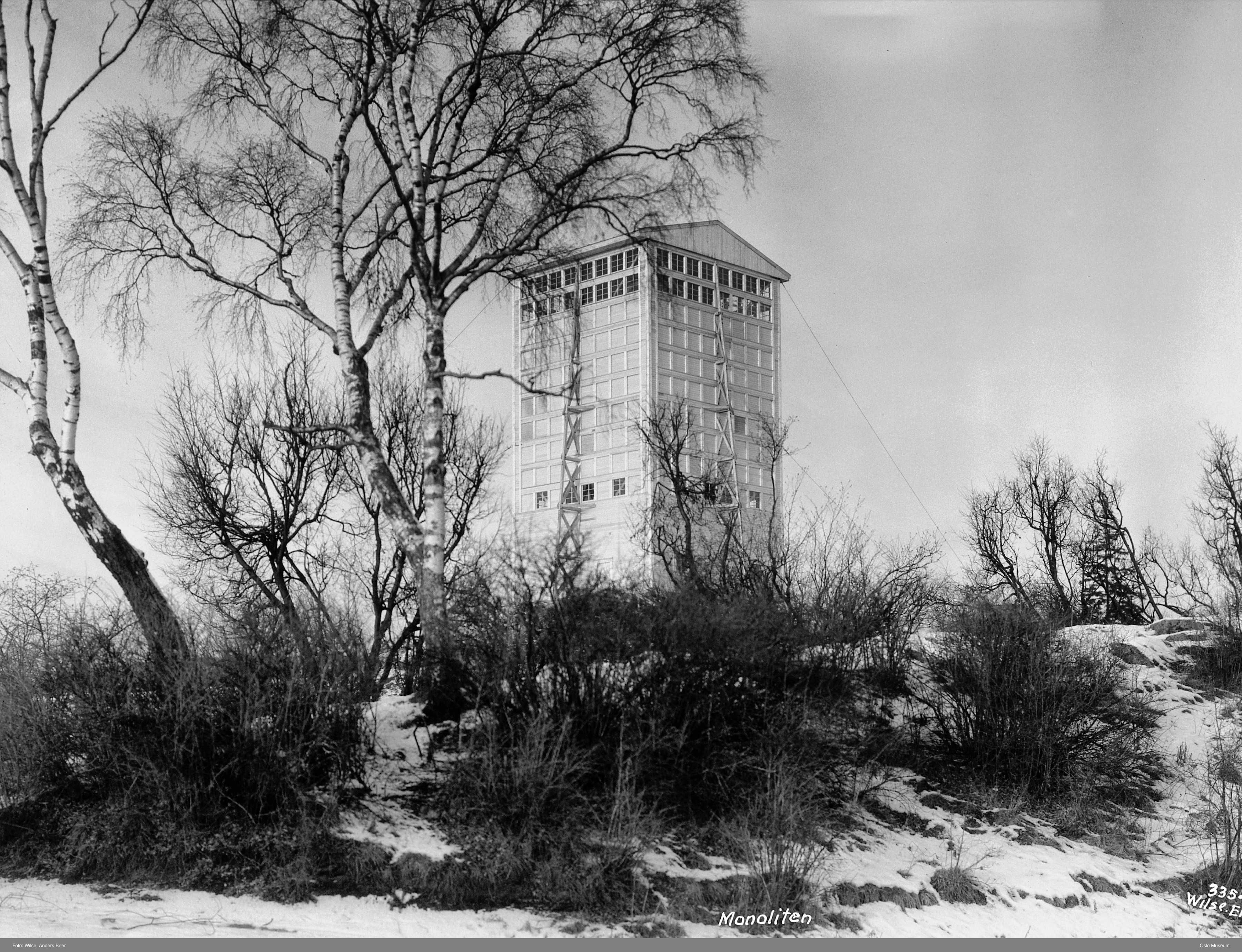
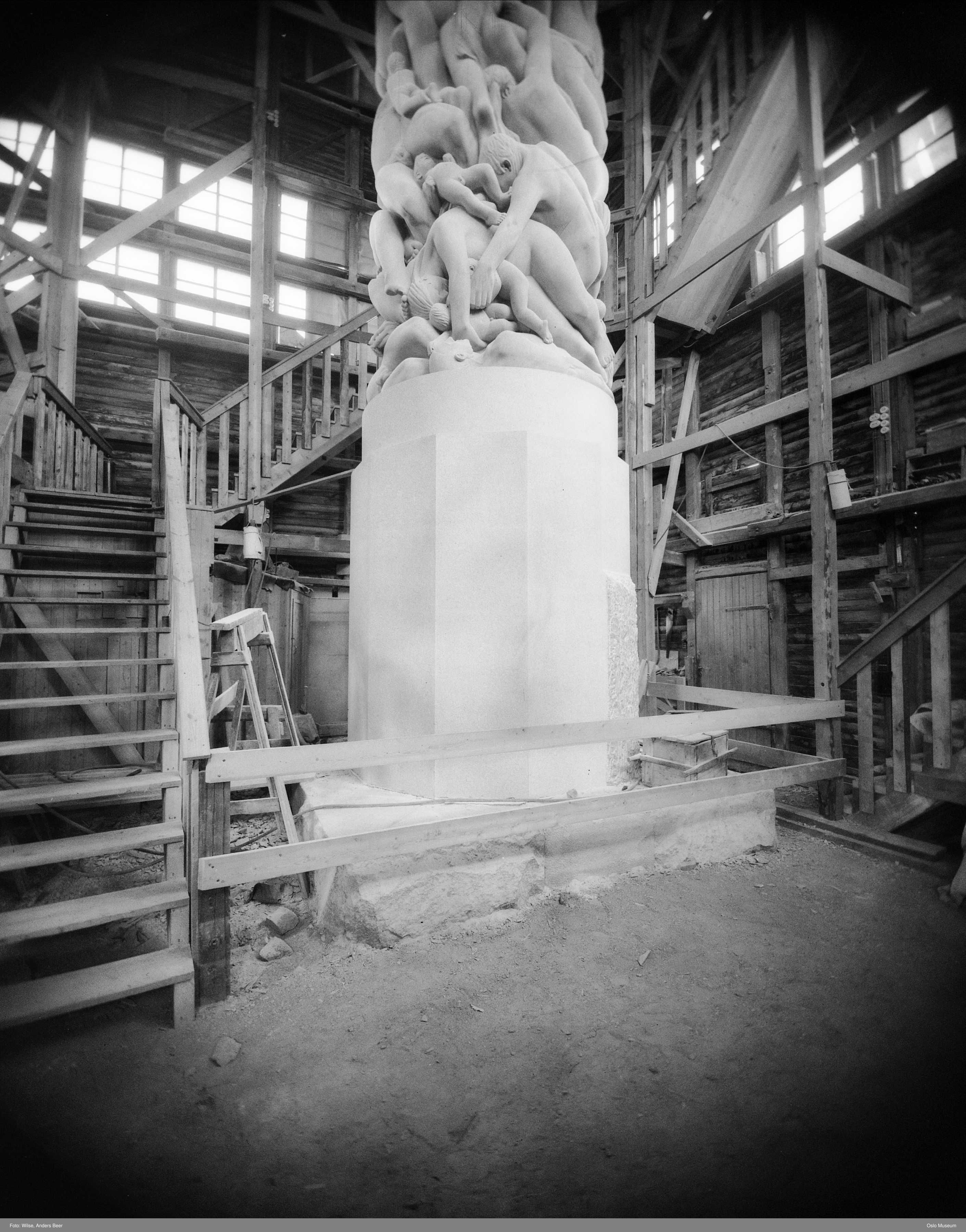
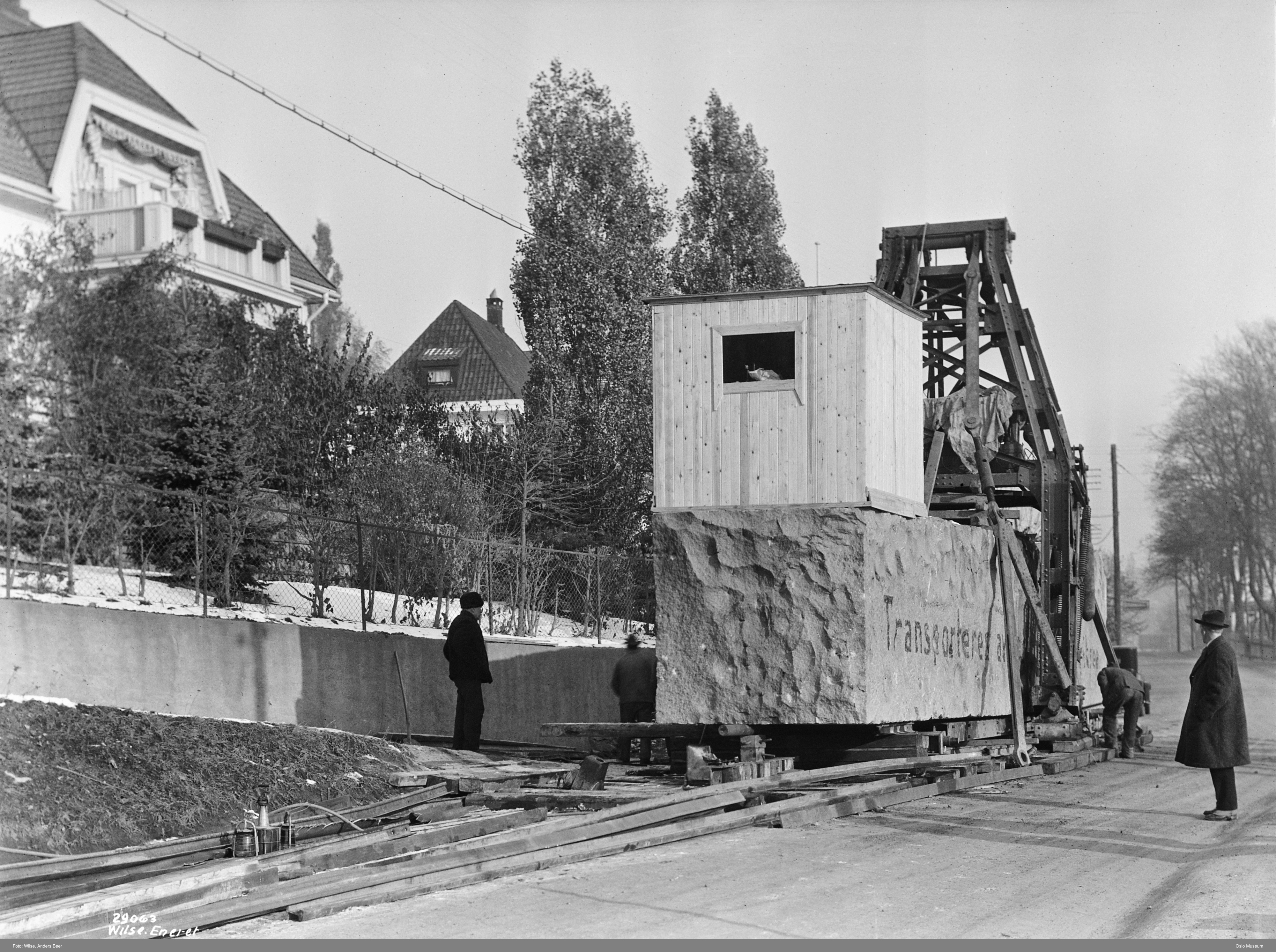
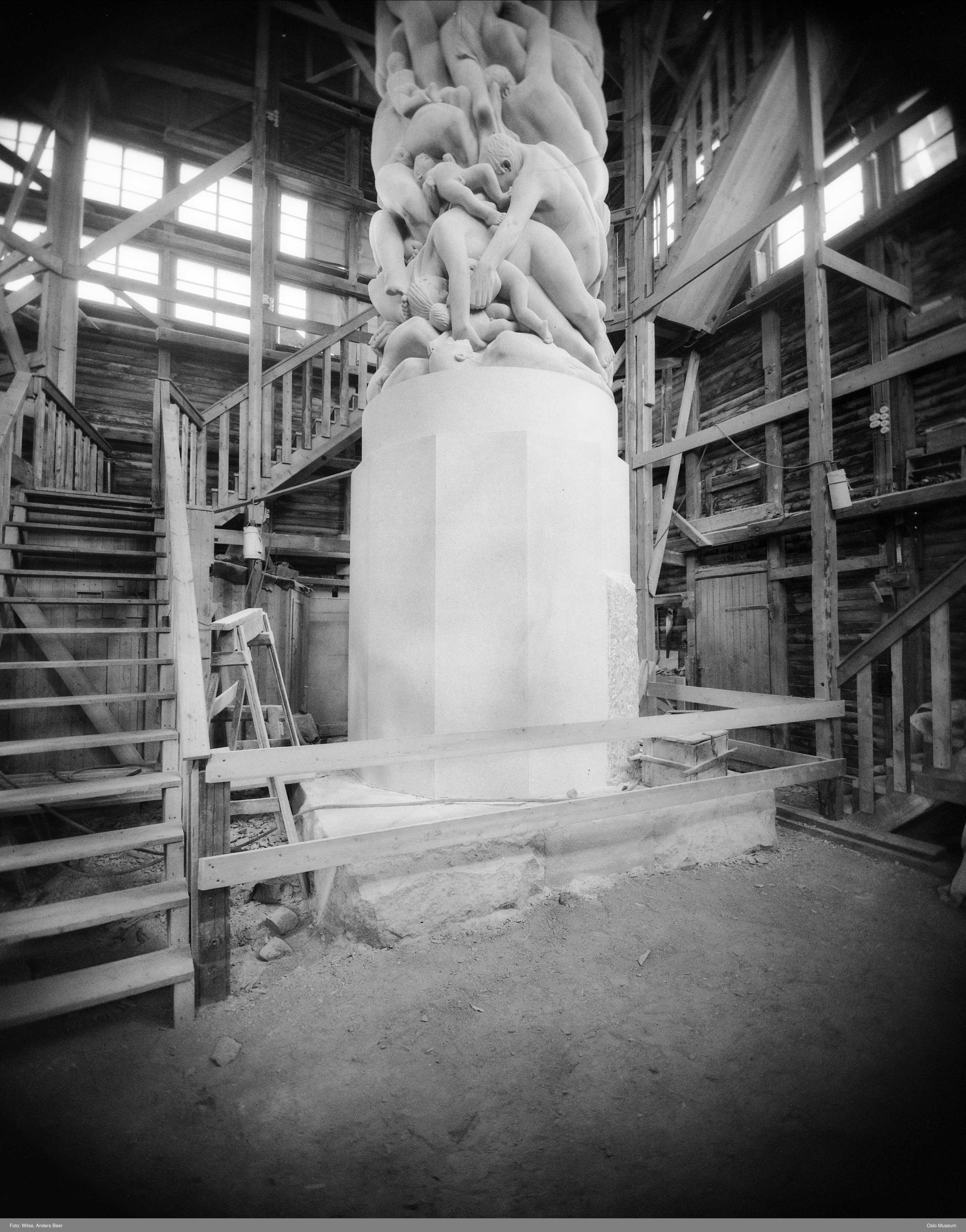
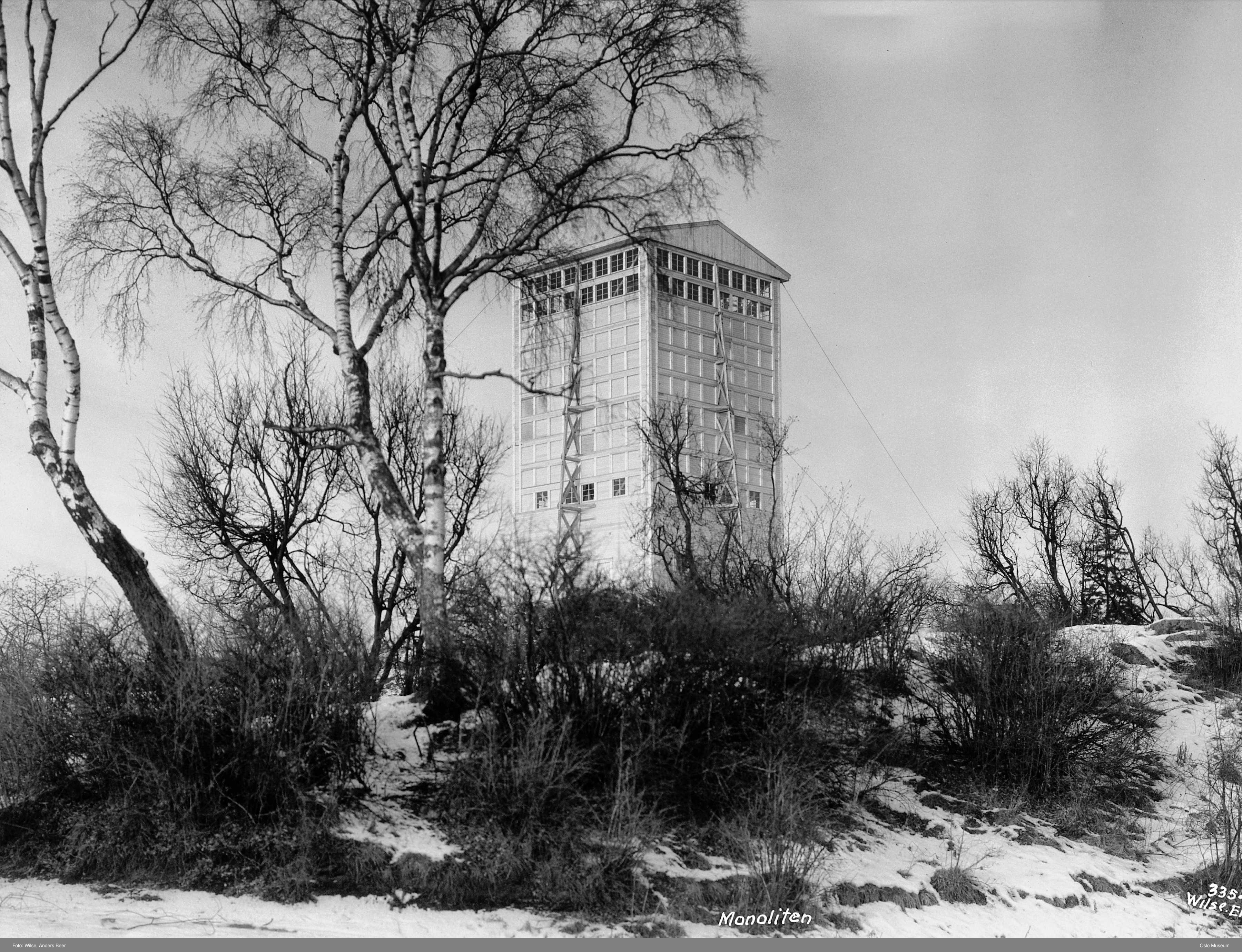
A tall timber house enclosing the Monolith, with boarded walls, high windows and external bracing, photographed among trees.

The timber house built around the upright Monolith block, 1929. It enclosed the stone and the plaster model during the years of carving.

Anders Beer Wilse / Oslo Museum

Licence: CC0-1.0.

View the original and source details
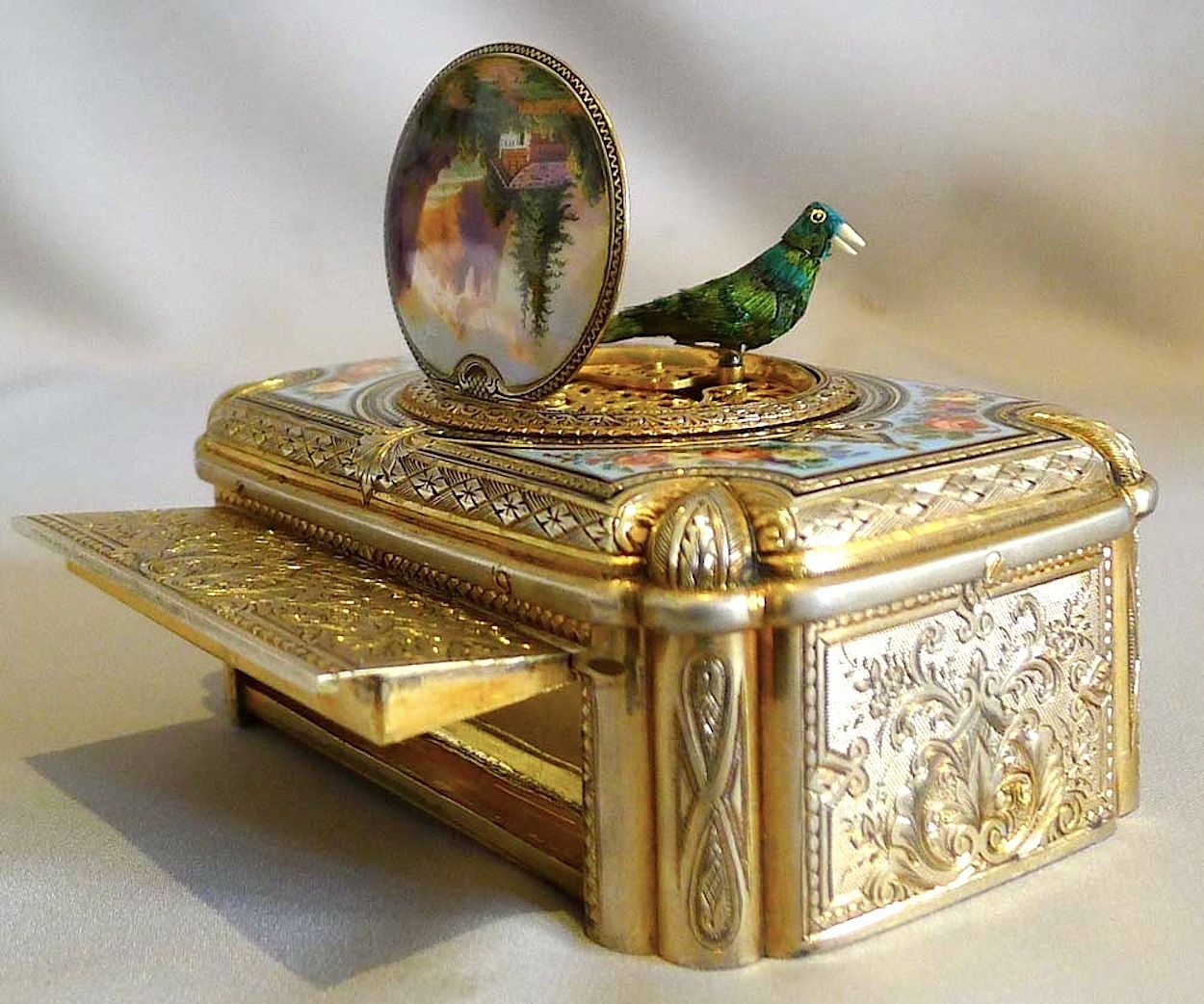
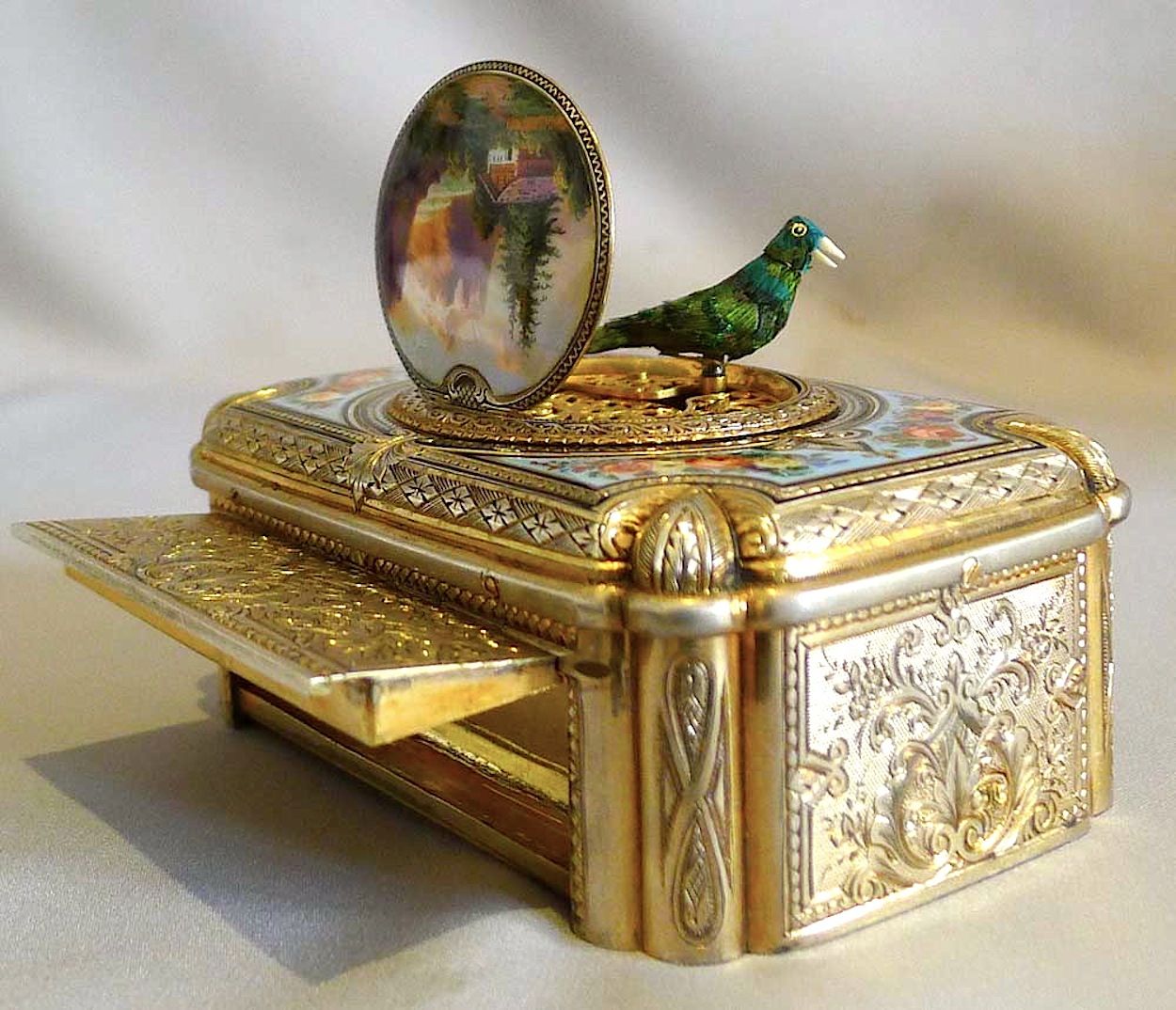
A green feathered mechanical bird stands above an open silver-gilt box, beside its raised enamel lid and open tobacco compartment

A Charles Bruguier singing-bird box, made around 1850. The raised bird and the separate tobacco compartment share a case about ten centimetres wide.

Gavin Douglas

Licence: CC BY-SA 3.0. Cropped 20 pixels from the top and 12 from the bottom for card and sharing formats; the full photograph is retained in the article. Cover cropped for article cards and sharing.

View the original and source details
A green feathered mechanical bird stands above an open silver-gilt box, beside its raised enamel lid and open tobacco compartment

A Charles Bruguier singing-bird box, made around 1850. The raised bird and the separate tobacco compartment share a case about ten centimetres wide.

Gavin Douglas

Licence: CC BY-SA 3.0. Original photograph retained.

View the original and source details
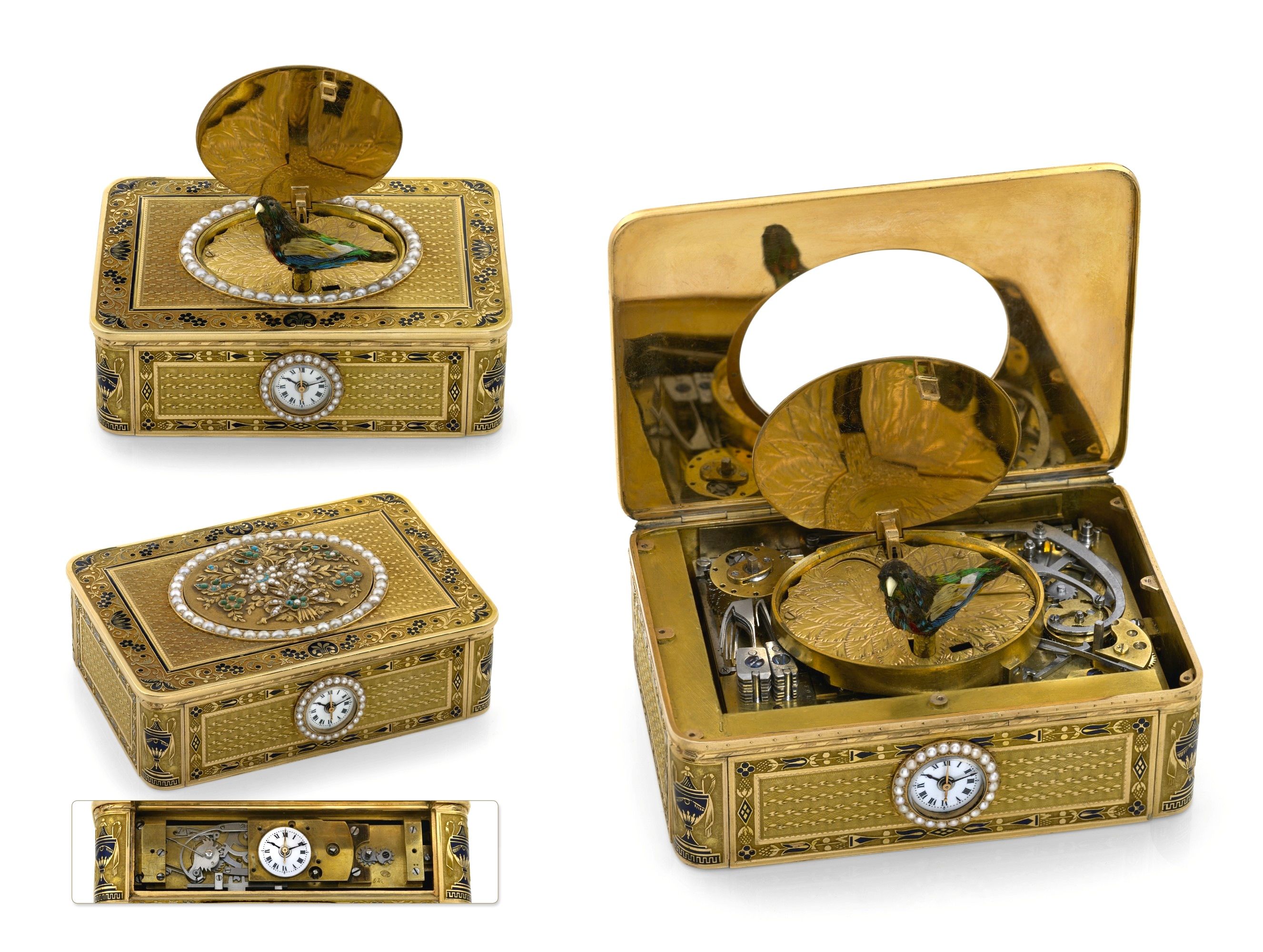
Three views of a gold Rochat bird box, including its watch, raised bird and exposed internal mechanisms

An earlier example by Frères Rochat, around 1820, with bird, music and a repeating watch. The opened case exposes mechanisms that a finished performance normally conceals.

Antiquorum

Licence: CC BY-SA 3.0. Original composite photograph retained.

View the original and source details
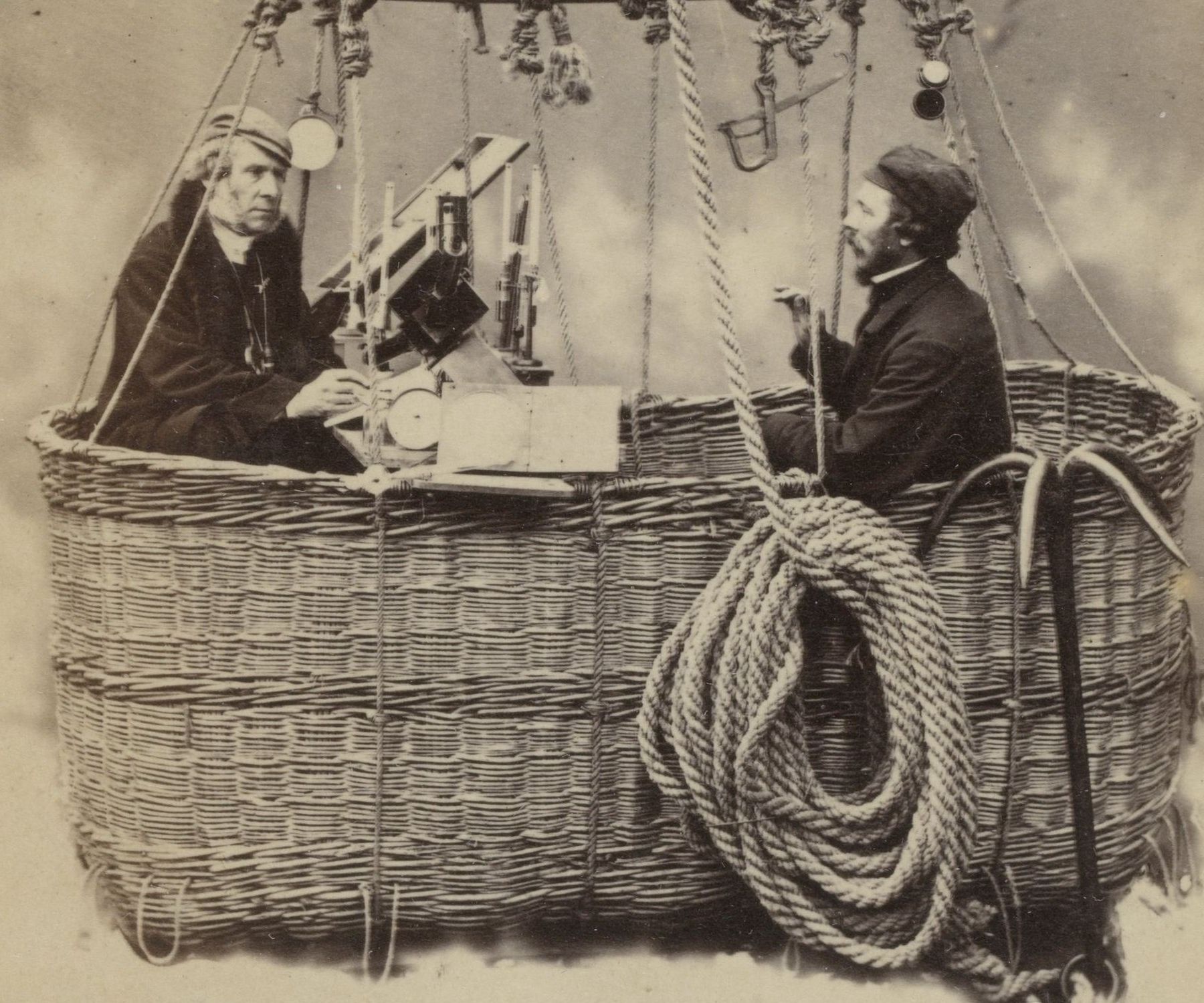
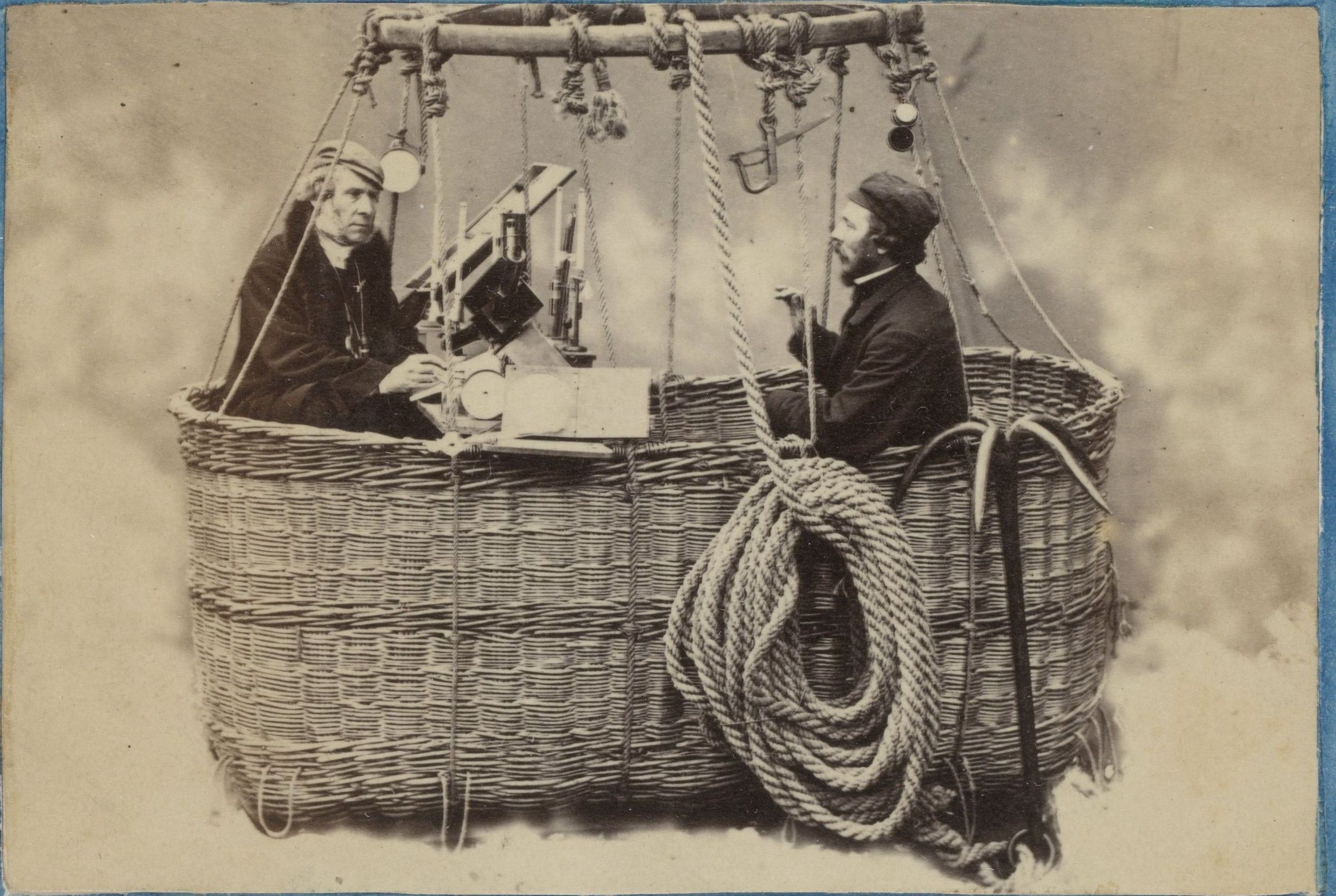
Glaisher and Coxwell on either side of the scientific instrument table in a balloon basket

Glaisher and Coxwell with their instrument table, in a photograph from around 1864.

Rijksmuseum

Licence: CC0 1.0. Photograph cropped from album leaf; separate tighter cover retains both men’s faces, hands and the instrument table. Cover cropped for article cards and sharing.

View the original and source details
James Glaisher and Henry Coxwell sit on opposite sides of a table of instruments in a wicker balloon basket

James Glaisher and Henry Coxwell with an instrument table in a balloon basket, photographed around 1864, after their celebrated ascent.

Rijksmuseum

Licence: CC0 1.0. Cropped from the album leaf to the photograph; painted border partly retained.

View the original and source details
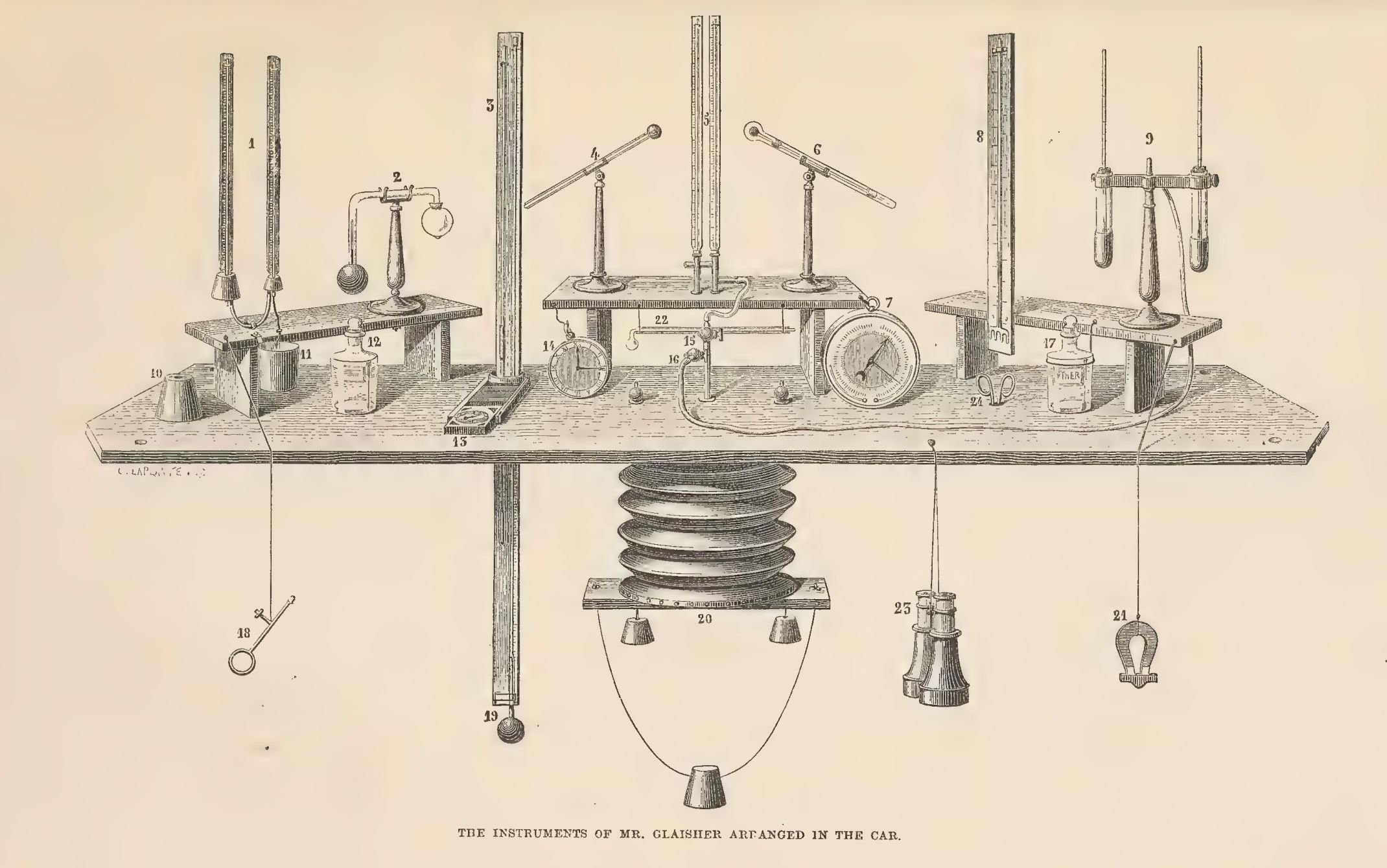
Numbered drawing of Glaisher’s thermometers, barometers, hygrometers, watch and scissors on a table, with foot-operated bellows underneath

Glaisher’s instrument arrangement in Travels in the Air, 1871. The bellows below the table drew air through the measuring apparatus; scissors, numbered 24, allowed equipment to be released quickly for landing.

Charles Laplante · Smithsonian Libraries and Archives

Licence: Public domain. Rendered from original PDF, rotated clockwise and cropped to remove blank margins; full numbered apparatus retained.

View the original and source details
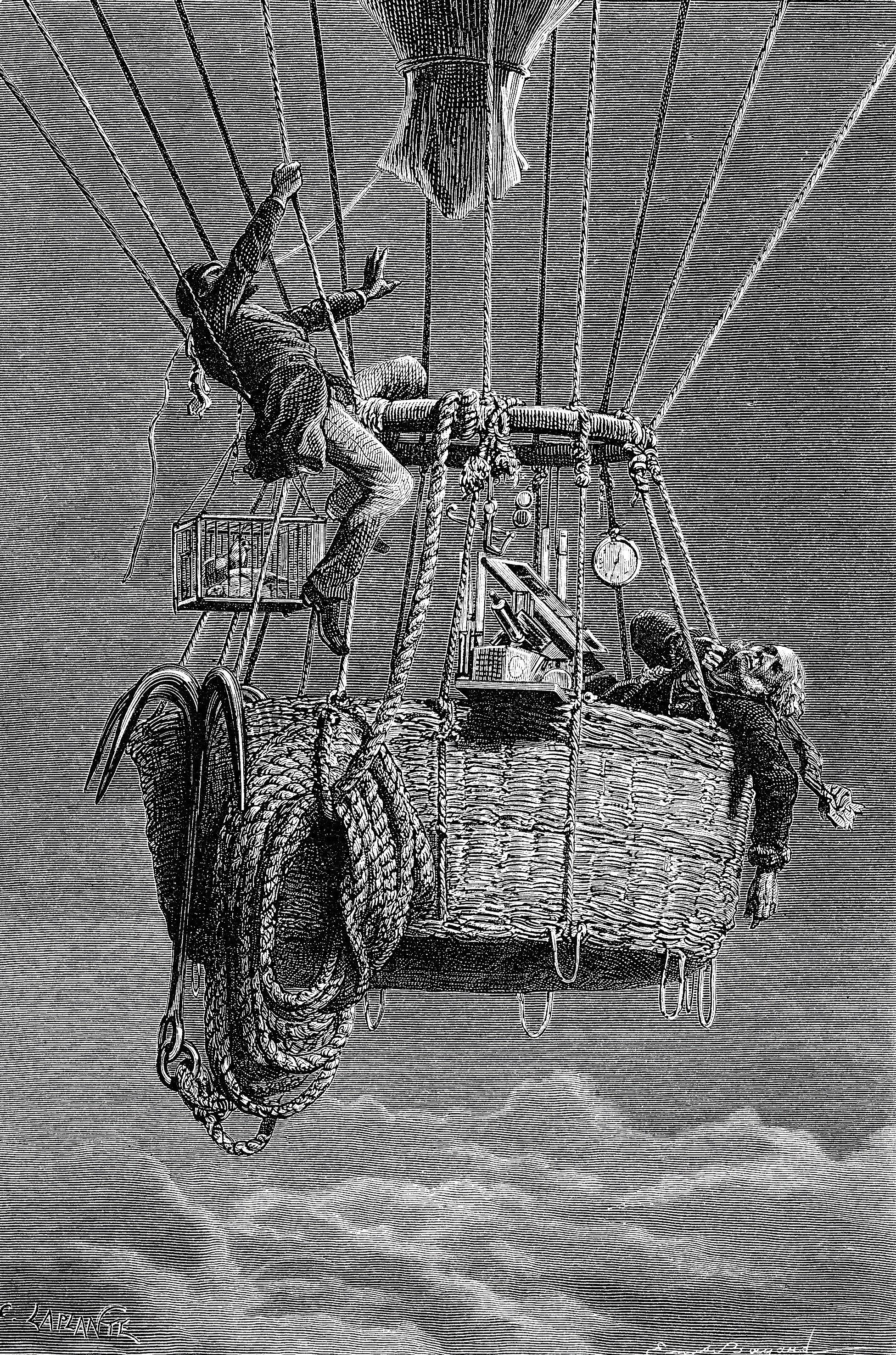
An engraving imagines Coxwell climbing the balloon rigging while Glaisher lies powerless across the basket edge

Coxwell at the rigging and Glaisher collapsed in the basket, in a later illustration by Émile Bayard, engraved by Charles Laplante. The picture reconstructs a crisis during which Glaisher could no longer observe.

Émile Bayard and Charles Laplante · Wikimedia Commons

Licence: Public domain. Original image retained.

View the original and source details
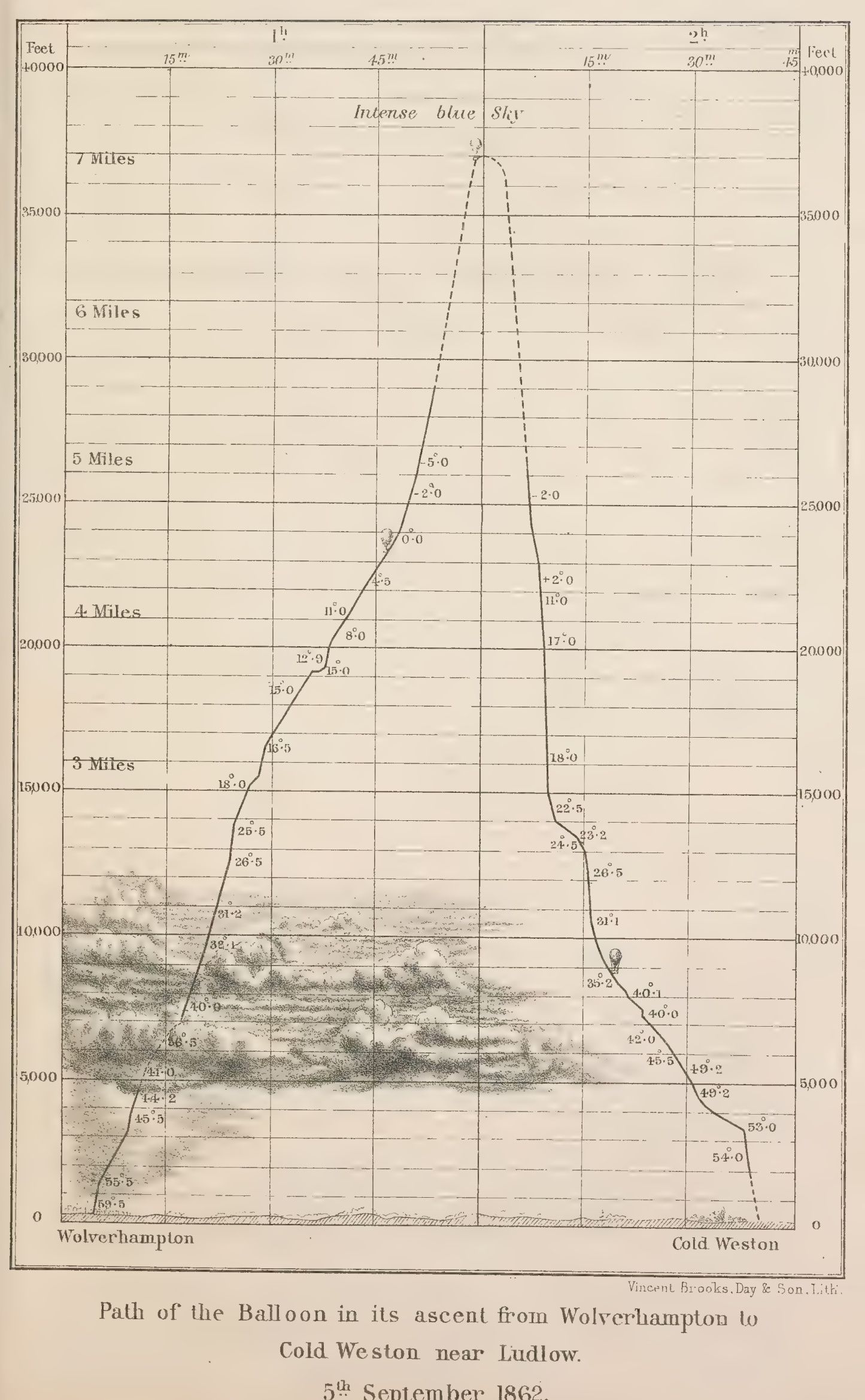
A nineteenth-century time-and-height chart of the balloon ascent, with a dashed curve near its estimated seven-mile summit

The published profile of the 5 September 1862 ascent. A dashed line carries the curve across its highest section: Glaisher reconstructed that part after observations stopped.

Vincent Brooks, Day & Son · Smithsonian Libraries and Archives

Licence: Public domain. Rendered from original PDF and cropped only at blank outer margins; axes, temperatures and plate caption retained.

View the original and source details
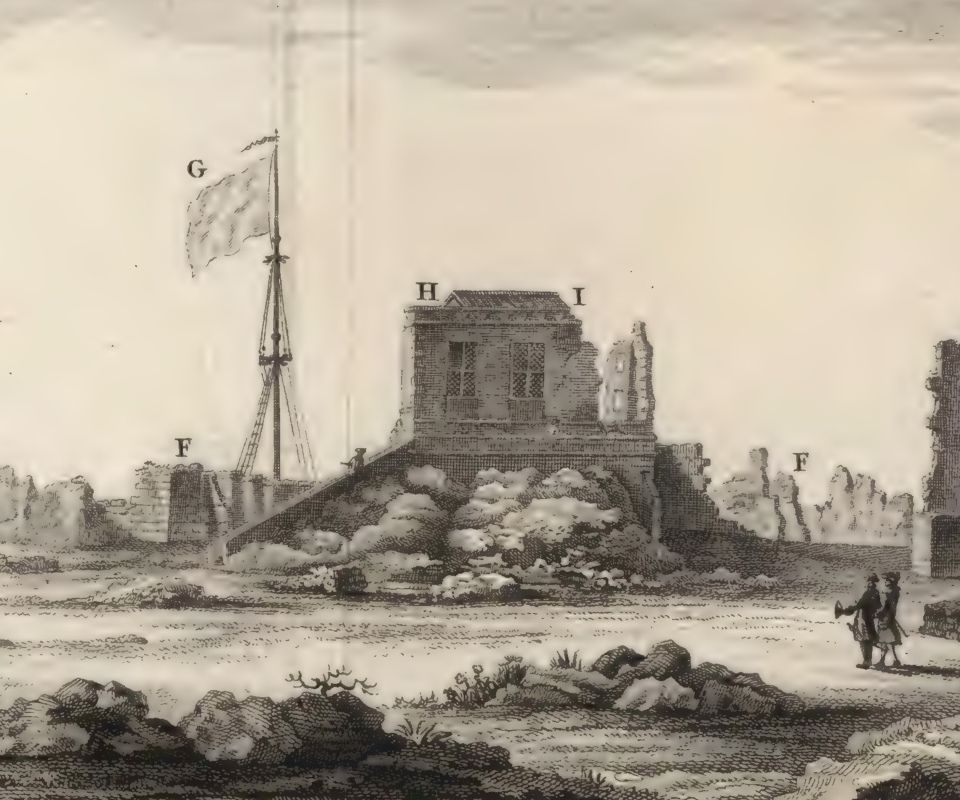
Le Gentil’s small observatory on a raised brick vault beside a flagstaff at Pondicherry

Le Gentil’s observatory above the ruins at Pondicherry, in the 1769 view published with his voyage account.

De la Gardette · Getty Research Institute

Licence: Public domain. Rendered from original PDF; separate detail cropped to the observatory, flagstaff and supporting masonry. Cover cropped for article cards and sharing.

View the original and source details
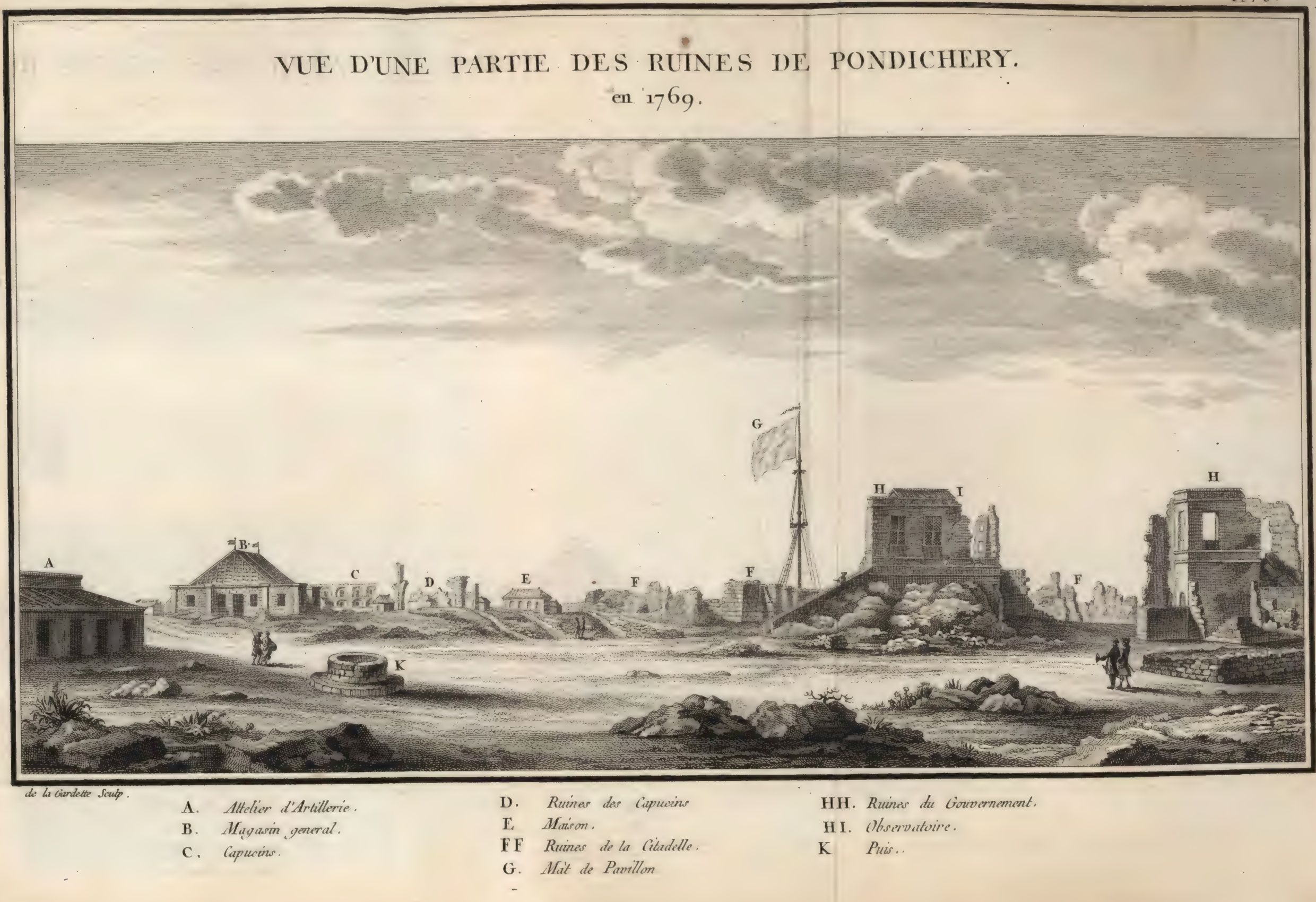
An eighteenth-century engraving of ruined Pondicherry, with Le Gentil’s small observatory on a raised masonry platform

Pondicherry in 1769, from Le Gentil’s voyage account. The observatory stands on the surviving palace masonry beside the flagstaff.

De la Gardette · Getty Research Institute

Licence: Public domain. Rendered from original PDF; outer scanner margins cropped, plate title and key retained.

View the original and source details
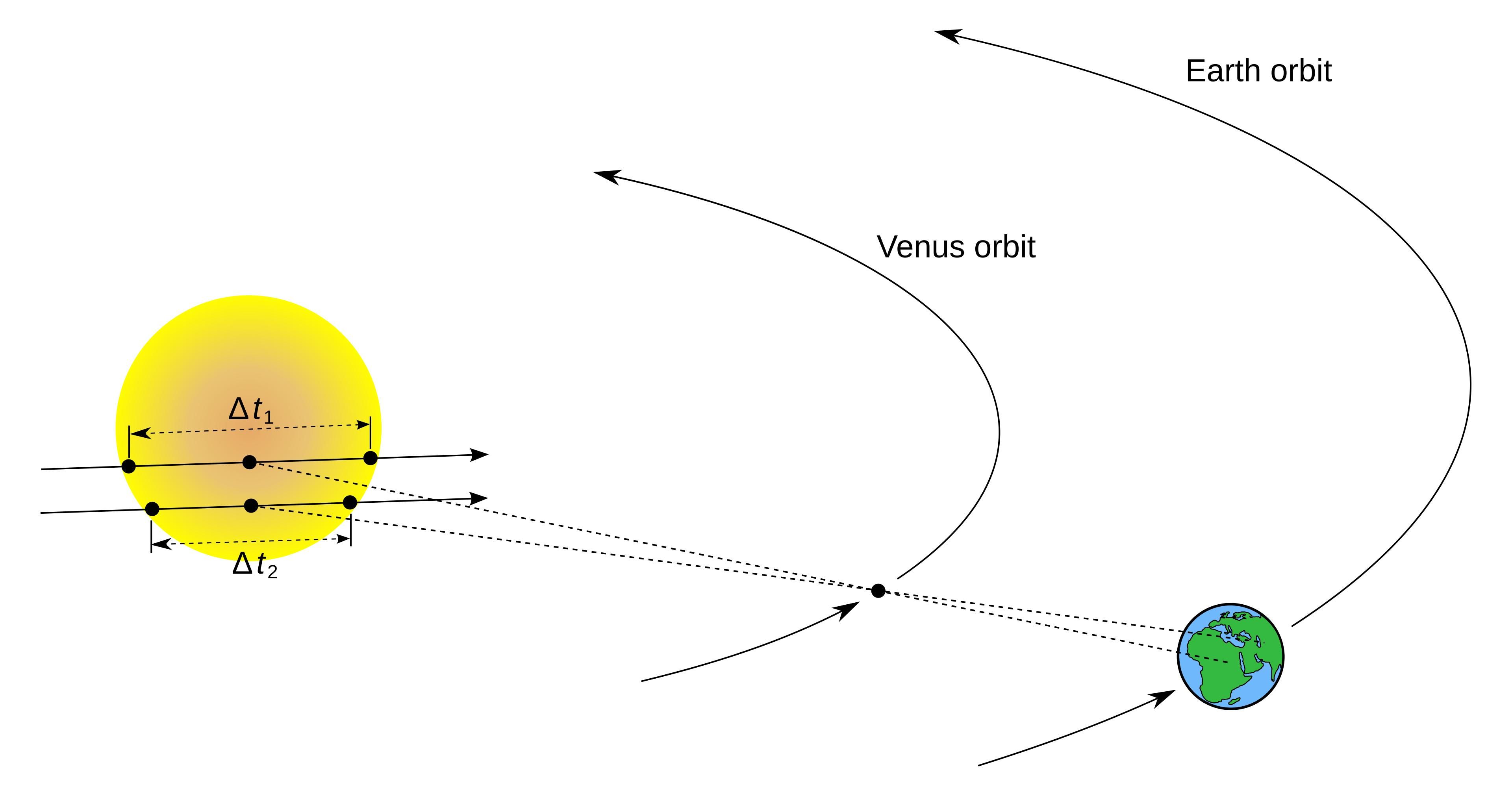
Diagram of the Sun, Venus and Earth, with two sightlines and different transit durations marked on the Sun

Two observers on Earth see Venus take slightly different tracks across the Sun. Comparing the timings helps turn the known proportions of the planetary orbits into distances. Modern explanatory diagram; distances and sizes are schematic.

Vermeer, Duckysmokton and Ilia · Wikimedia Commons

Licence: CC BY-SA 3.0. Commons raster rendition converted from transparent WebP to JPEG with white background; full diagram retained.

View the original and source details
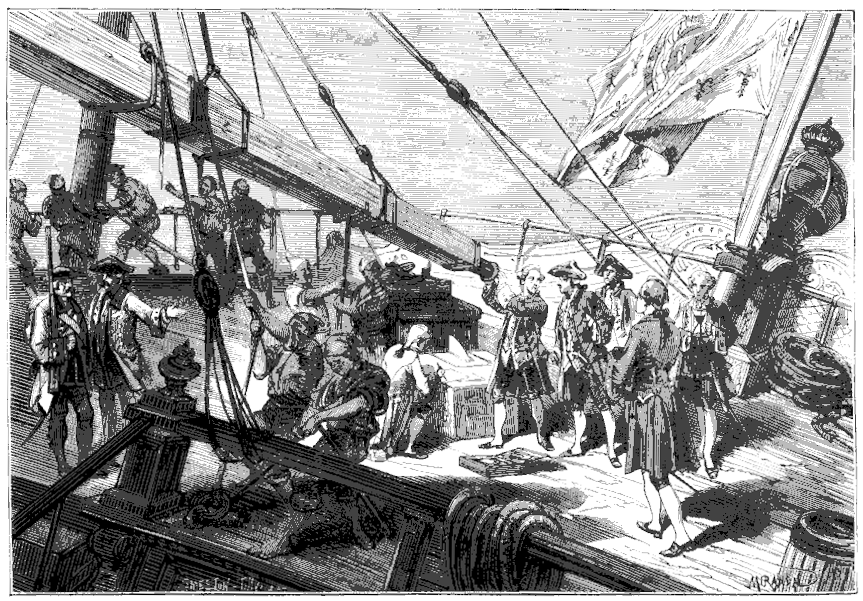
A later engraving imagines Le Gentil using a long telescope on a ship’s crowded deck, surrounded by sailors and rigging

Le Gentil trying to observe at sea, imagined for La Nature in 1874. The event belonged to 1761; the later magazine caption incorrectly dated it 1769.

La Nature, 1874 · Wikimedia Commons

Licence: Public domain. Original image retained.

View the original and source details
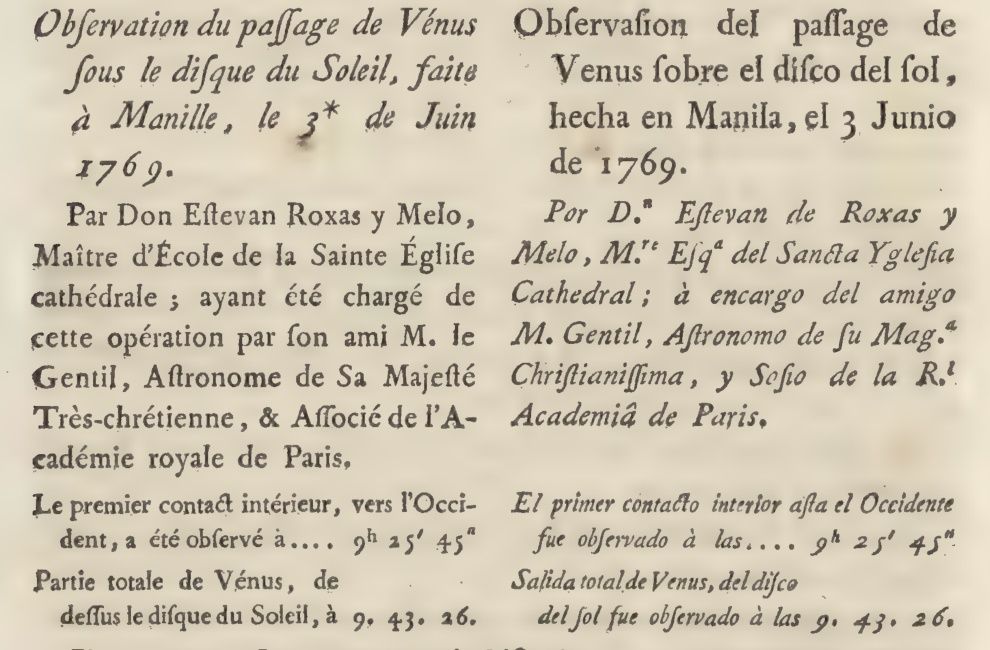
Two columns in French and Spanish name Roxas y Melo and record the timed contacts of Venus observed from Manila

Don Estevan Roxas y Melo’s Manila observation, printed in French and Spanish in Le Gentil’s book. It records Venus’s internal contact at 9:25:45 and its complete departure at 9:43:26.

Le Gentil, Voyage · Getty Research Institute

Licence: Public domain. Rendered and cropped from printed page510 to the two-column observation.

View the original and source details
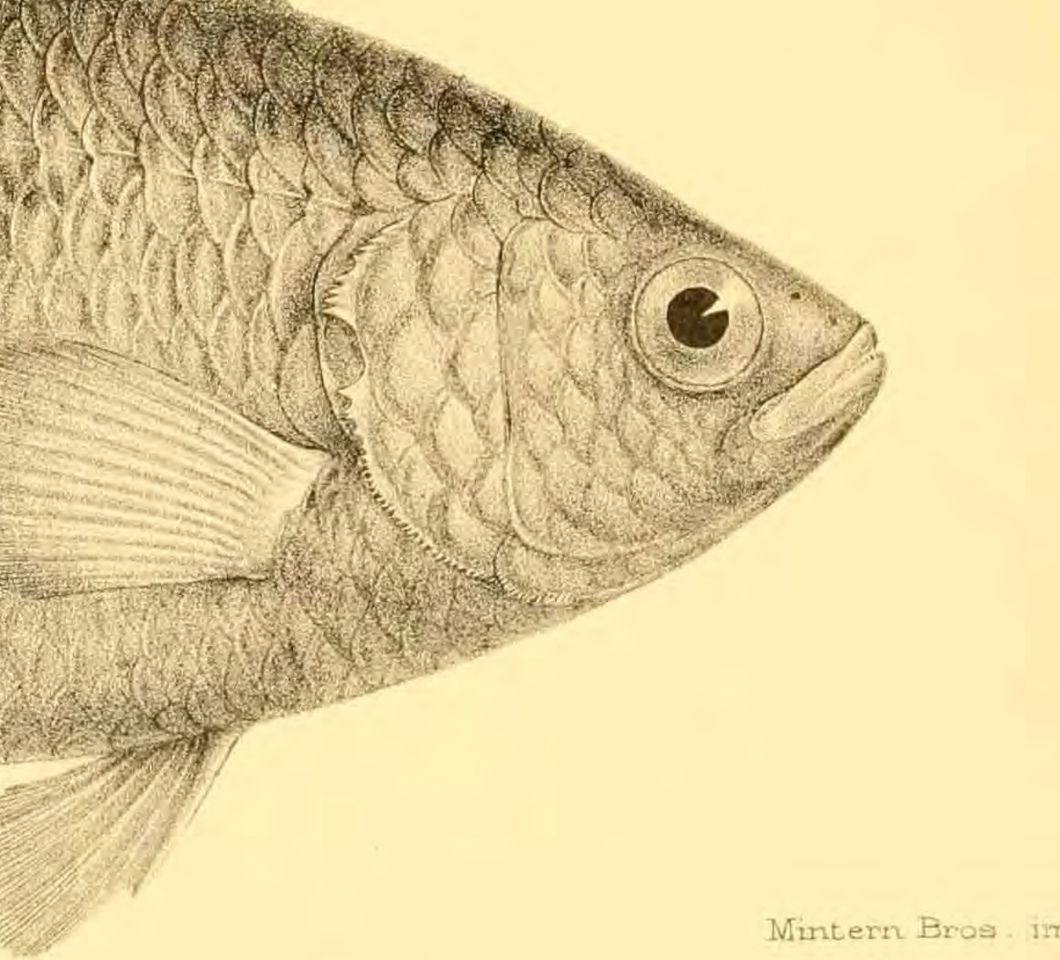
The head, gill cover, scales and pectoral fin of Ctenopoma kingsleyae in an 1896 scientific drawing

Detail of Ctenopoma kingsleyae in J. Green’s illustration for Günther’s 1896 report.

J. Green · Smithsonian Libraries and Archives, BHL

Licence: Public domain. Rotated ninety degrees clockwise; head detail cropped from plate; colour unaltered. Cover cropped for article cards and sharing.

View the original and source details
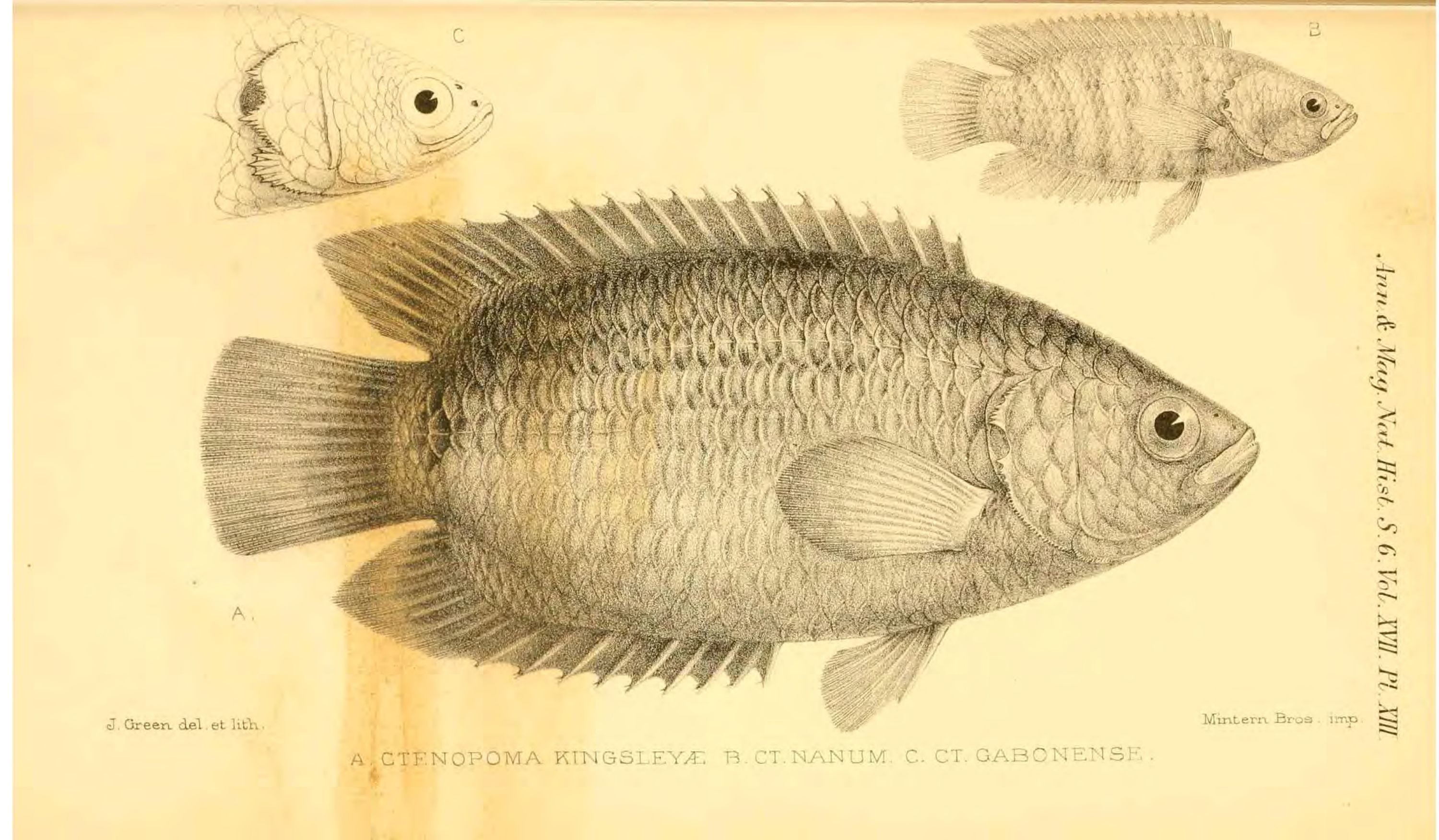
An 1896 scientific plate with a large drawing of Ctenopoma kingsleyae and two smaller comparison drawings

Ctenopoma kingsleyae, the large fish marked A, in Albert Günther’s 1896 report. B and C illustrate two other Ctenopoma species.

J. Green · Smithsonian Libraries and Archives, BHL

Licence: Public domain. Rotated ninety degrees clockwise from original plate; scaled for delivery; colour unaltered.

View the original and source details
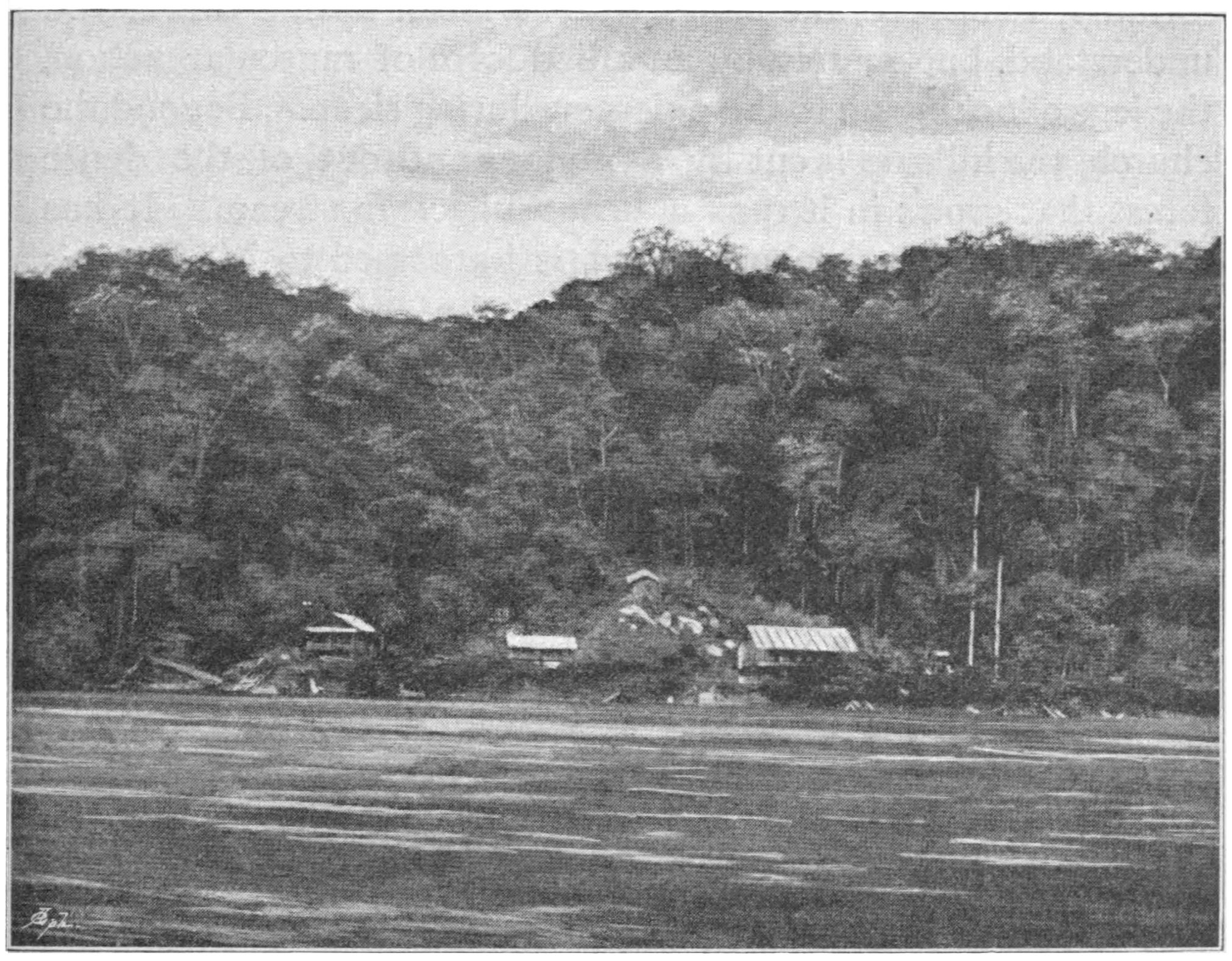
Buildings of the Talagouga mission station beneath a wooded hillside on the bank of a broad river

The mission station at Talagouga, pictured in Travels in West Africa. Kingsley stayed with the Forgets while buying and preparing fish.

Travels in West Africa · Wikimedia Commons

Licence: Public domain. Full source image scaled for delivery.

View the original and source details
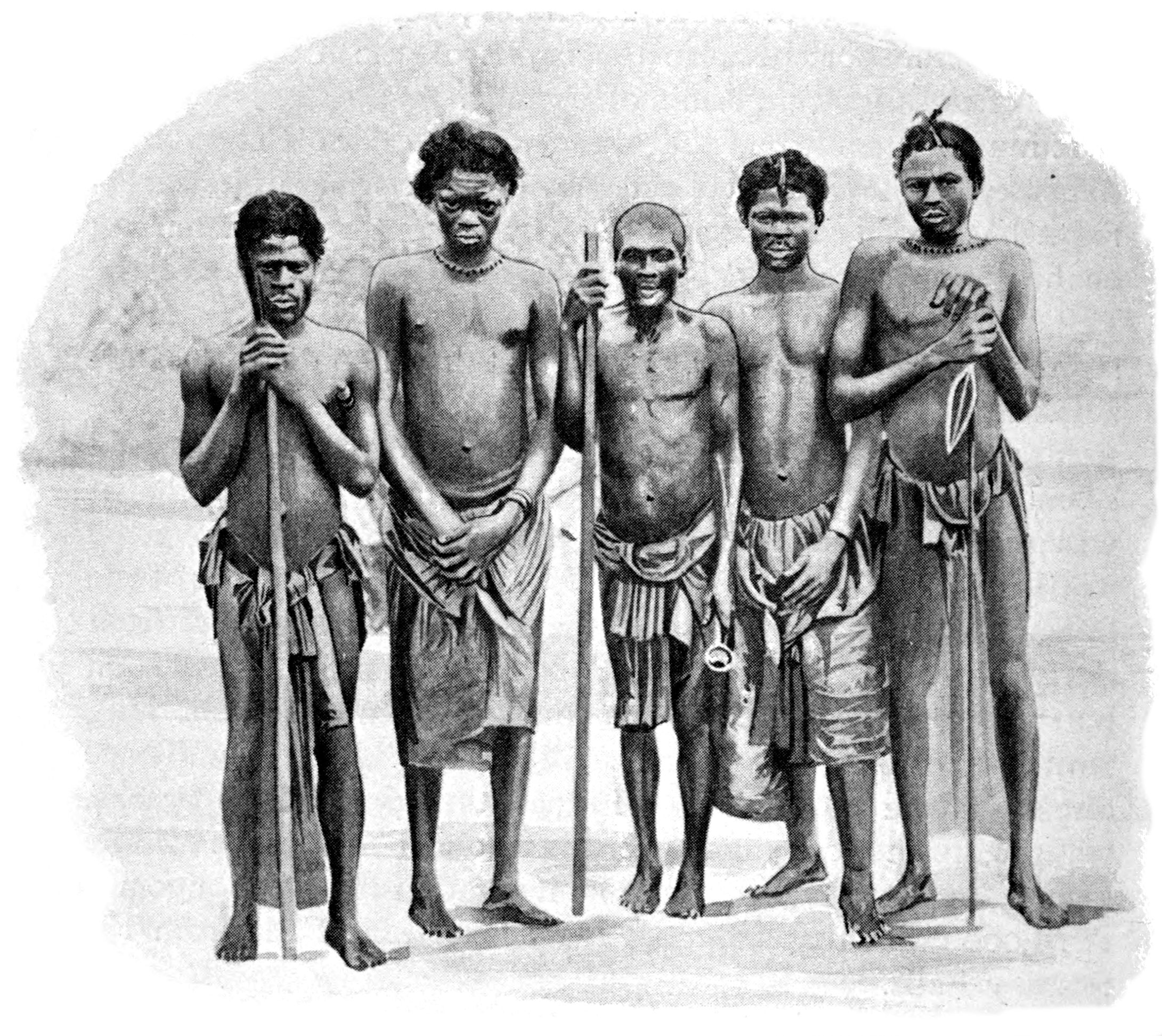
Five Adooma men of the upper Ogooué posed together in wrapped cloths and necklaces

Adooma men of the upper Ogooué, in an illustration supplied to Kingsley’s book by the Mission Évangélique of Paris.

Mission Évangélique, Paris · Travels in West Africa

Licence: Public domain. Full source image scaled for delivery.

View the original and source details
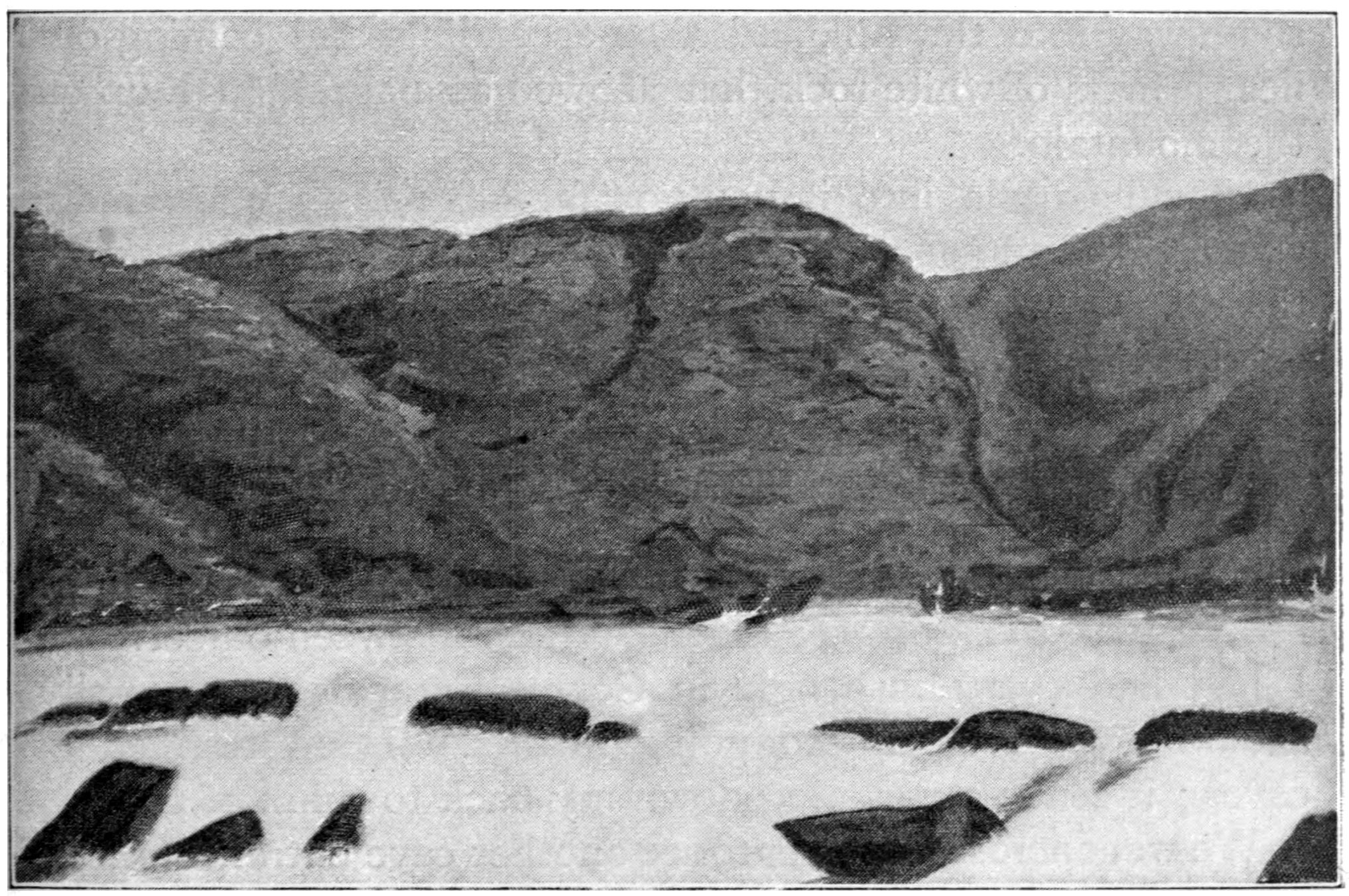
Dark rocks and wooded banks constricting foaming water at the Boko Boko rapids

Boko Boko rapids on the Ogooué, pictured in Kingsley’s book. The canoe journey continued upstream towards Kondo-Kondo and the Alemba rapid.

Travels in West Africa · Wikimedia Commons

Licence: Public domain. Full source image scaled for delivery.

View the original and source details
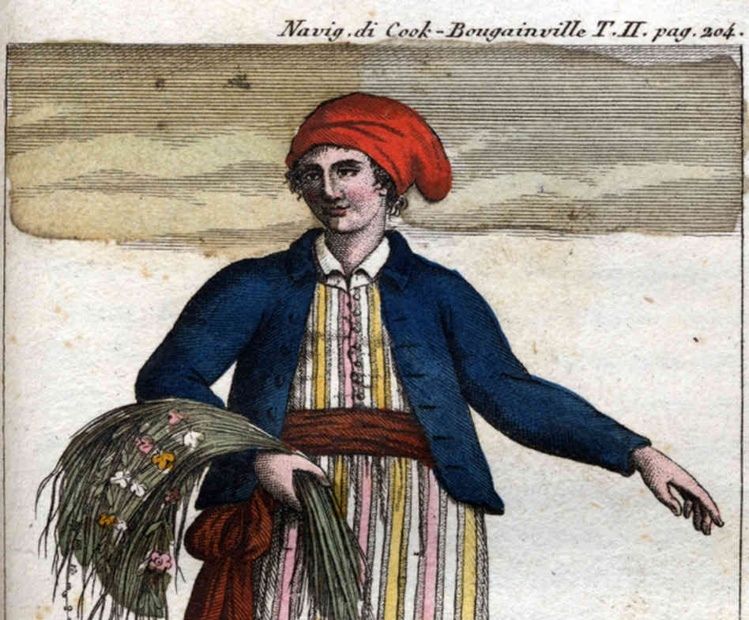
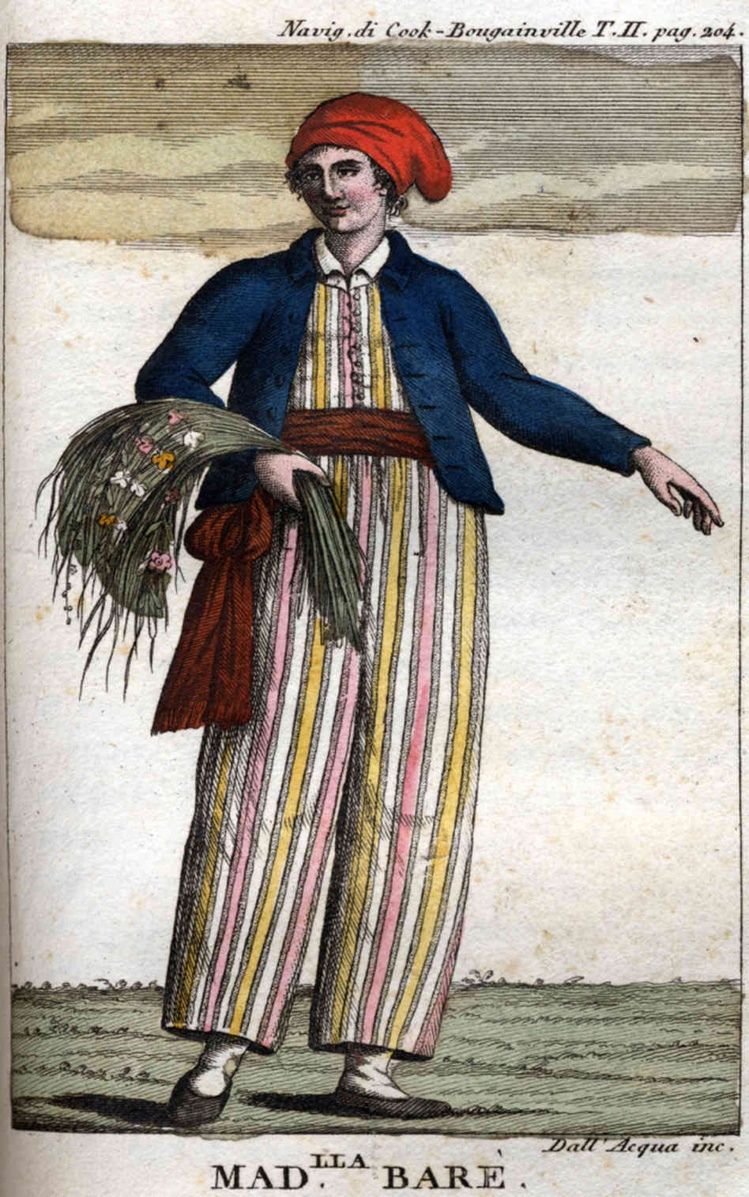
A hand-coloured engraving depicting Baret in a red cap, blue jacket and striped trousers, carrying a bundle of plants

Baret depicted as a plant-carrying sailor in an engraving signed Dall’Acqua.

Dall’Acqua · Wikimedia Commons

Licence: Public domain. Upper-body detail cropped from original engraving; colour unaltered. Cover cropped for article cards and sharing.

View the original and source details
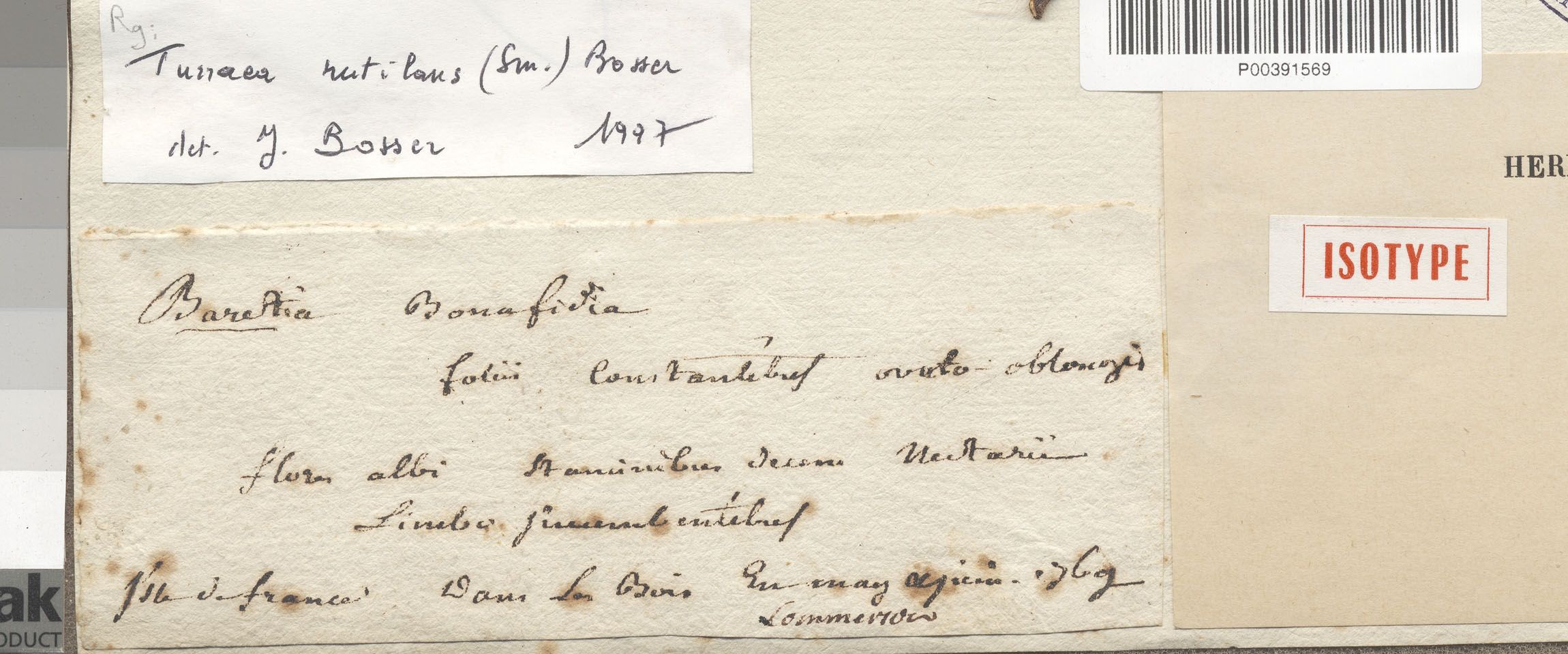
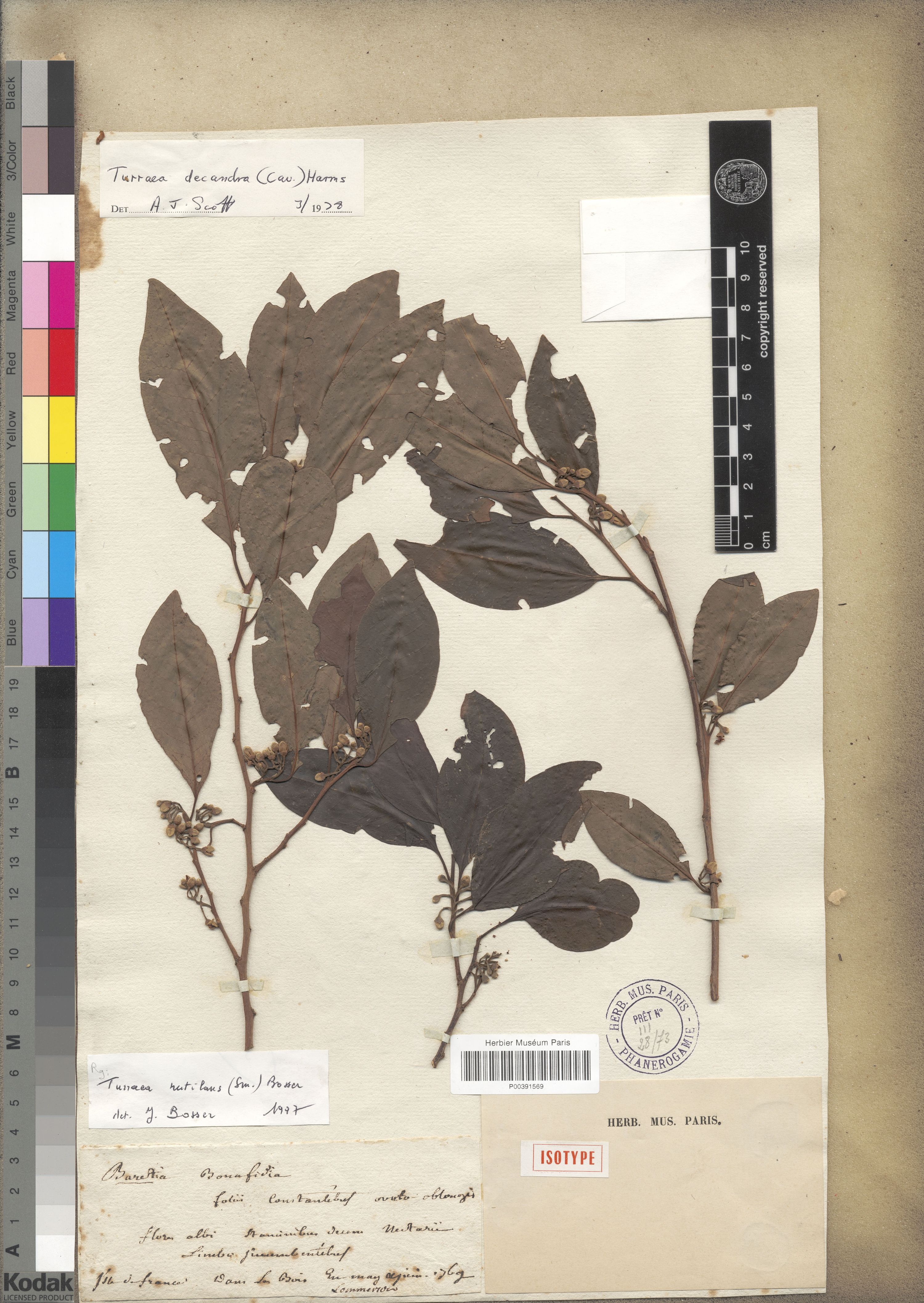
A preserved botanical sheet with leafy branches, an old handwritten Baretia label and later identification slips

A plant collected on Mauritius in 1769, preserved in Paris. Its old label carries the proposed name Baretia bonafidia; the specimen is now identified as Turraea rutilans.

MNHN, Paris · TM, 2004

Licence: CC BY 4.0. Full source image scaled for delivery.

View the original and source details
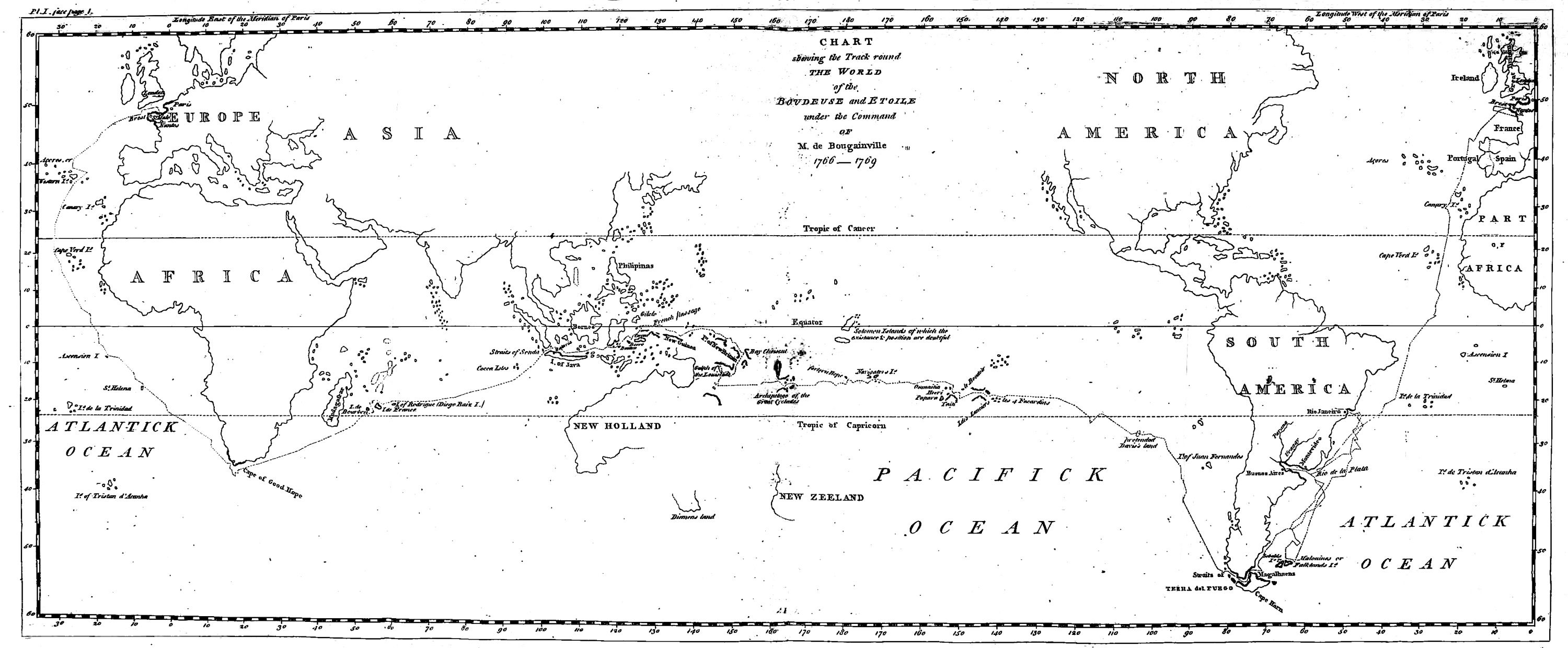
An eighteenth-century world chart tracing the Boudeuse and Étoile through the Atlantic, Strait of Magellan, Pacific and Indian Ocean

The route of Bougainville’s two ships in the English edition of his voyage, published in 1772. Baret remained on Mauritius and completed her own journey later.

Bougainville’s voyage, 1772 edition · Project Gutenberg

Licence: Public domain. Full source image scaled for delivery.

View the original and source details
A close-up of handwritten Baretia bonafidia and a later Turraea rutilans identification slip

The old Baretia name remains on the specimen’s label, below a later identification by Jean Bosser dated 1997.

MNHN, Paris · TM, 2004

Licence: CC BY 4.0. Detail cropped from source photograph; colour unaltered.

View the original and source details
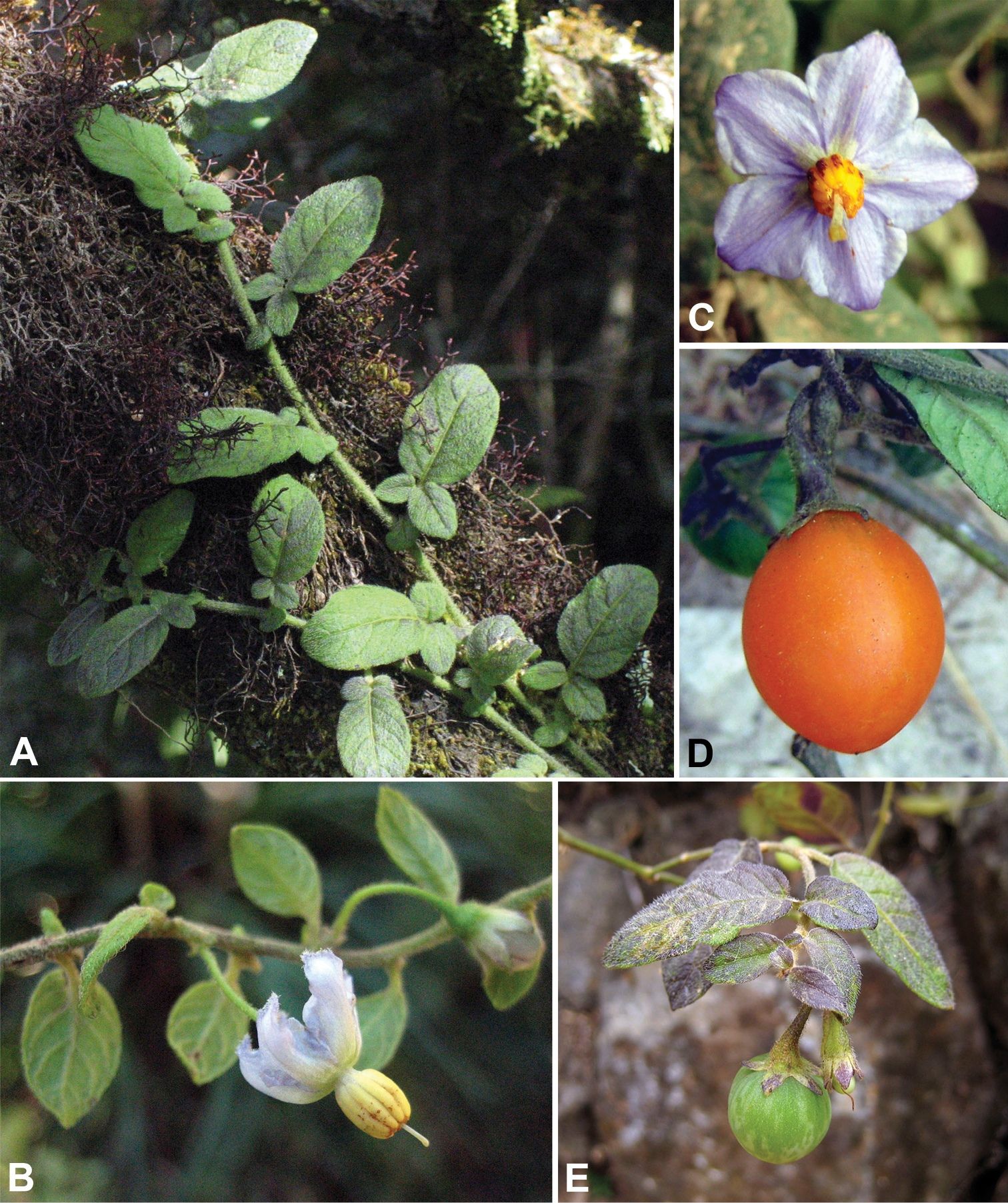
A modern scientific photo plate of Solanum baretiae showing leaves, purple flowers and orange and green fruit

Solanum baretiae in the paper that named it in 2012: leafy growth, two flower forms, ripe orange fruit and unripe green fruit. This Andean plant commemorates Baret.

Eric J. Tepe, Glynis Ridley and Lynn Bohs · PhytoKeys

Licence: CC BY 3.0. Full source image scaled for delivery.

View the original and source details
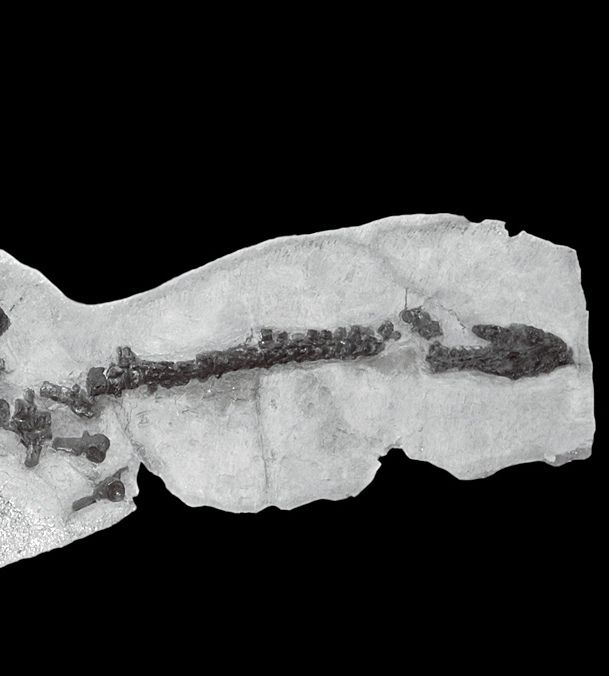
The long neck and small skull of Mary Anning’s plesiosaur preserved in stone

Detail of the long neck and small skull of Anning’s 1823 plesiosaur, photographed in 2017.

the paleobear

Licence: CC BY 2.0. Detail cropped from the source photograph; colour unaltered. Cover cropped for article cards and sharing.

View the original and source details
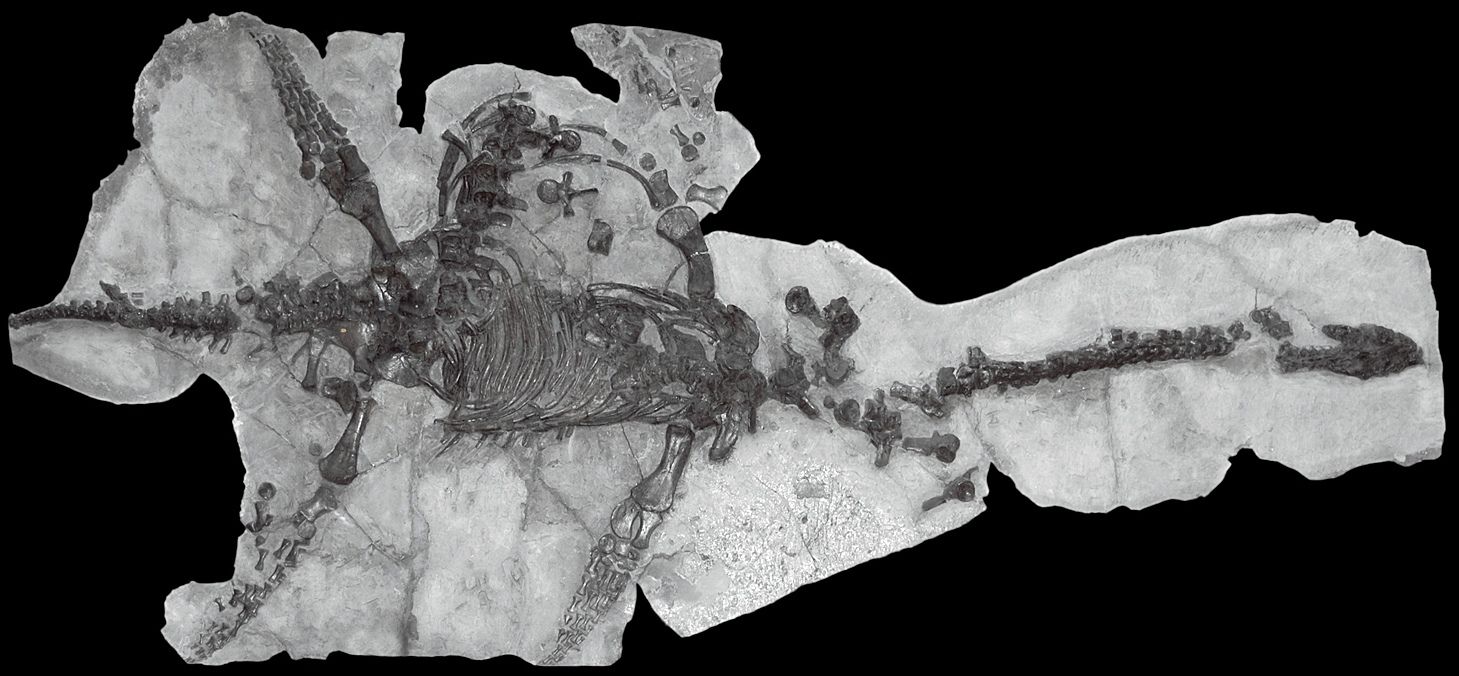
A fossil plesiosaur spread across a stone slab, with four paddles, a long neck and a small skull at the right

The plesiosaur Anning found in 1823, photographed at the Natural History Museum in 2017. Its long neck ends in a small skull at the right.

the paleobear

Licence: CC BY 2.0. Source image retained in full; JPEG delivery copy.

View the original and source details
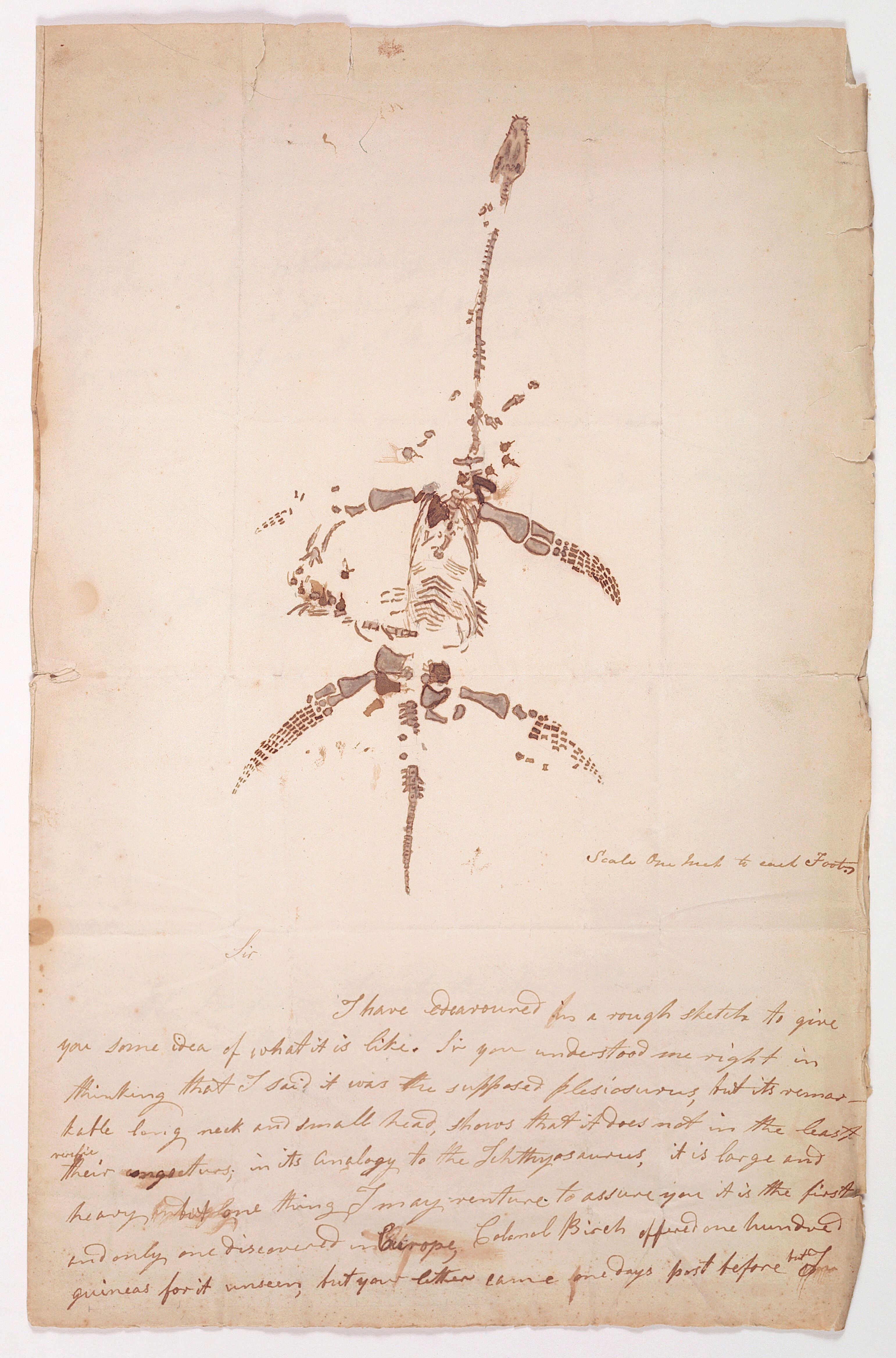
Mary Anning’s handwritten letter beneath an upright drawing of a plesiosaur with a small head, long neck and four paddles

Anning’s drawing and the beginning of her letter to Sir Henry Bunbury, December 1823. The scale reads one inch to each foot.

Mary Anning · Wellcome Collection

Licence: CC BY 4.0. Source image retained in full; JPEG delivery copy.

View the original and source details
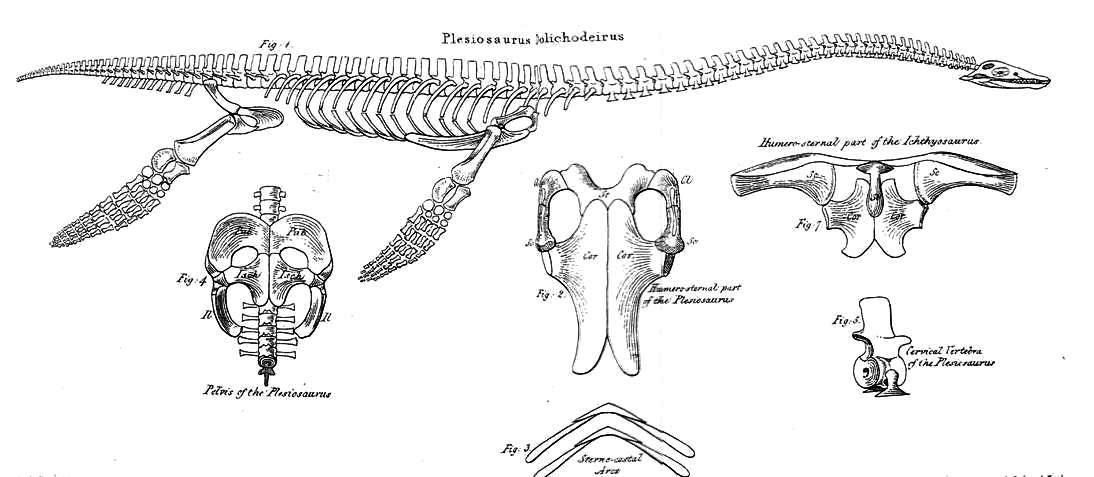
An 1824 scientific plate showing a reconstructed long-necked plesiosaur and separate anatomical diagrams

A reconstructed skeleton and comparative anatomical details published with Conybeare’s 1824 account. The regular arrangement interprets the animal rather than recording every bone’s position in the rock.
From W. D. Conybeare’s 1824 paper

Licence: Public domain. Source image retained in full; JPEG delivery copy.

View the original and source details
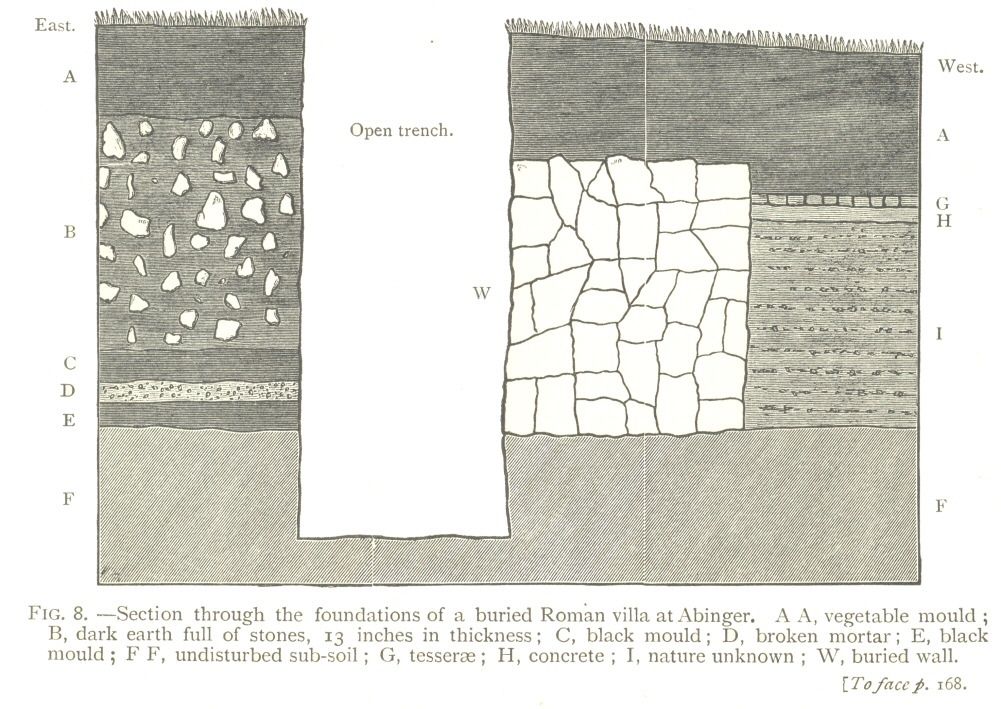
A nineteenth-century section through the soil, open trench, buried wall and floor of the Roman villa at Abinger

The Abinger excavation in section: soil above the surviving wall and floor. The trench is drawn narrower than its true proportions. From Darwin’s book, 1904 edition.

Project Gutenberg

Licence: Public domain. Whole Abinger section selected for cover. Cards may trim the sides; body and gallery preserve the full image. Cover cropped for article cards and sharing.

View the original and source details
A nineteenth-century section through the soil, open trench, buried wall and floor of the Roman villa at Abinger

The Abinger excavation in section: soil above the surviving wall and floor. The trench is drawn narrower than its true proportions. From Darwin’s book, 1904 edition.
Project Gutenberg

Licence: Public domain. Full source image scaled for delivery.

View the original and source details
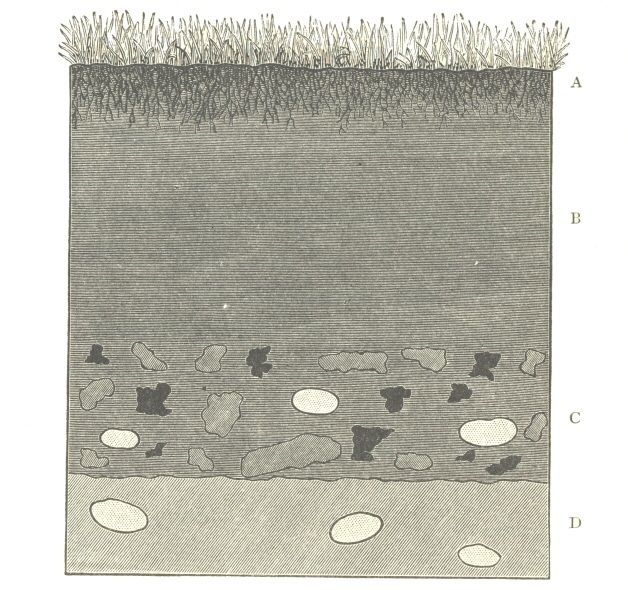
A field section showing turf, a layer of fine earth and a lower band containing marl fragments, cinders and pebbles

A different marker layer, near Maer Hall: fragments spread on reclaimed ground had become covered by fine earth after fifteen years. From Darwin’s book, 1904 edition.

Project Gutenberg

Licence: Public domain. Detail cropped from original page; colour unaltered.

View the original and source details
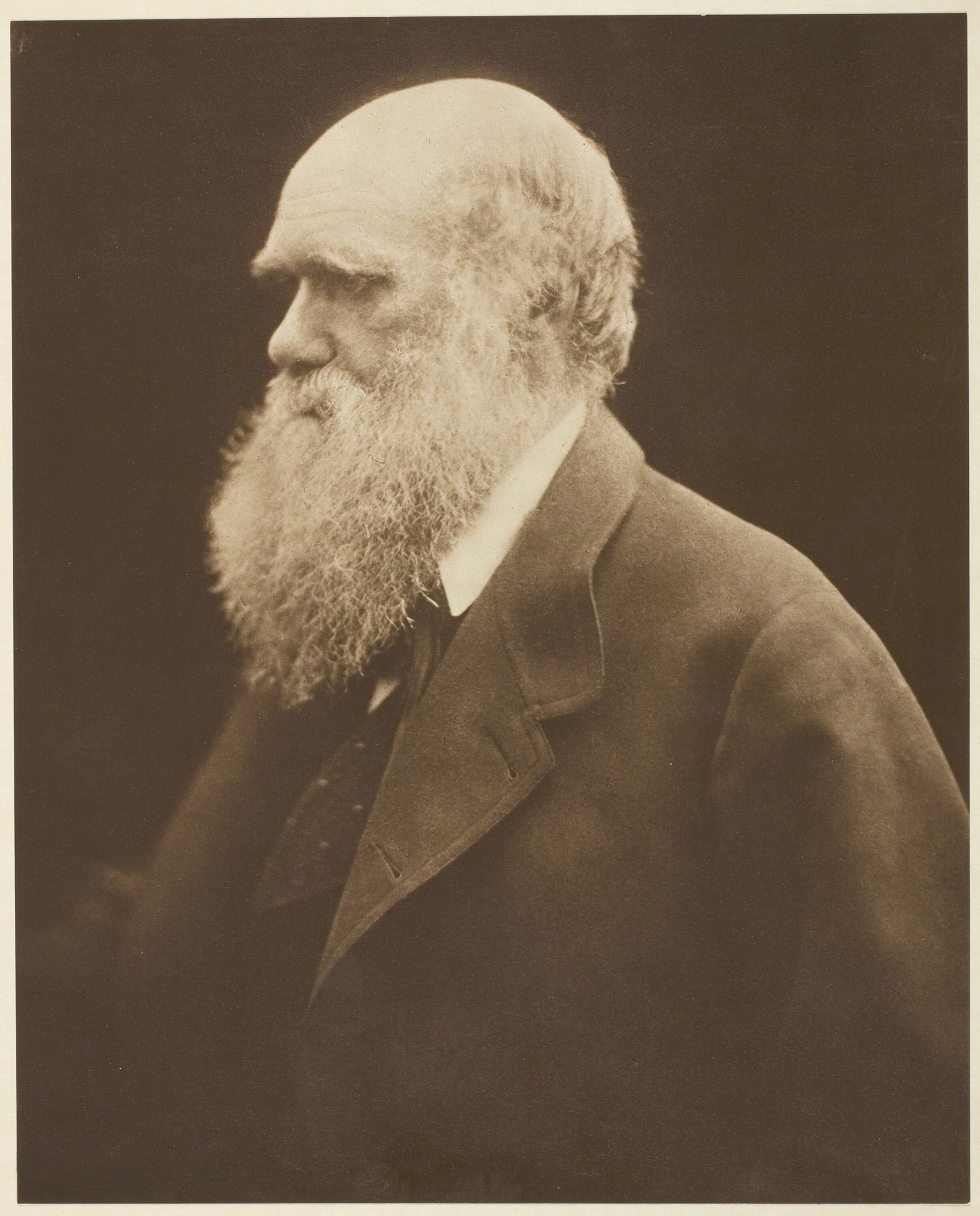
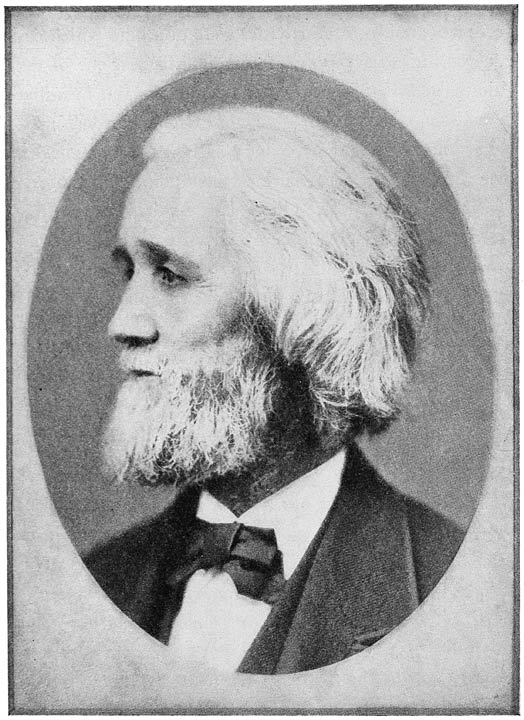
Charles Darwin in profile with a long white beard, photographed by Julia Margaret Cameron

Charles Darwin, photographed by Julia Margaret Cameron around 1868; this carbon print was made in 1875.

Julia Margaret Cameron · Art Institute of Chicago

Licence: Public domain. Full source image scaled for delivery.

View the original and source details
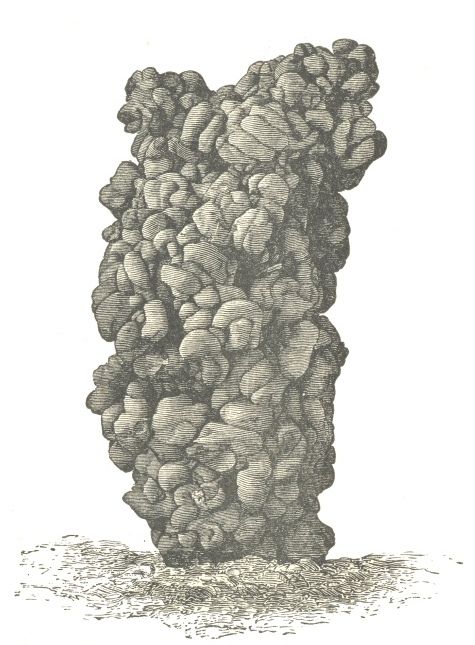
A nineteenth-century illustration of a tall earthworm casting made of coils of deposited earth

A tower-like casting from near Nice, copied from a photograph for Darwin’s book. It illustrates the deposited material, rather than a specimen from the Leith Hill plots.

Project Gutenberg

Licence: Public domain. Detail cropped from original page; colour unaltered.

View the original and source details
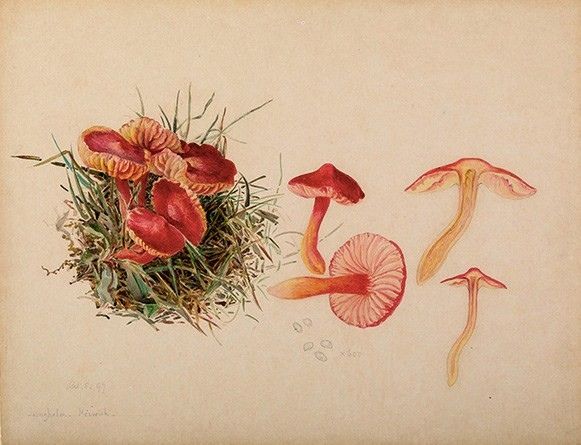
A watercolour of red waxcap mushrooms growing in moss, with separate specimens, a cut section and small spore studies

Potter’s red waxcap, Hygrocybe coccinea, 1897. Whole mushrooms, a section and small spore studies share the sheet.

Armitt Museum and Library

Licence: Public domain. Whole watercolour selected for cover. Cards may trim the sides; body and gallery retain the complete sheet. Cover cropped for article cards and sharing.

View the original and source details
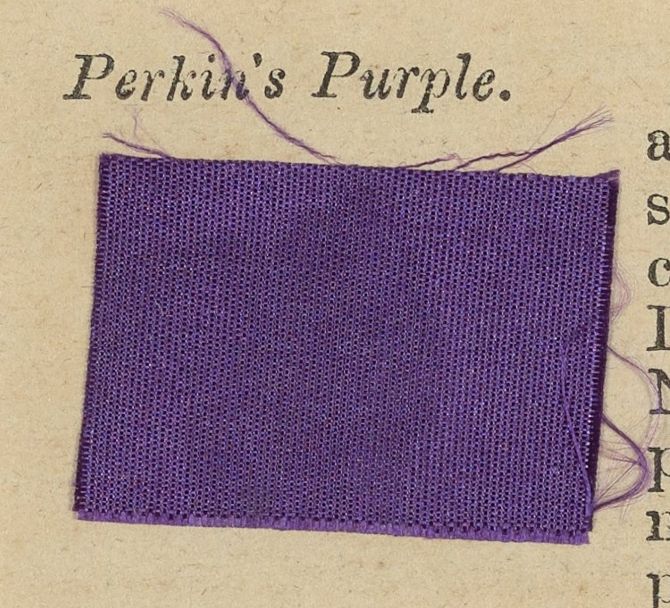
A purple woven fabric specimen with loose threads, attached beneath the printed label Perkin’s Purple

A specimen labelled “Perkin’s Purple” in Frederick Crace Calvert’s Lectures on Coal Tar Colours, published in the 1860s.

Science History Institute

Licence: Public domain. Detail cropped from the original page for article cards and sharing; colour unaltered. Cover cropped for article cards and sharing.

View the original and source details
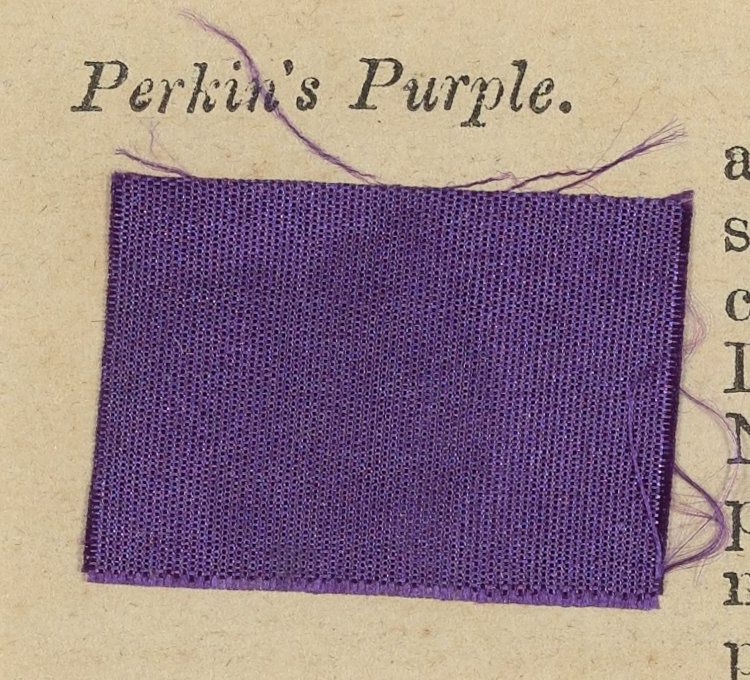
A purple woven fabric specimen with loose threads, attached beneath the printed label Perkin’s Purple

A specimen labelled “Perkin’s Purple” in Frederick Crace Calvert’s Lectures on Coal Tar Colours, published in the 1860s.

Science History Institute

Licence: Public domain. Detail cropped from original page; colour unaltered.

View the original and source details
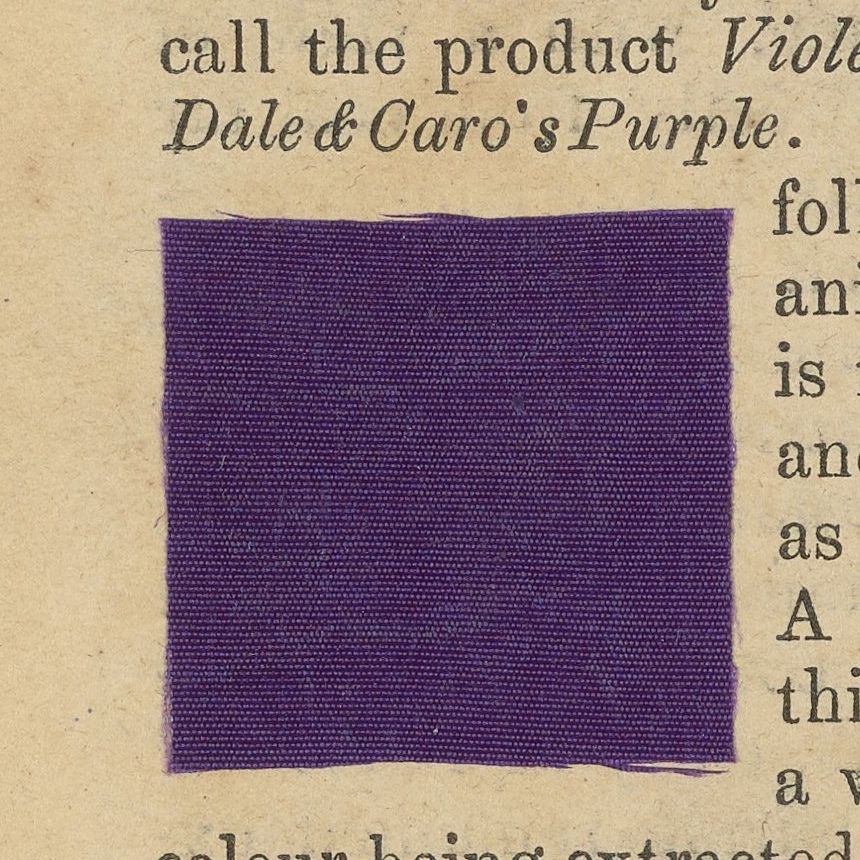
A square purple textile specimen attached below the printed label Dale and Caro’s Purple

“Dale & Caro’s Purple”, another specimen in Calvert’s manual. A competing manufacturing process was patented in 1860.

Science History Institute

Licence: Public domain. Detail cropped from original page; colour unaltered.

View the original and source details
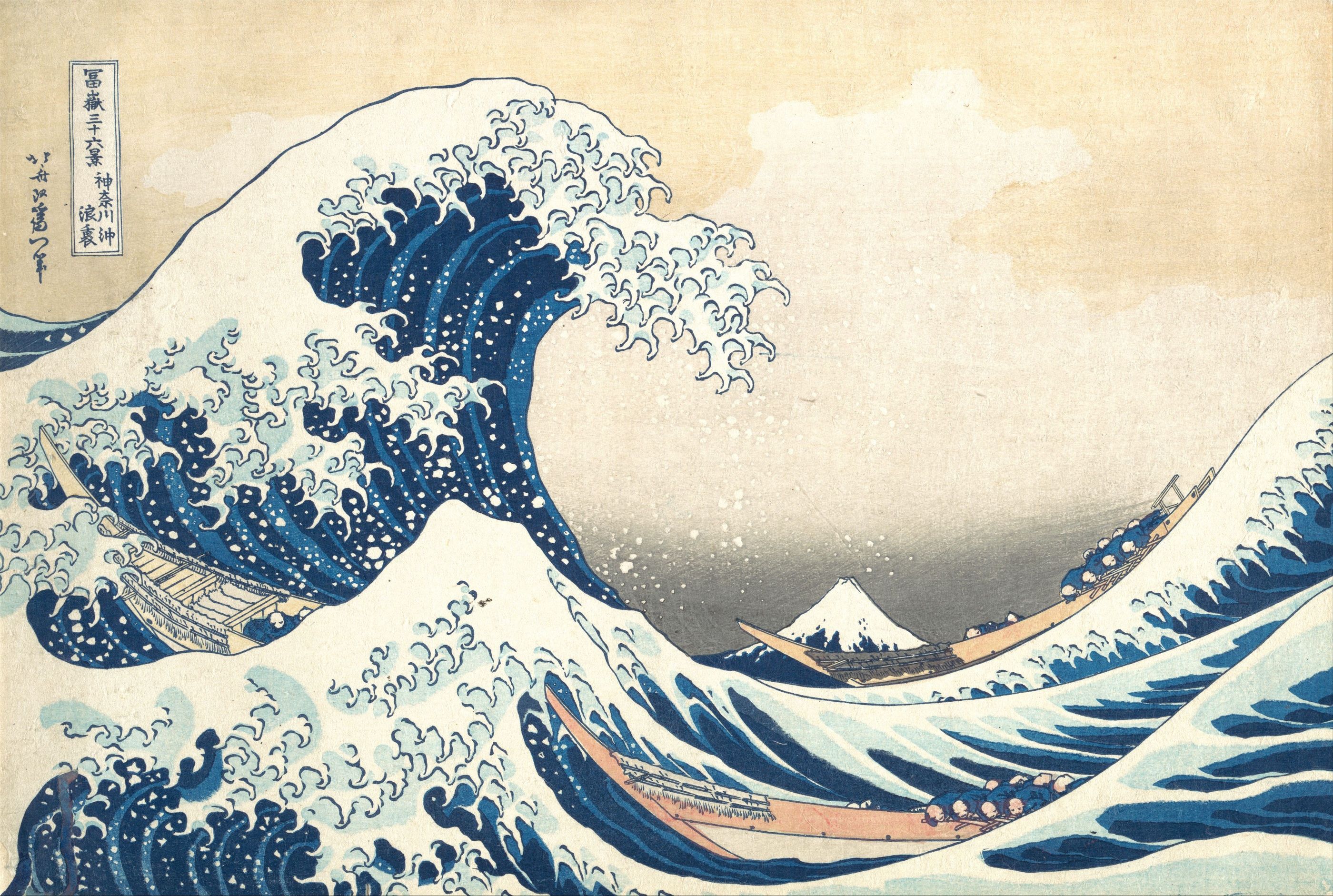
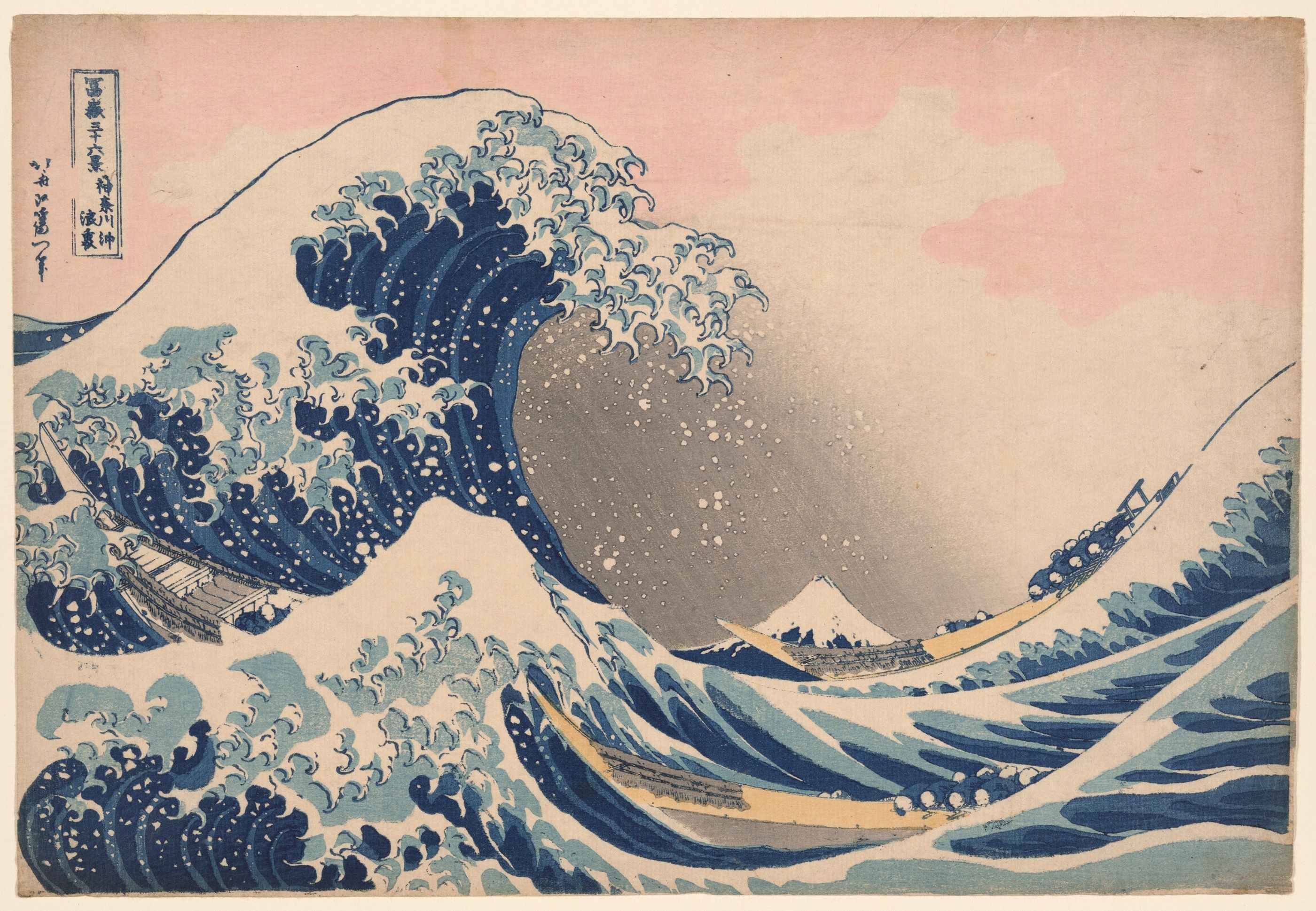
An early Great Wave print, with three boats beneath the curling blue wave and Mount Fuji in the distance

An early impression of Hokusai’s Under the Wave off Kanagawa, made around 1830–32.

The Metropolitan Museum of Art

Licence: CC0 1.0. Whole source composition selected after comparison with tighter crops. Cards may trim the sides; the narrative image and gallery preserve the full sheet. Cover cropped for article cards and sharing.

View the original and source details
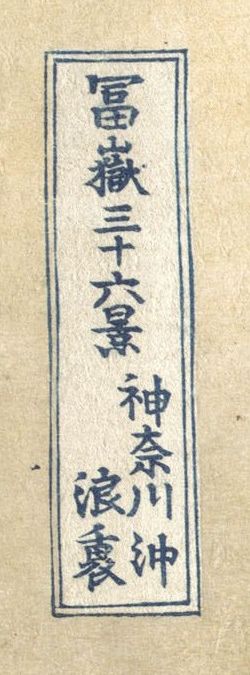
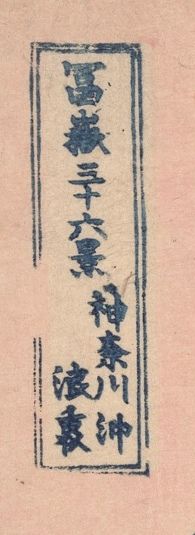
Close view of the Japanese title in the Met impression, enclosed by two continuous blue lines

The title frame in the Met’s early impression. Its double border is continuous.

The Metropolitan Museum of Art

Licence: CC0 1.0. Detail cropped from the original image; no lines reconstructed.

View the original and source details
Close view of the Japanese title in the Chicago impression, with gaps in the left-hand double border

The corresponding frame in the later Chicago impression. Gaps in the left border record damage to the carved printing surface.

The Art Institute of Chicago

Licence: CC0 1.0. Detail cropped from the original image; no lines reconstructed.

View the original and source details
A later Great Wave print with pink sky, a dark grey area under the crest and angular pale-blue patterns in the foreground

A later impression, with changed light-blue shapes and missing yellow in parts of the boats. The pink clouds may also have been strengthened after printing.

The Art Institute of Chicago

Licence: CC0 1.0. Full source image scaled for delivery.

View the original and source details
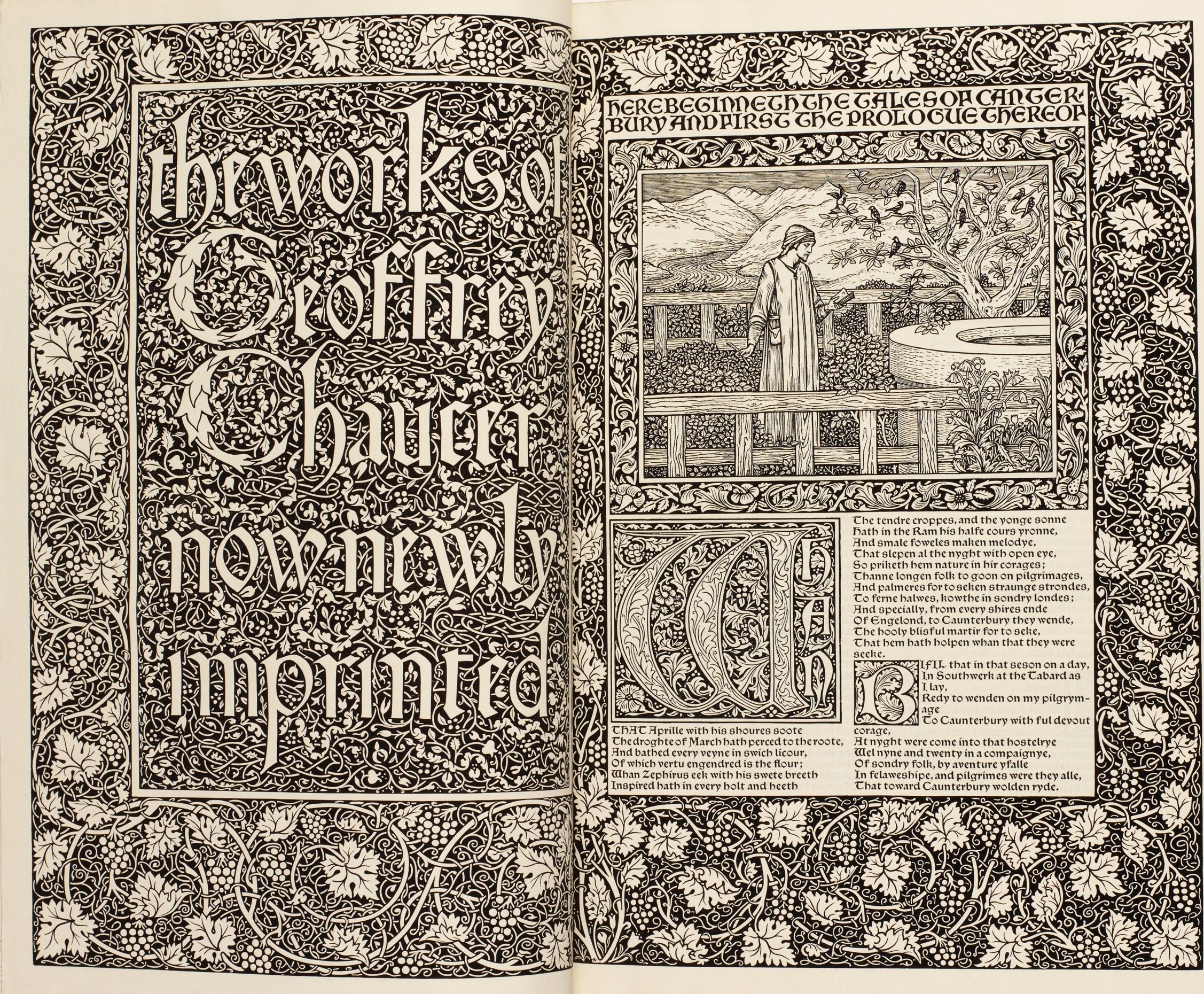
An open Kelmscott Chaucer, with an ornamental title page facing Chaucer in a garden above two columns of verse

The title page and opening of the General Prologue in the 1896 Kelmscott Chaucer. The picture above the verse was designed by Edward Burne-Jones and cut by W. H. Hooper.

Cantor Arts Center, Stanford University · Google Art Project

Licence: Public domain. Separate full source retained; CMS cover crop rectangle322,71,2254,1860 within2800×2055; whole source in narrative and gallery. Cover cropped for article cards and sharing.

View the original and source details
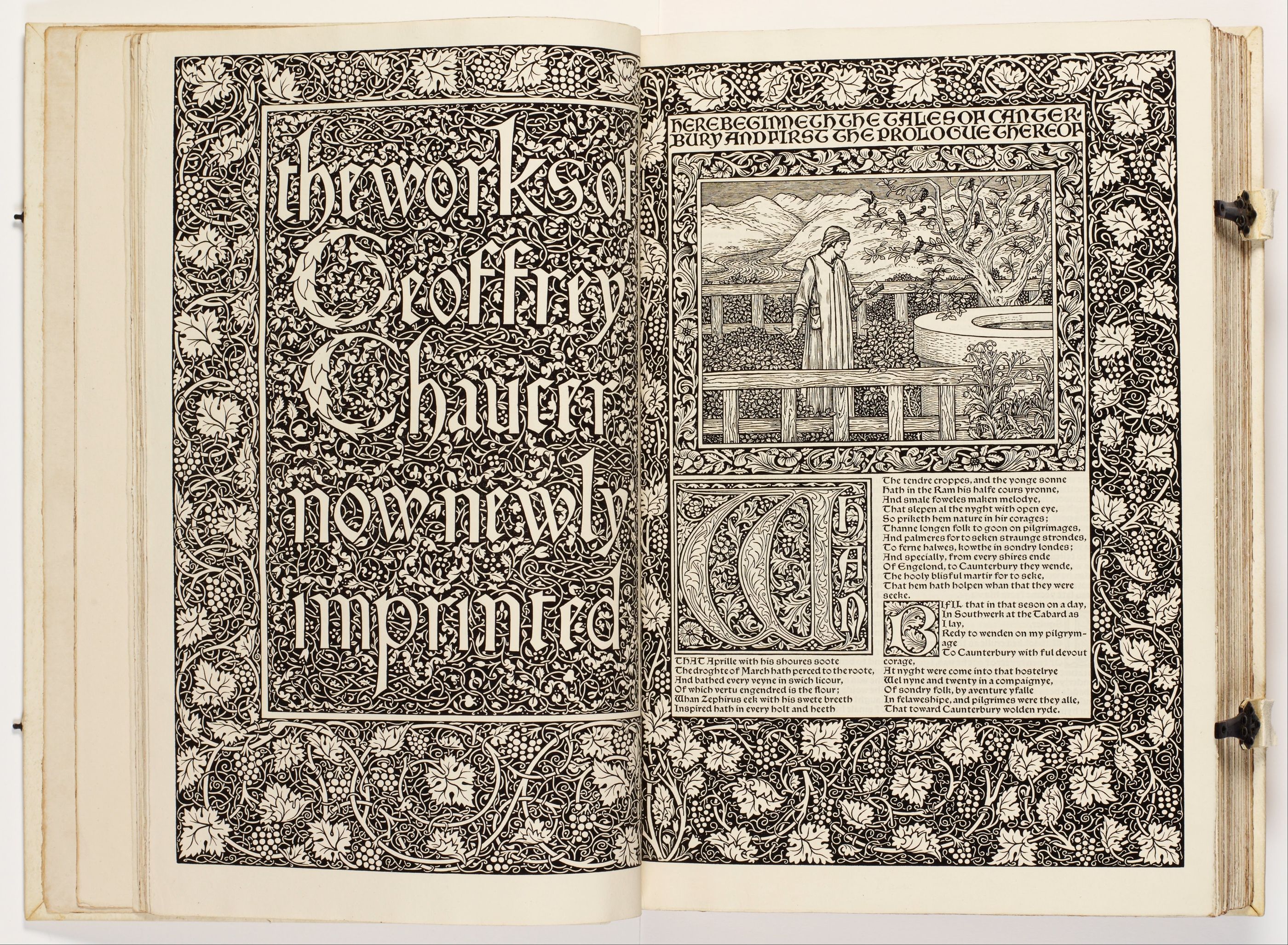
An open Kelmscott Chaucer, with an ornamental title page facing Chaucer in a garden above two columns of verse

The title page and opening of the General Prologue in the 1896 Kelmscott Chaucer. The picture above the verse was designed by Edward Burne-Jones and cut by W. H. Hooper.

Cantor Arts Center, Stanford University · Google Art Project

Licence: Public domain. Full source image scaled for delivery; no reconstructed content.

View the original and source details
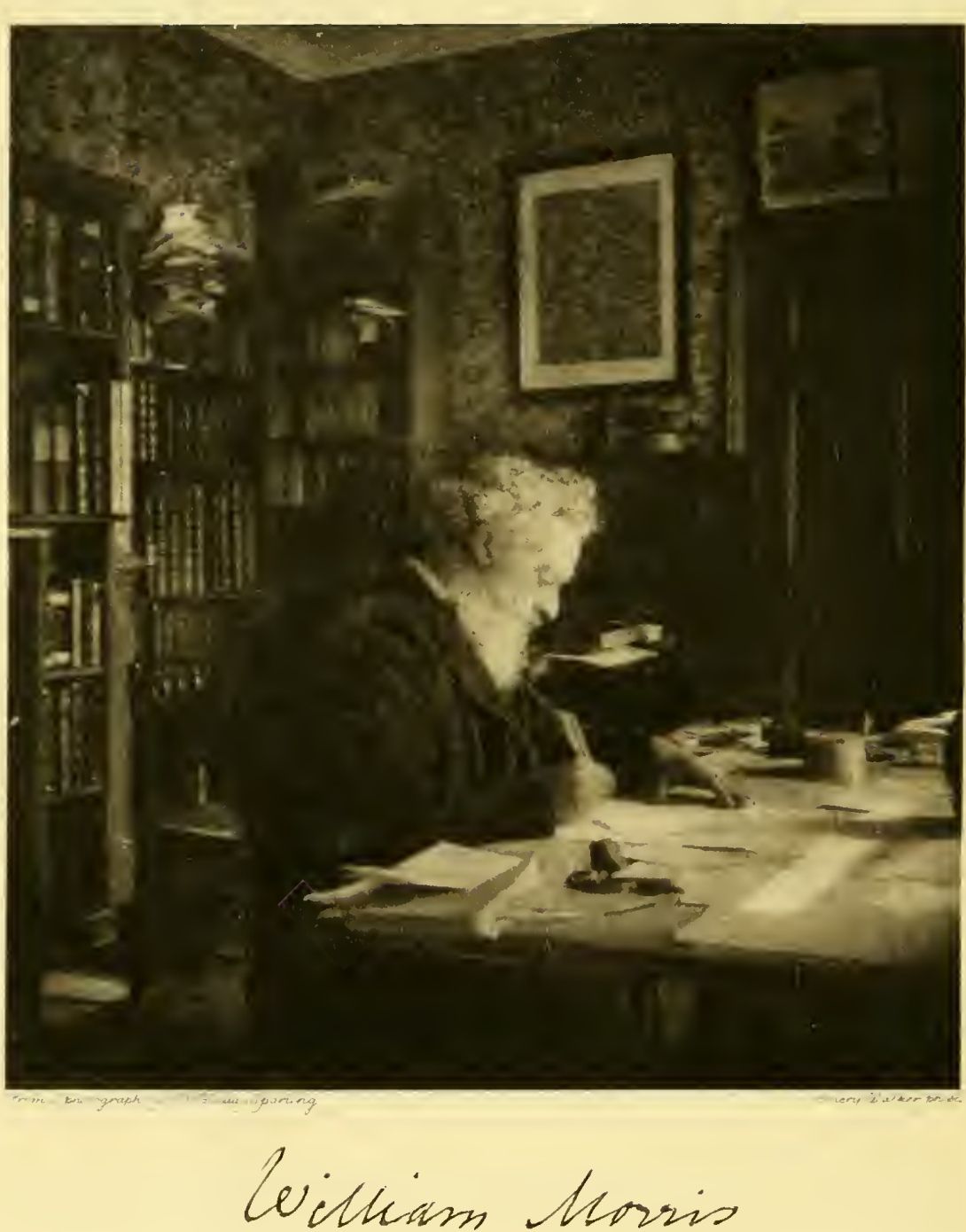
William Morris seated writing at a crowded desk, with bookshelves and framed pictures behind him

William Morris at his desk in the library of Kelmscott House, in the 1890s.

H. Halliday Sparling · Northeastern University Libraries

Licence: Public domain. Mechanical scan rendered; surrounding blank margin trimmed; facsimile signature retained.

View the original and source details
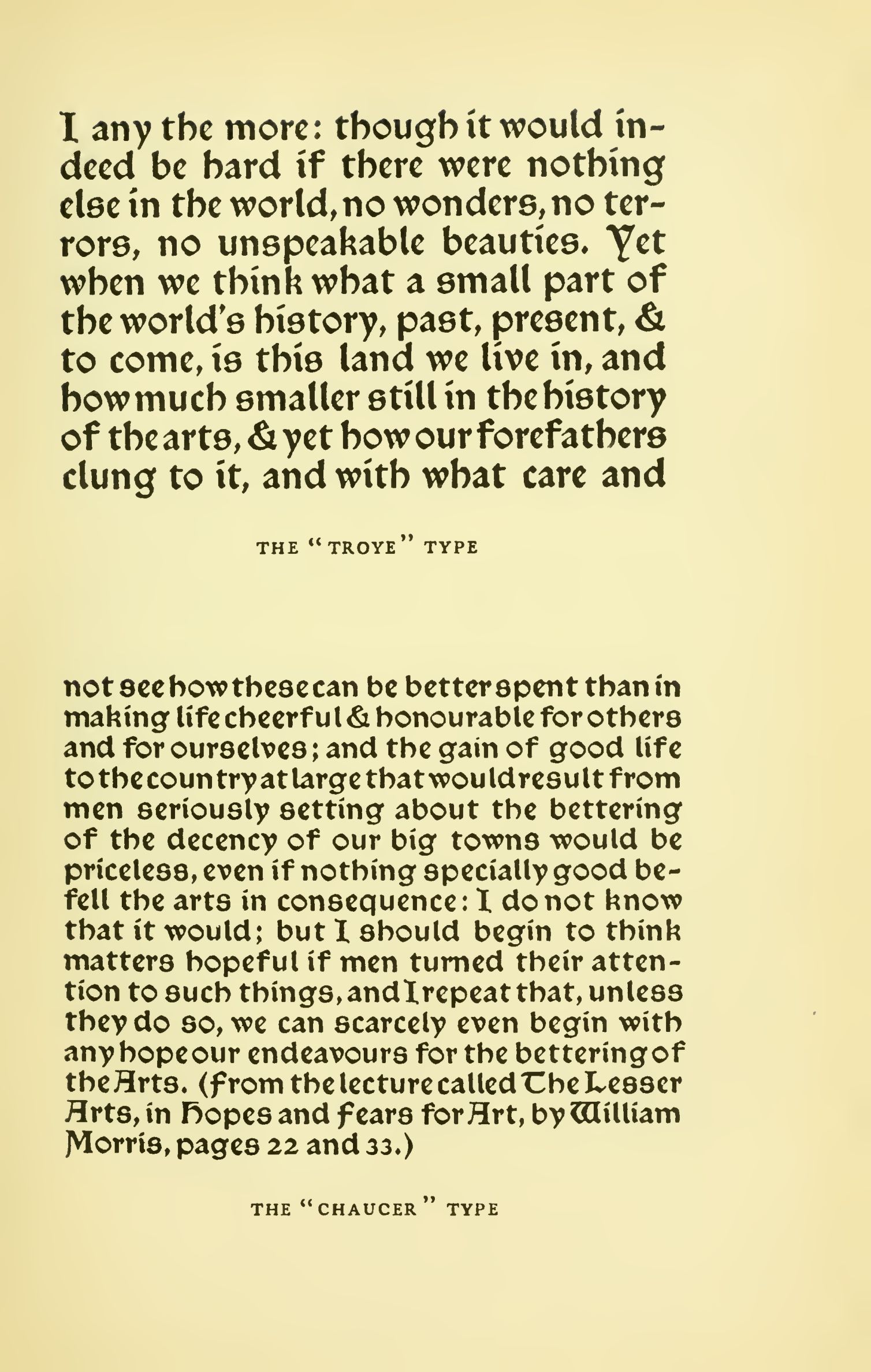
Two labelled specimens comparing the larger Troy type with the smaller Chaucer type

Troy type above and the smaller Chaucer type below, reproduced in H. Halliday Sparling’s 1924 book.

Northeastern University Libraries

Licence: Public domain. Full source image scaled for delivery; no reconstructed content.

View the original and source details
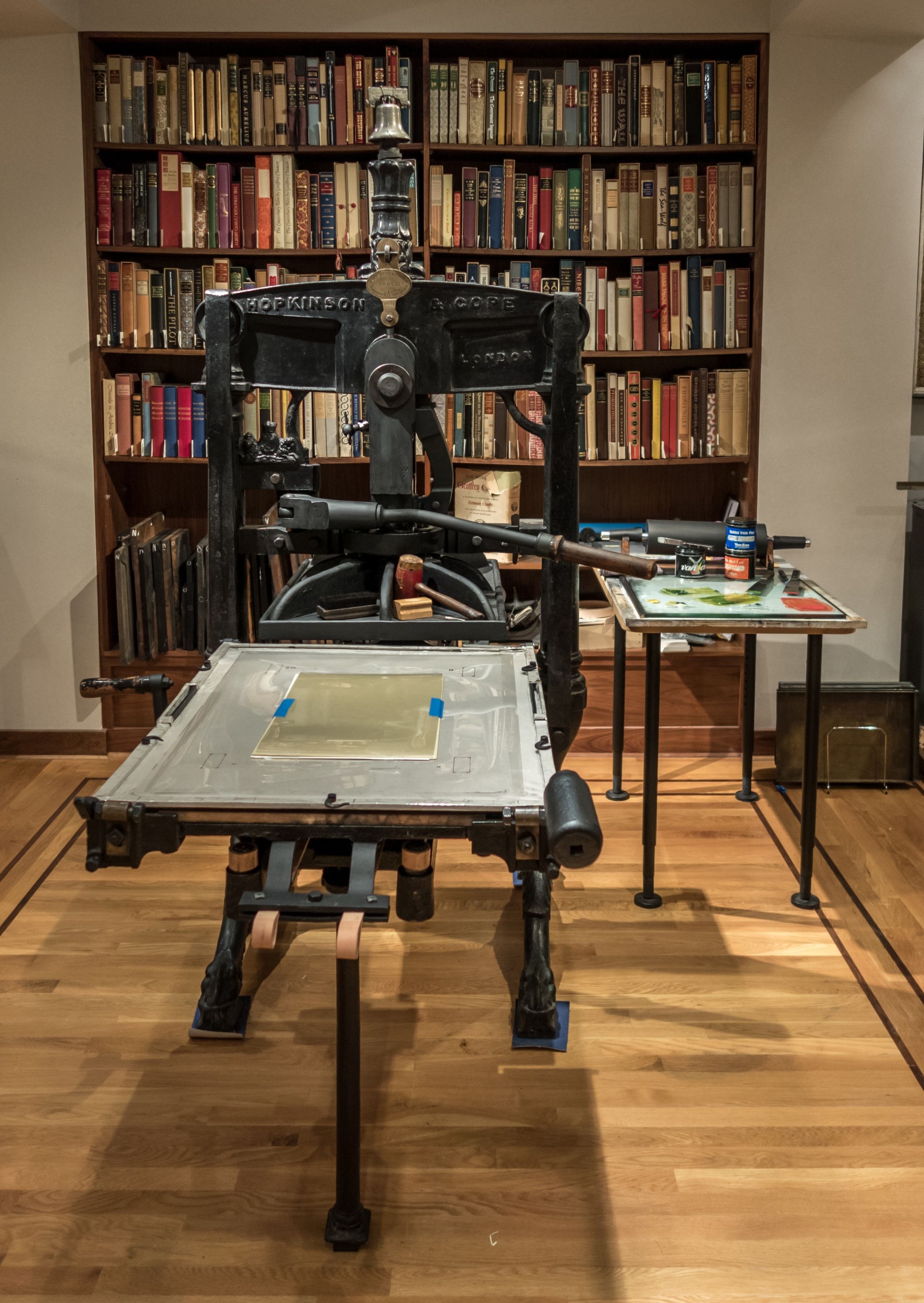
A tall iron Albion hand press with a long handle, raised paper frame and a printing bed in a modern library

The restored Kelmscott/Goudy Albion press at RIT’s Cary Graphic Arts Collection, photographed in 2015.

Jim Kuhn

Licence: CC0 1.0. Full source image scaled for delivery; no reconstructed content.

View the original and source details
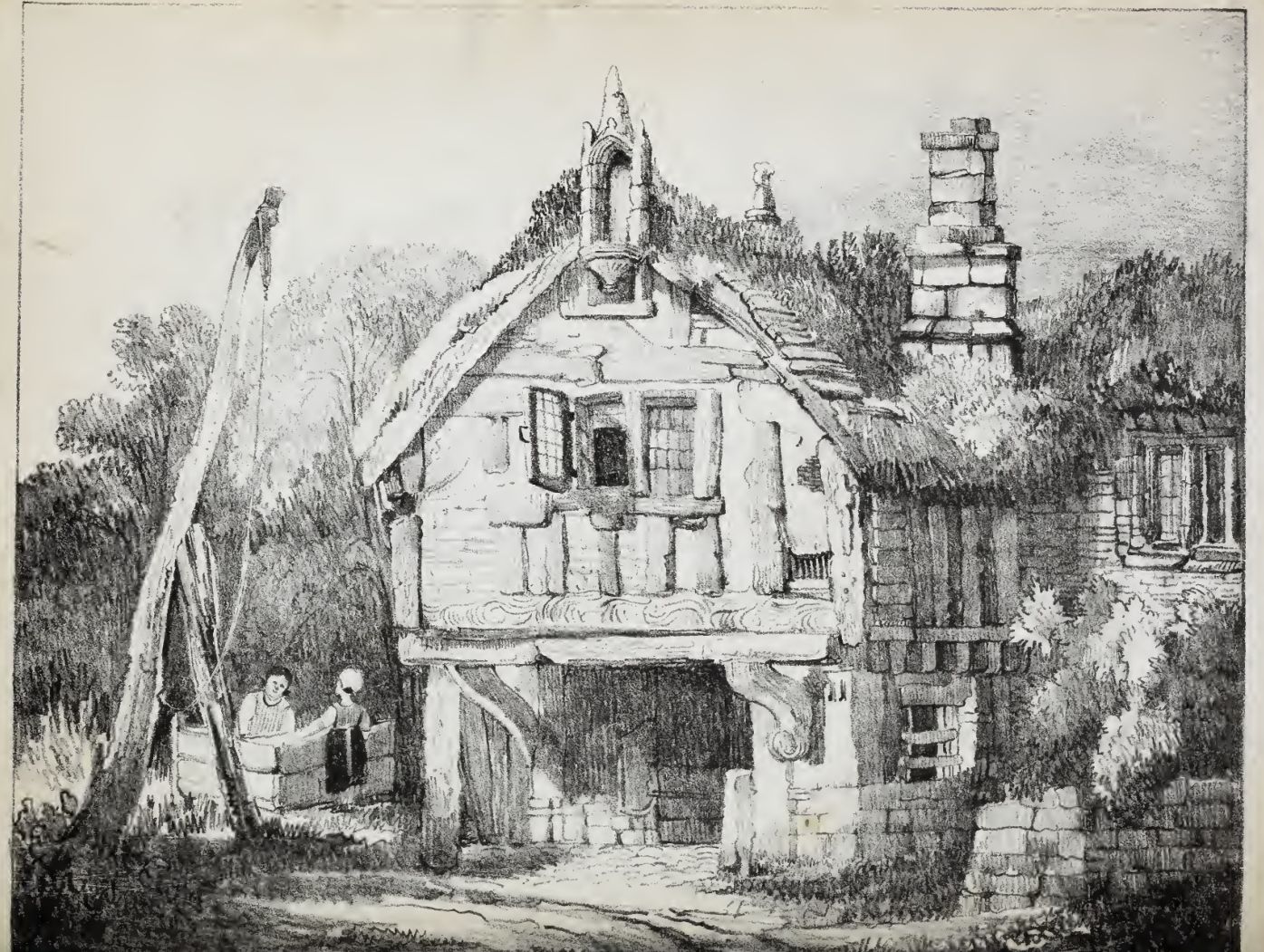
A chalk lithograph of an old thatched cottage with two figures beside a washing tub

Samuel Prout’s chalk-manner lithograph, published in Senefelder’s English handbook in 1819.

Samuel Prout · Getty Research Institute

Licence: Public domain. Separate full source retained; CMS cover crop removes scanned border, rectangle52,45,1395,1051 within1500×1142. Whole plate in body and gallery. Cover cropped for article cards and sharing.

View the original and source details
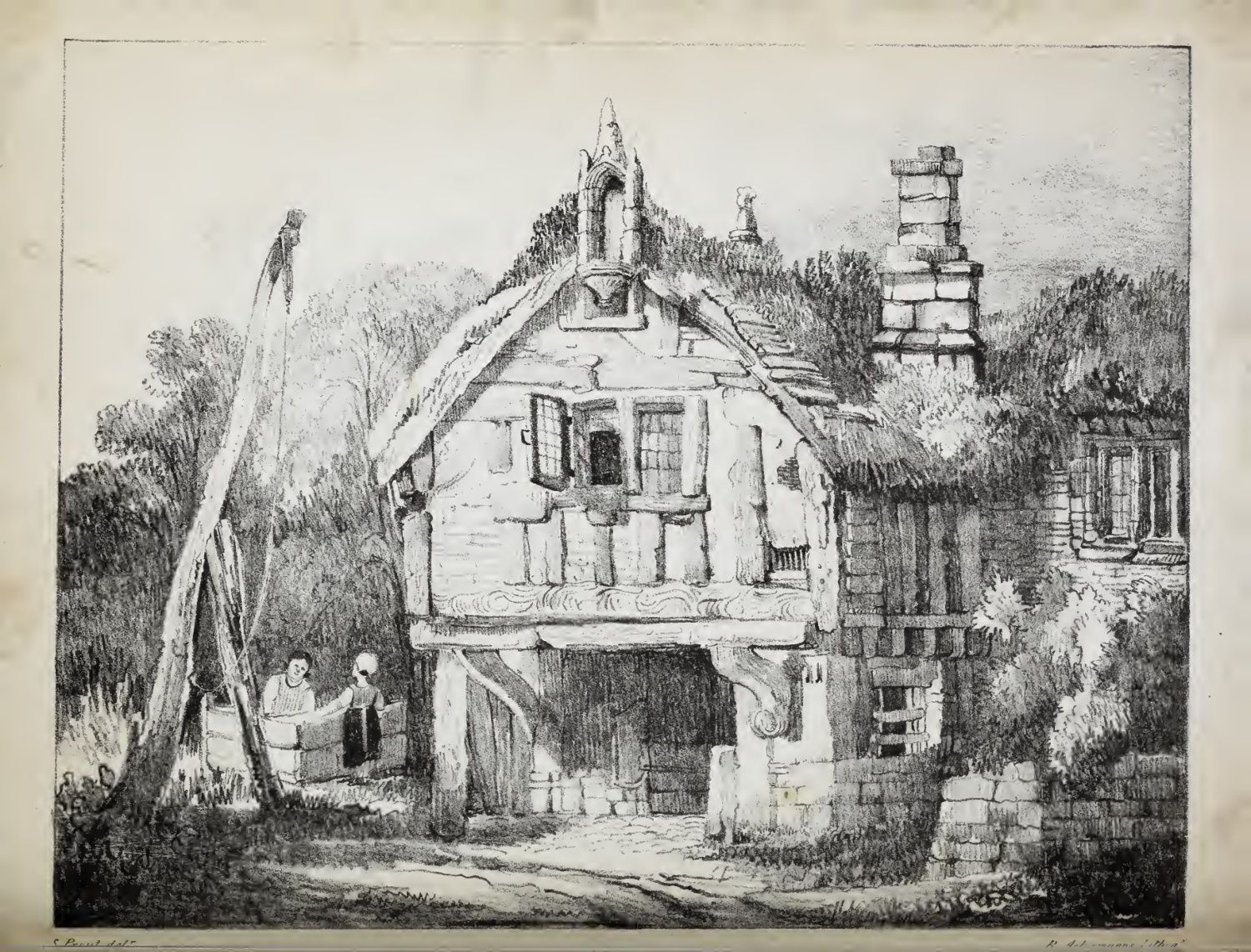
A chalk lithograph of an old thatched cottage with two figures beside a washing tub

Samuel Prout’s chalk-manner lithograph, published in Senefelder’s English handbook in 1819.

Samuel Prout · Getty Research Institute

Licence: Public domain. Plate rendered from original 1819 scan and rotated upright; no image content removed.

View the original and source details
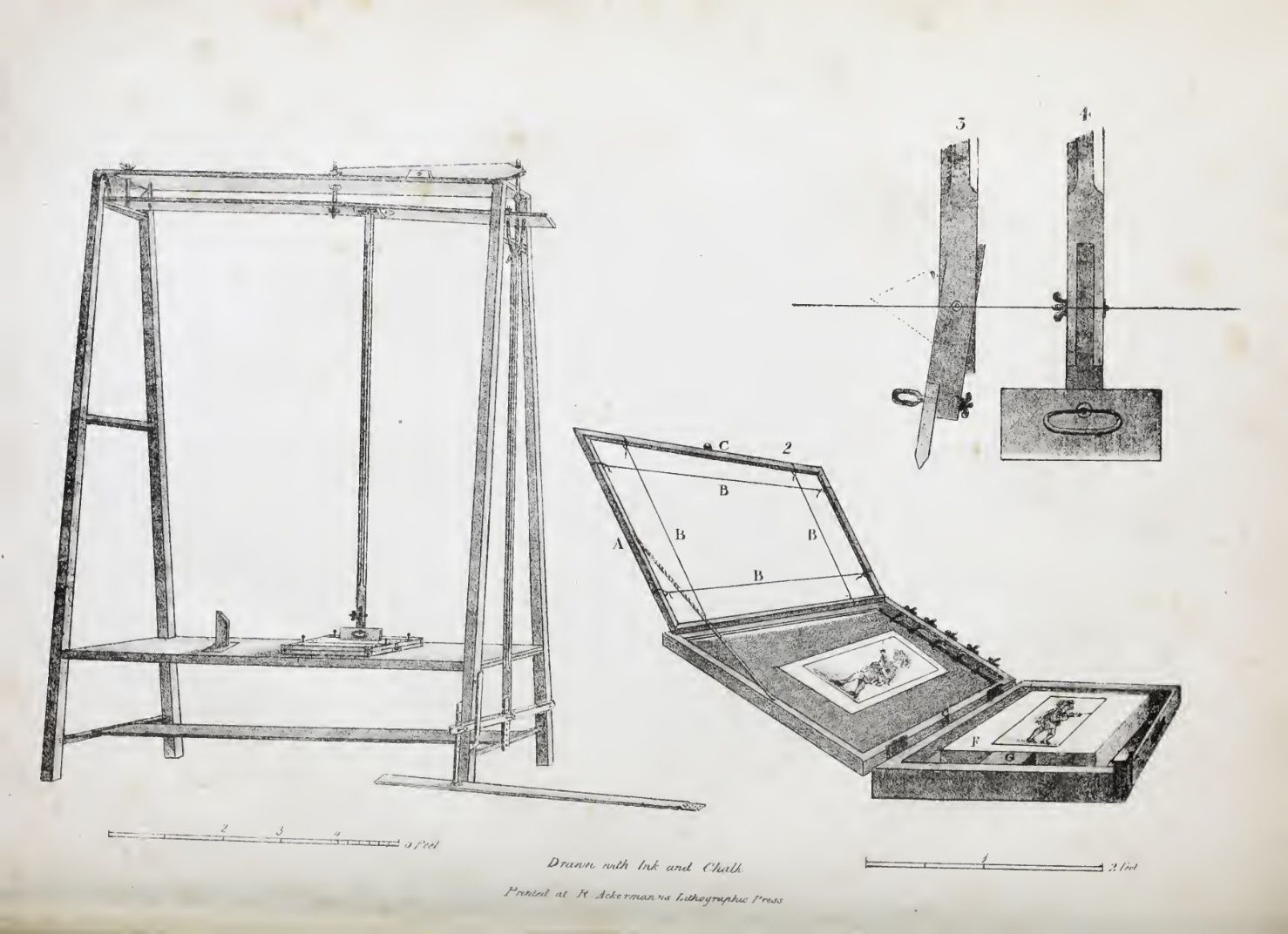
An upright lithographic lever press, its hinged printing frame, the stone and paper-holding strings

A lever press and its printing frame, illustrated in the 1819 handbook. The paper is held above the stone until pressure brings it down.

Getty Research Institute

Licence: Public domain. Plate rendered from original 1819 scan and rotated upright; no image content removed.

View the original and source details
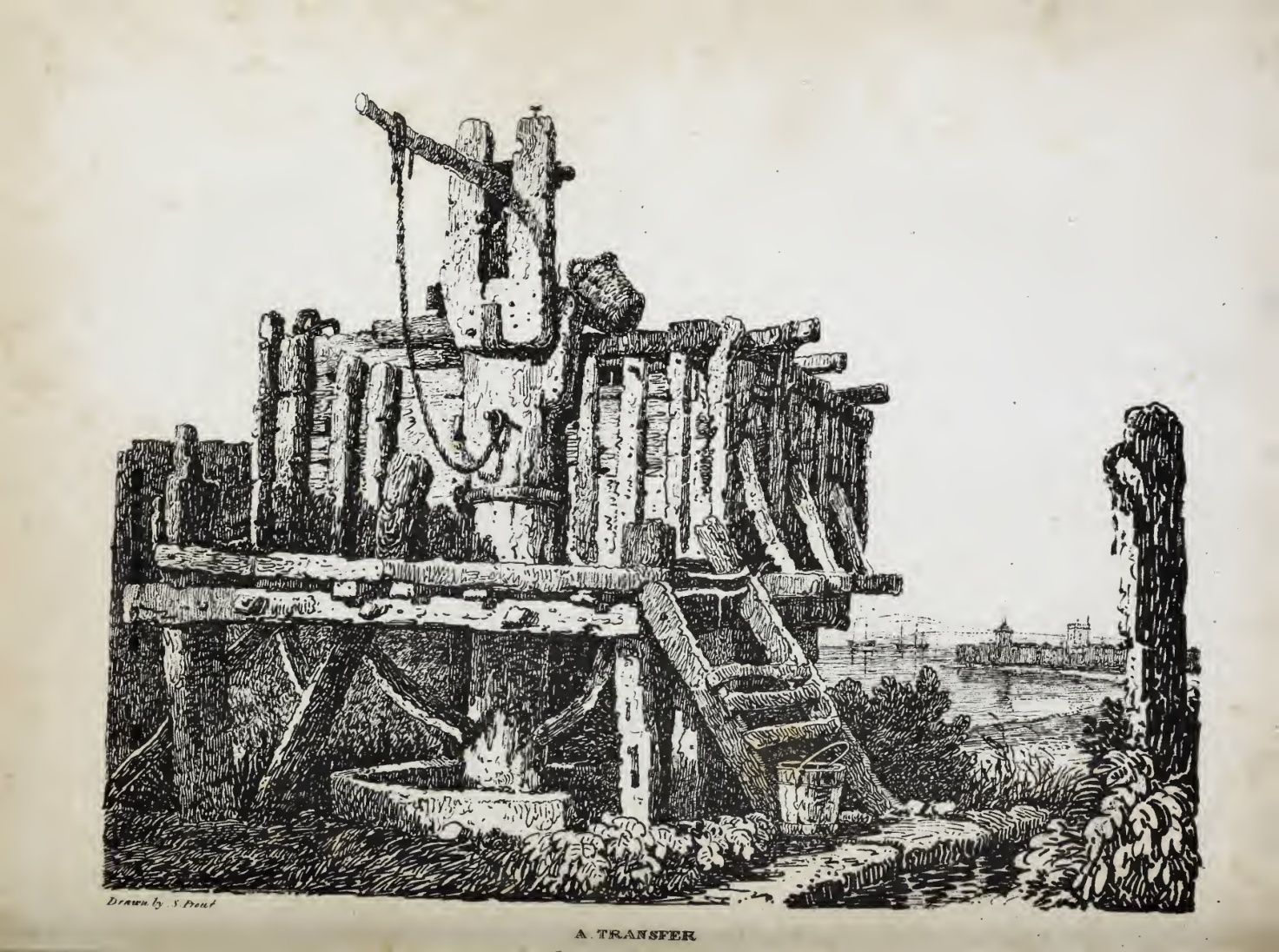
A pen-style lithograph of a timber riverside structure with ropes, posts and a distant skyline

Prout’s transfer lithograph in the 1819 handbook: a drawing made on paper and transferred to the printing stone.

Samuel Prout · Getty Research Institute

Licence: Public domain. Plate rendered from original 1819 scan and rotated upright; no image content removed.

View the original and source details
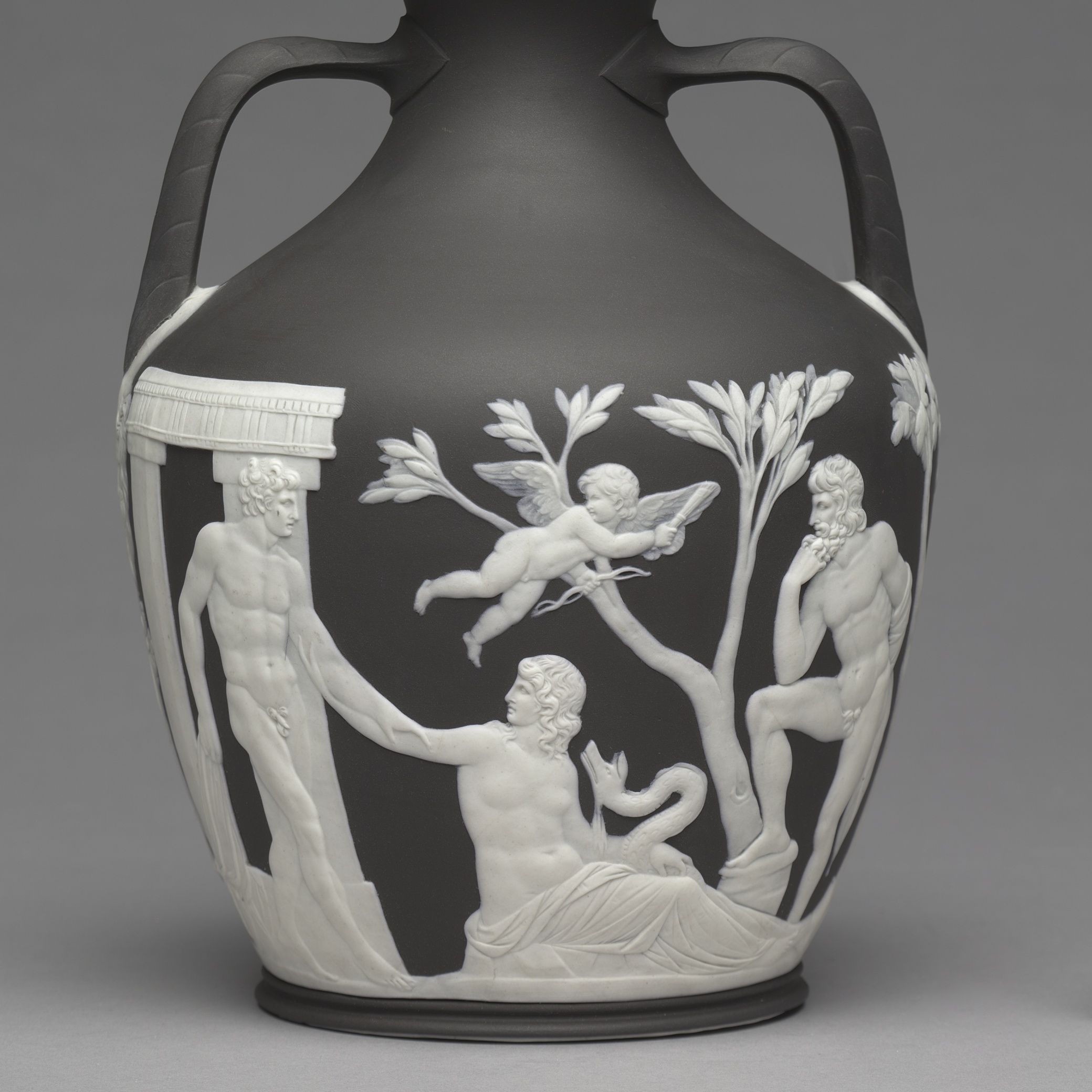
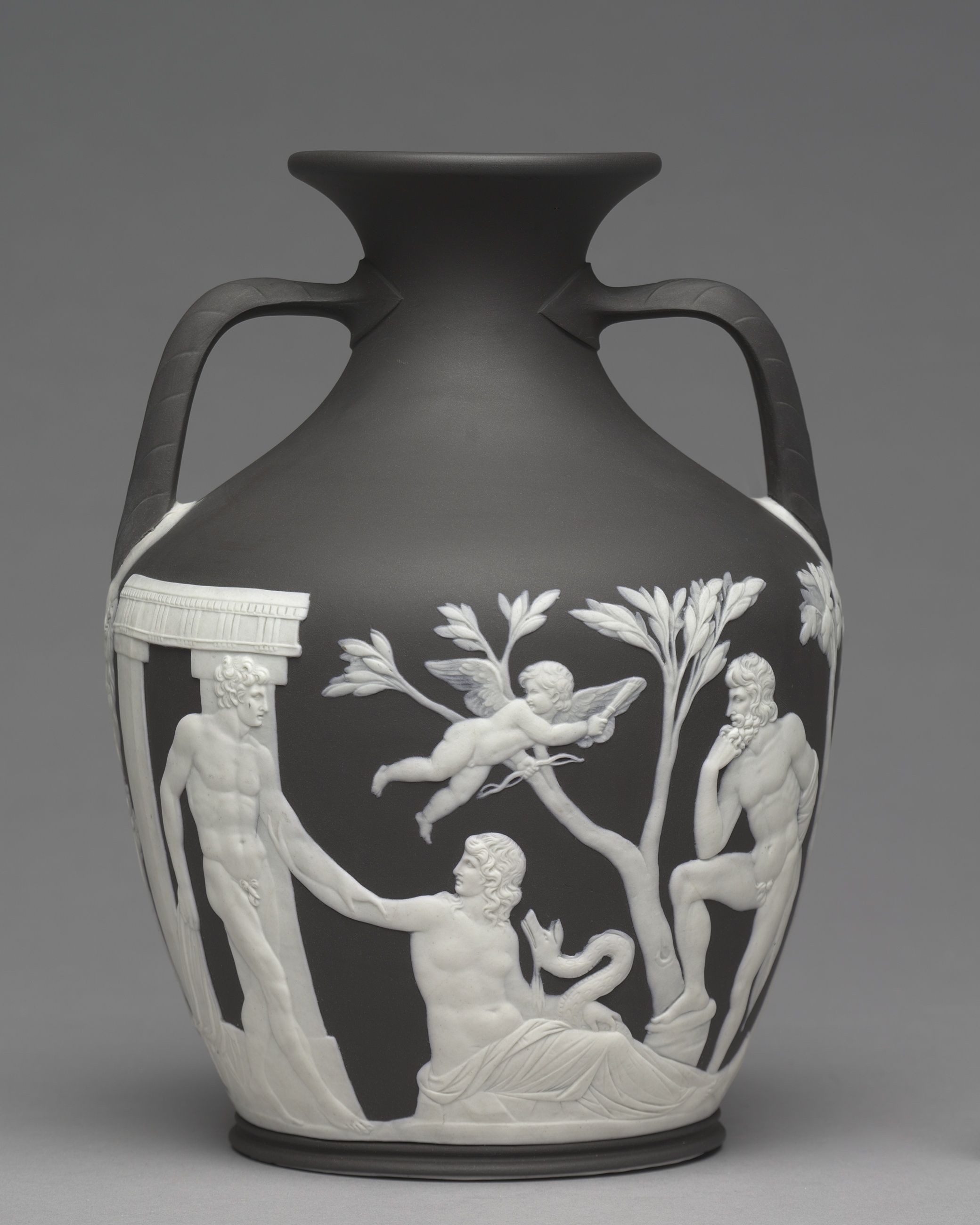
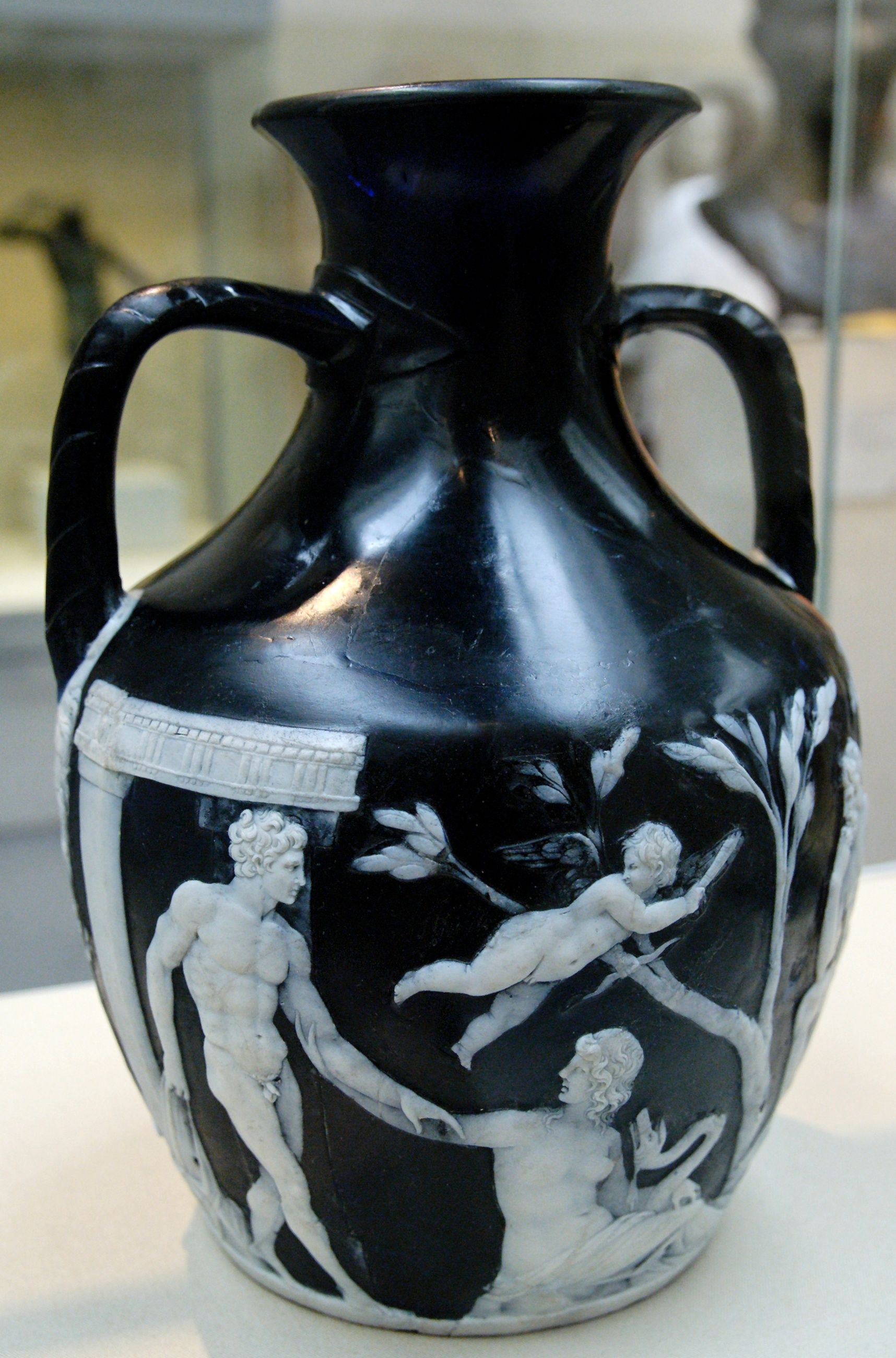
White classical figures and a winged child on the dark body of an early Wedgwood Portland Vase

Detail of an early Wedgwood copy of the Portland Vase, about 1790.

Cleveland Museum of Art

Licence: CC0 1.0. Separate full original retained; CMS cover crop removes top20percent, rectangle0,520,2080,2080. Whole vase in body/gallery. Cover cropped for article cards and sharing.

View the original and source details
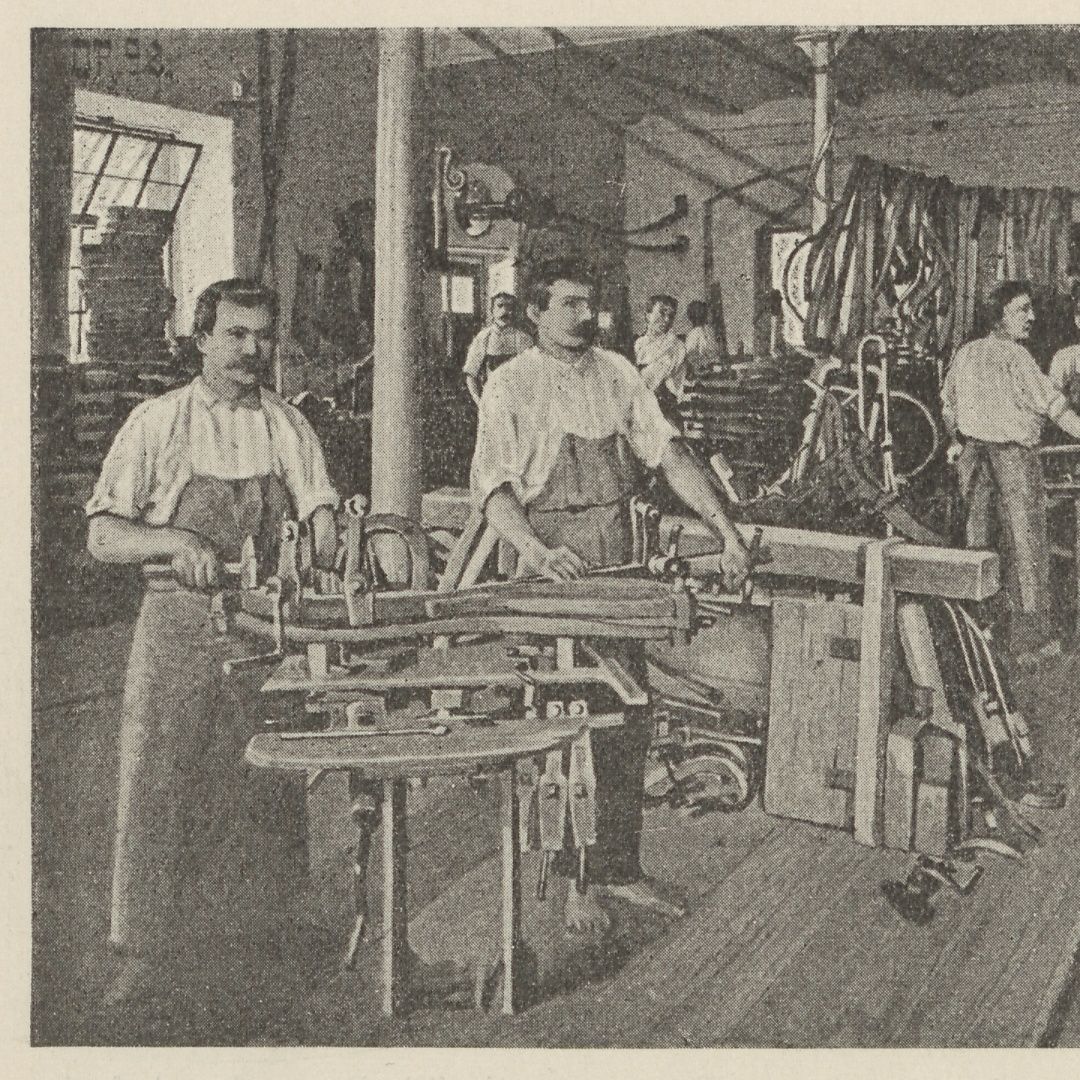
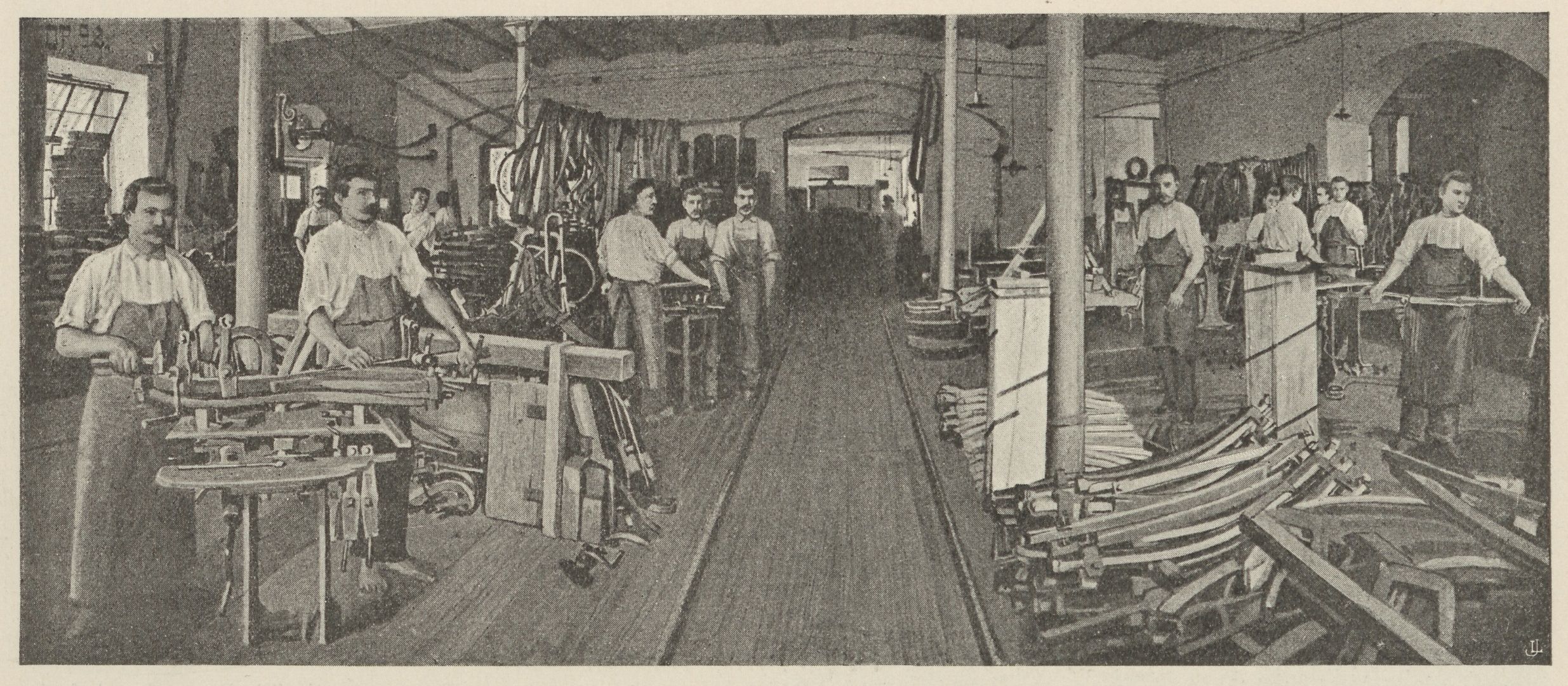
Workers bending and clamping wooden parts in Thonet's Bistritz workshop

The bending workshop at Bistritz, in an illustration published in 1898.

Austrian National Library

Licence: Public domain. Separate whole workshop asset retained; cover rectangle 0,0,1080,1080 focuses on two foreground workers, their hands and forms. Whole scene remains in body/gallery. Cover cropped for article cards and sharing.

View the original and source details
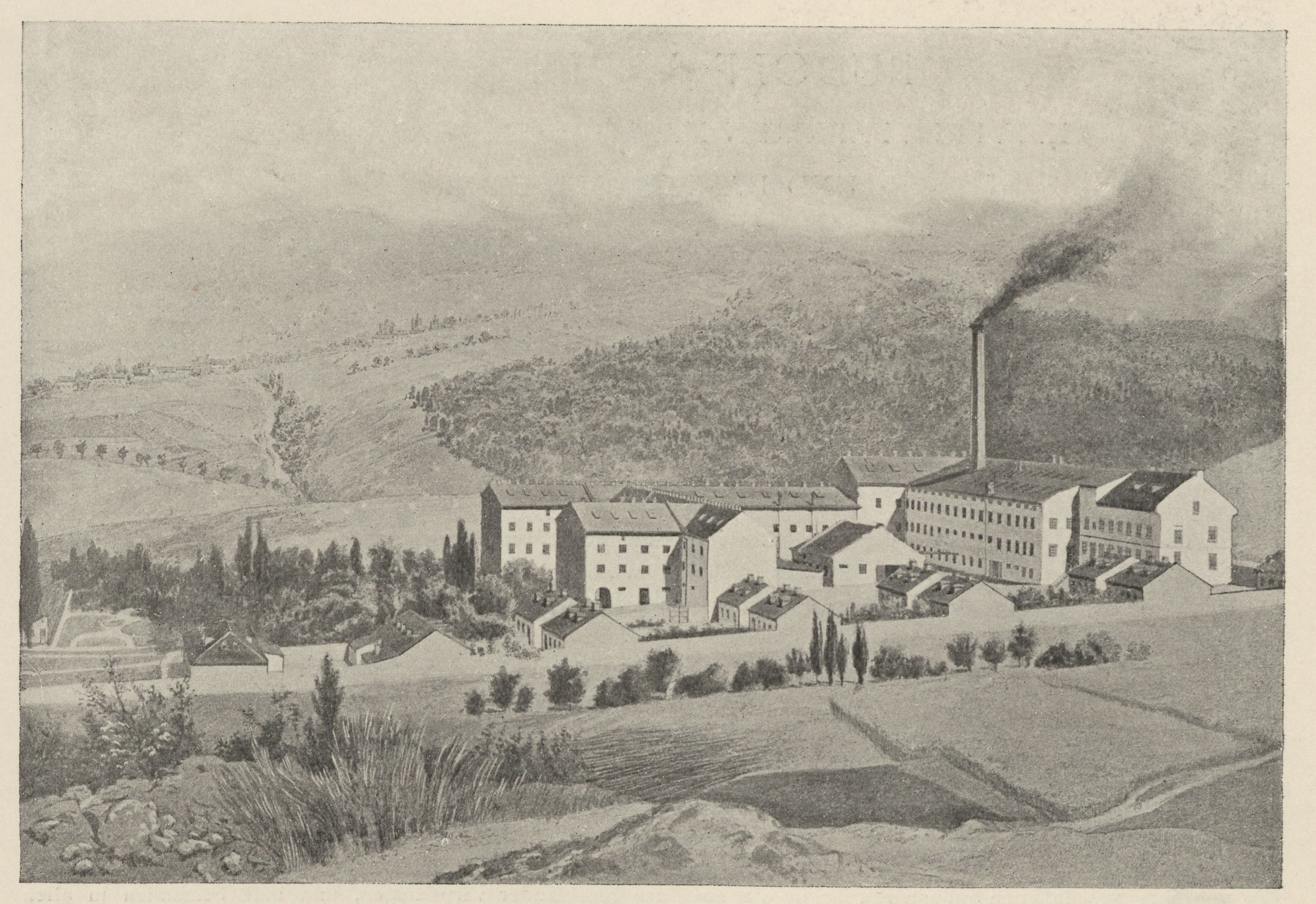
Workers at forms and benches in Thonet's Bistritz bending workshop

The bending workshop at Bistritz, now Bystřice pod Hostýnem, in an illustration published in 1898.

Austrian National Library

Licence: Public domain. Whole workshop illustration cropped from the 1898 page; original page retained.

View the original and source details
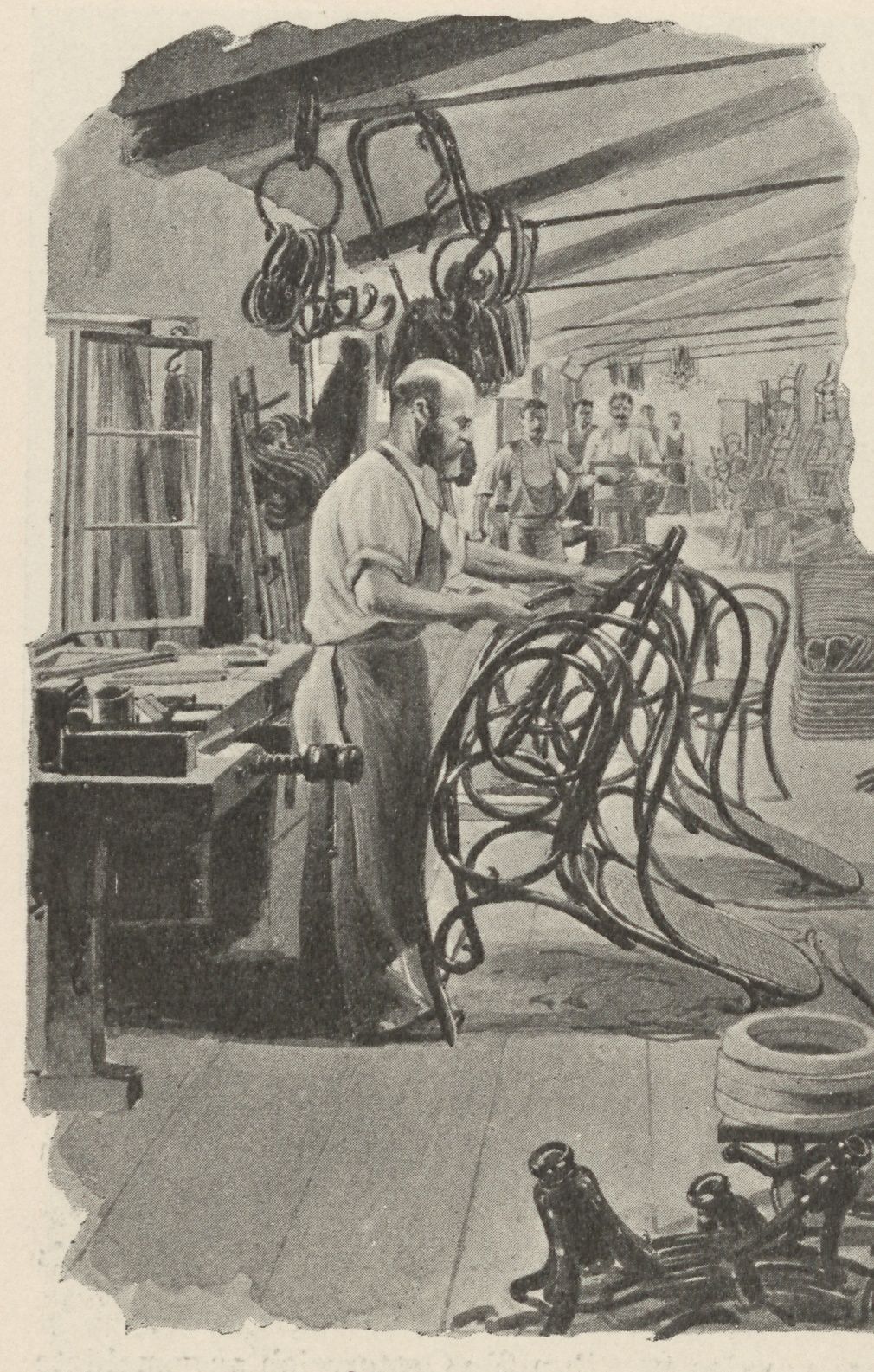
A worker assembling curved chair parts in the Bistritz factory, with further frames overhead and behind him

Assembly at the Bistritz works, in an illustration published in 1898.

Austrian National Library

Licence: Public domain. Closer assembly view cropped from the 1898 page to remove neighbouring printed text; main worker, both hands and held chair frame retained. Whole page preserved.

View the original and source details
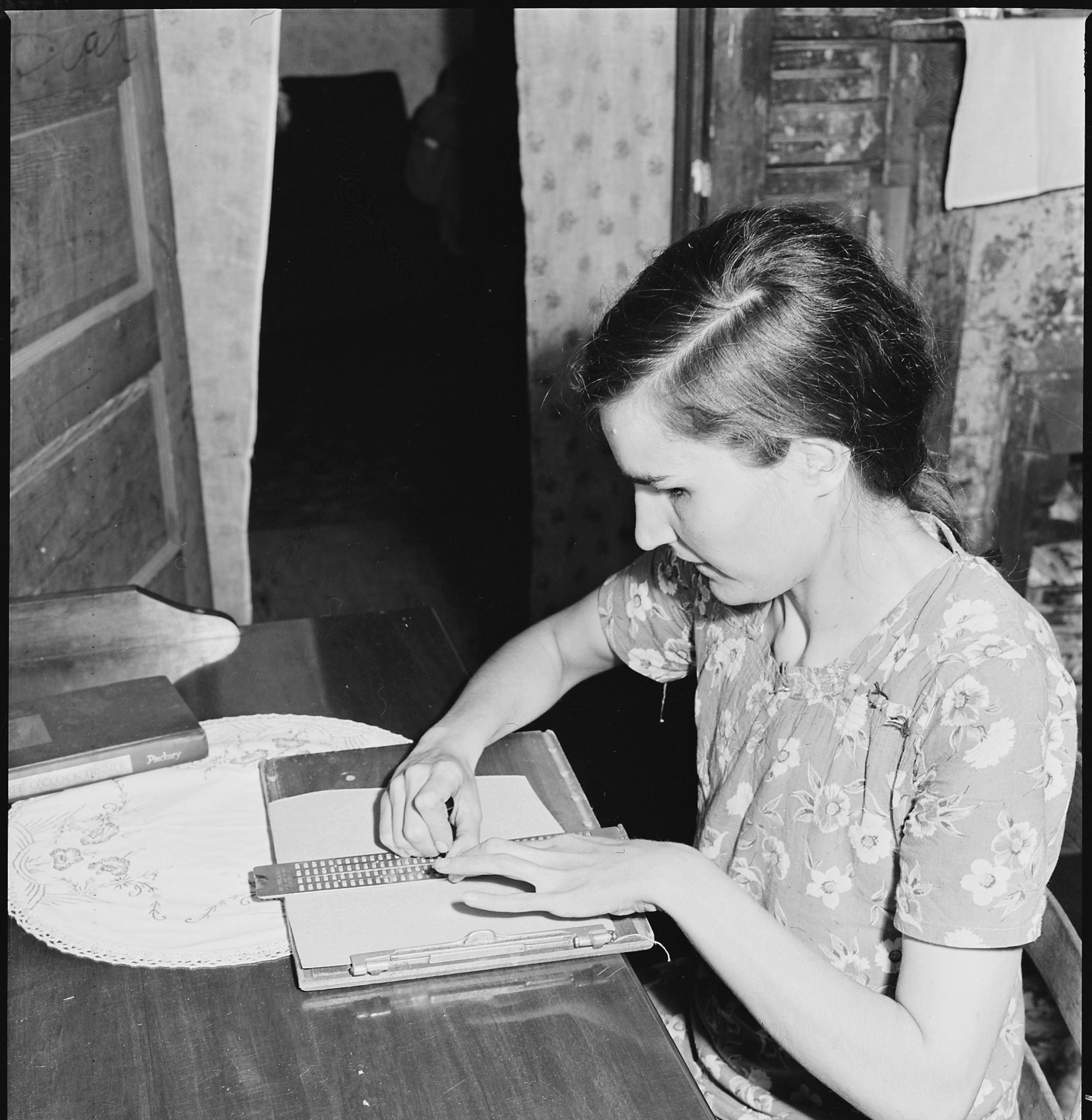
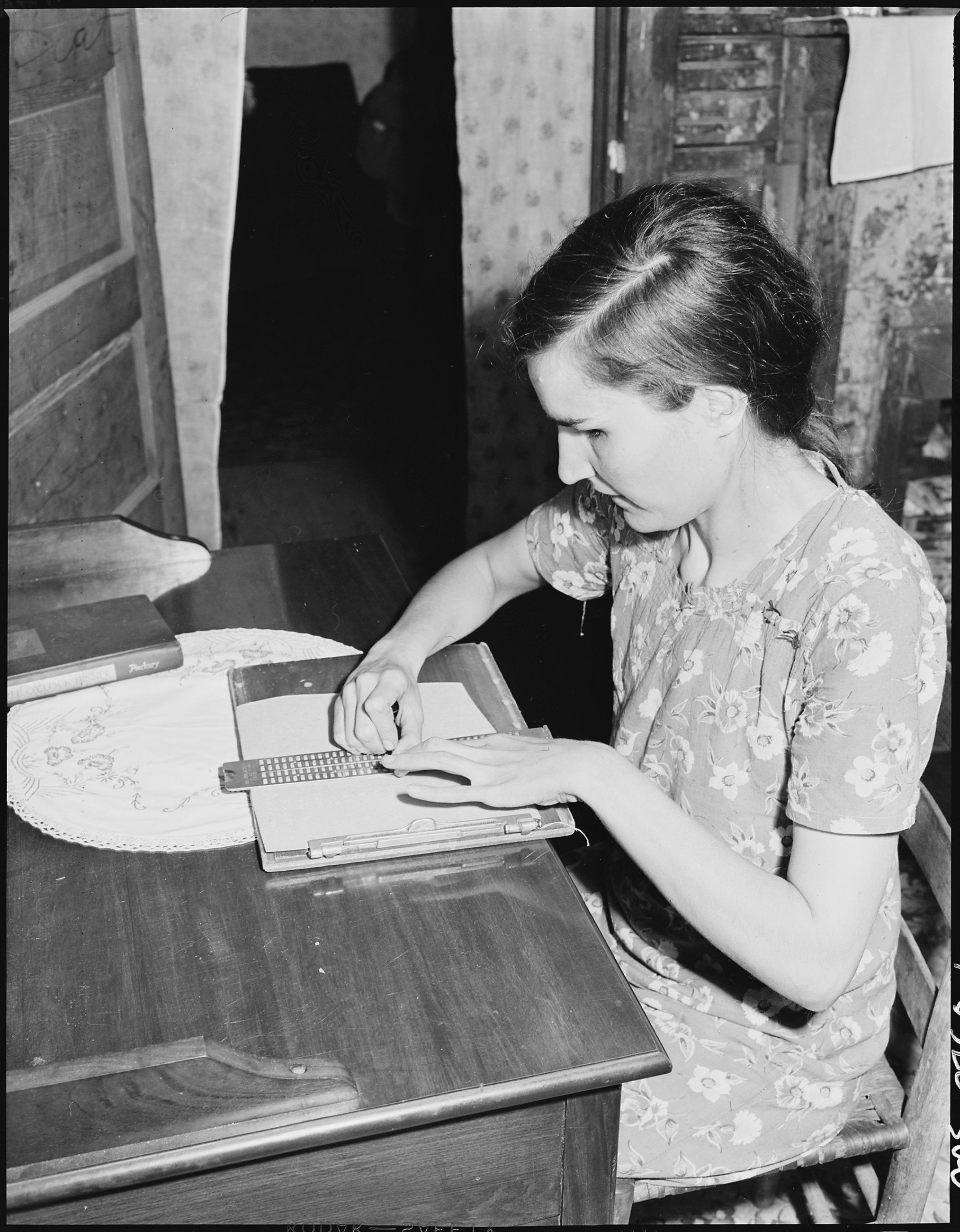
Lucy Sergent’s face, hands, stylus and writing frame in Russell Lee’s 1946 photograph

Lucy Sergent writing in Lejunior, Kentucky, 1946.

Russell Lee / National Archives

Licence: Public domain (US government work). Separate full original asset retained; cover crops lower table/body area to2339×2400. Face, both hands, stylus and working guide retained. Whole source in body/gallery. Cover cropped for article cards and sharing.

View the original and source details
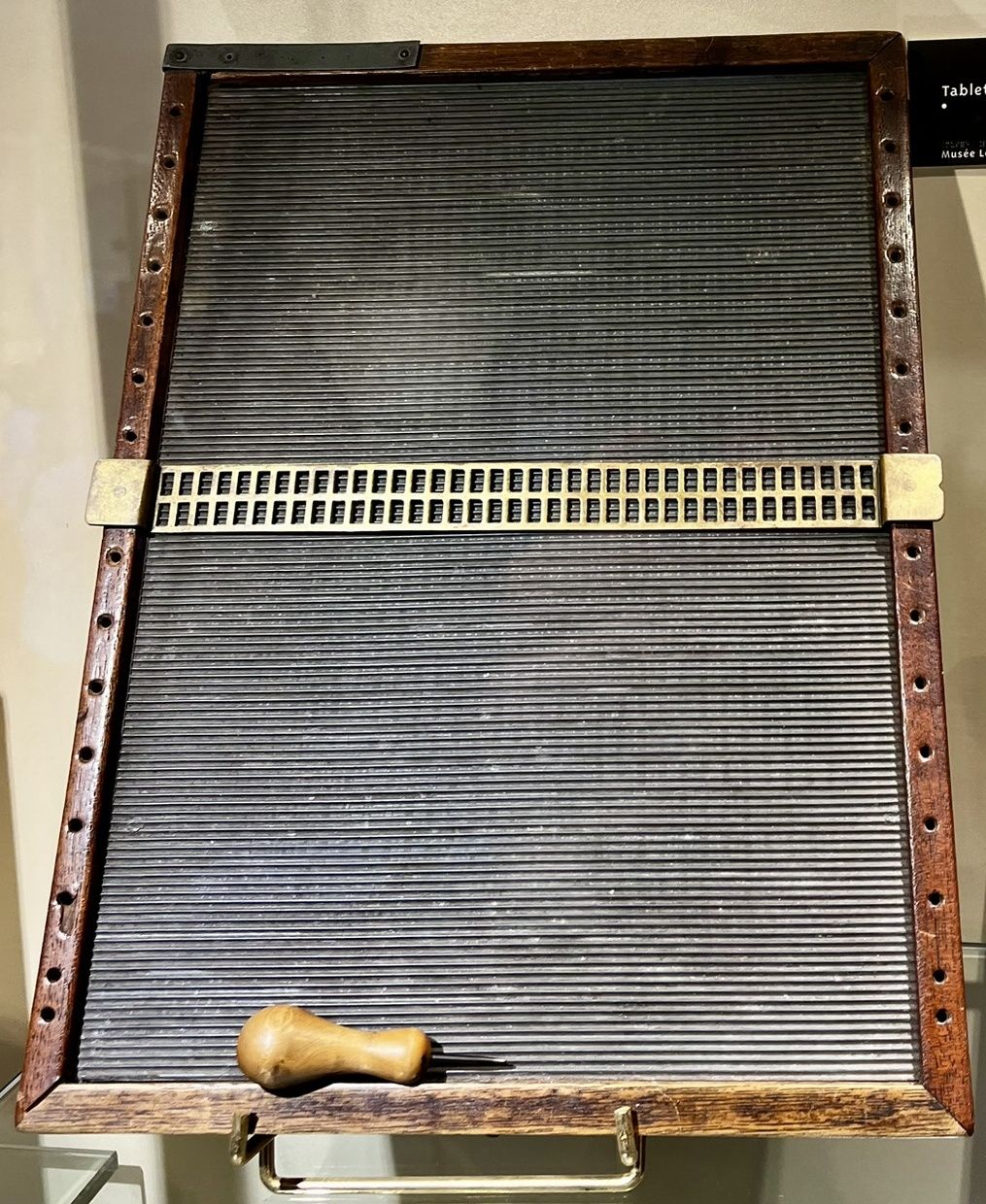
A wooden writing frame with a grooved bed, a two-line brass guide and a yellow-handled stylus displayed below it

Braille’s writing slate, displayed at the Musée Louis Braille. A movable guide positions the marks on the grooved board.

Esymington / Musée Louis Braille

Licence: CC BY 4.0. Display background cropped; complete slate, guide and displayed stylus retained.

View the original and source details
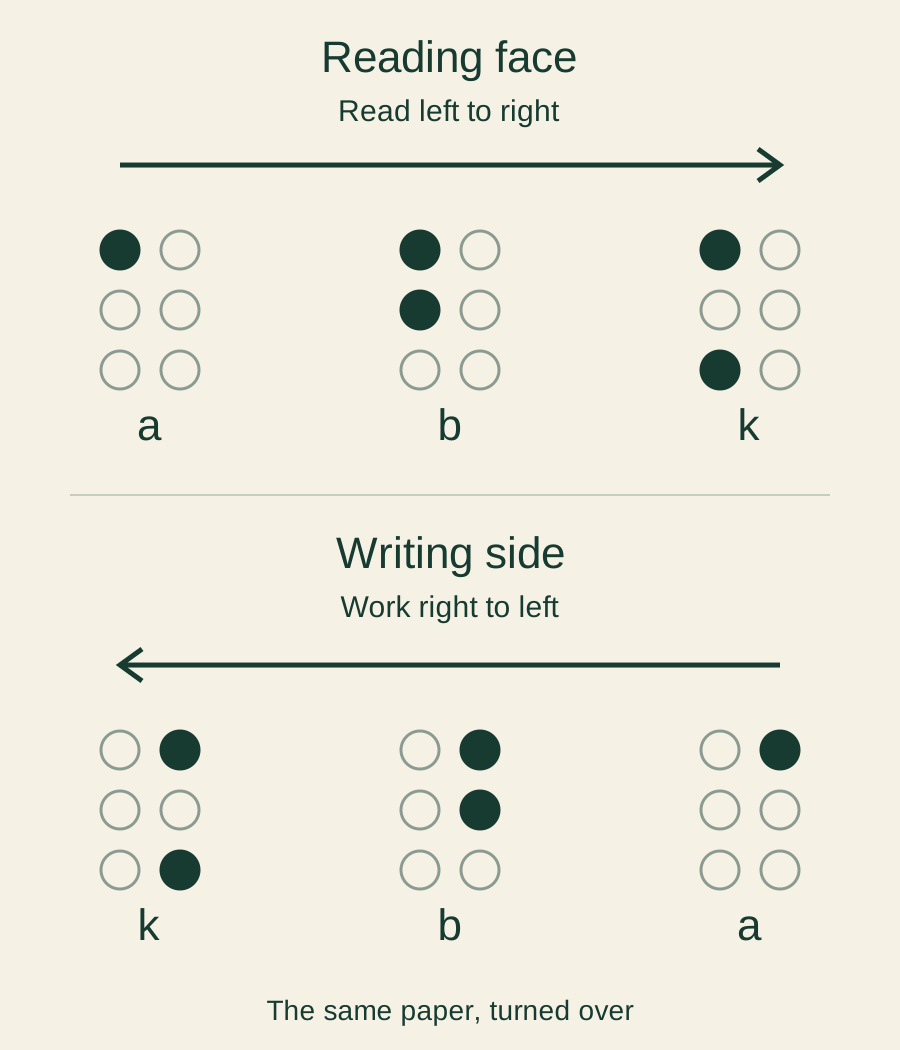
Three example letters, a, b and k, in six-dot cells: read left to right on the raised face, and punched as mirrored cells in the opposite order from right to left on the back

The same three letters on the reading face and the writing side. Filled circles mark the dots or the positions pressed; hollow circles mark unused positions.

Vanguard Chronicles

Licence: Original editorial diagram; rights reserved. New code-native SVG schematic; no historical page or third-party diagram reproduced.

View the original and source details
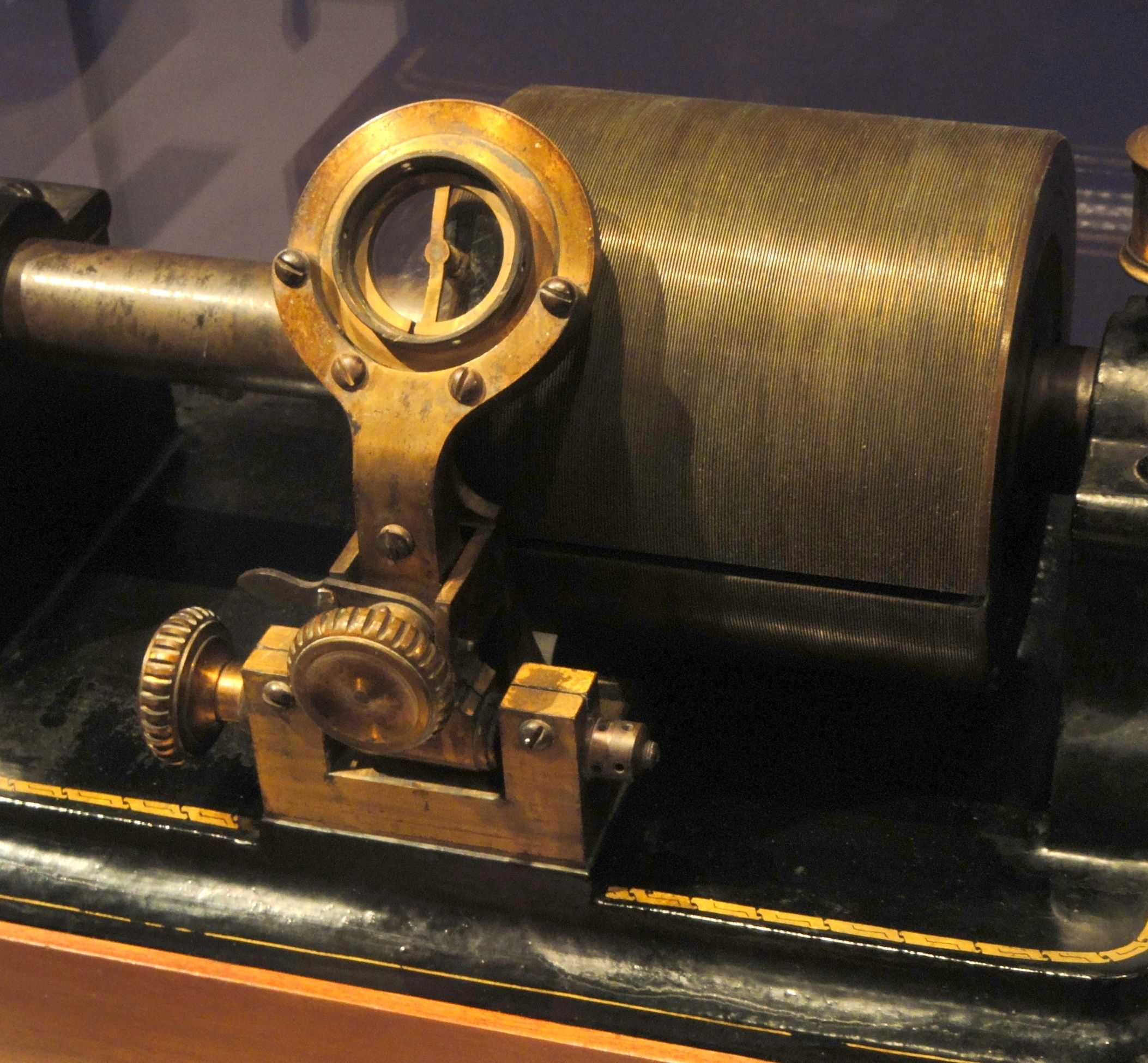
The grooved cylinder and adjustable diaphragm mounting of an 1878 tinfoil phonograph

Detail of an 1878 tinfoil phonograph in the National Museum of American History.

Daderot / National Museum of American History

Licence: CC0 1.0. Separate full source asset scaled2600×1950; CMS cover crops right edge to2106×1950. Different1878instrument; detail framing omits peripheral oiler and extended axle. Whole photo remains in body/gallery. Cover cropped for article cards and sharing.

View the original and source details
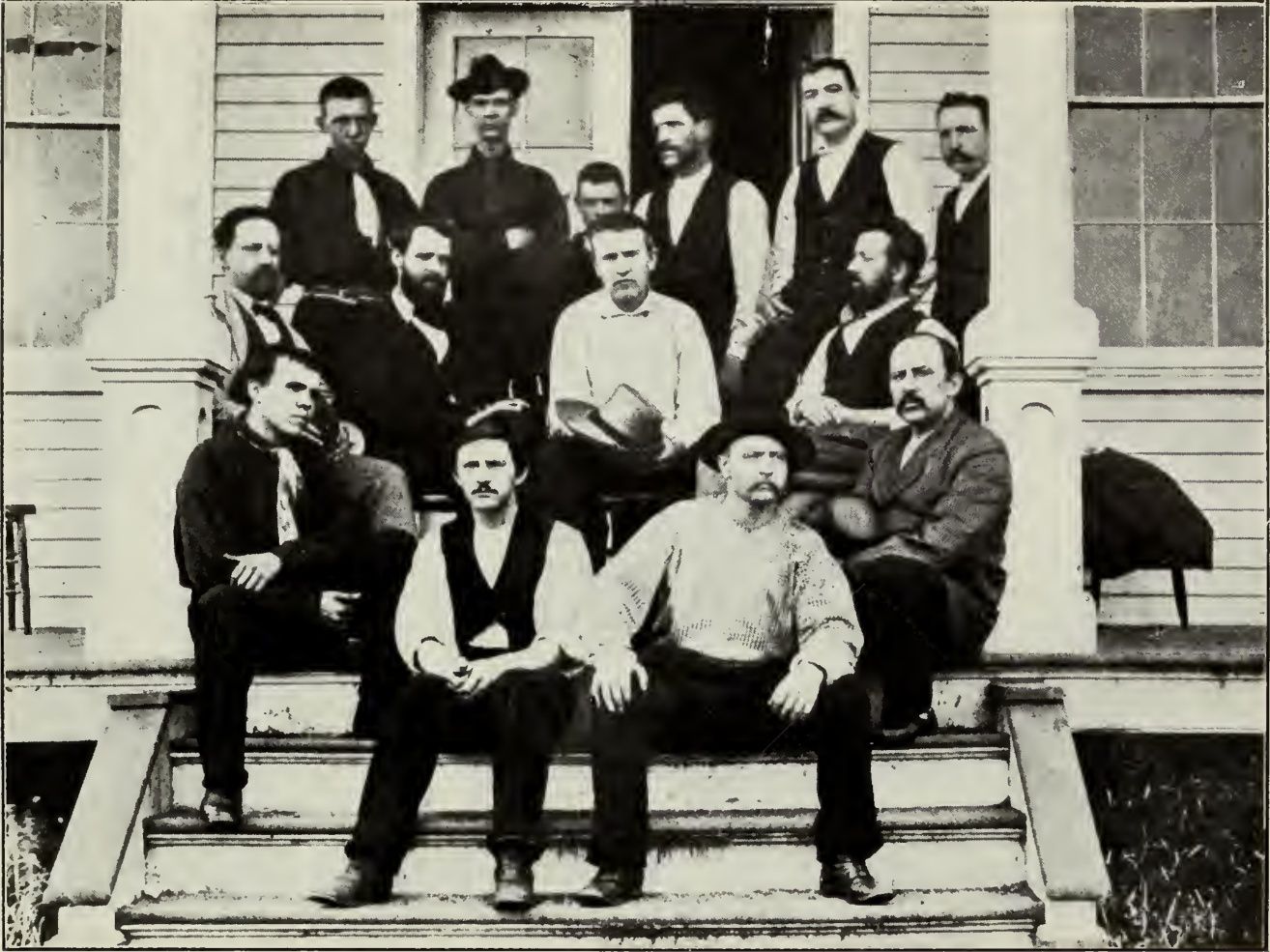
Edison and a group of assistants posed outside a wooden building at Menlo Park

Edison and his assistants at Menlo Park, including Charles Batchelor.

Dyer and Martin, Edison: His Life and Inventions

Licence: Public domain. Photographic rectangle cropped from PDF319 and rotated90degrees; all people retained.

View the original and source details
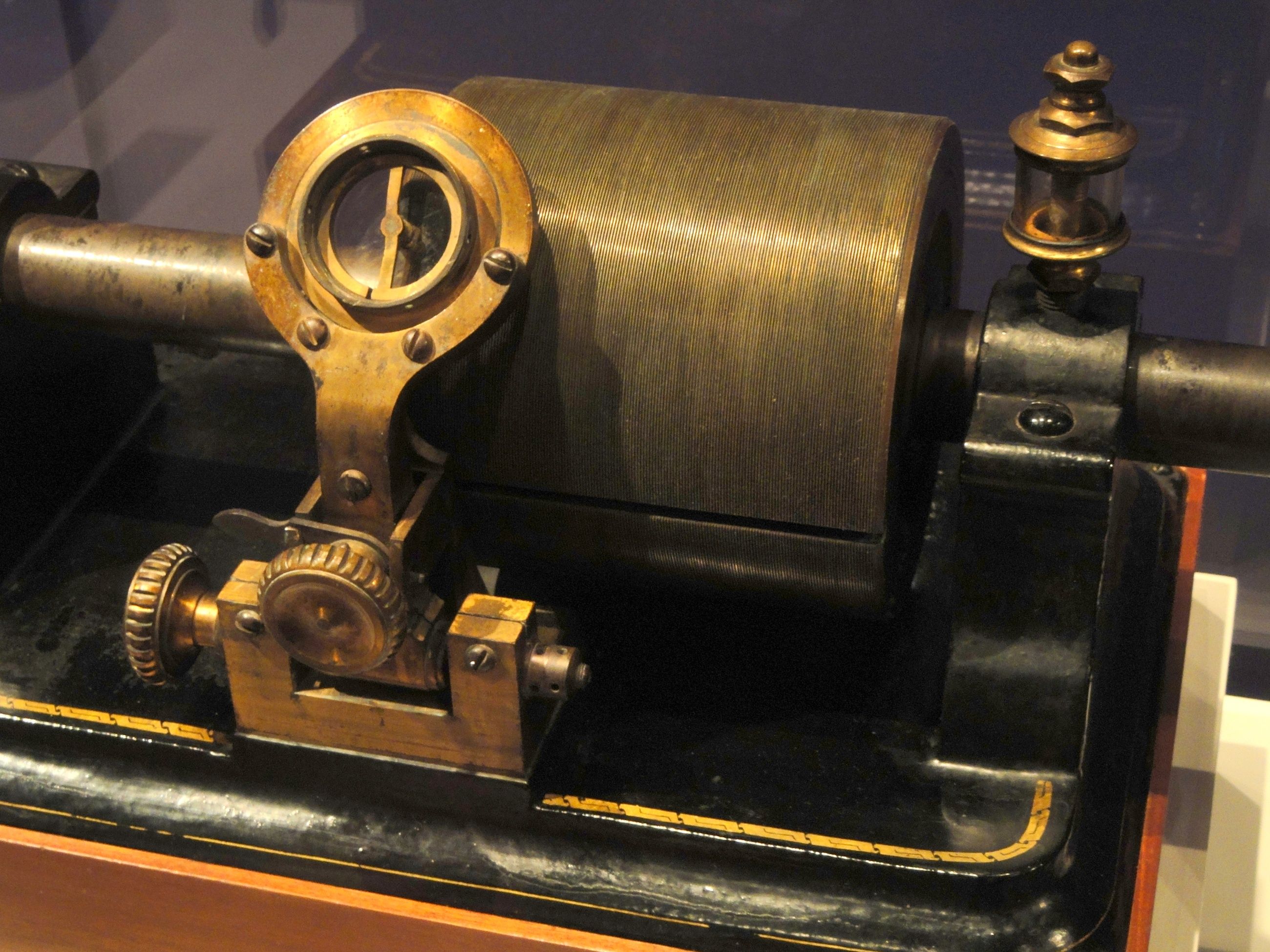
Grooved cylinder, round diaphragm mounting and adjustment wheels on a brass and black phonograph

The recording surface and adjustments of a different tinfoil phonograph, dated 1878, in the National Museum of American History.

Daderot / National Museum of American History

Licence: CC0 1.0. Full original photograph scaled for delivery.

View the original and source details
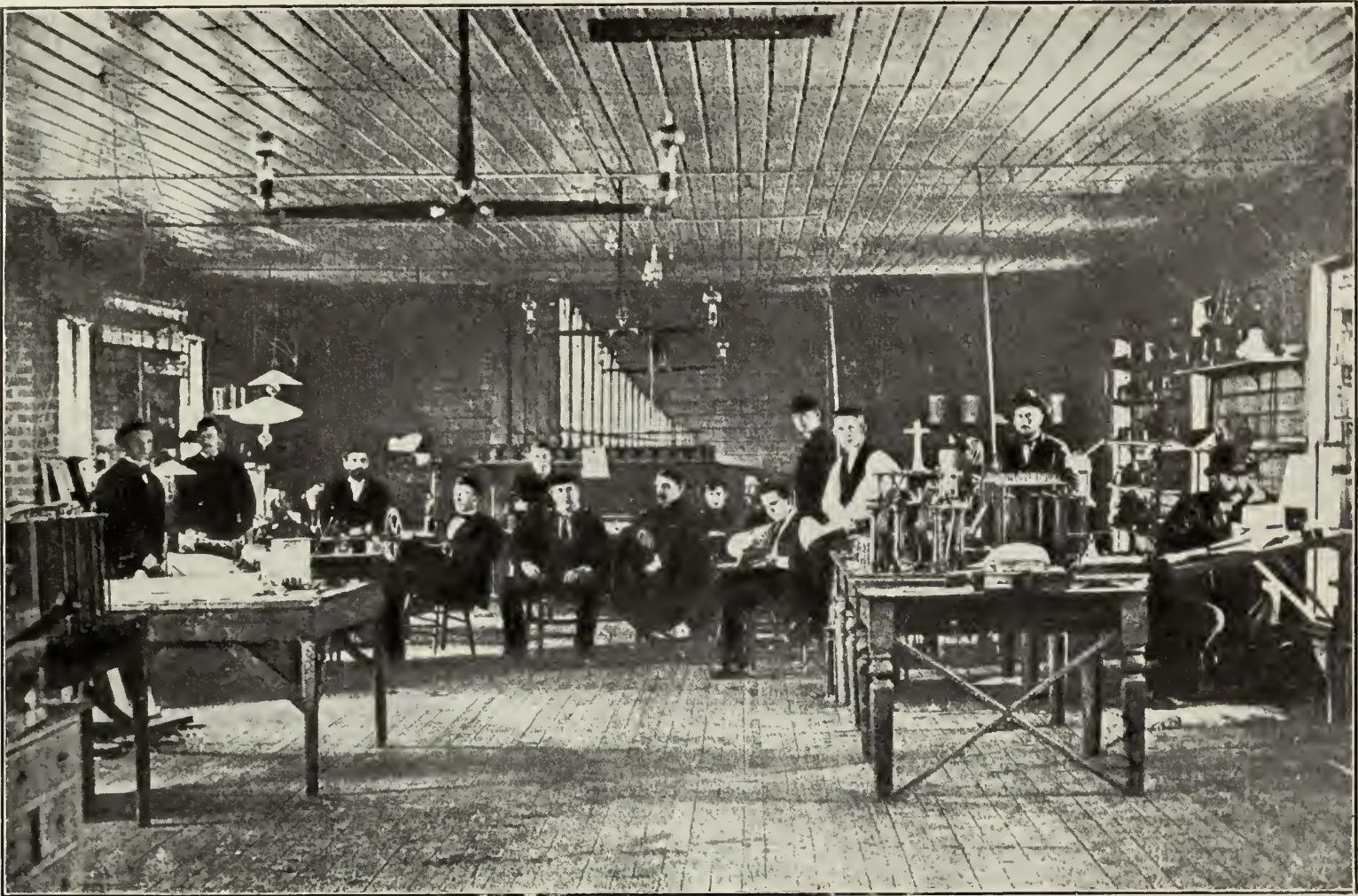
A long wooden laboratory room with benches, instruments and a group of people

The Menlo Park laboratory with Edison and his assistants, about 1880.

Dyer and Martin, Edison: His Life and Inventions

Licence: Public domain. Photographic rectangle cropped from PDF313 and rotated90degrees; full laboratory photograph retained.

View the original and source details
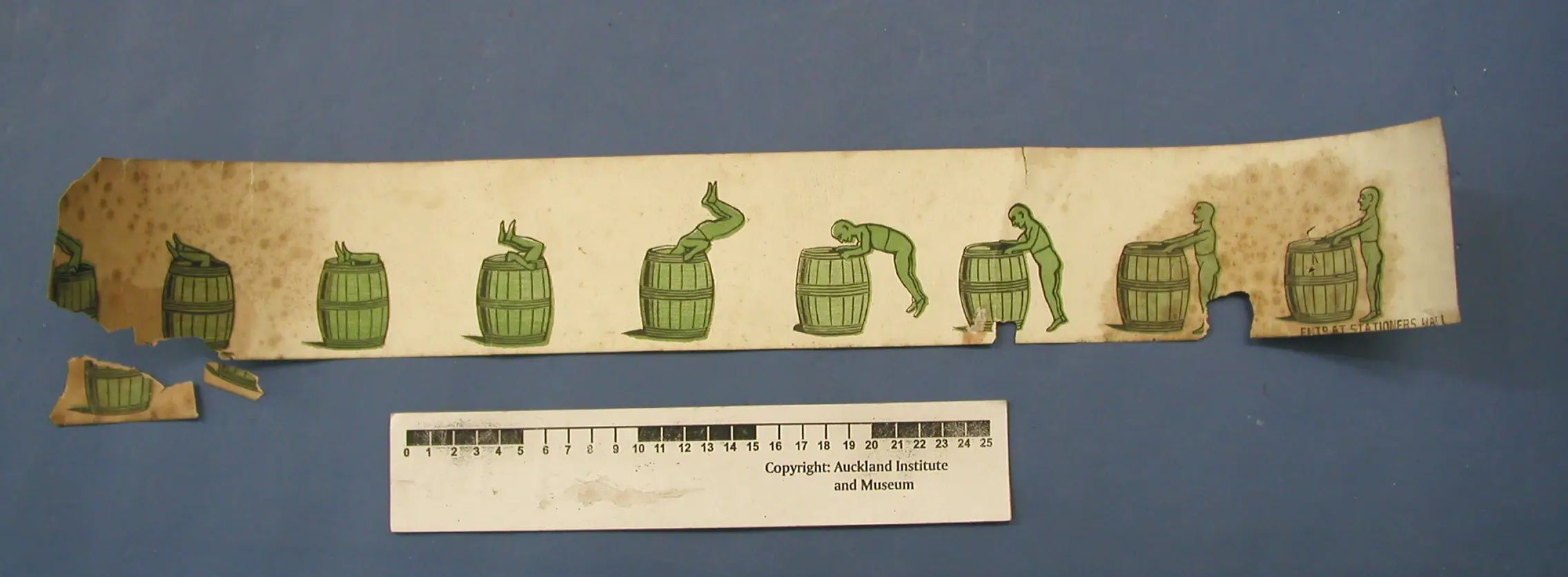
The slotted drum of a nineteenth-century zoetrope in Auckland Museum

A nineteenth-century zoetrope in Auckland Museum.

Auckland Museum

Licence: CC BY 4.0. Cropped to square source rectangle around the complete slotted cylinder; stand partly outside cover. Full original and full apparatus body image retained. Cover cropped for article cards and sharing.

View the original and source details
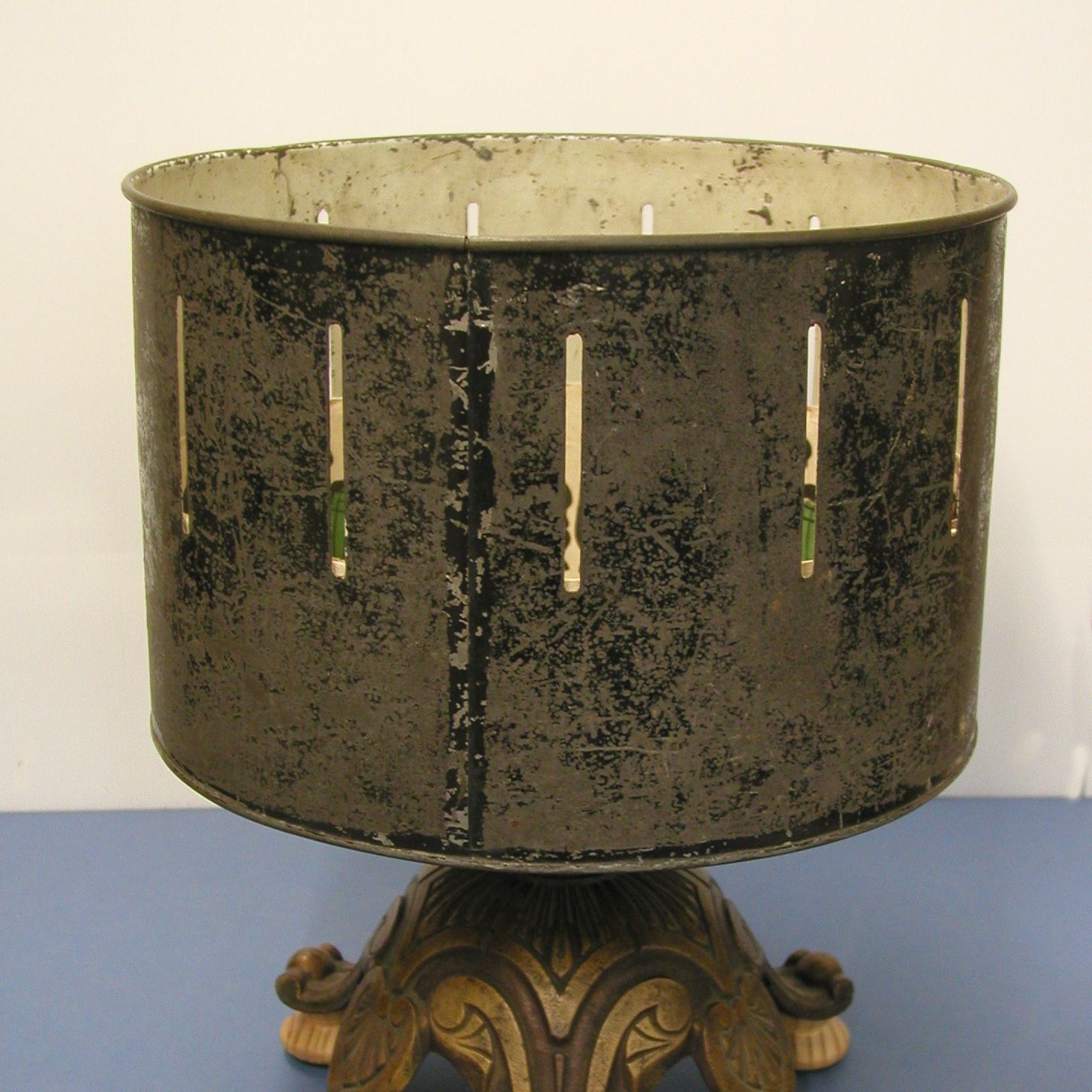
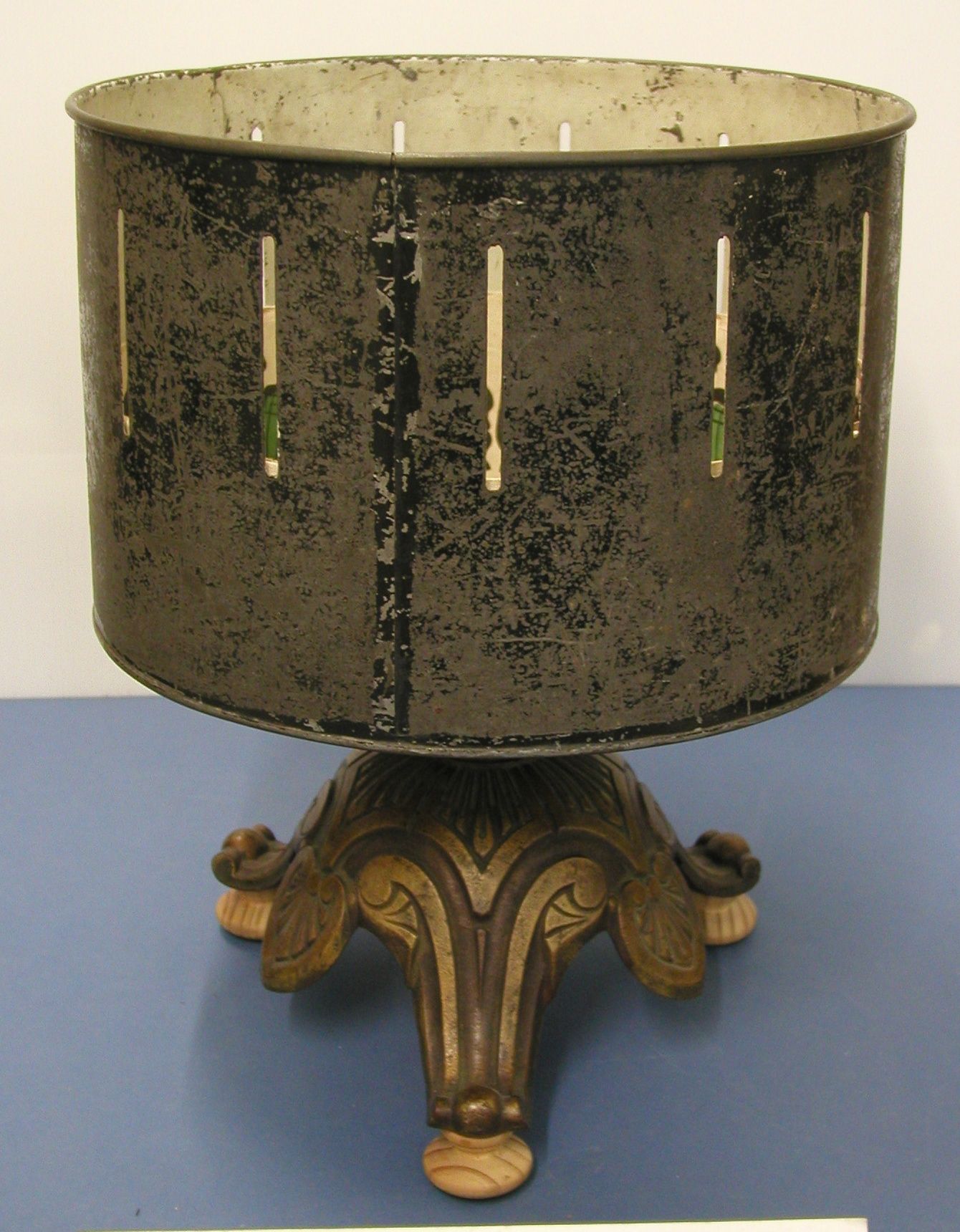
A weathered black zoetrope drum with narrow vertical slots, standing on an ornamental three-footed base

A nineteenth-century zoetrope in Auckland Museum. The narrow slots interrupt the viewer’s sight of the drawings inside.

Auckland Museum

Licence: CC BY 4.0. Background and measurement scale cropped; whole apparatus retained.

View the original and source details
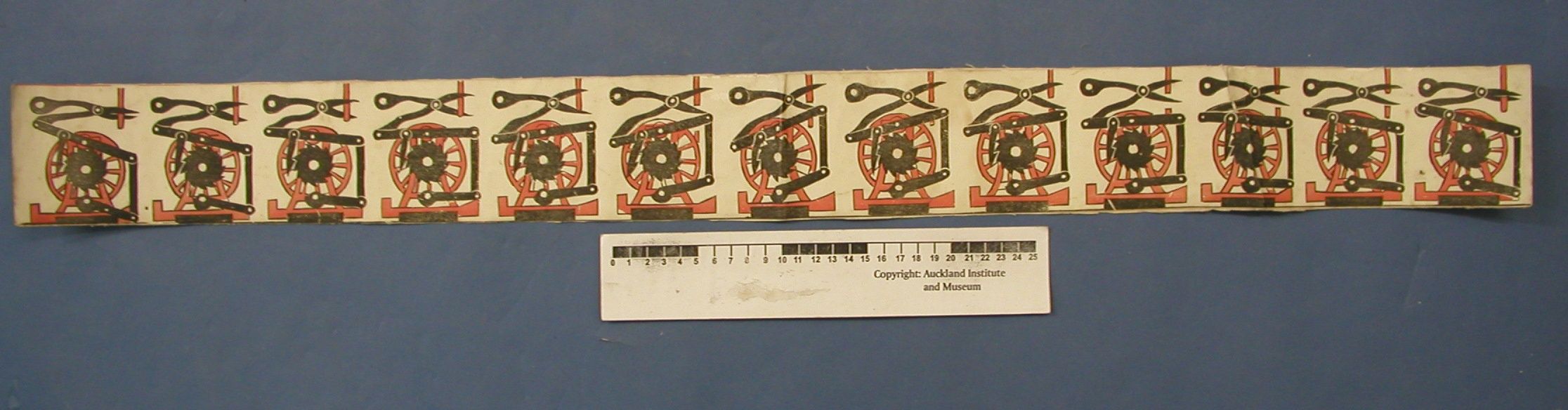
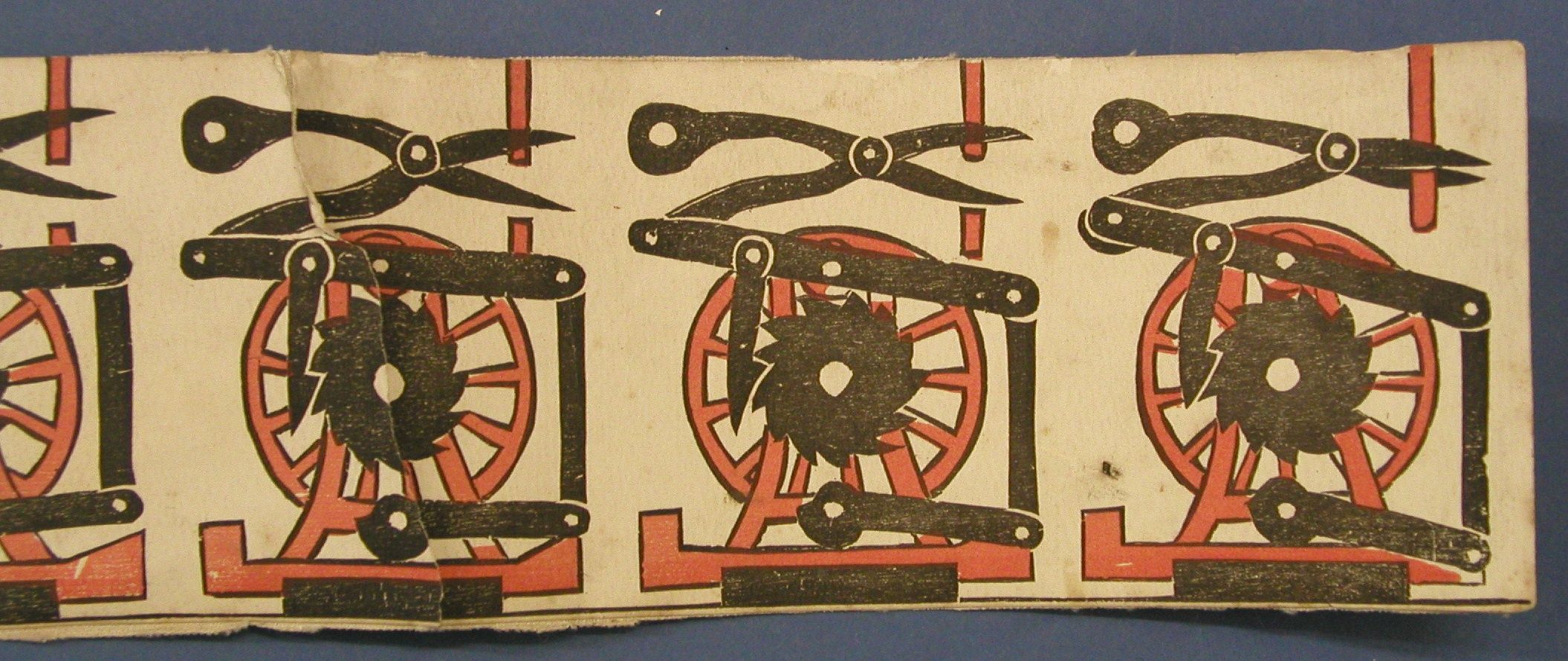
Thirteen successive drawings of a red and black machine, with a wheel, connecting rods and shears

A complete machinery sequence kept with the Auckland zoetrope. Thirteen drawings divide the action into successive positions.

Auckland Museum

Licence: CC BY 4.0. Full original museum photograph retained.

View the original and source details
Three successive machine drawings, with different wheel and rod positions and opening shears

A closer view of the machinery strip. The changes in the wheel, rods and blades must belong to the same action.

Auckland Museum

Licence: CC BY 4.0. Background trimmed from the original close-up; partial adjacent figure at left retained.

View the original and source details
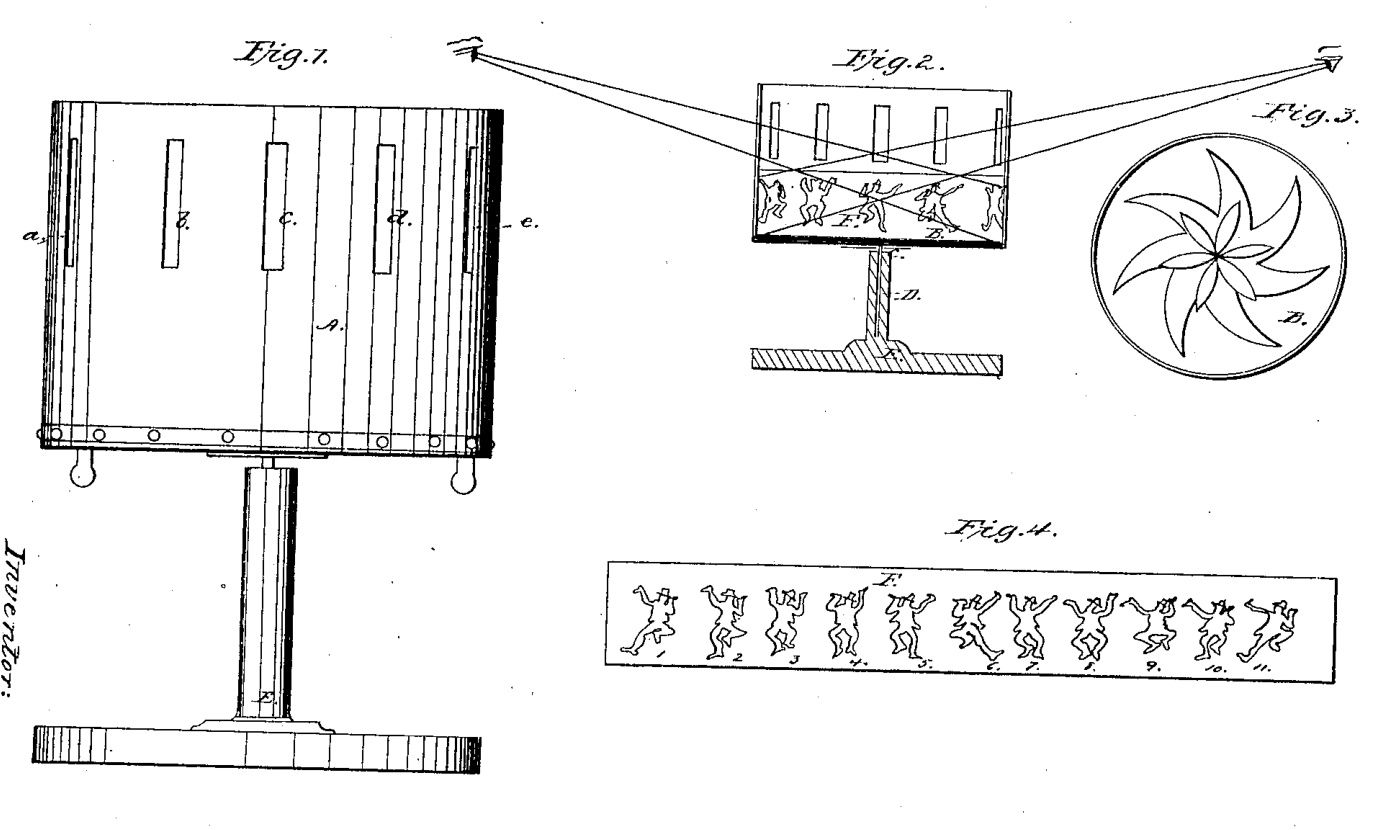
Lincoln’s patent drawings of a slotted drum, its central stand, a section through the viewer’s sight lines and a strip of dancing figures

Lincoln’s 1867 patent: the drum, its support, the viewing geometry and successive dancing figures.

United States Patent Office

Licence: Public domain. Figure area cropped from original patent sheet and rotated for reading; full source PDF retained.

View the original and source details
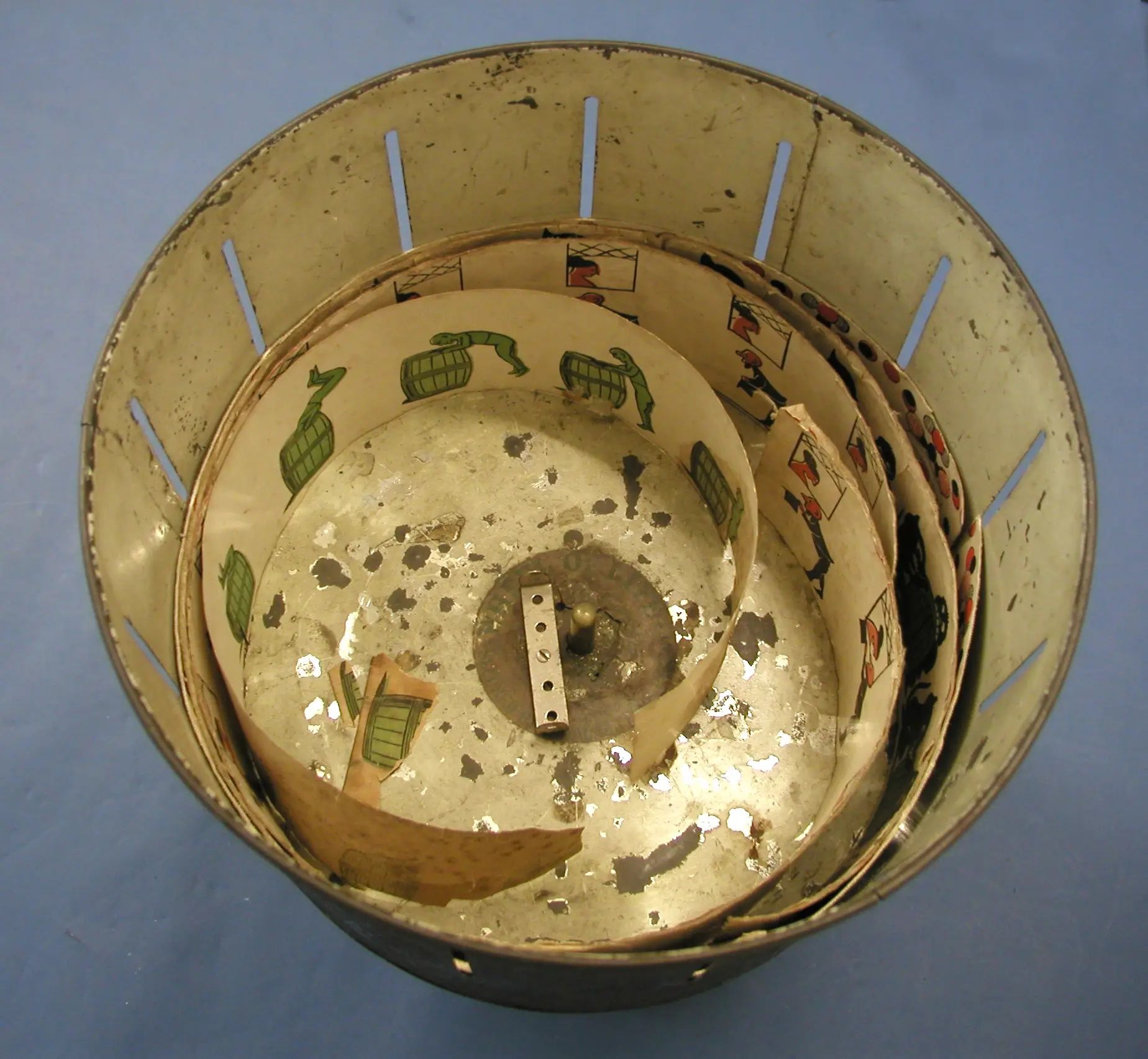
A view down into the slotted drum, with several picture strips loosely nested around its central pivot

Inside the Auckland drum, with several strips stored together. A strip used for viewing runs around the lower inner wall.

Auckland Museum

Licence: CC BY 4.0. Full original top-view photograph retained.

View the original and source details
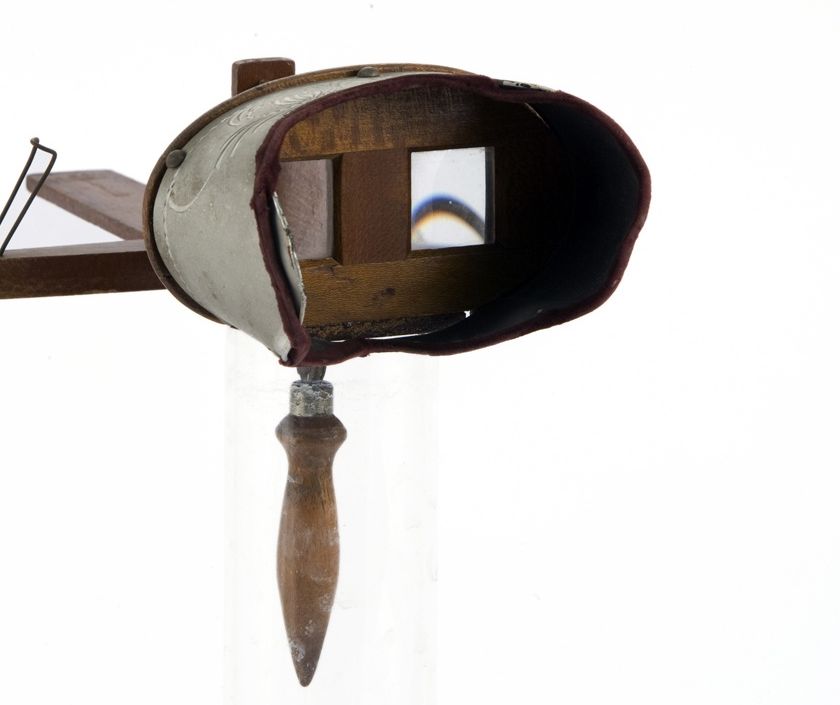
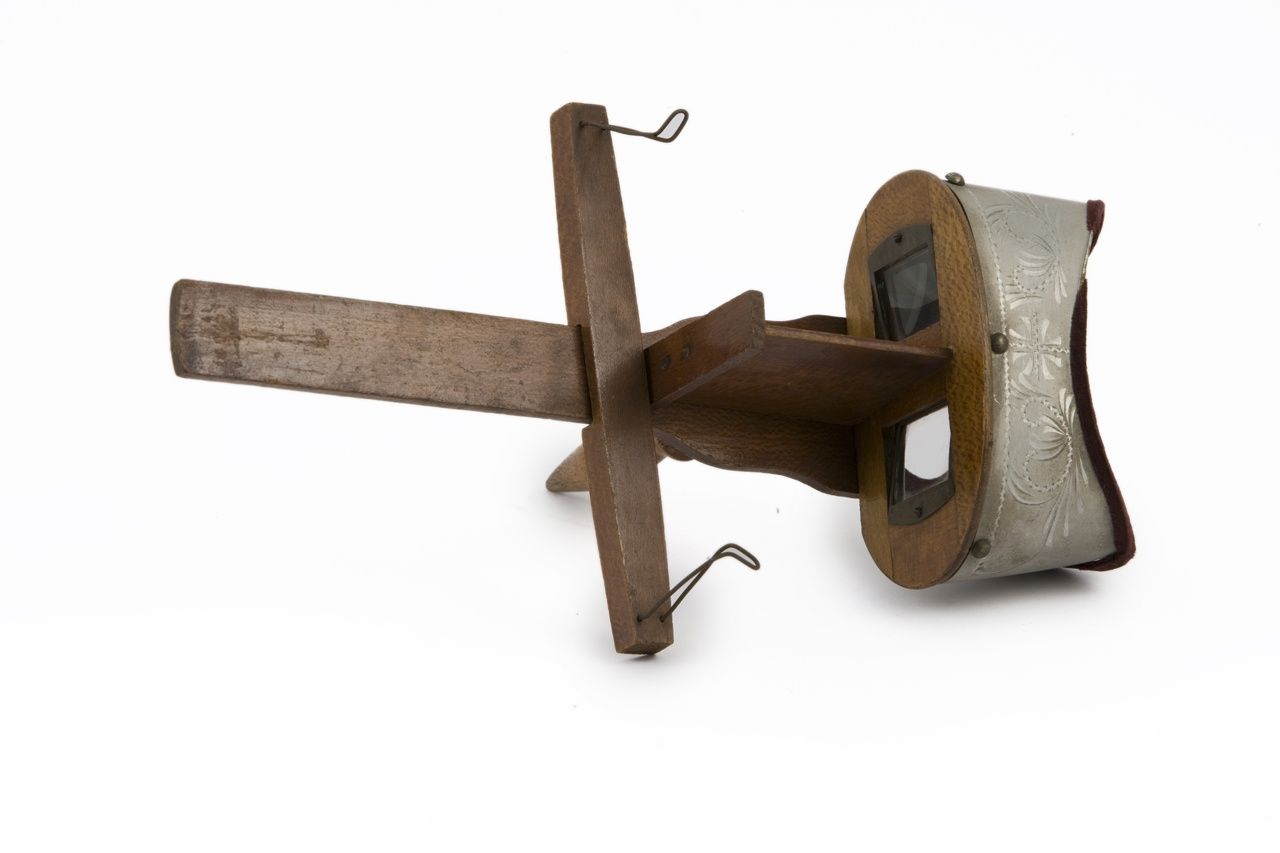
The hood, paired lenses and wooden handle of a handheld stereoscope

A handheld stereoscope from 1900–1910, in Milan’s science museum.

Museo Nazionale Scienza e Tecnologia Leonardo da Vinci, Milan

Licence: CC BY-SA 4.0. Cropped to the complete hood, paired lenses and handle for cards and sharing; original full photograph retained. Cover cropped for article cards and sharing.

View the original and source details
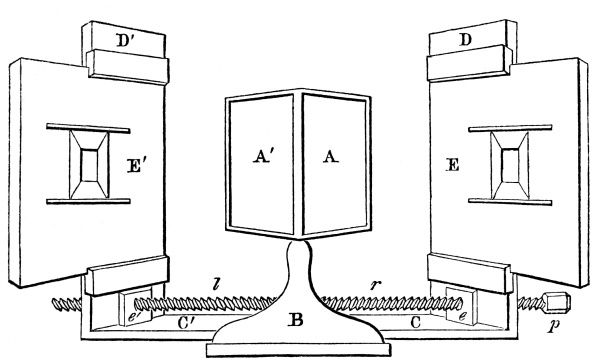
A mirror stereoscope with two central mirrors and picture panels on adjustable side supports

Wheatstone’s mirror arrangement, illustrated in Brewster’s 1856 book. The two pictures stand at the sides of the instrument.

The Stereoscope, 1856

Licence: Public domain. Complete original historical engraving retained.

View the original and source details
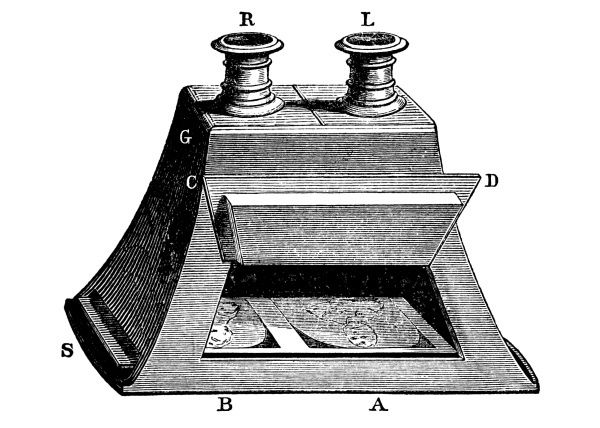
A box stereoscope with two eye tubes, a hinged lid and a slot for paired pictures

Brewster’s lenticular form, illustrated in the same book. The pictures sit together in front of the lenses, inside the box.

The Stereoscope, 1856

Licence: Public domain. Complete original historical engraving retained.

View the original and source details
A wooden handheld stereoscope seen from the card side, with two lenses, a central divider and a sliding crosspiece with clips

A handheld stereoscope from 1900–1910, seen from the card side. The crosspiece slides along the shaft to focus the view.

Museo Nazionale Scienza e Tecnologia Leonardo da Vinci, Milan

Licence: CC BY-SA 4.0. Complete museum photograph retained.

View the original and source details
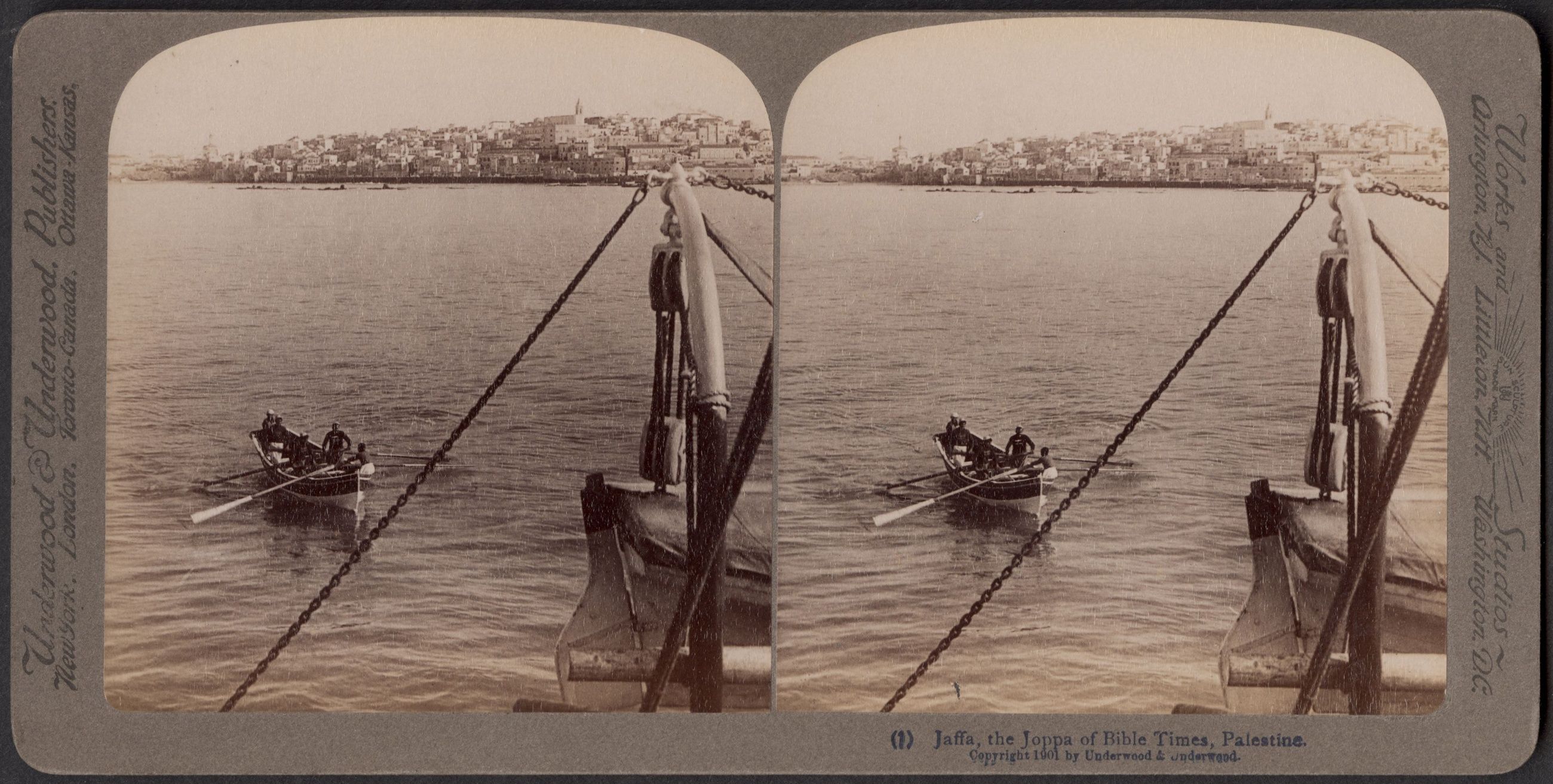
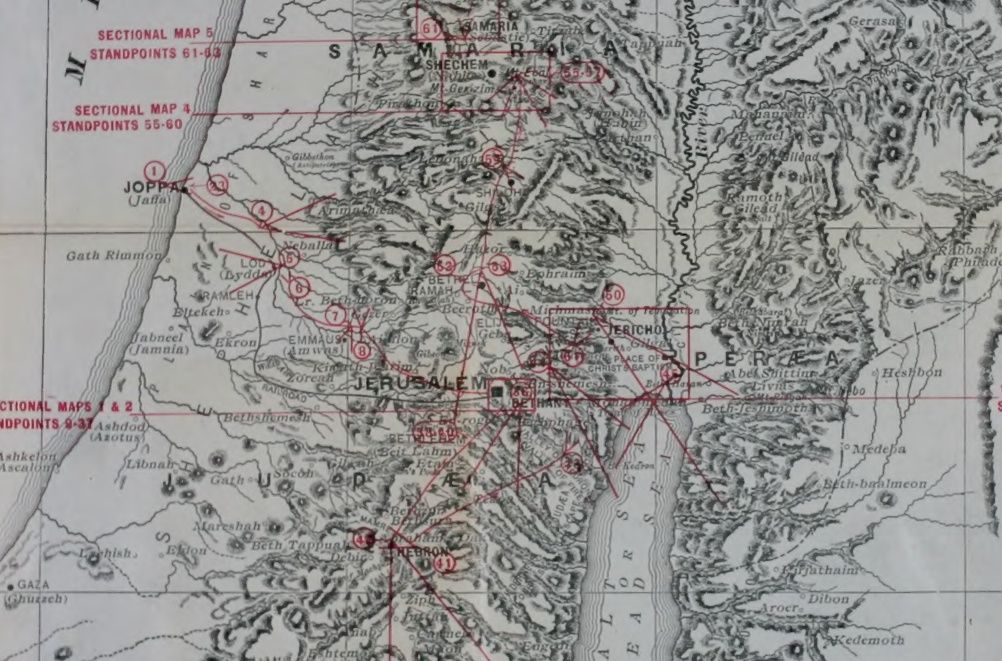
A section of the tour map showing numbered red viewpoints at Jaffa and along the route towards Jerusalem

Part of the tour’s general map. The red viewpoint numbered 1 lies offshore at Jaffa; the route continues inland towards Jerusalem.

Underwood & Underwood / University of Toronto Libraries

Licence: Public domain. Section cropped from the southern scan of Map 7; original PDF and full scan part retained.

View the original and source details
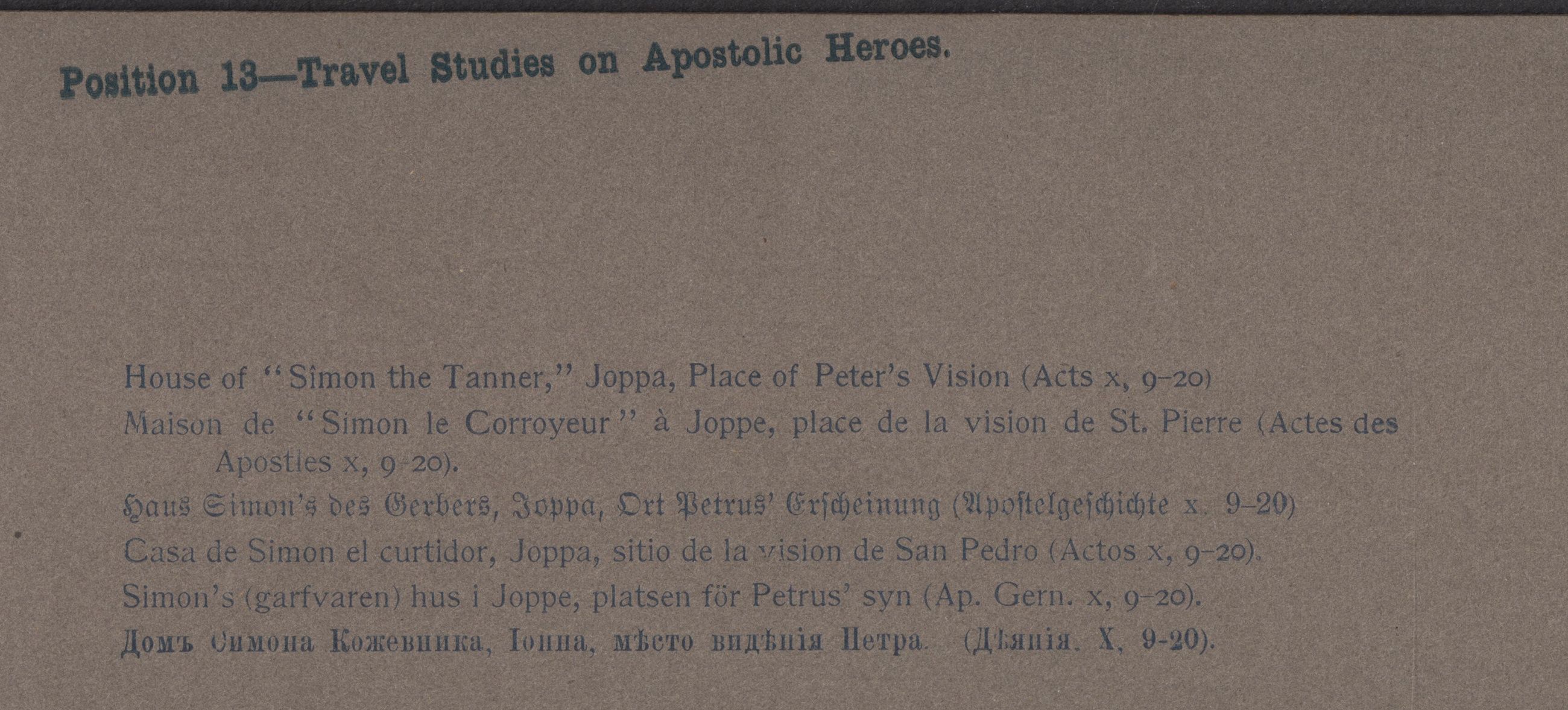
The reverse of the same card, headed Position 13—Travel Studies on Apostolic Heroes, with the title in six languages

The same card’s reverse assigns it another position in a different series. The title appears in English, French, German, Spanish, Swedish and Russian.

Underwood & Underwood / Boston Public Library

Licence: Public domain (United States). Empty card margins trimmed; all printed title and six-language text retained. Full original reverse preserved.

View the original and source details
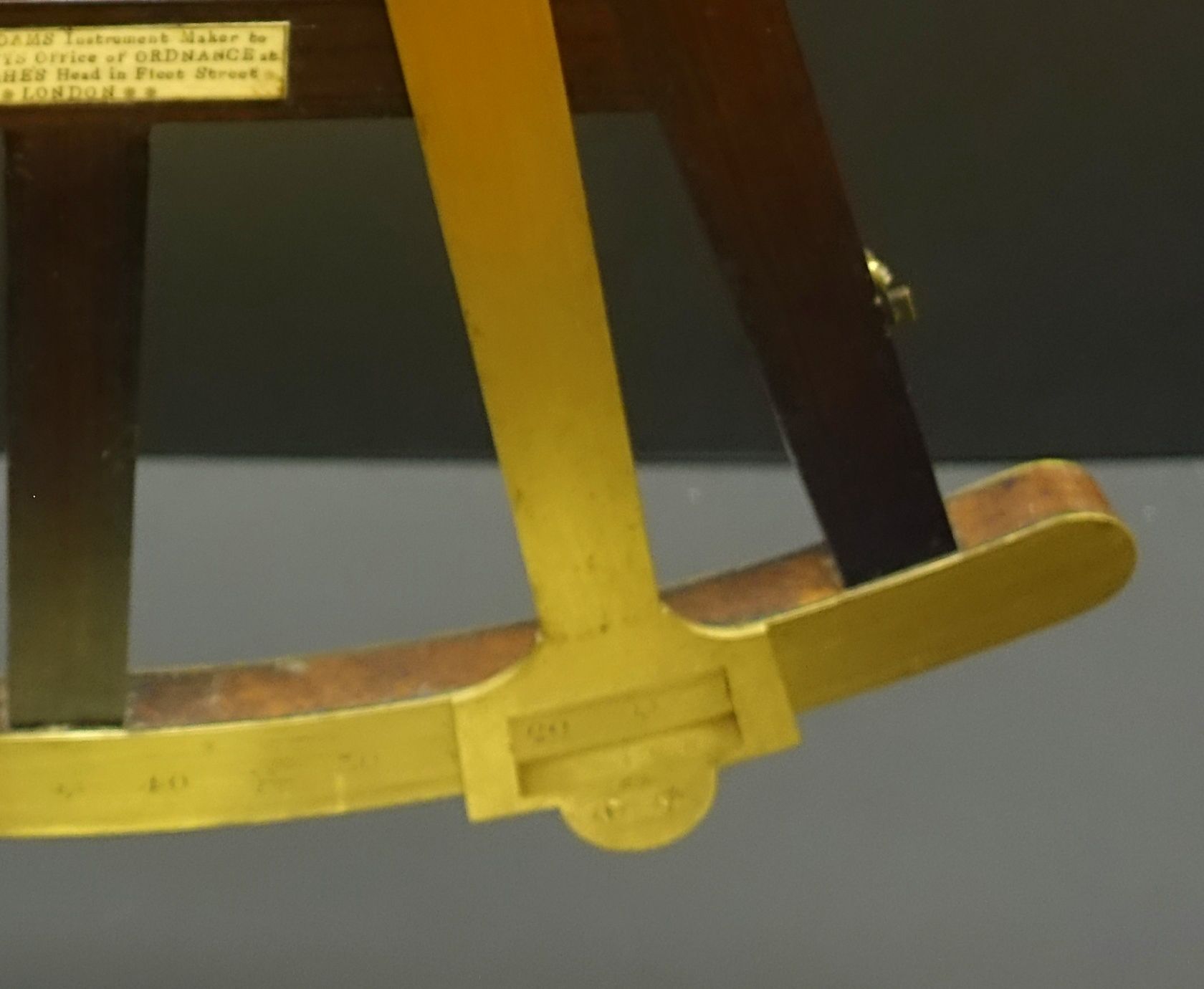
The curved reading scale and brass index arm of a wooden-framed octant

Reading arc and index arm of an octant signed George Adams, London.

Daderot / Museu da Ciência da Universidade de Coimbra

Licence: CC0. Cropped to the lower index arm and reading scale for cards and sharing; full original retained. Cover cropped for article cards and sharing.

View the original and source details
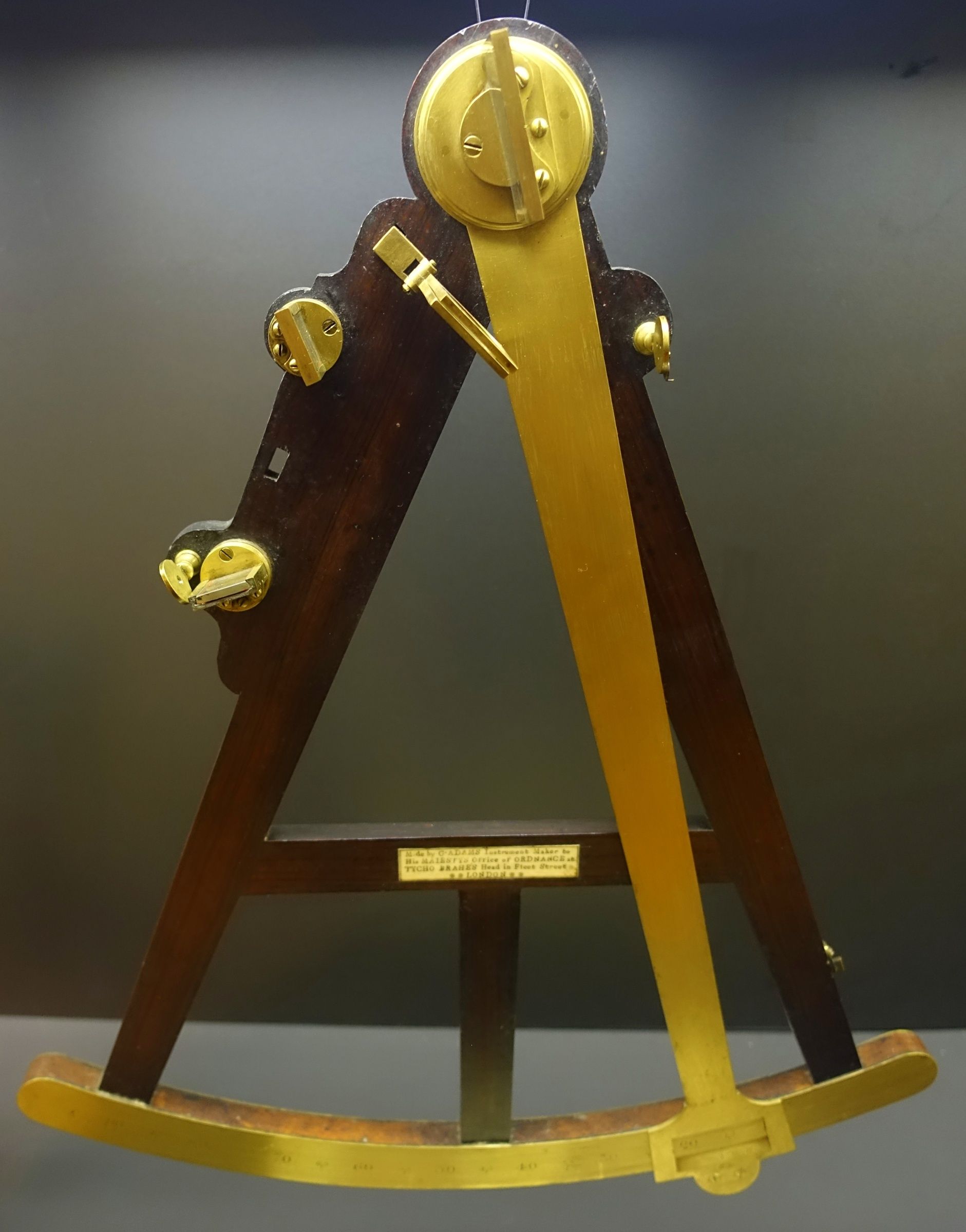
A wooden-framed octant with a brass index arm crossing its triangular opening and curved lower scale

An octant signed George Adams, London, in Coimbra’s science museum. The index arm pivots at the top of the frame and moves along the lower arc.

Daderot / Museu da Ciência da Universidade de Coimbra

Licence: CC0. Background margins trimmed.

View the original and source details
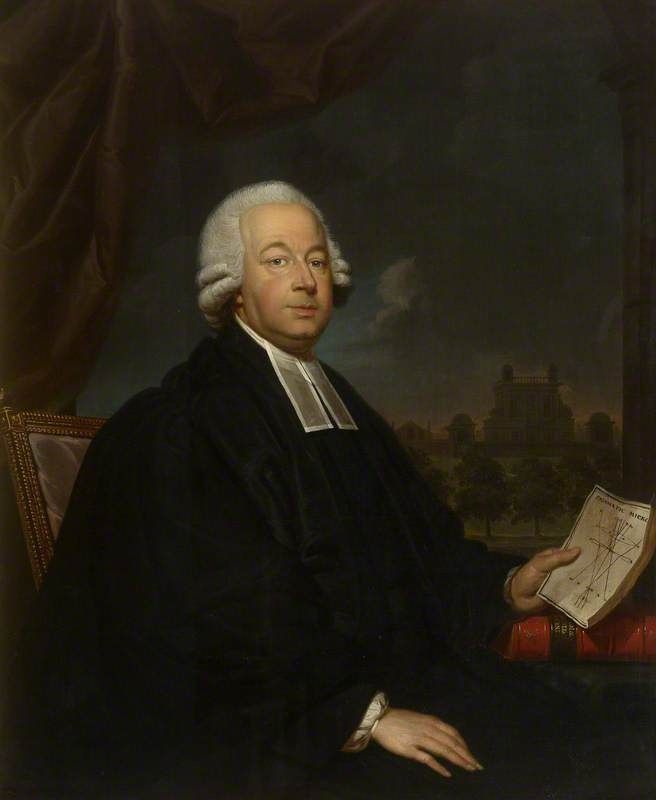
Nevil Maskelyne seated in clerical dress, holding an astronomical diagram

Nevil Maskelyne in 1785, painted by Gerard van der Puyl. The portrait dates from his later career as Astronomer Royal.

Gerard van der Puyl / The Royal Society

Licence: Public domain. Faithful painting reproduction retained.

View the original and source details
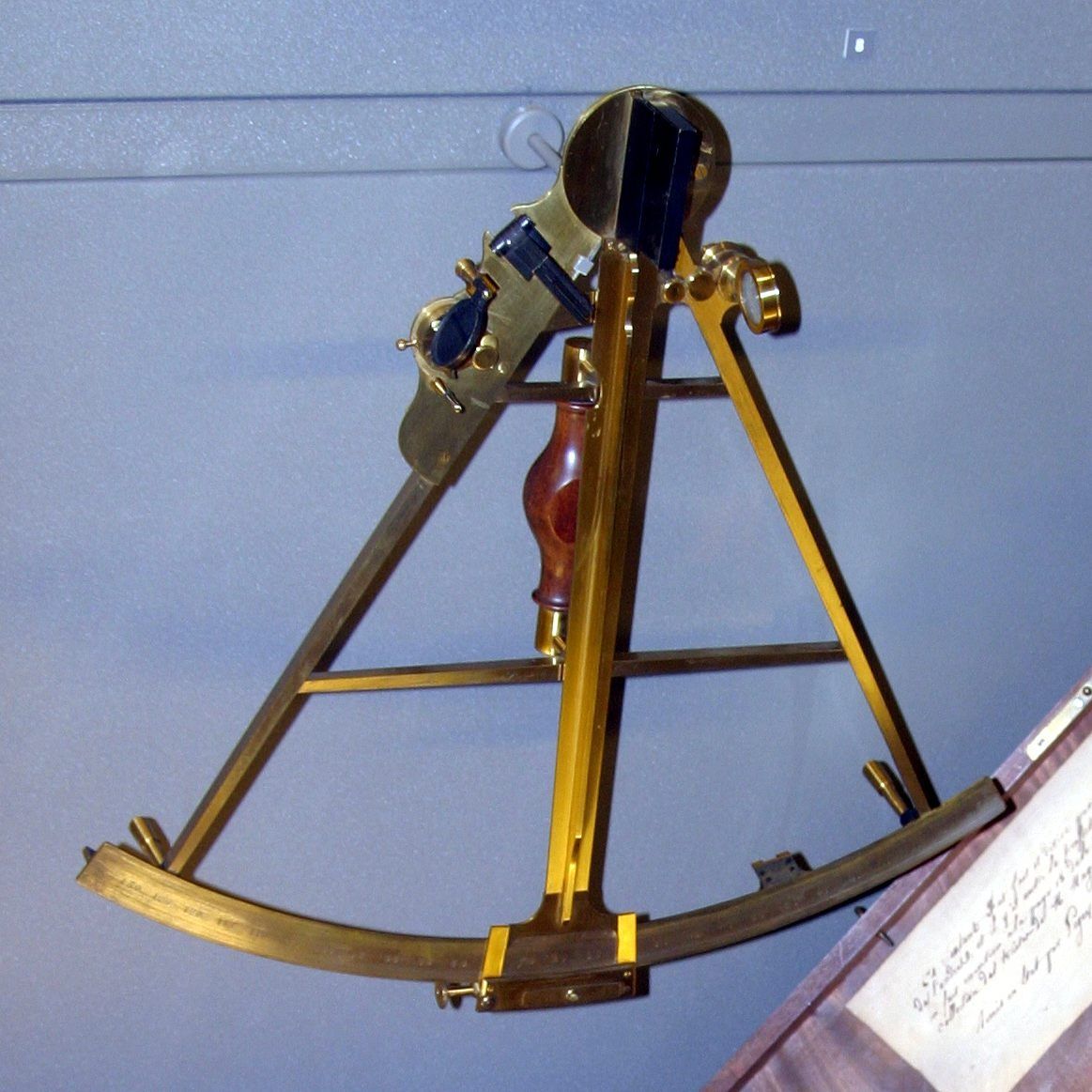
A brass sextant with mirrors and sights above an open frame, a wooden handle and a curved reading scale

A Ramsden sextant from 1775–1800, at the Musée des Arts et Métiers in Paris. Its wider arc belongs to the later instrument family; it is not the quadrant used on Maskelyne’s voyage.

Rama / Musée des Arts et Métiers

Licence: CC BY-SA 2.0 France. Complete original photograph retained.

View the original and source details
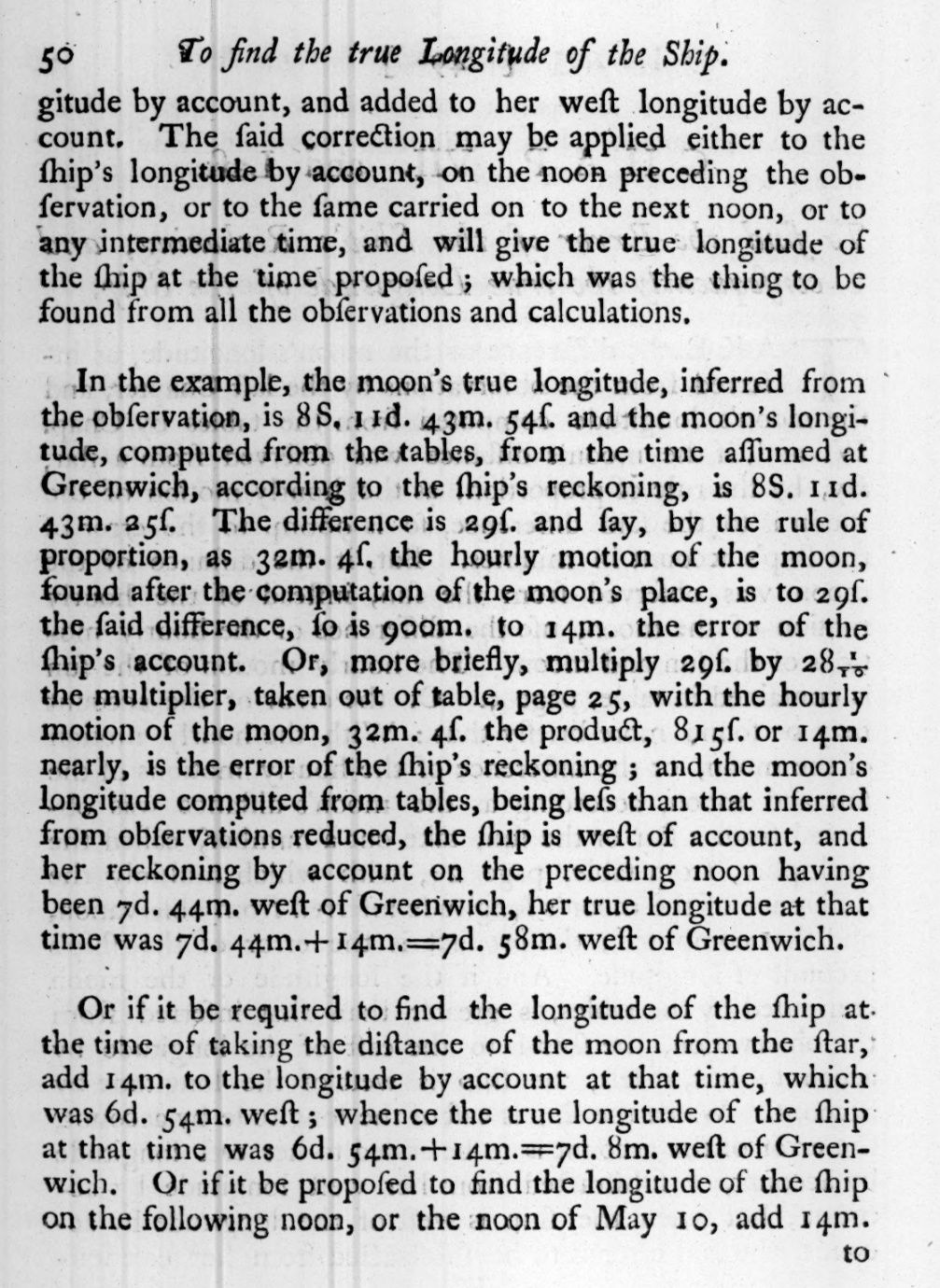
A passage in Maskelyne’s printed guide adding fourteen minutes to the ship’s dead-reckoned longitude

The worked result in Maskelyne’s 1763 guide: fourteen minutes added to the ship’s reckoning at the time of the observation.

The British Mariner’s Guide / Internet Archive

Licence: Public domain. Blank scan margins trimmed from printed page 50; text unchanged.

View the original and source details
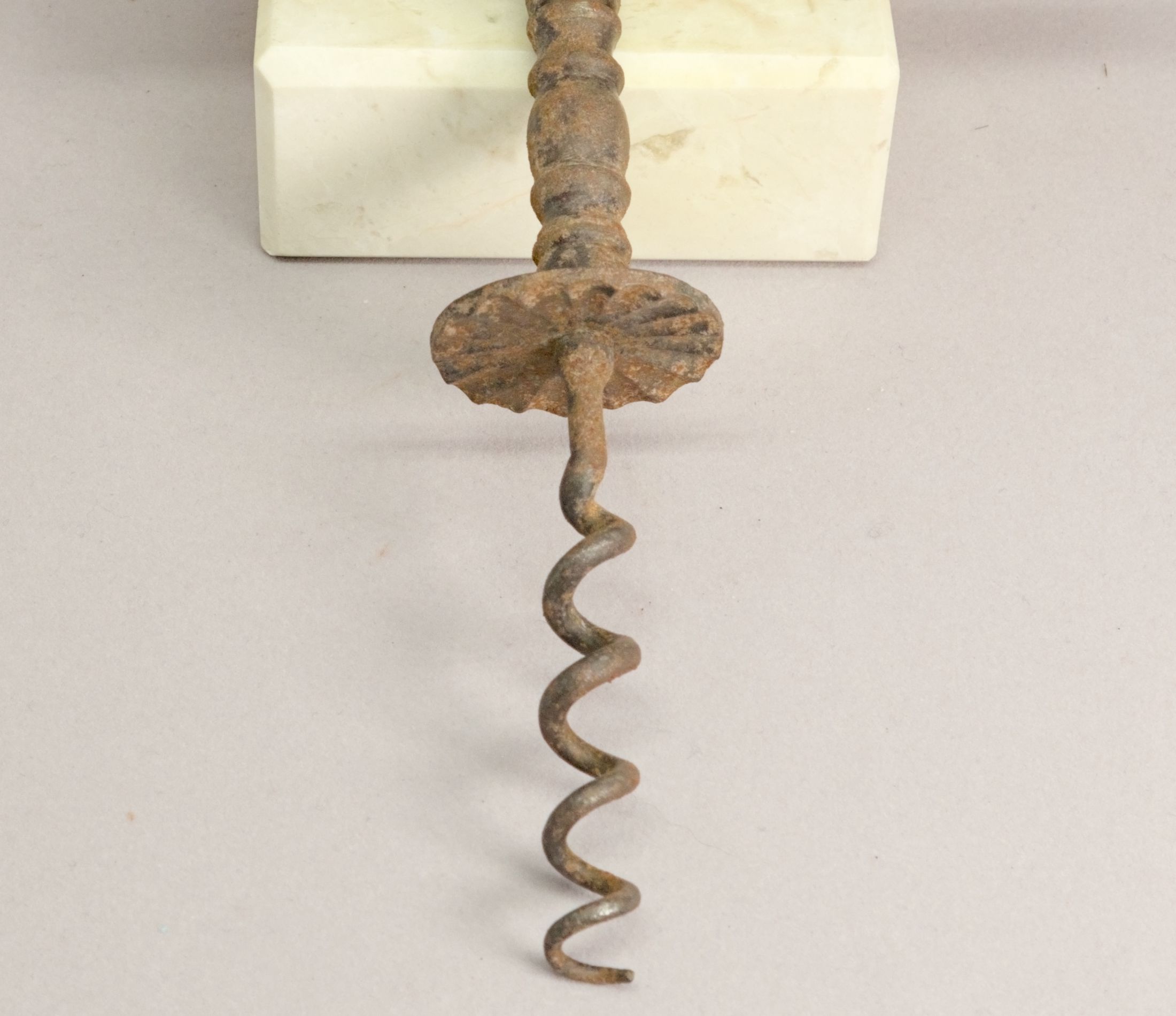
Serrated button and spiral worm on a Henshall-type corkscrew

A Henshall-type corkscrew, early nineteenth century.

Lambertalia / Musée de la Gourmandise

Licence: CC BY-SA 4.0. JPEG prepared from the original TIFF. Cropped to the button and worm for article cards and sharing. Cover cropped for article cards and sharing.

View the original and source details
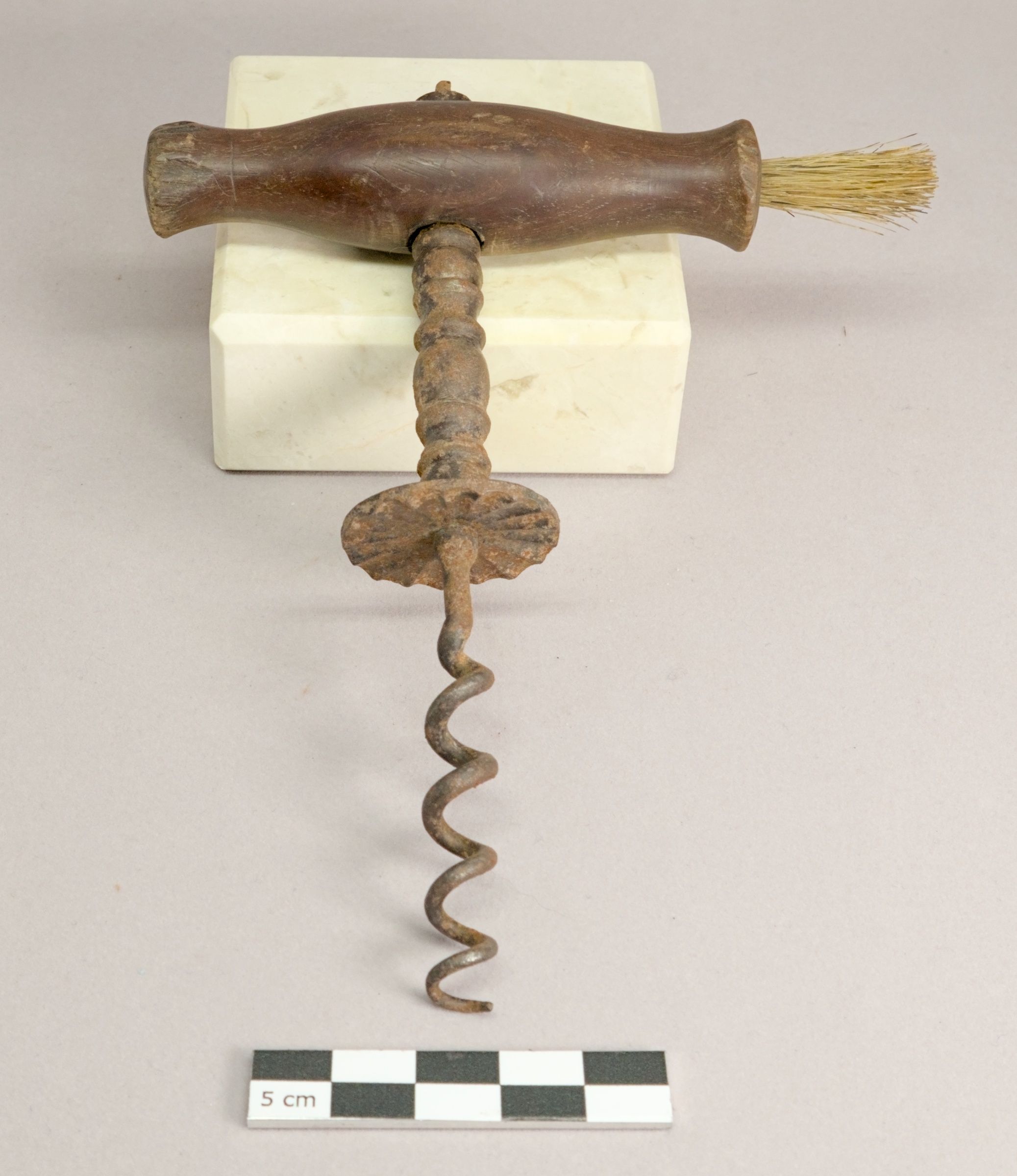
A wooden-handled corkscrew with a serrated disc above its open spiral and a brush at one end

A Henshall-type corkscrew from the early nineteenth century. A serrated button sits above the worm; the handle carries a brush of pig bristles.

Lambertalia / Musée de la Gourmandise

Licence: CC BY-SA 4.0. Blank background trimmed; JPEG prepared from the original TIFF.

View the original and source details
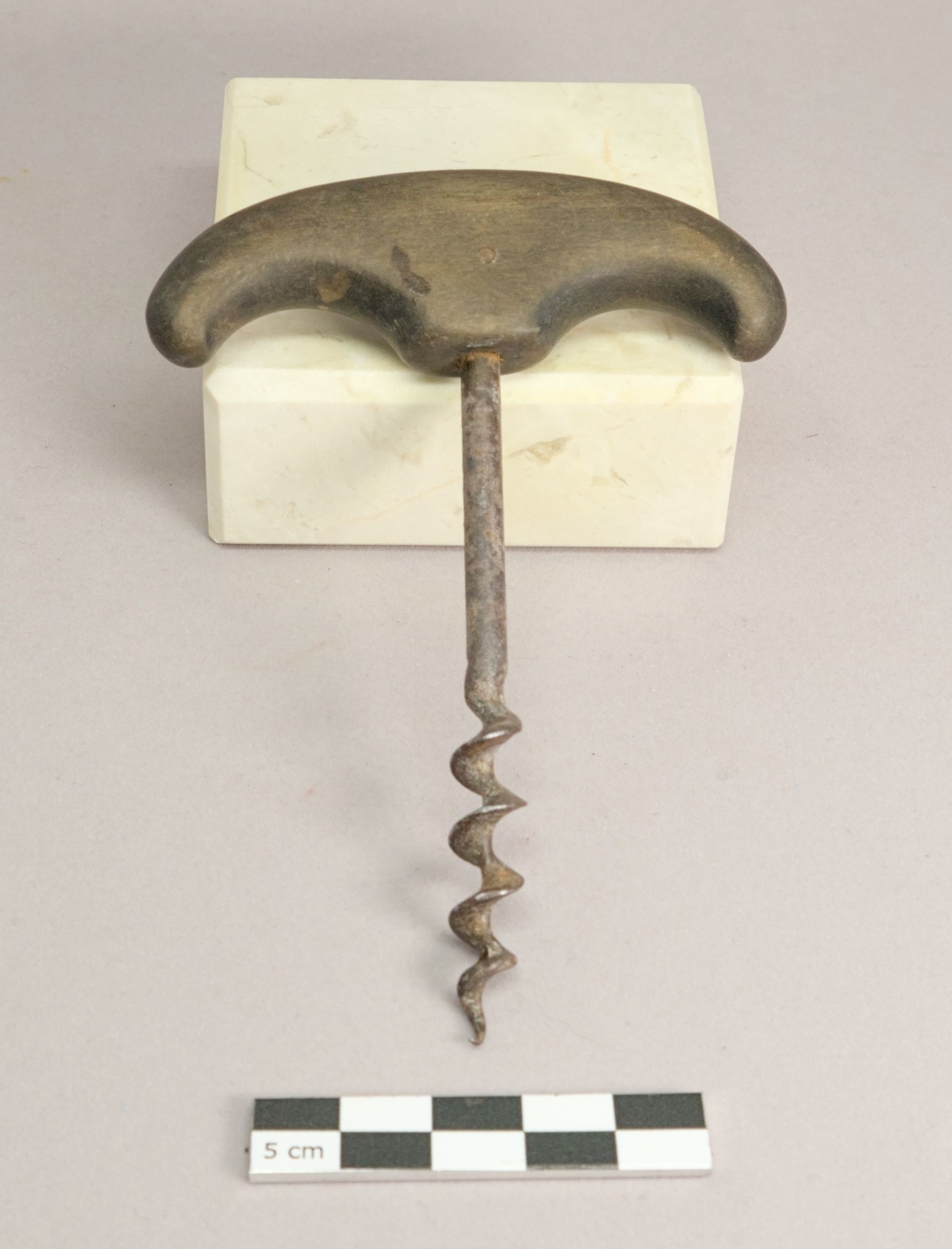
A T-shaped corkscrew with a curved handle, plain shaft and solid spiral screw

A simple T corkscrew with a shaped two-finger grip. Without a stop above the worm, the user decides when to finish turning and begin pulling.

Lambertalia / Musée de la Gourmandise

Licence: CC BY-SA 4.0. Blank background trimmed; JPEG prepared from the original TIFF.

View the original and source details
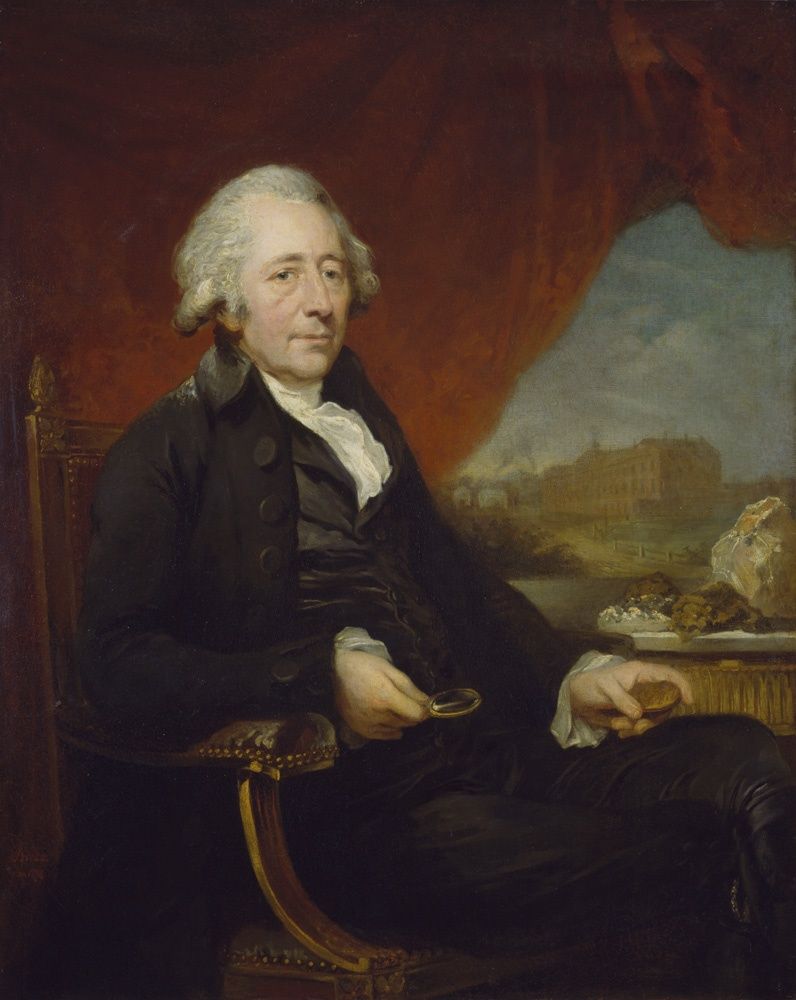
Matthew Boulton seated in a dark coat, holding a small object in each hand

Matthew Boulton, painted by Carl Frederik von Breda. His Soho manufactory made Henshall’s corkscrews.

Carl Frederik von Breda / Birmingham Museums Trust

Licence: Public domain. Complete faithful reproduction retained.

View the original and source details
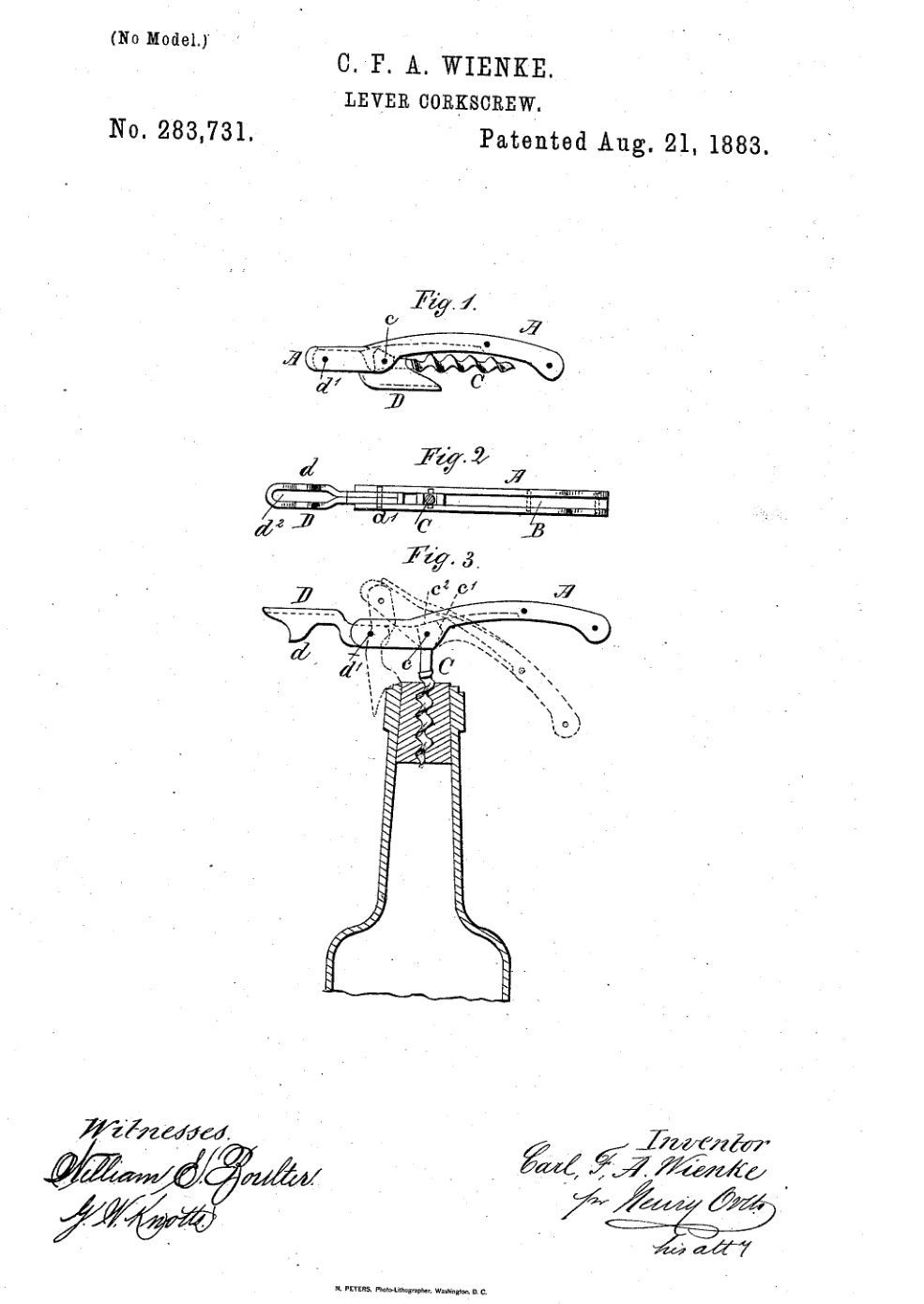
Wienke’s patent drawing of a folding lever corkscrew, including a section through a bottle neck

Carl Friedrich Albert Wienke’s 1883 US patent. In the lower drawing, the folding arm rests on the bottle rim while the handle raises the cork.

United States Patent Office

Licence: Public domain. Surrounding margins cropped from the original patent drawing.

View the original and source details
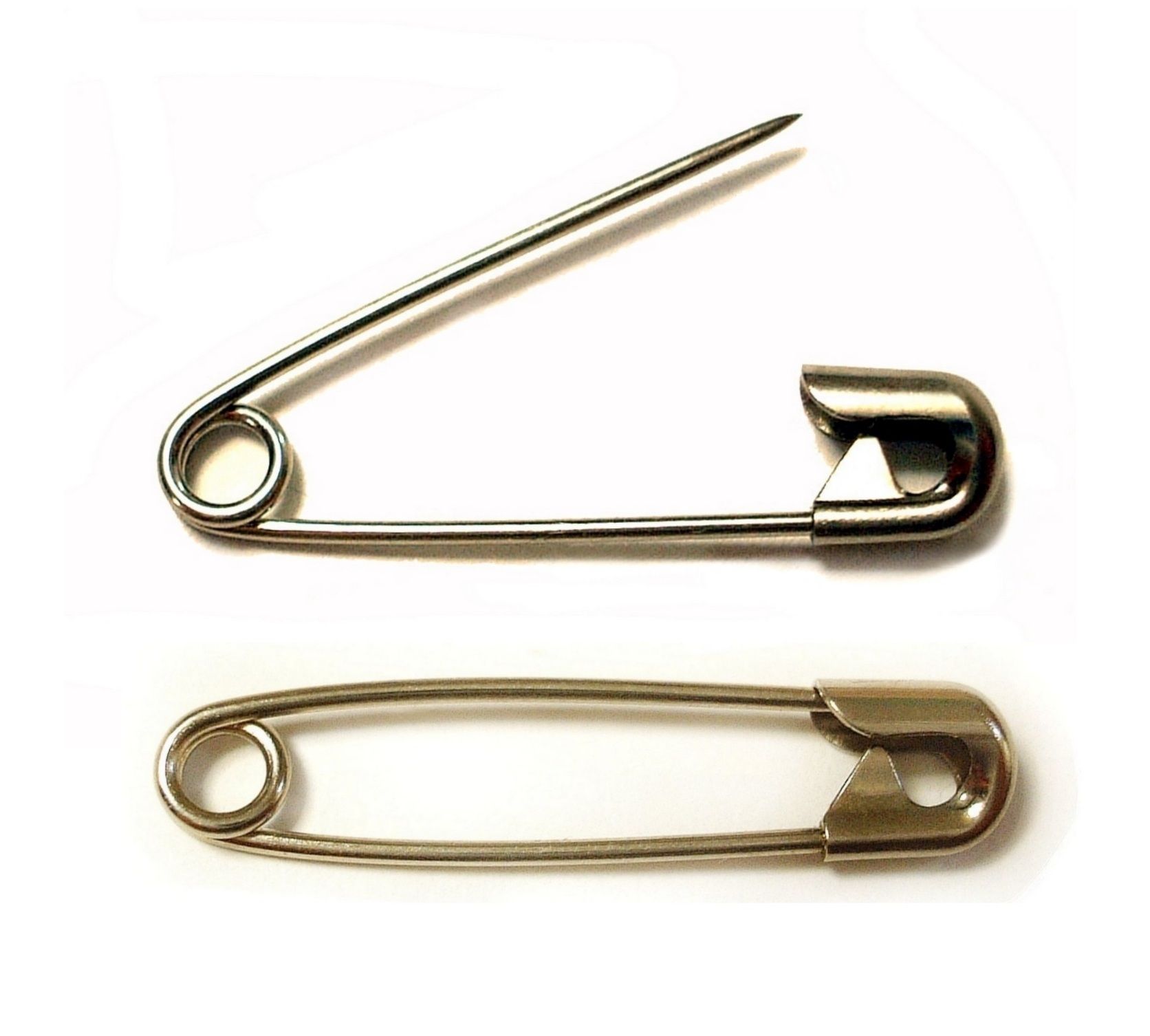
An open safety pin above a closed one

A modern safety pin open and closed.

Haragayato; arrangement: VladiMens

Licence: CC BY-SA 3.0. Complete arrangement retained in separate cover asset; no additional crop. Cover cropped for article cards and sharing.

View the original and source details
Open and closed modern safety pins, with a coil at one end and a metal cap at the other

A modern safety pin in its open and closed positions. The protective cap is a separate piece of metal.

Haragayato; arrangement: VladiMens

Licence: CC BY-SA 3.0. Original arrangement retained; JPEG prepared for publication.

View the original and source details
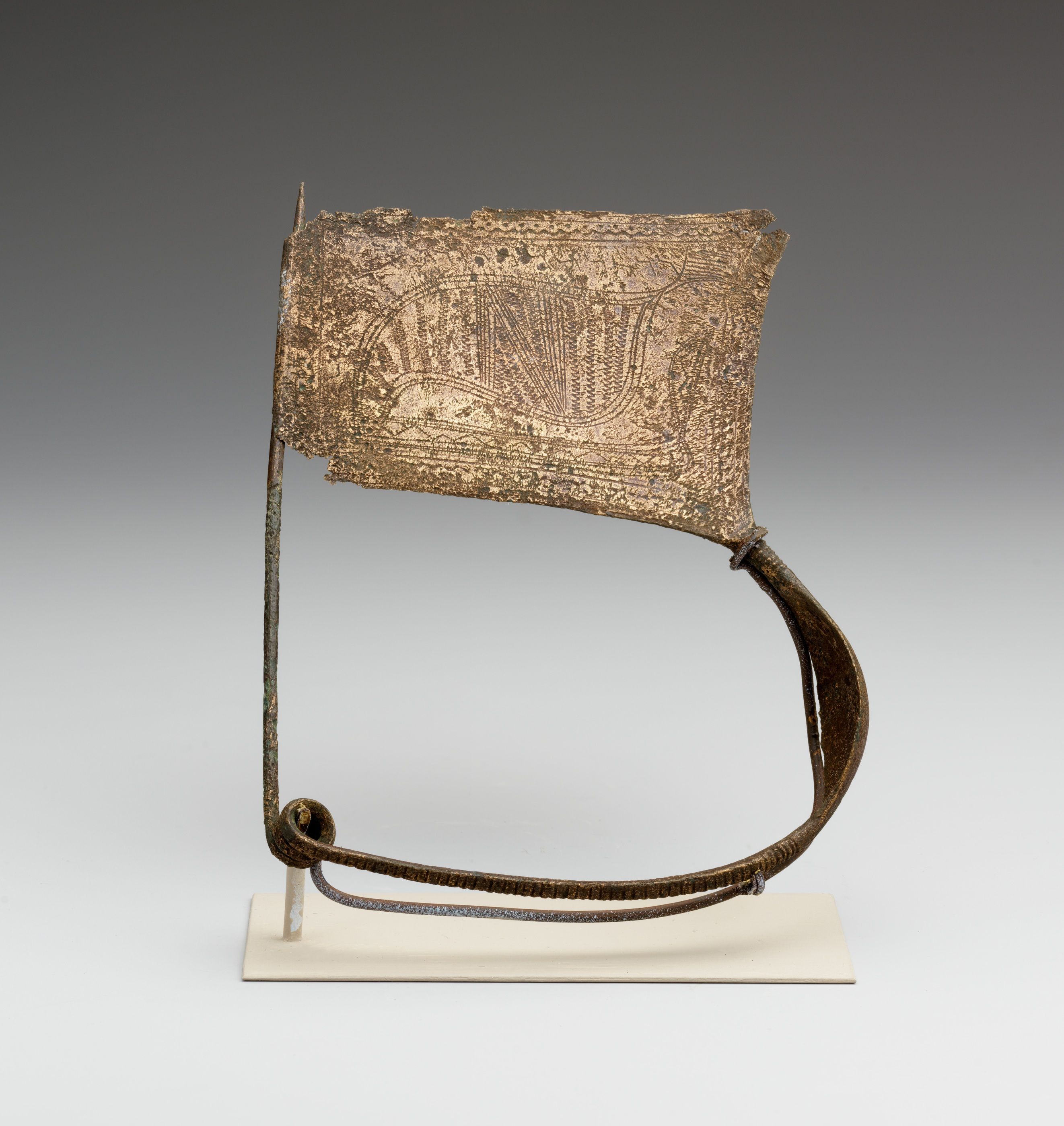
An ancient bronze clothing fastener with a coiled pin and a broad catch plate engraved with a bird

A Greek, Boeotian bronze fibula, late eighth–seventh century BCE. Its decorated catch plate carries an incised bird.

The Metropolitan Museum of Art

Licence: CC0. Resized to 2645×2800; full original retained.

View the original and source details
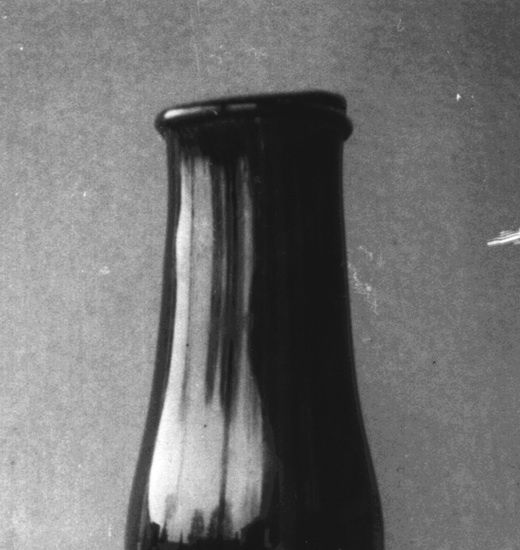
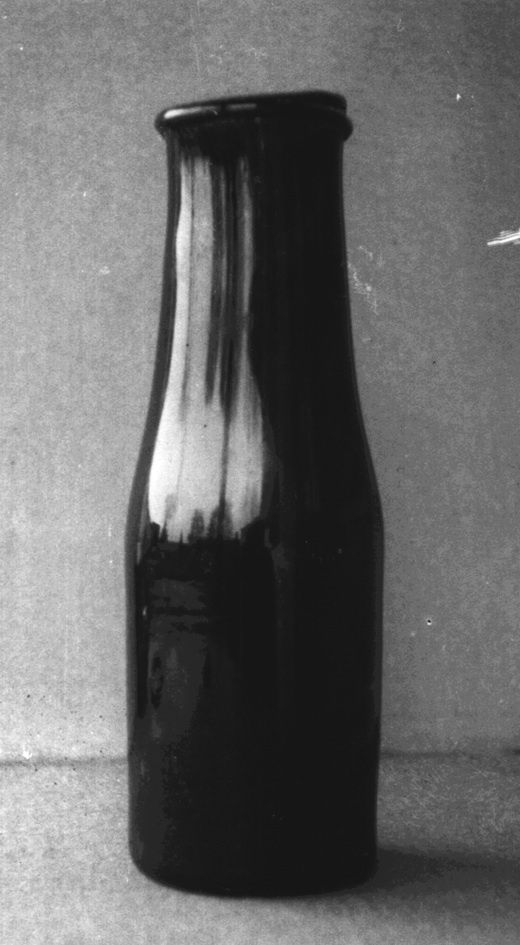
The lip and neck of a dark glass preserving bottle

The neck of a preserving bottle from Appert’s time.

Jean-Paul Barbier

Licence: CC BY-SA 3.0. Separate cover crop: rectangle 0,0,520,550; complete original preserved. Cover cropped for article cards and sharing.

View the original and source details
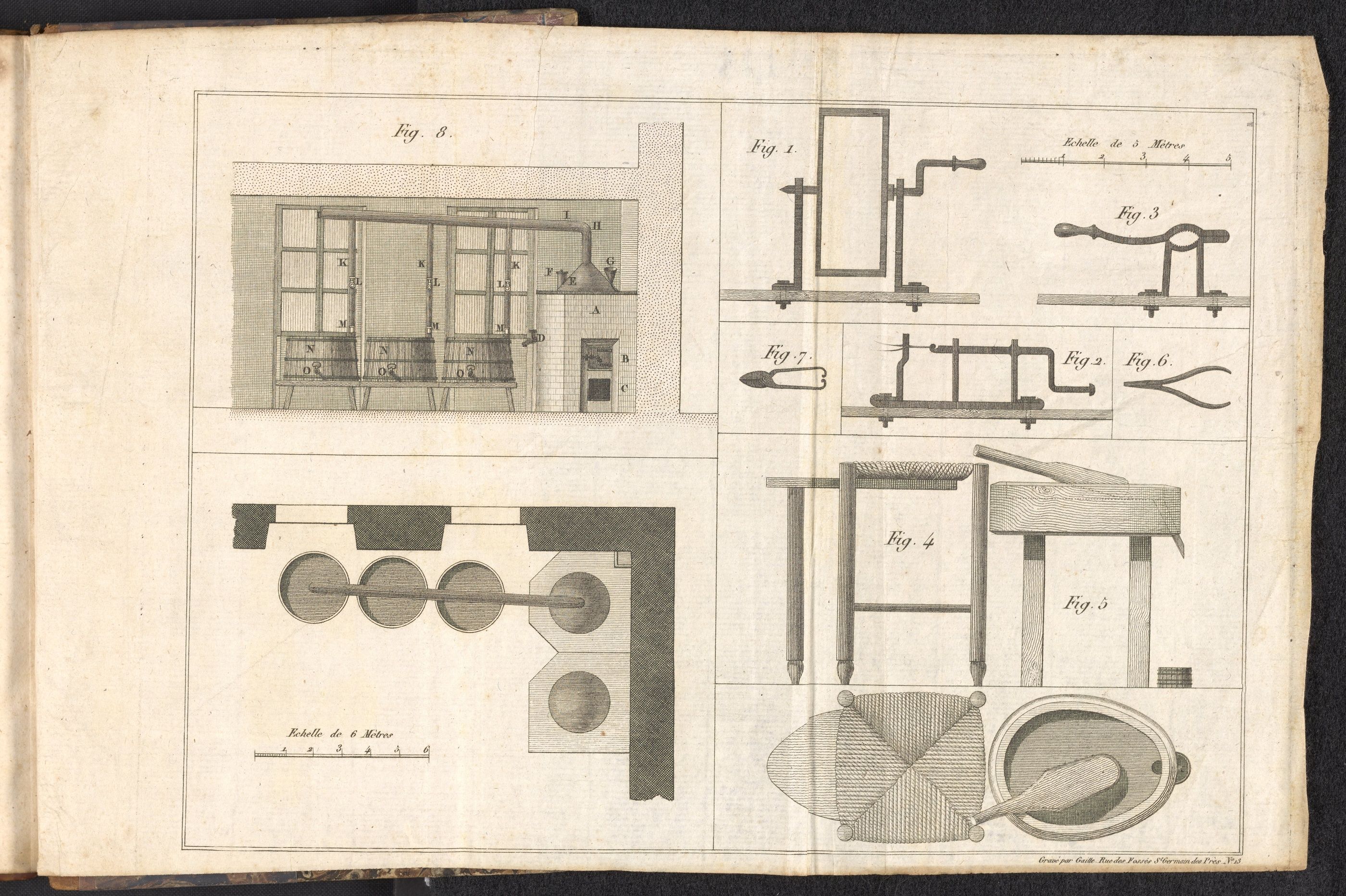
Appert’s 1813 foldout, with drawings of corking tools, stools and a heating installation

The foldout in Appert’s 1813 edition brings corking tools and a heating installation onto one sheet.

Antoine-Joseph Gaitte / Courtesy of Science History Institute

Licence: Public domain. Resized; full original preserved.

View the original and source details
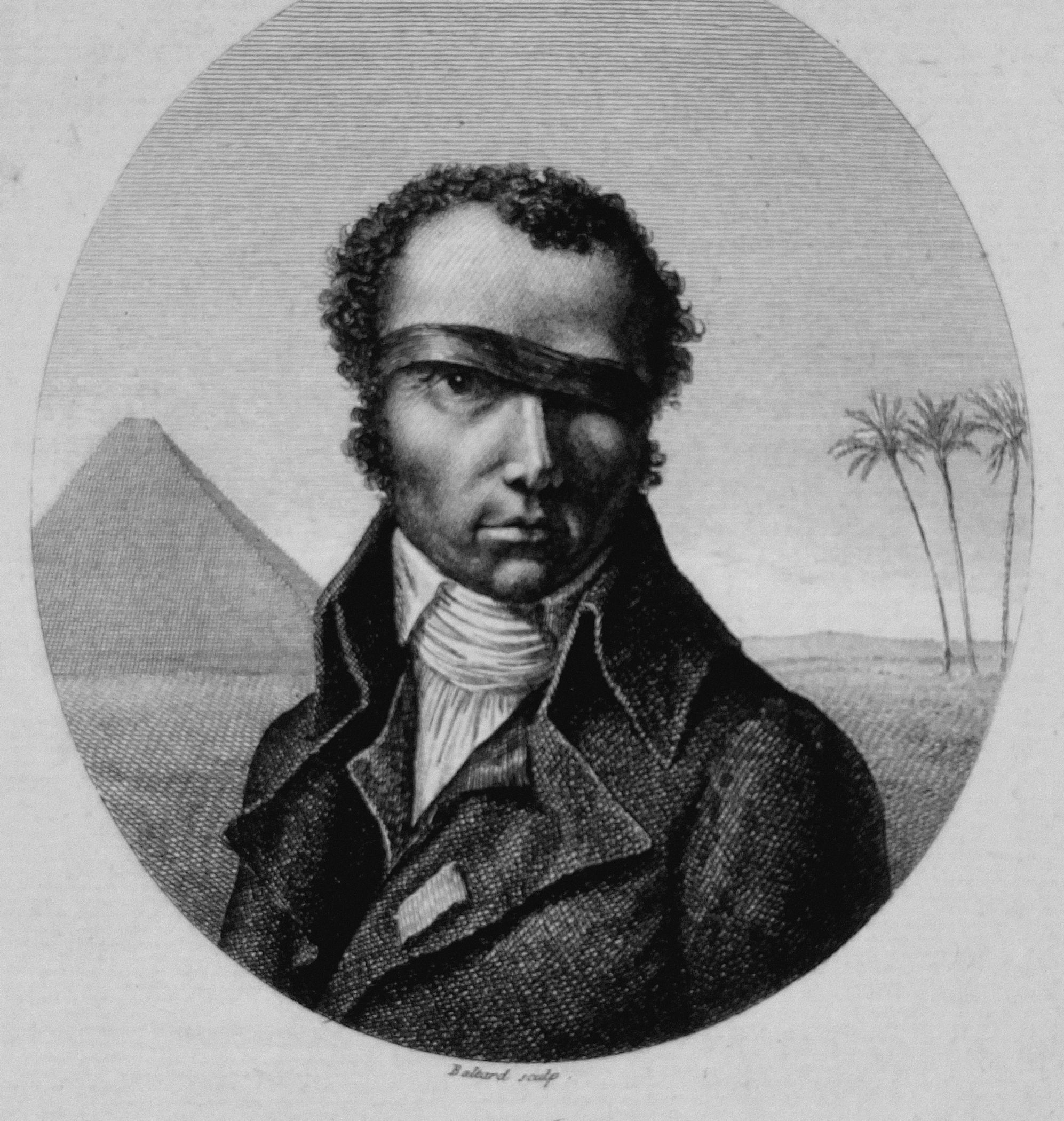
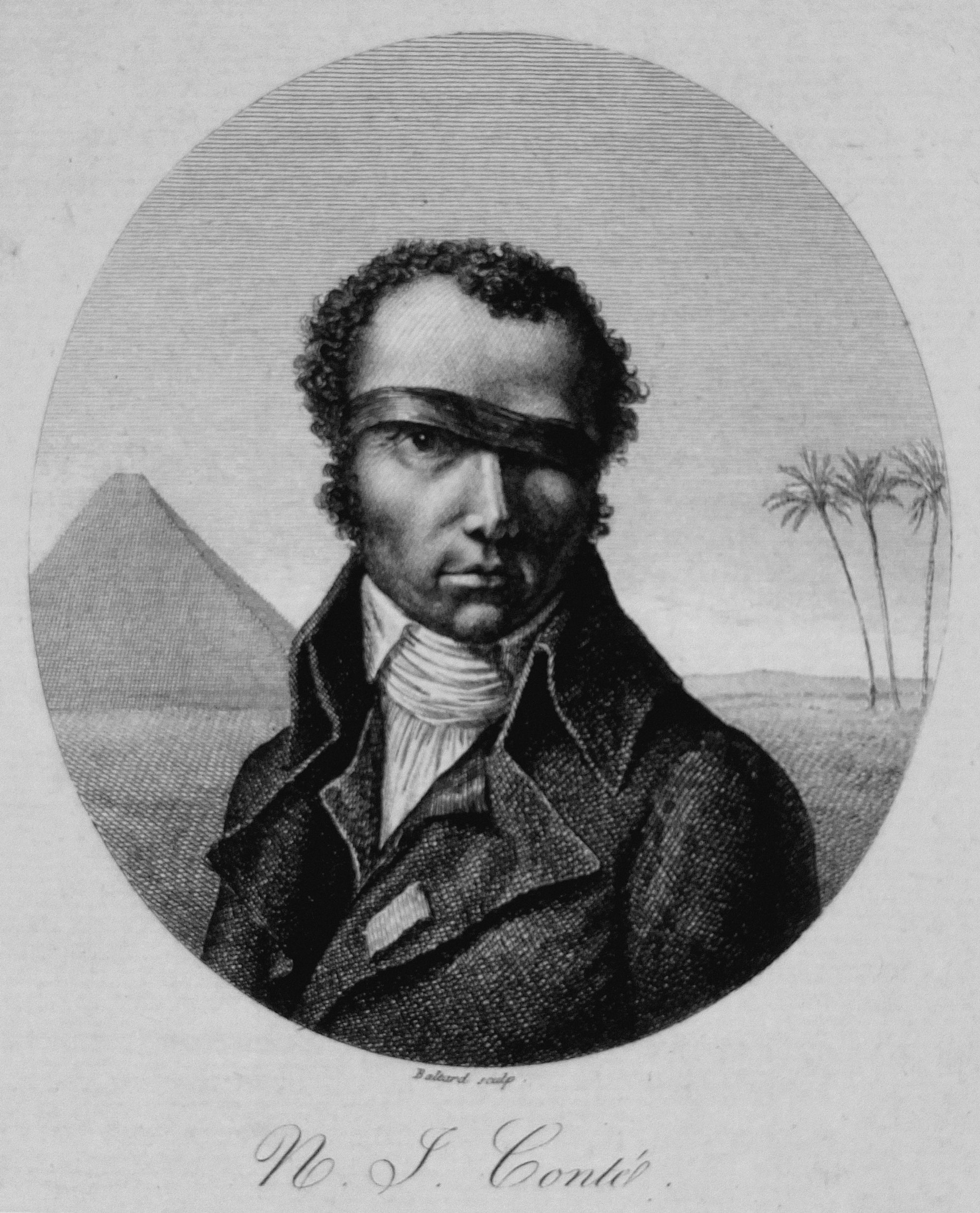
An engraved portrait of Nicolas-Jacques Conté

Nicolas-Jacques Conté, in an engraved portrait by Louis-Pierre Baltard.

Louis-Pierre Baltard / Wikimedia Commons

Licence: Public domain. Separate cover crop: rectangle 0,180,1994,2100; full original preserved. Cover cropped for article cards and sharing.

View the original and source details
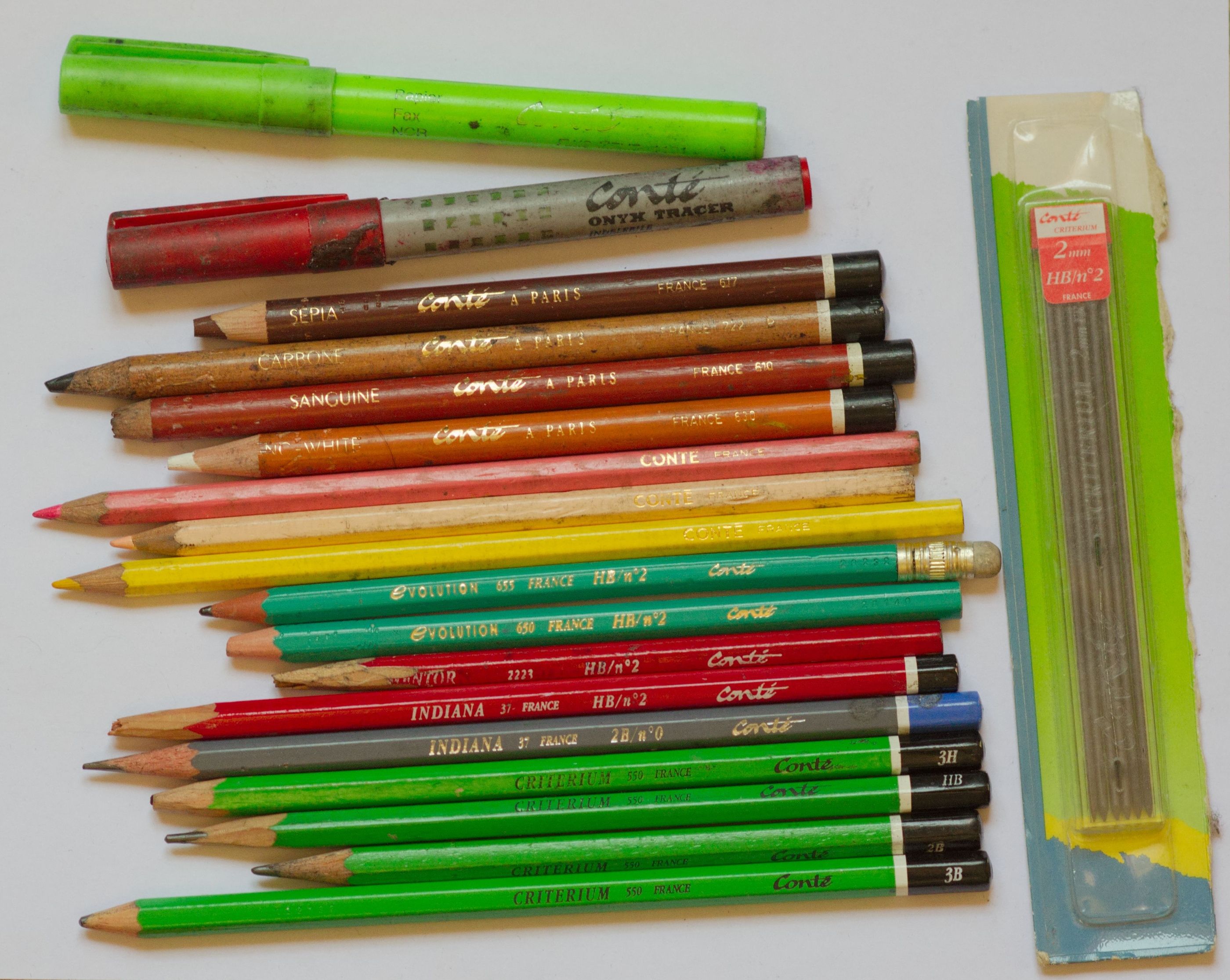
A collection of modern Conté and Criterium pencils, drawing materials and replacement leads

Modern Conté and Criterium materials. The graphite pencils in the lower rows include several hardness grades; the coloured drawing materials above use other compositions.

Popolon

Licence: CC BY-SA 3.0. Resized; complete photograph and original preserved.

View the original and source details
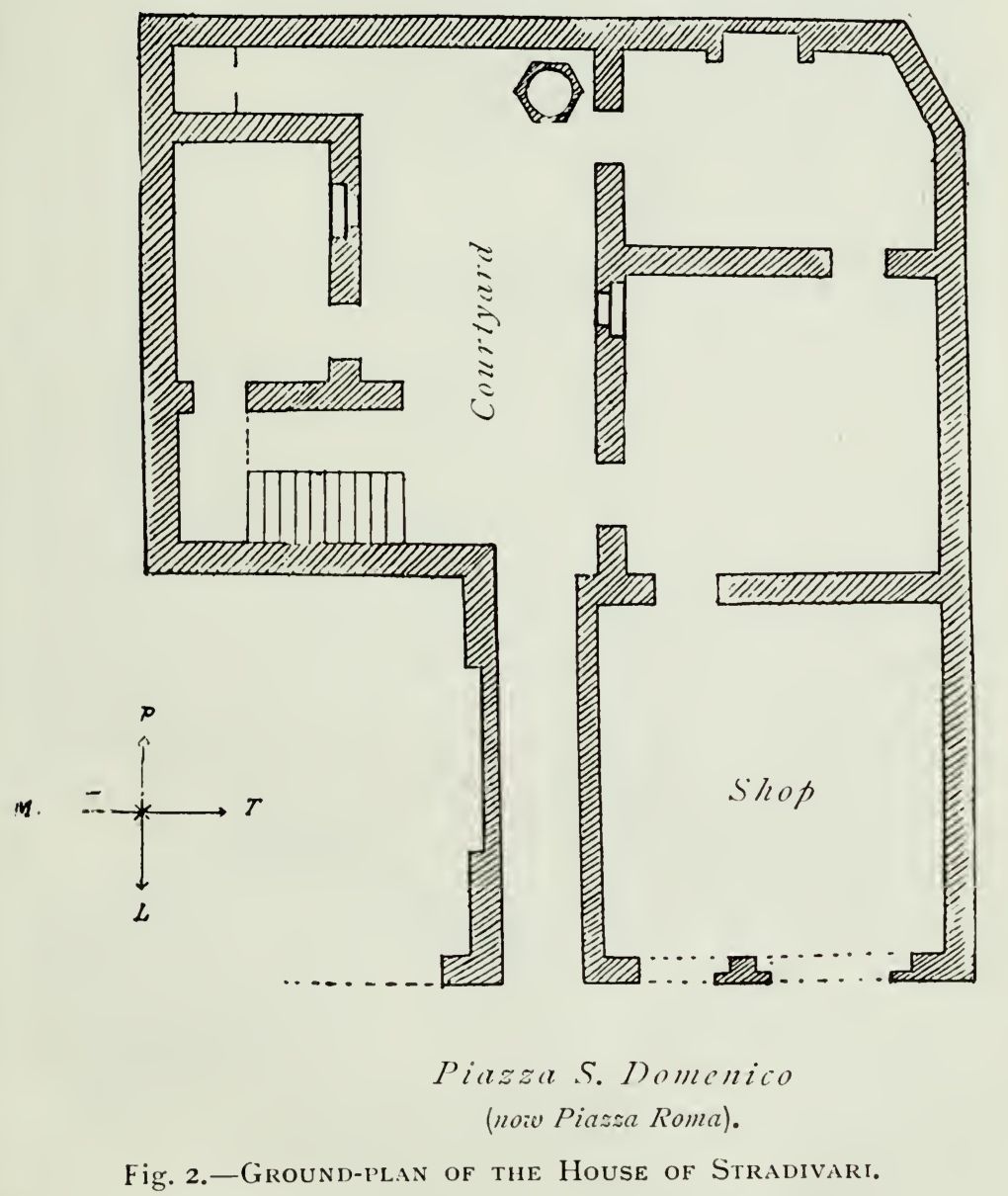
A historical house plan with a shop opening onto the piazza and a courtyard behind

The Hill brothers’ plan of Stradivari’s house on the Piazza San Domenico places the shop at the street entrance.

W. H., A. F. and A. E. Hill, 1909

Licence: Public domain. Historical figure cropped from page and resized; original preserved.

View the original and source details
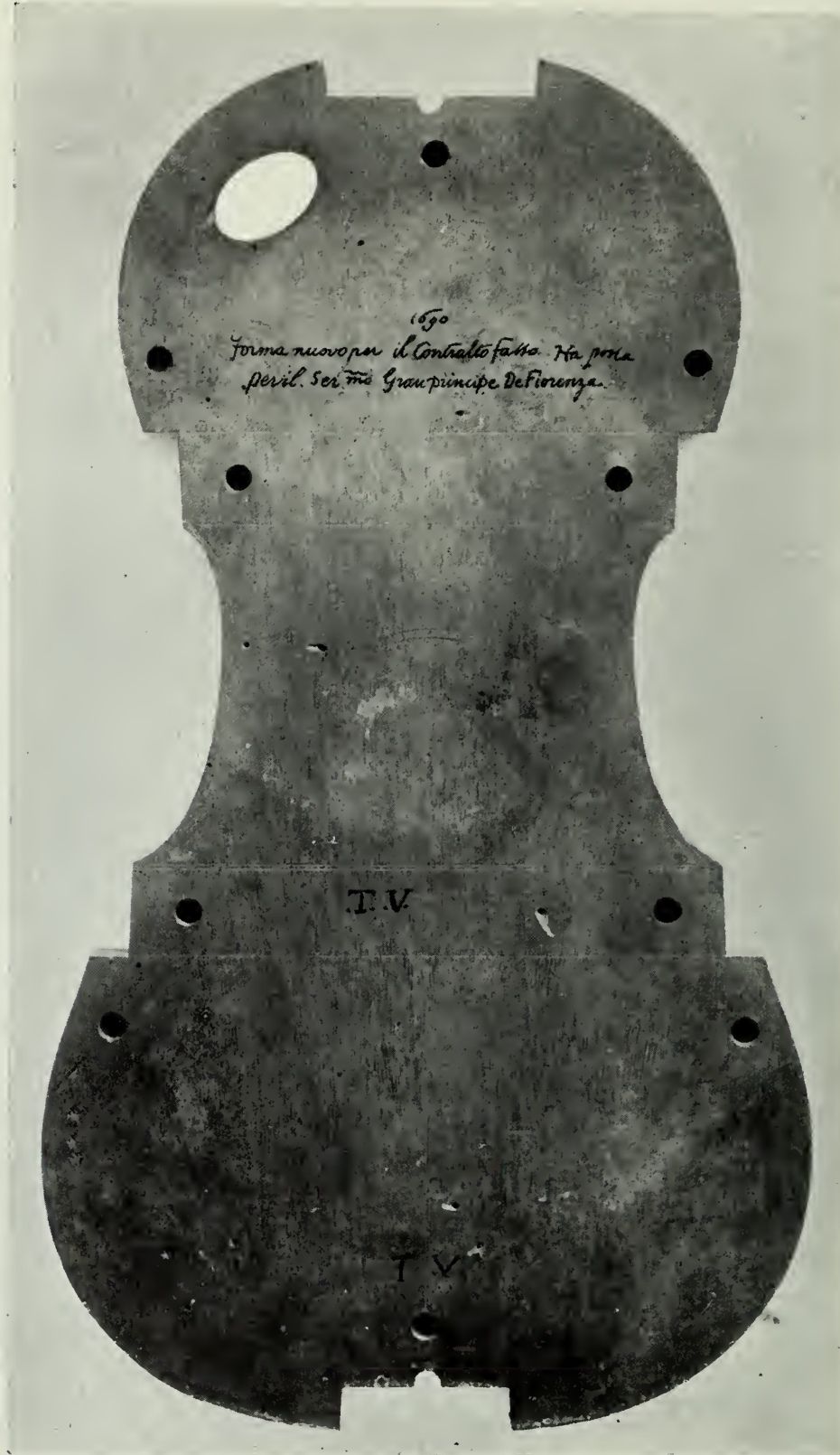
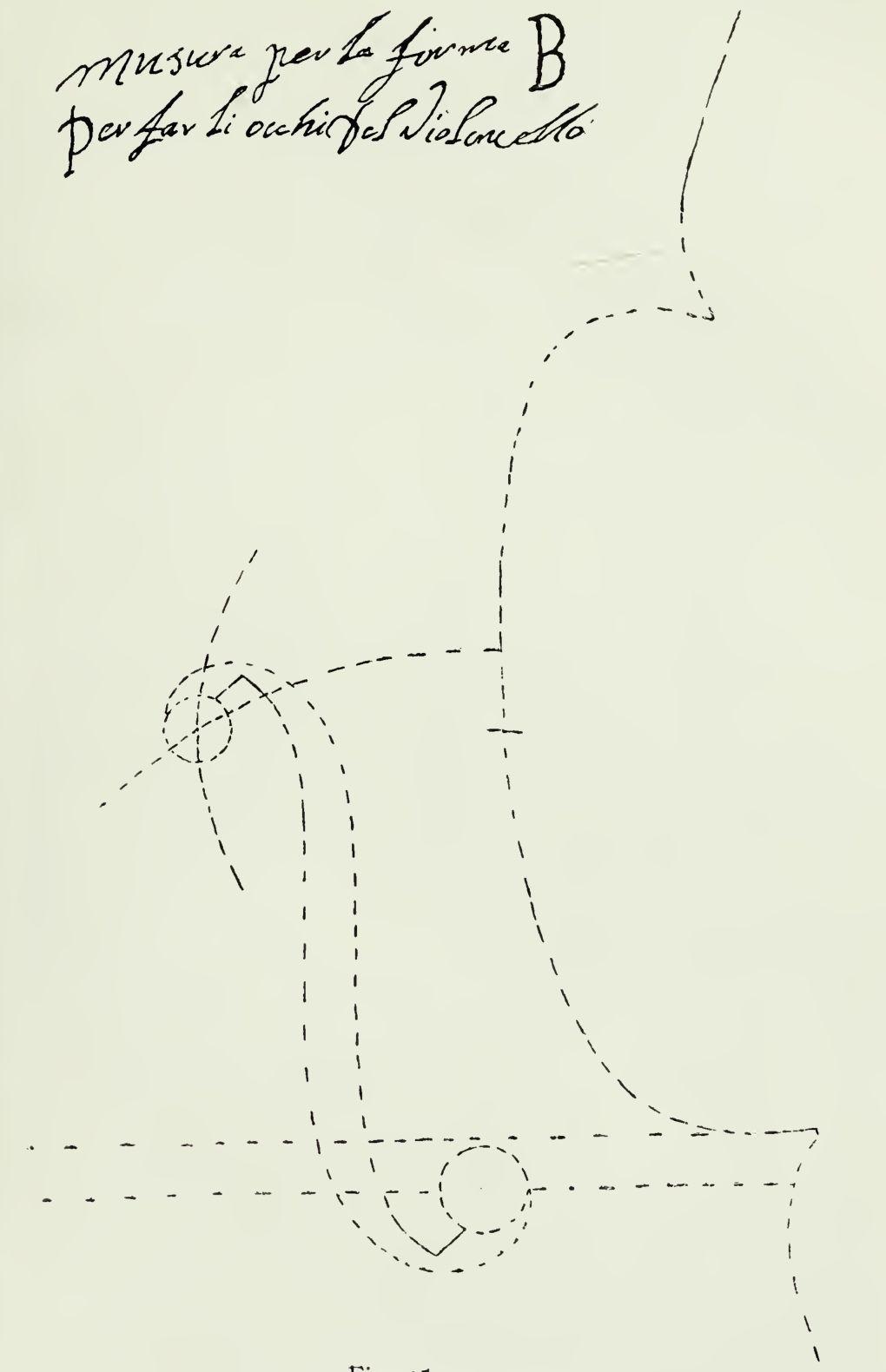
An old cello sound-hole layout with compass circles and a written reference to form B

A workshop drawing for placing a cello’s sound-holes, reproduced in 1909. Its heading refers to the B form.

W. H., A. F. and A. E. Hill, 1909

Licence: Public domain. Historical figure cropped from page and resized; original preserved.

View the original and source details
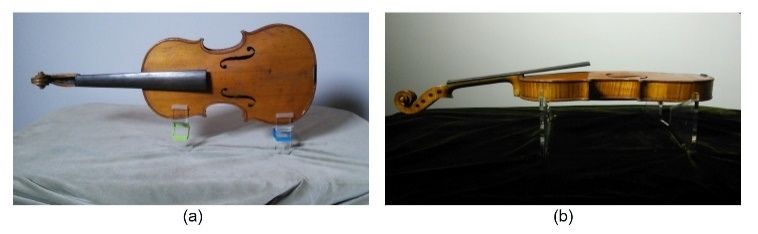
A violin placed on vertical and horizontal supports for laser scanning

Supports used by the Pavia researchers to scan a violin from different directions.

Piercarlo Dondi, Luca Lombardi, Marco Malagodi and Maurizio Licchelli / Acta IMEKO

Licence: CC BY 3.0. Resized for publication; original preserved.

View the original and source details
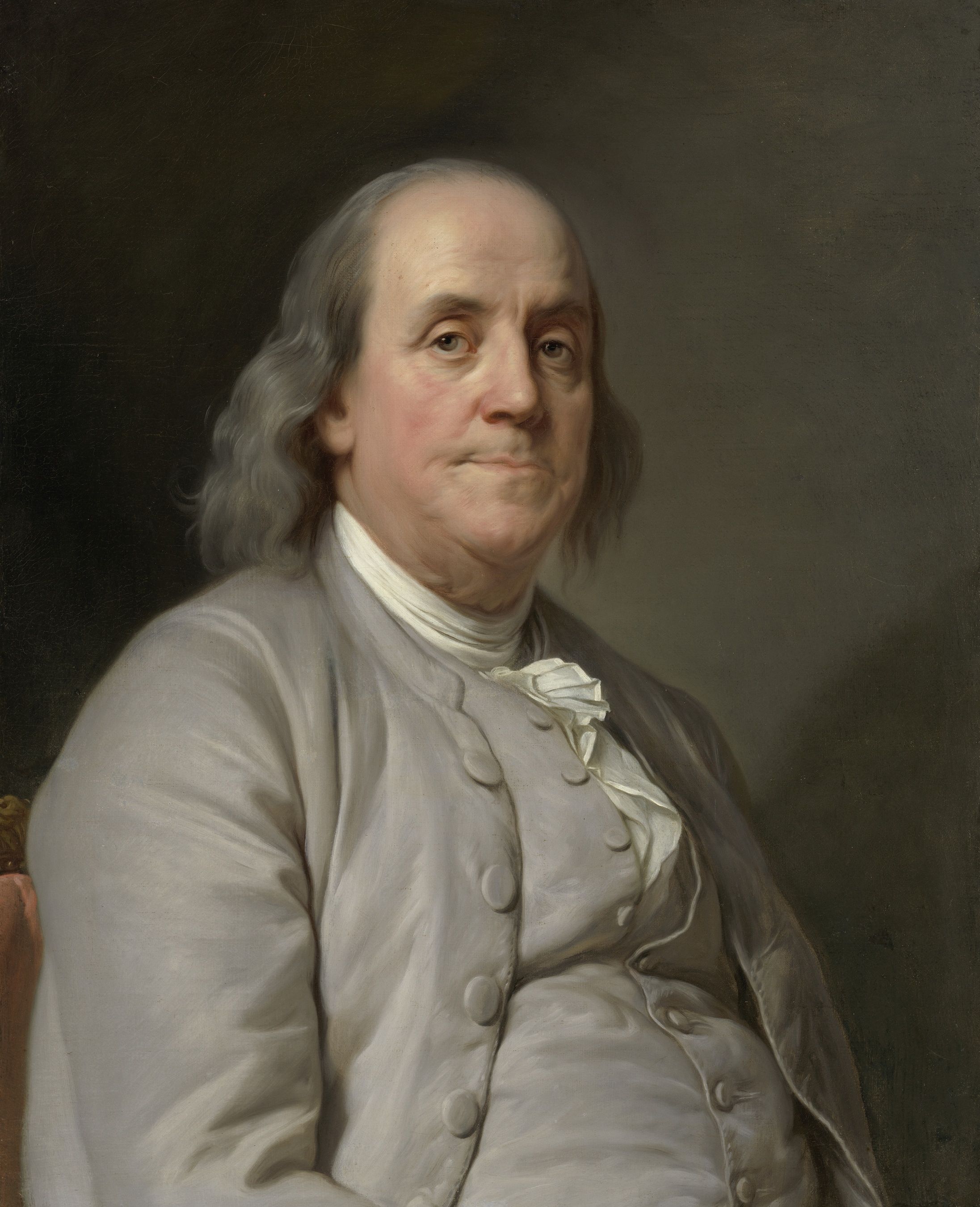
Benjamin Franklin in Joseph-Siffred Duplessis’s portrait

Benjamin Franklin, painted by Joseph-Siffred Duplessis around 1785.

National Portrait Gallery, Smithsonian Institution

Licence: CC0. Resized for publication; complete original retained.

View the original and source details
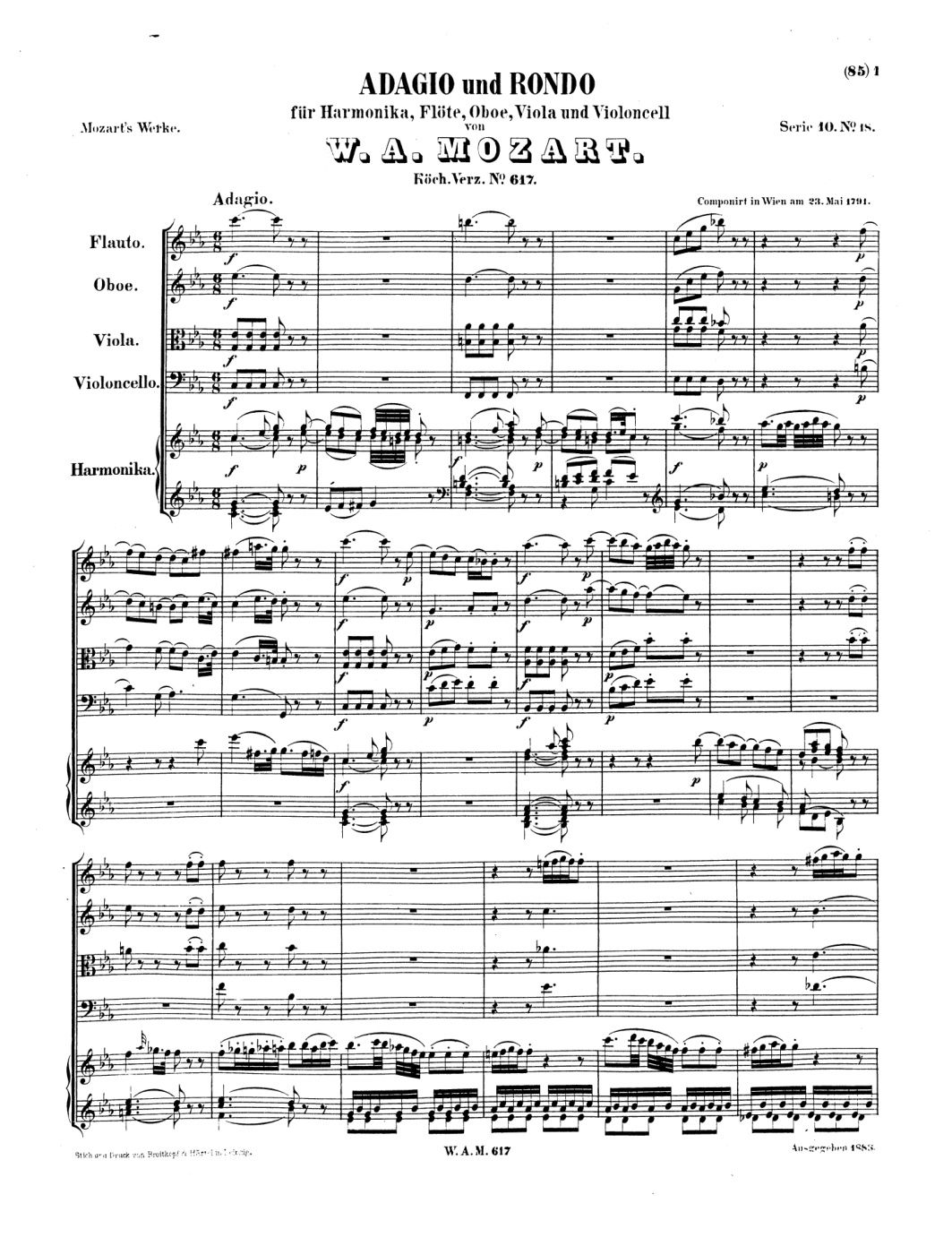
The opening of Mozart’s Adagio and Rondo in a nineteenth-century printed score

The opening of K. 617 in Breitkopf & Härtel's 1883 edition. The armonica part occupies two staves below the other four instruments.

Breitkopf & Härtel / Internet Archive

Licence: Public domain. First page rendered from the public-domain PDF; original PDF retained.

View the original and source details
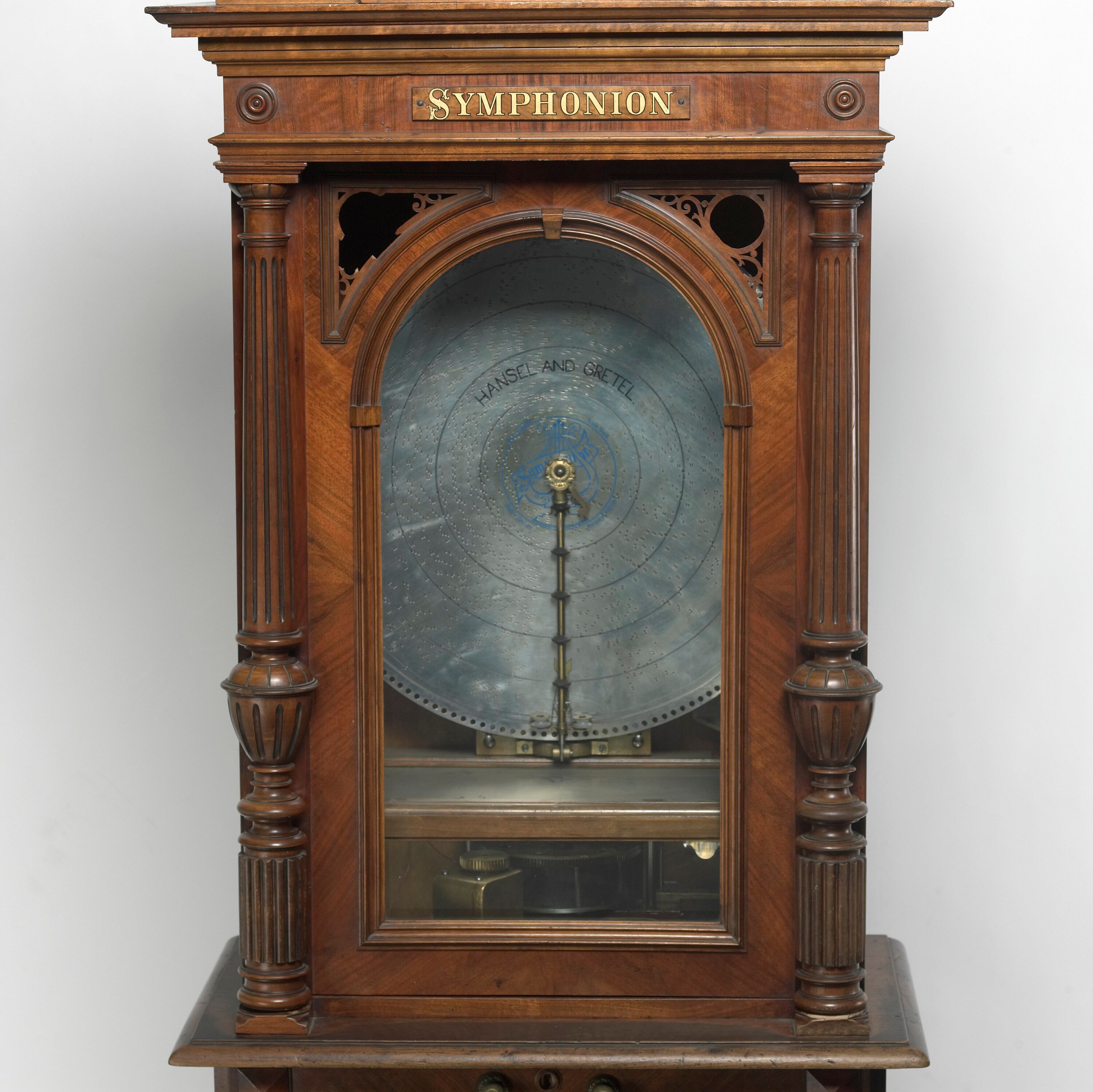
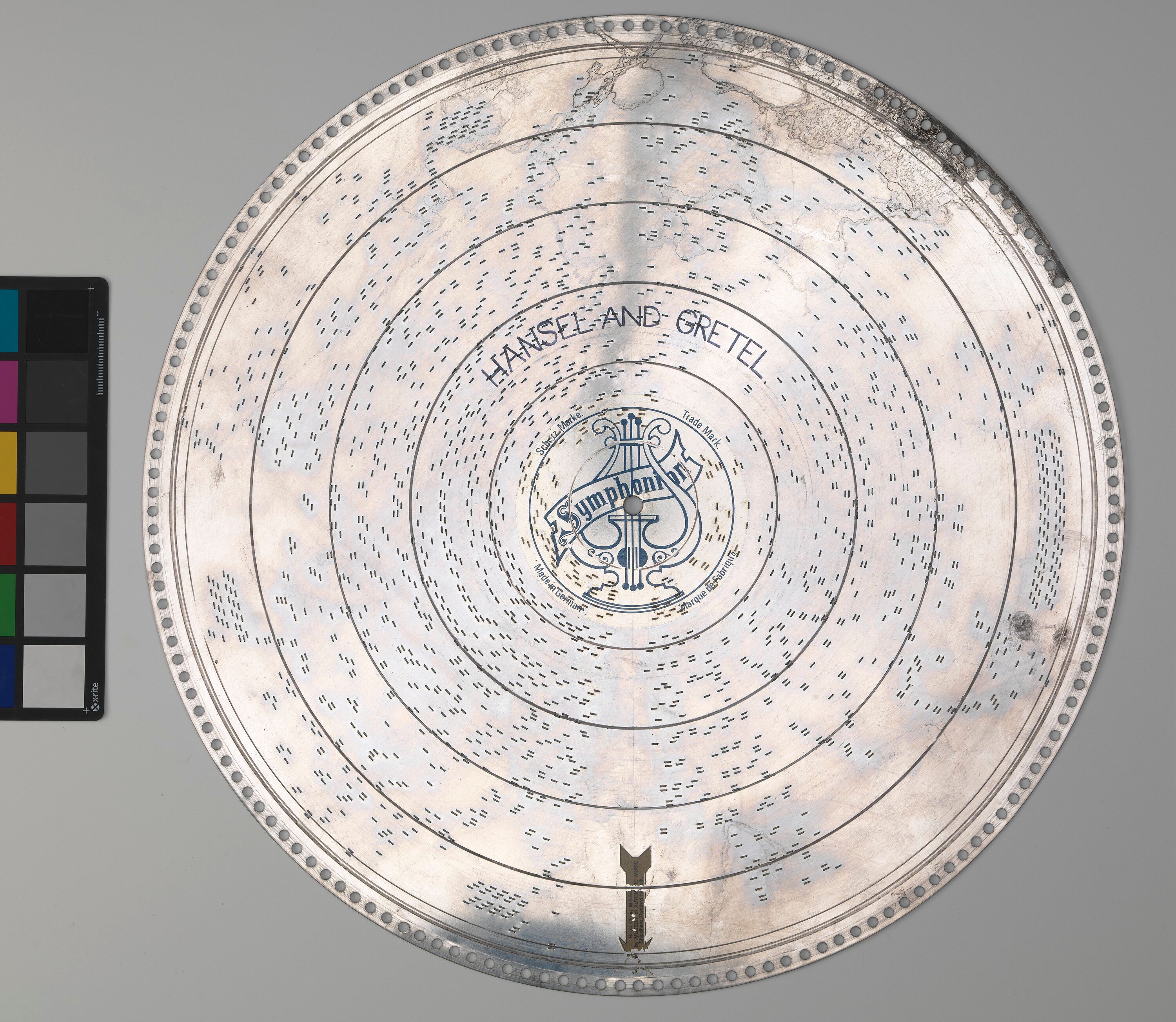
Symphonion nameplate above the steel disc in its wooden cabinet

The upper cabinet of Cole's Symphonion, with a later museum-acquired disc installed.

Jon Augier / Museums Victoria

Licence: CC BY 4.0. Cover cropped separately for cards and sharing. Cover cropped for article cards and sharing.

View the original and source details
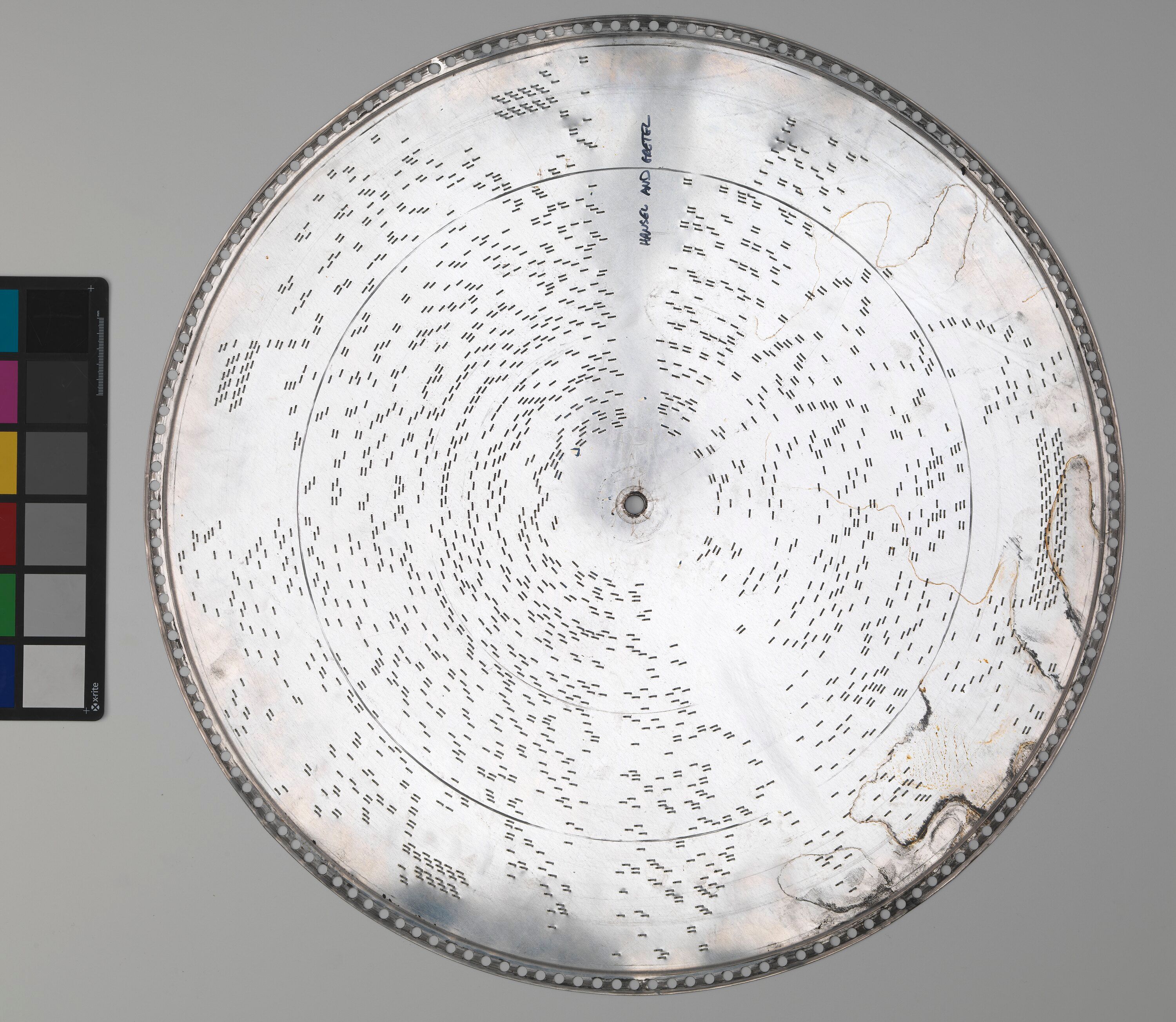
The labelled face of a Hansel and Gretel Symphonion disc

Hansel and Gretel: one of eight discs bought by the museum in 1982 to supplement those acquired with the machine.

Benjamin Healley / Museums Victoria

Licence: CC BY 4.0. Original image, unchanged.

View the original and source details
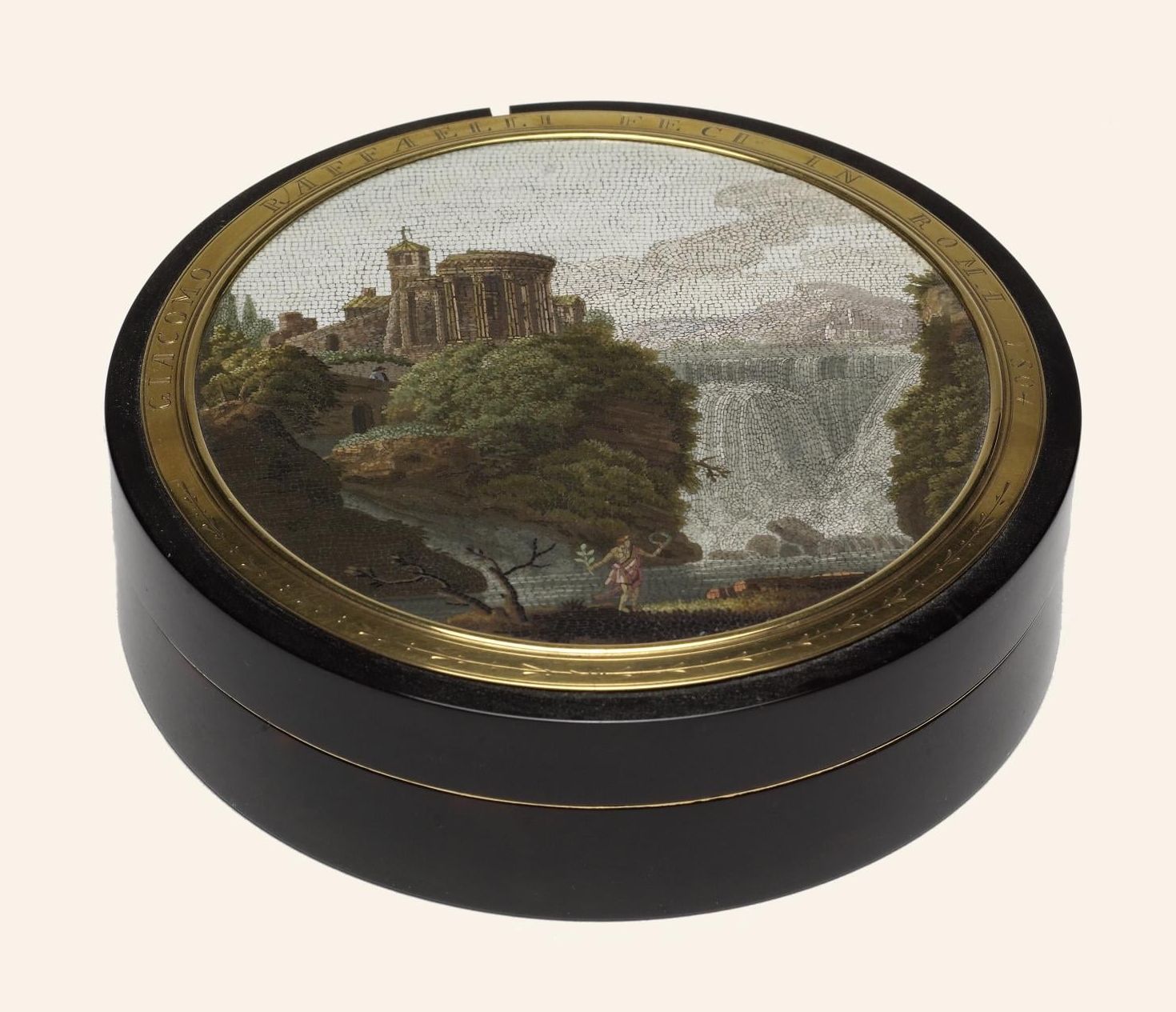
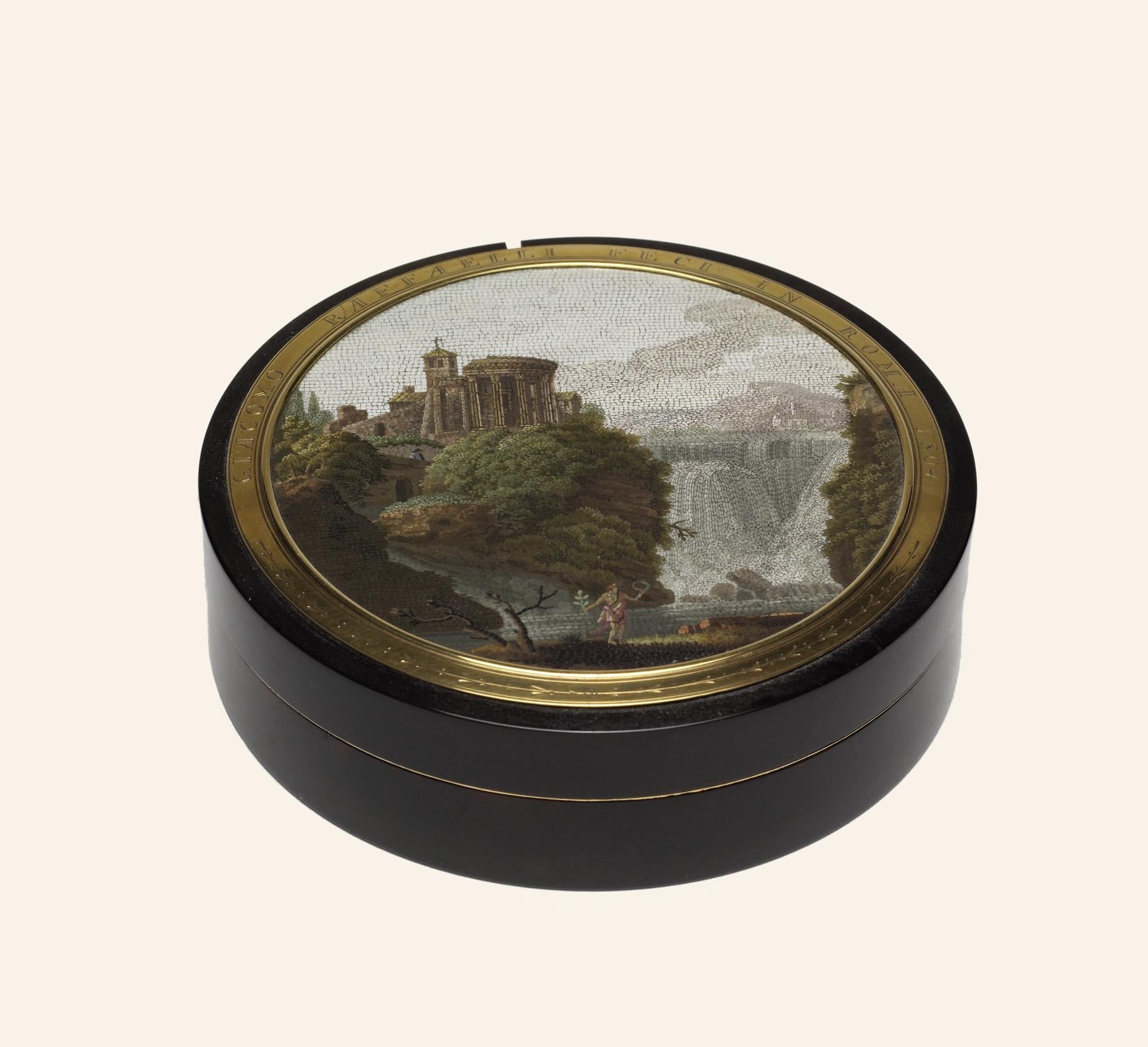
A portable glass mosaic of Tivoli in a circular box signed by Raffaelli

Raffaelli's Box with a View of Tivoli, 1804.

Walters Art Museum

Licence: CC0. Cover cropped separately for cards and sharing. Cover cropped for article cards and sharing.

View the original and source details
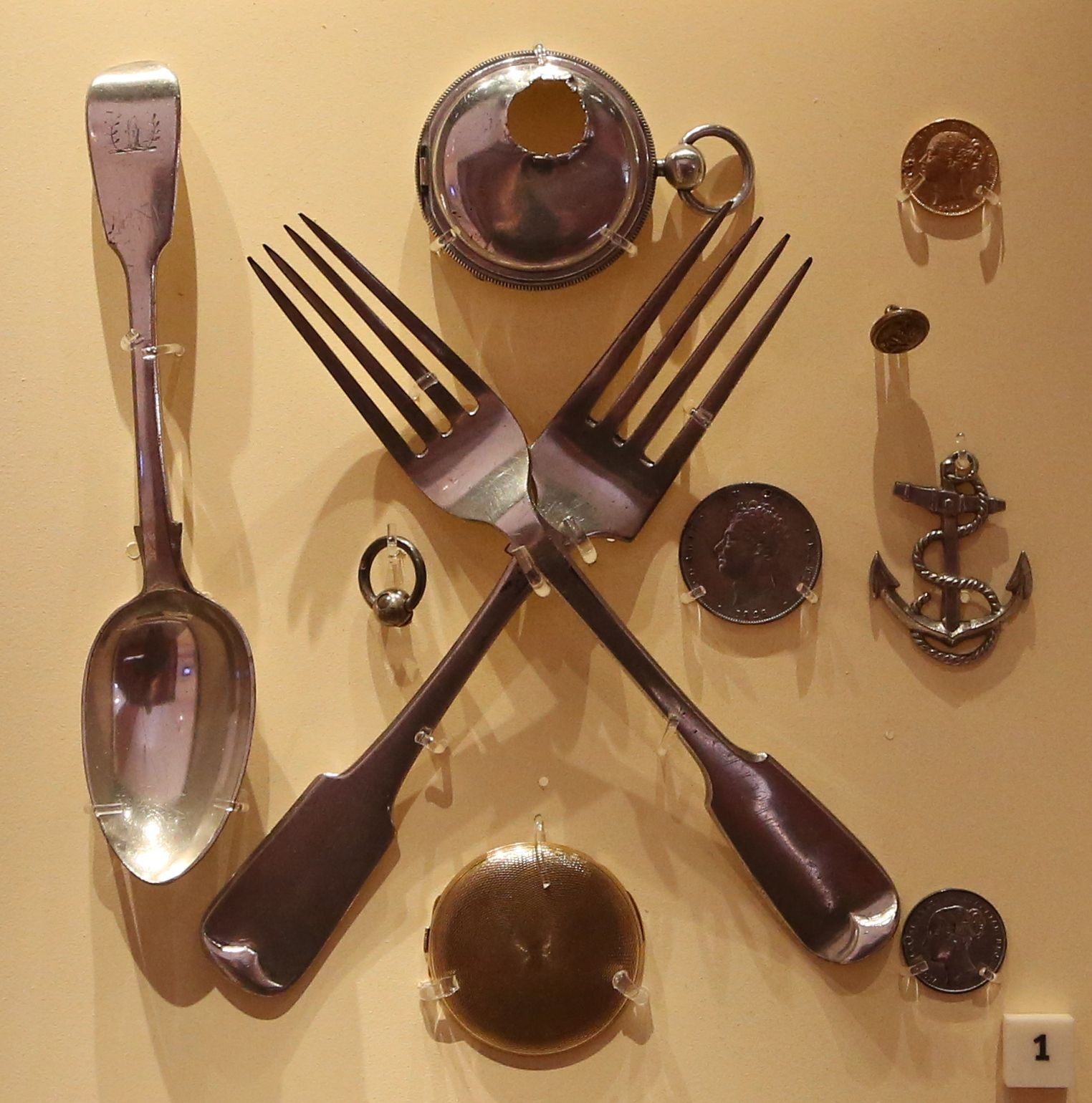
Crossed forks and small objects recovered through Inuit communities

Objects from Franklin's expedition acquired from Inuit by John Rae.

Geni

Licence: CC BY-SA 4.0. Whole photograph retained; card layout may trim outer edges. Card adaptations shared under CC BY-SA 4.0. Cover cropped for article cards and sharing.

View the original and source details
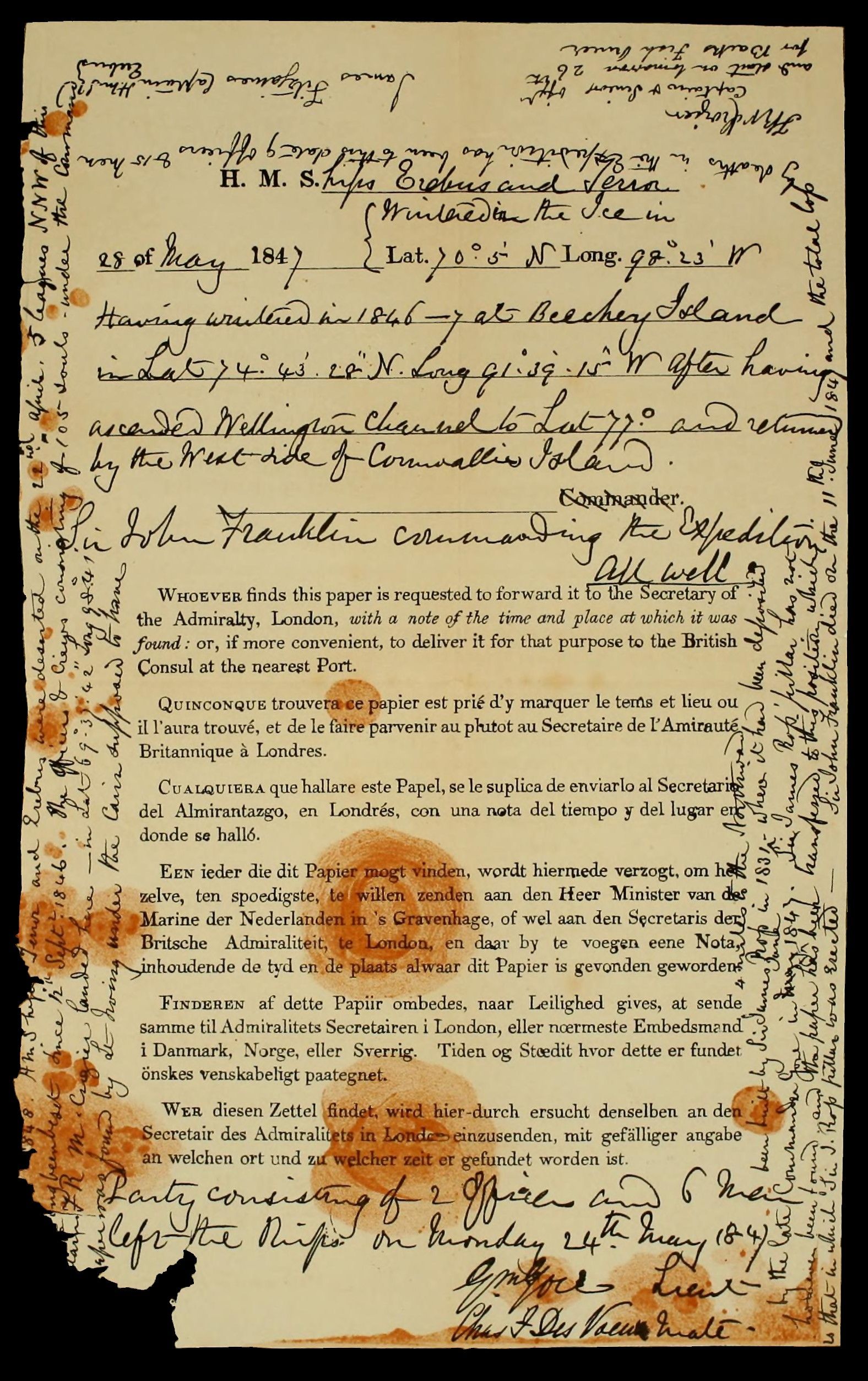
The Victory Point record, with a central message and later writing around its edges

A historical reproduction of the Victory Point record. The May 1847 message occupies the form; the April 1848 addition runs around its margins.

McClintock, The Voyage of the Fox, 1869 edition

Licence: Public domain. Original image, unchanged.

View the original and source details
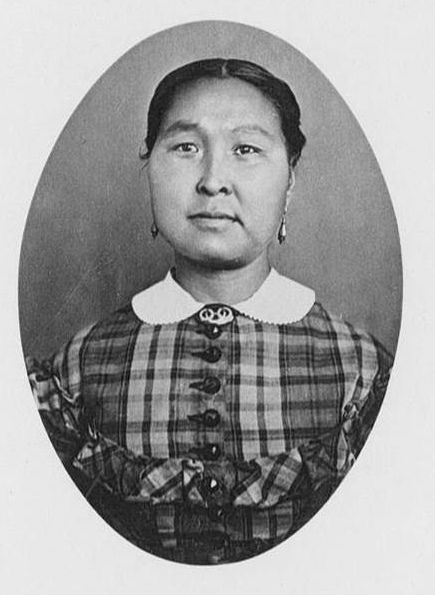
Taqulittuq in a photographic portrait wearing a checked dress

Taqulittuq, also known as Tookoolito, one of the interpreters who made Hall’s inquiries possible. From a photograph by T. W. Smillie, published in 1879.

T. W. Smillie / Hall–Nourse narrative

Licence: Public domain. Blank printed page margins and signature cropped; complete original preserved.

View the original and source details
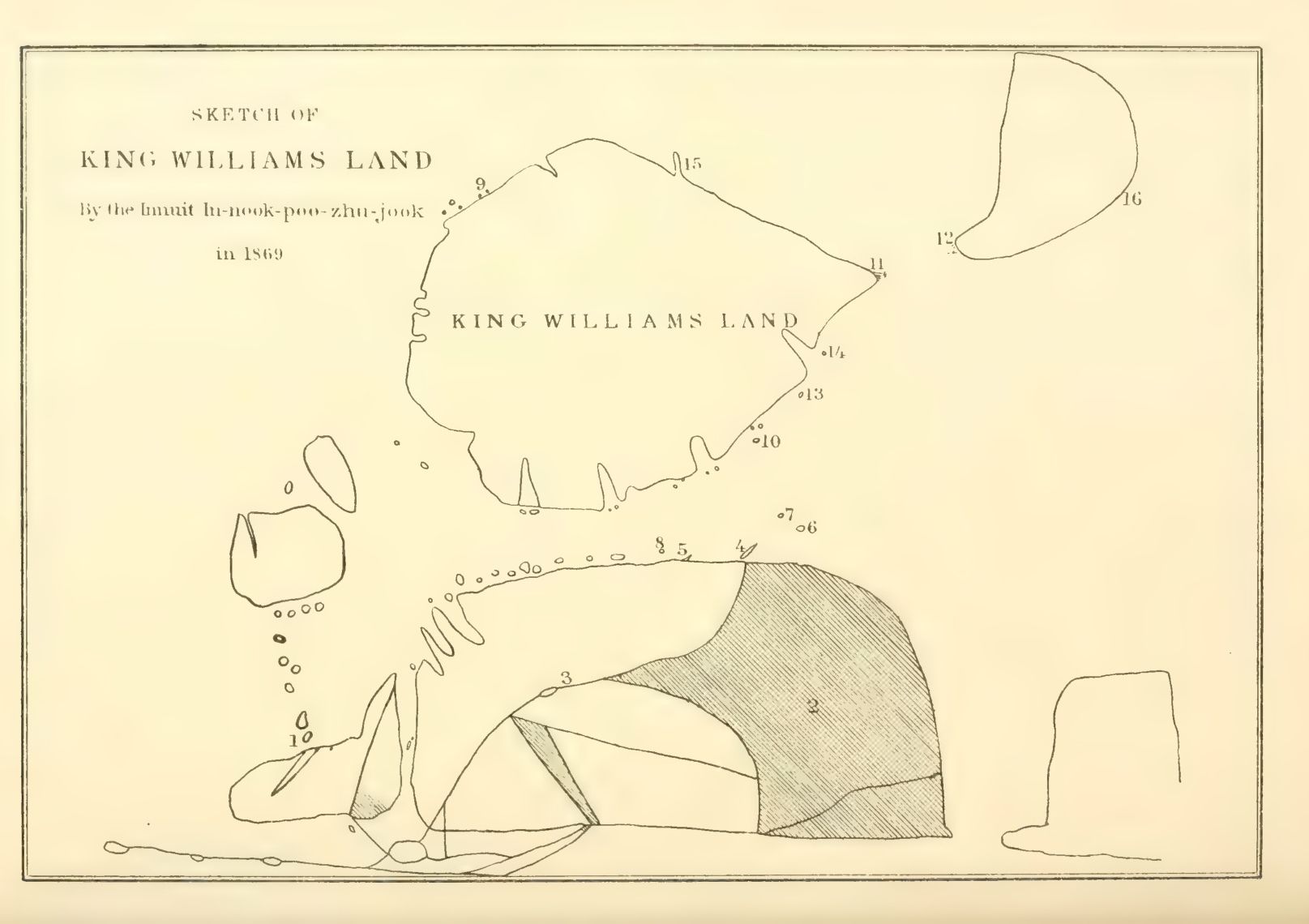
Inukpujijuk’s map of King William Island and adjacent country, with numbered places

Inukpujijuk's 1869 sketch, reproduced in the 1879 narrative edited from Hall's records. Its numbered places were accompanied by names and explanations, including a wreck location.

Inukpujijuk / Hall–Nourse narrative

Licence: Public domain. Rotated 90 degrees counterclockwise for reading; outer blank margins cropped.

View the original and source details
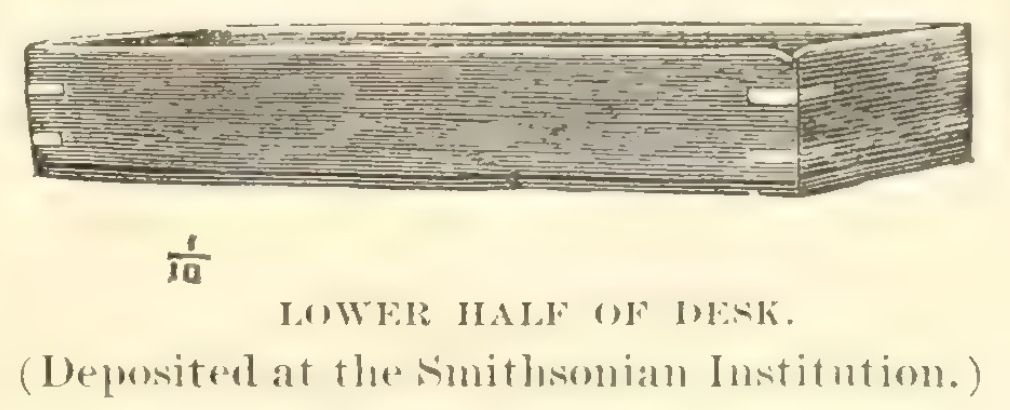
An illustration of the lower half of a shallow wooden writing desk

The lower half of the writing desk collected by Hall. His account describes the added bottom board and its use as a blubber tray.

Hall–Nourse narrative, 1879

Licence: Public domain. Individual upper illustration/caption cropped from full page.

View the original and source details
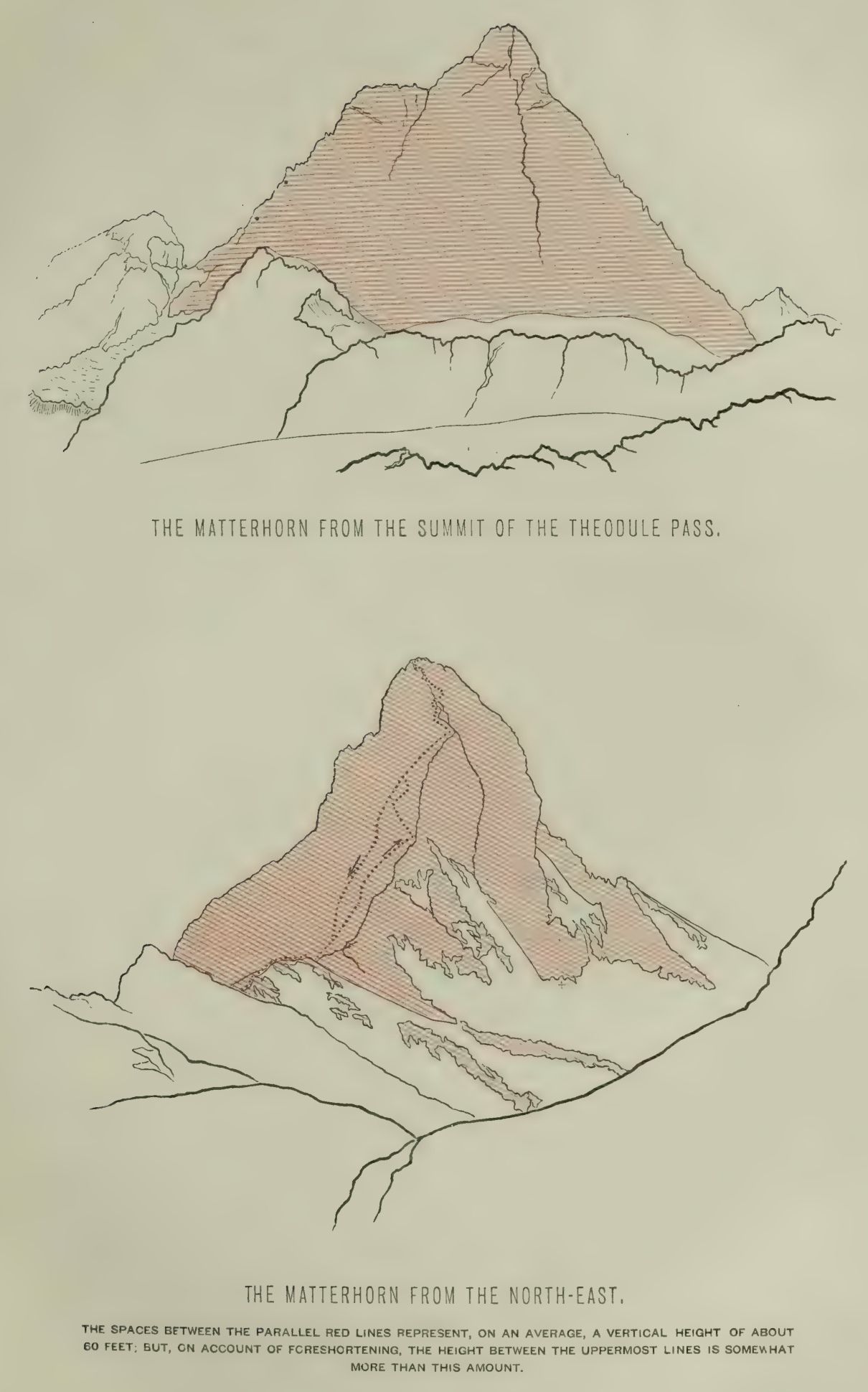
Two outline views of the Matterhorn crossed by fine red height lines

The Theodule Pass view above and the north-eastern view below, published in 1871. The red intervals represent about sixty vertical feet on average, with the qualification about foreshortening retained in the original legend.

Edward Whymper

Licence: Public domain. Outer blank page margins cropped.

View the original and source details
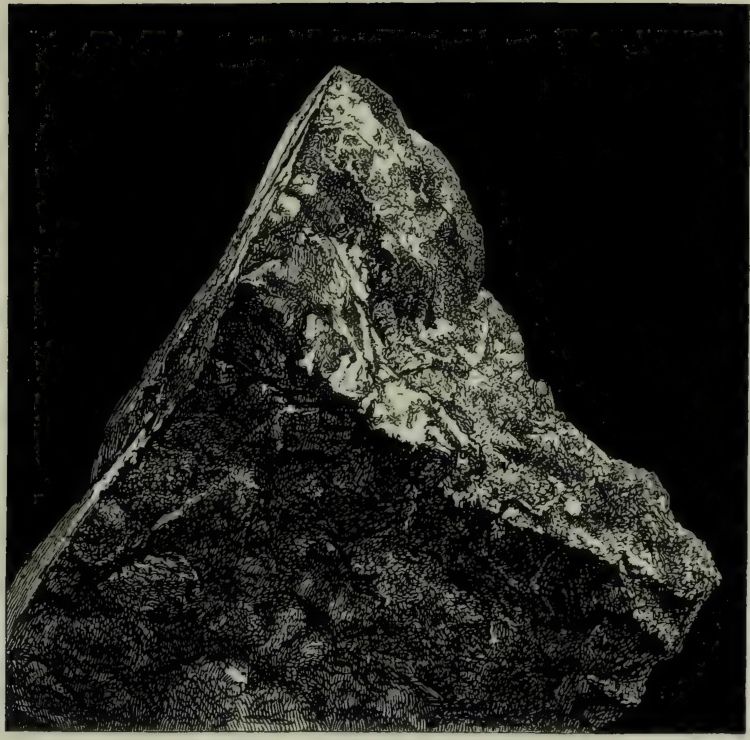
An engraving of the angular rock fragment Whymper took from the summit

The Actual Summit of the Matterhorn in 1865: Whymper's fragment of the highest rock, whose shape he compared to the mountain. Published in 1871.

From Edward Whymper, Scrambles Amongst the Alps

Licence: Public domain. Illustration cropped from page; surrounding text omitted.

View the original and source details
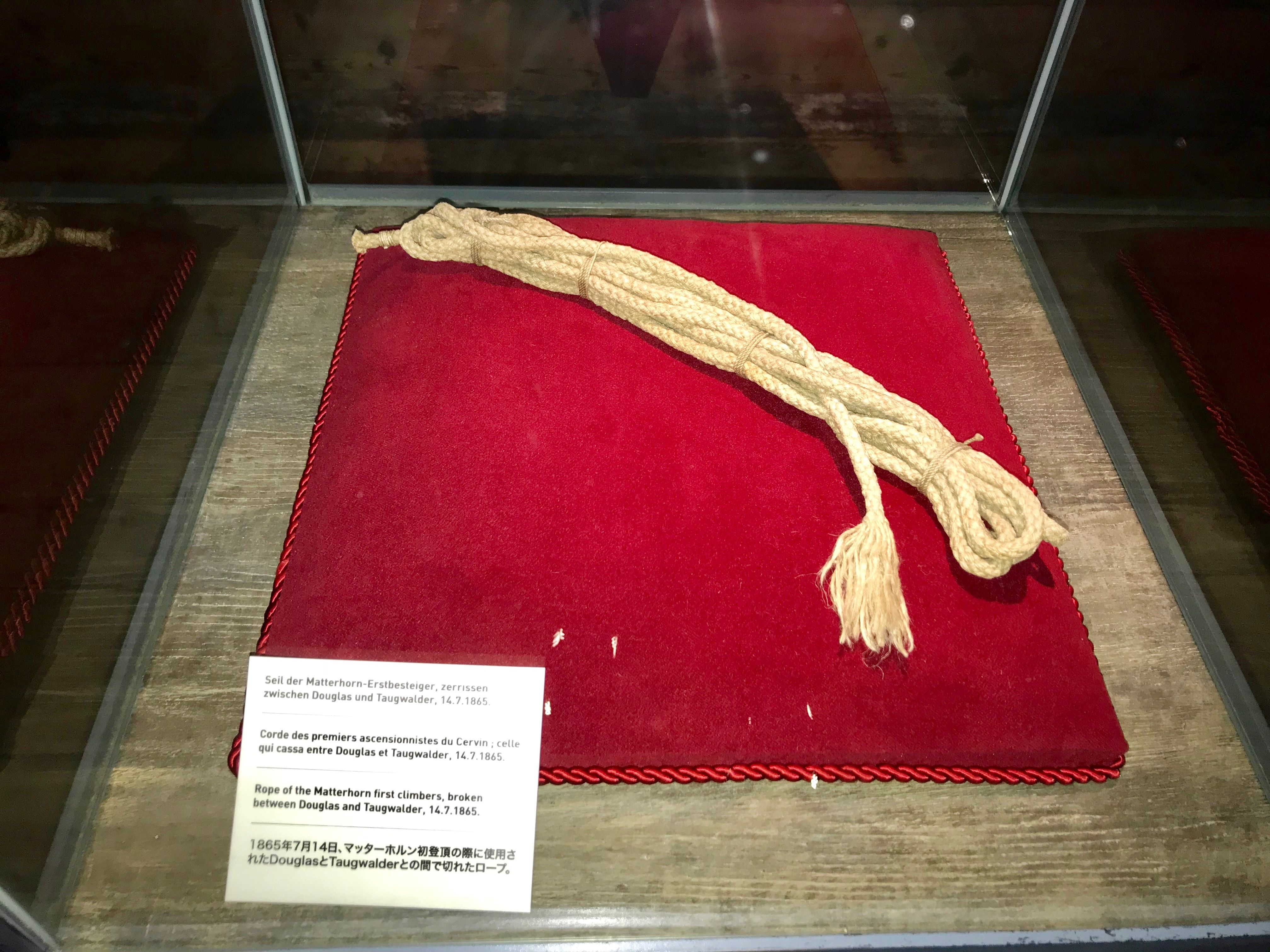
The surviving broken rope displayed in a glass case in the Matterhorn Museum

The broken rope in the Matterhorn Museum, photographed in 2017. The museum identifies it with the link between Douglas and the elder Taugwalder.

AdrianMichael

Licence: CC BY 3.0. Original image, unchanged.

View the original and source details
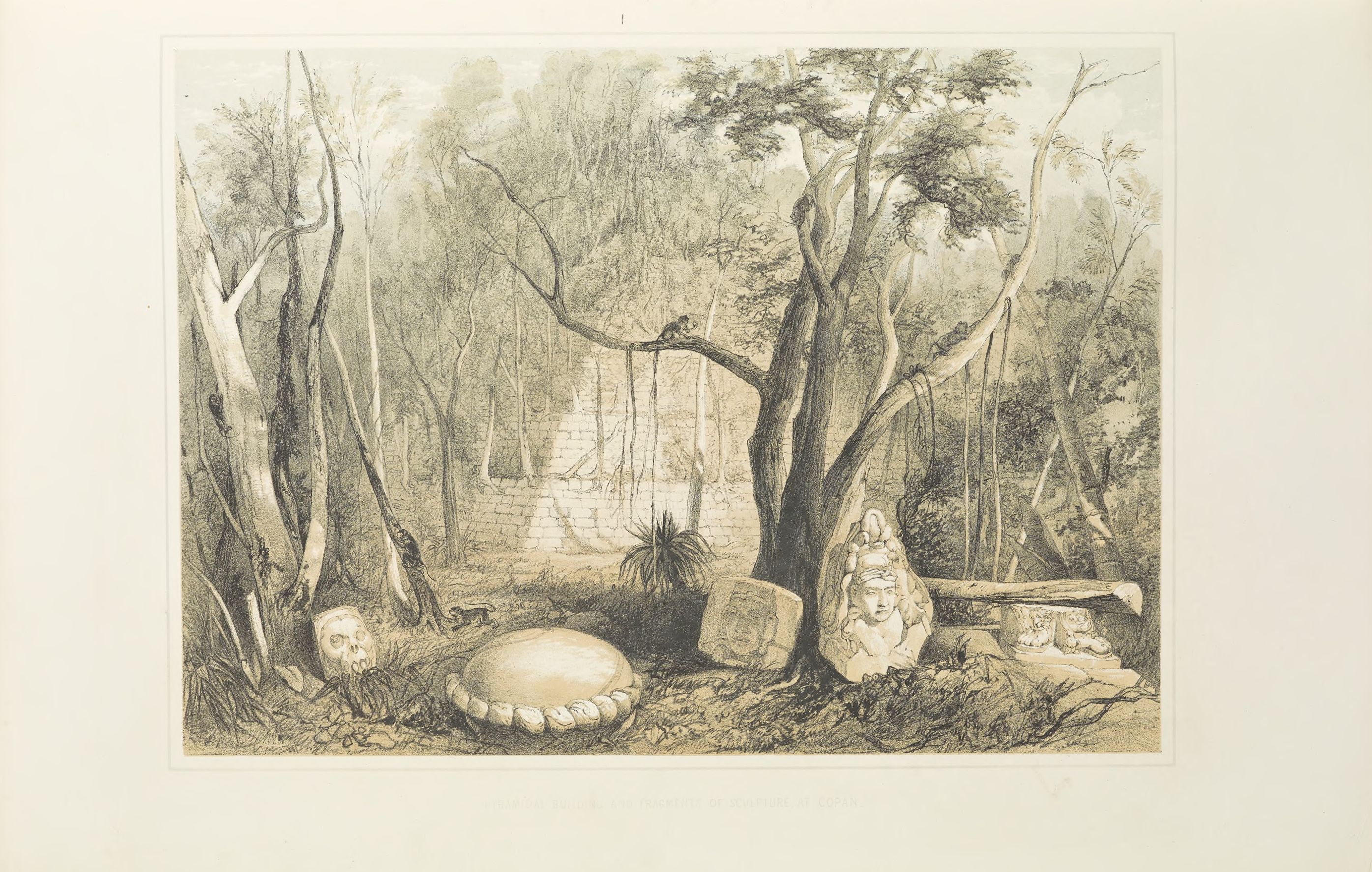
Catherwood and Warren's lithograph of carved fragments before a forest-covered stepped mound at Copán

Pyramidal Building and Fragments of Sculpture, at Copan, Plate II of Catherwood's 1844 Views. The foreground gathers pieces found elsewhere at the site.

Henry Warren after Frederick Catherwood / Getty Research Institute

Licence: Public domain. Cover cropped for article cards and sharing.

View the original and source details
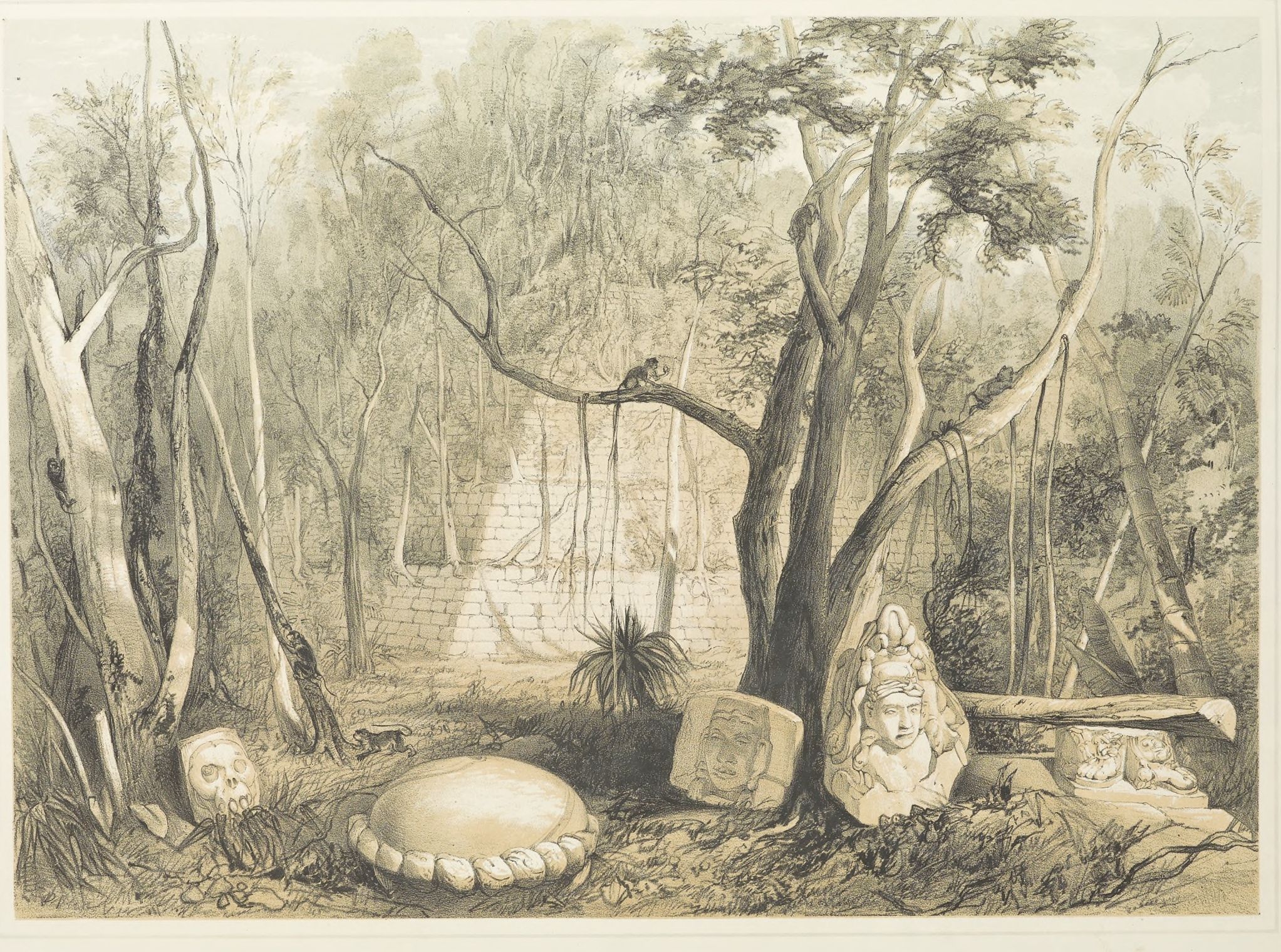
Catherwood and Warren's lithograph of carved fragments before a forest-covered stepped mound at Copán

Pyramidal Building and Fragments of Sculpture, at Copan, Plate II of Catherwood's 1844 Views. The foreground gathers pieces found elsewhere at the site.

Henry Warren after Frederick Catherwood / Getty Research Institute

Licence: Public domain. Book margins cropped; raw scan preserved.

View the original and source details
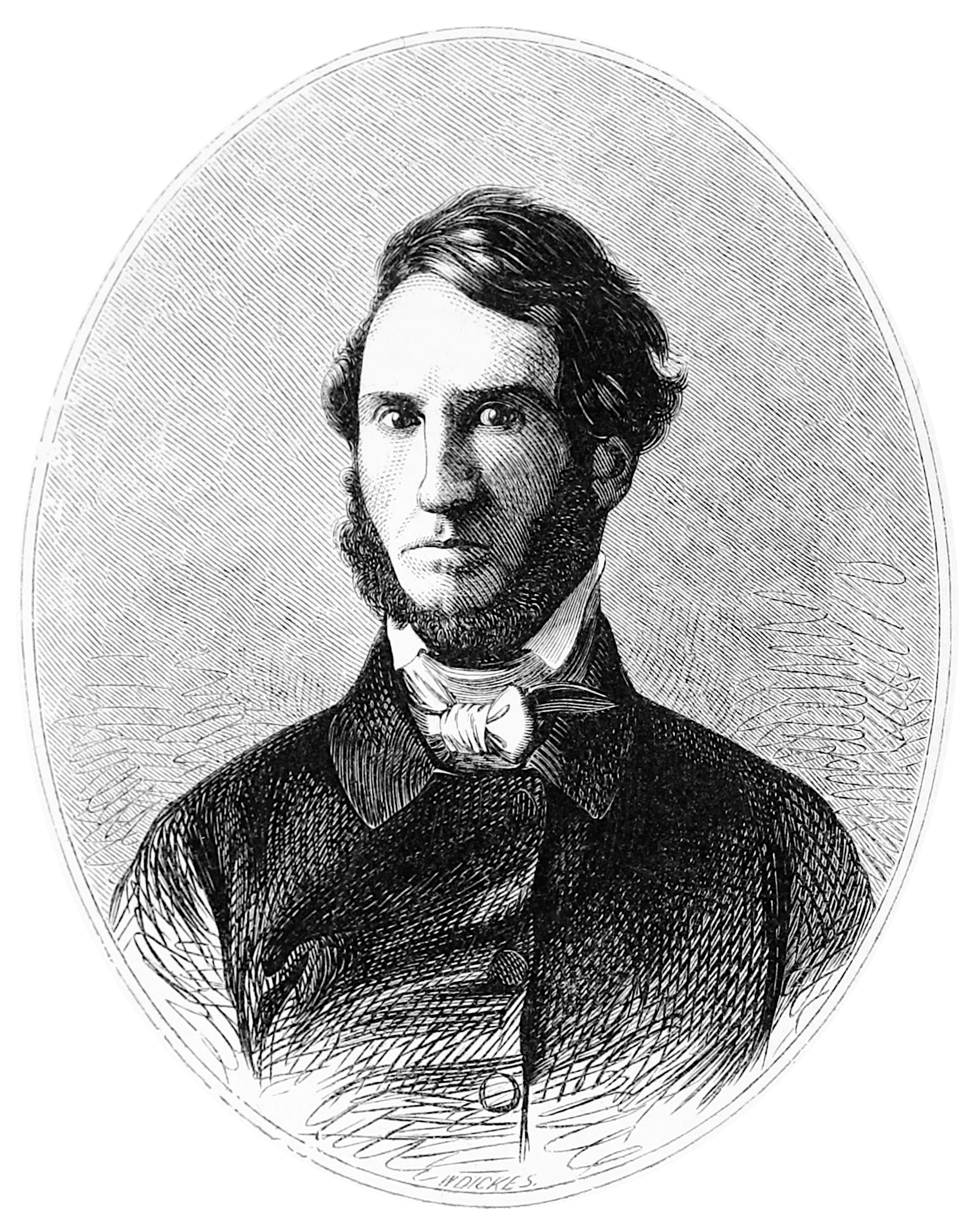
A nineteenth-century engraved portrait of John Lloyd Stephens

John Lloyd Stephens, whose travel narrative preserves the account of the work at Copán. This portrait appeared in the 1854 edition revised by Catherwood.

W. Dickes, after a daguerreotype

Licence: Public domain. Original image, unchanged.

View the original and source details
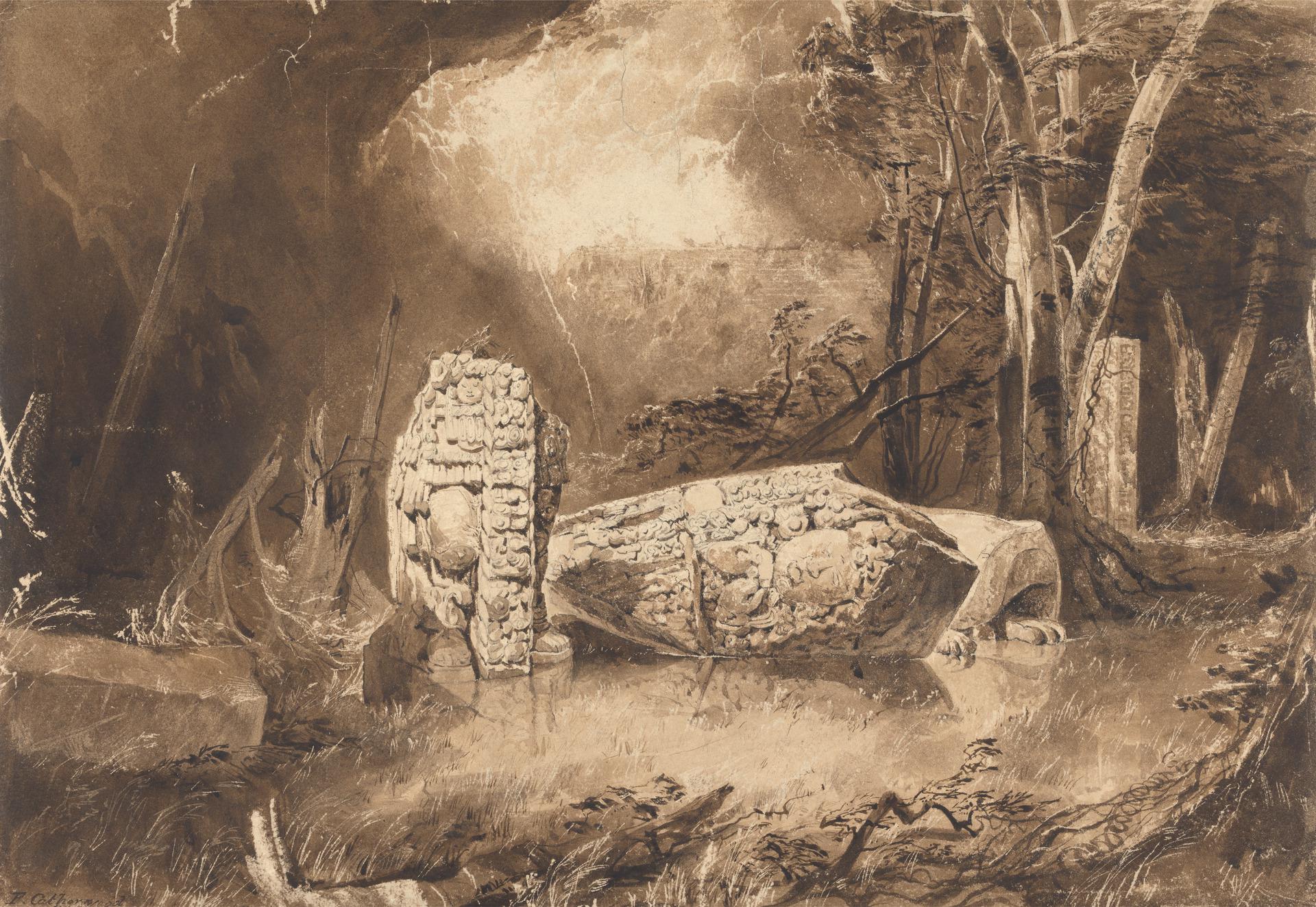
Catherwood's watercolour of a broken carved Maya monument lying beside its standing lower portion

Catherwood's Maya Stela at Copan, Honduras, signed 1843: watercolour, ink, wash and graphite, with scratched highlights.

Yale Center for British Art, Yale Art Gallery Collection, Gift of Henry Schnakenberg

Licence: Public domain. Original image, unchanged.

View the original and source details
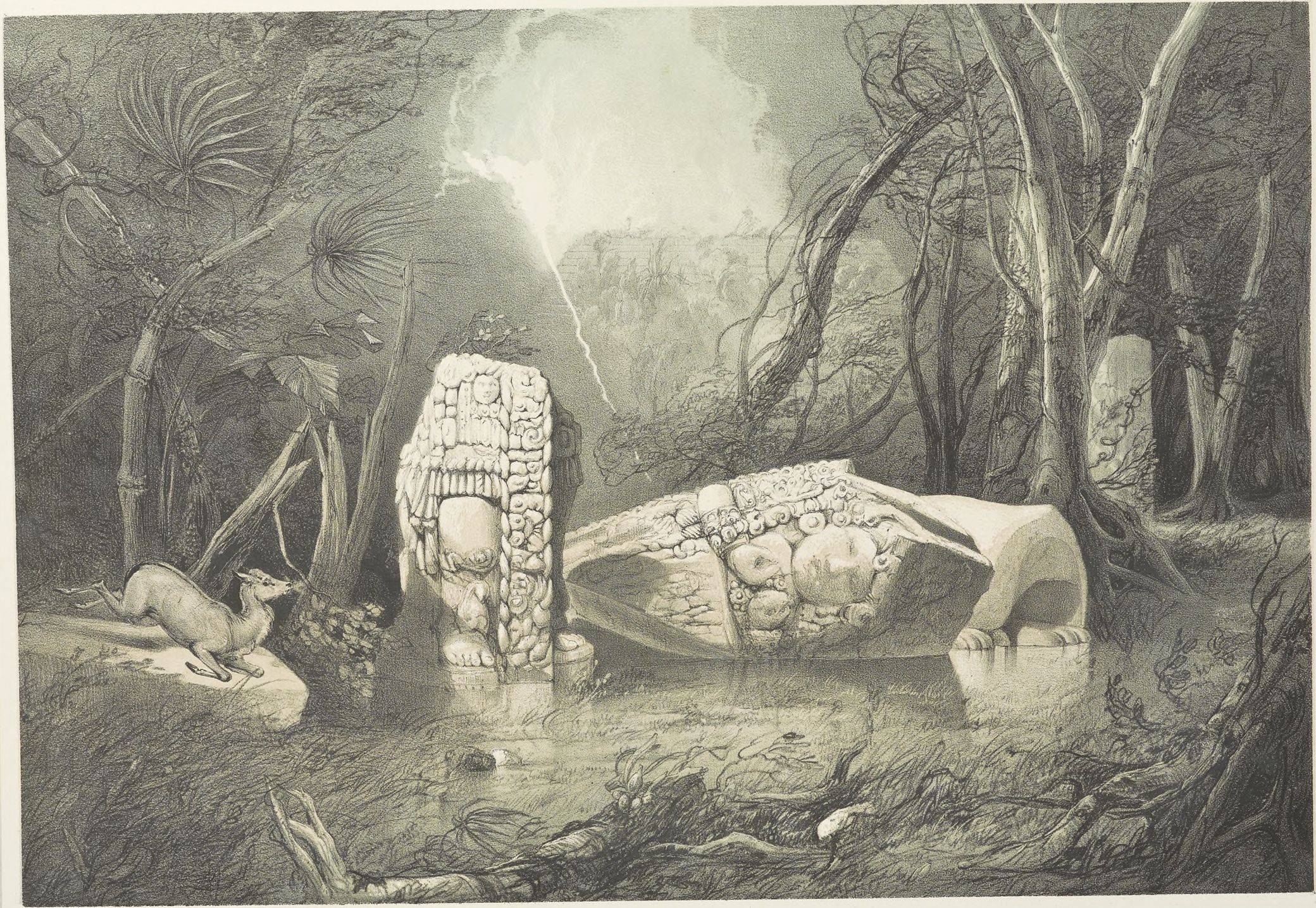
Warren's 1844 lithograph of the broken Copán monument with a deer in the foreground

Broken Idol, at Copan, Plate IV, 1844. Warren's lithograph presents the broken sculpture within another carefully composed forest scene.

Henry Warren after Frederick Catherwood / Getty Research Institute

Licence: Public domain. Book margins cropped; raw scan preserved.

View the original and source details
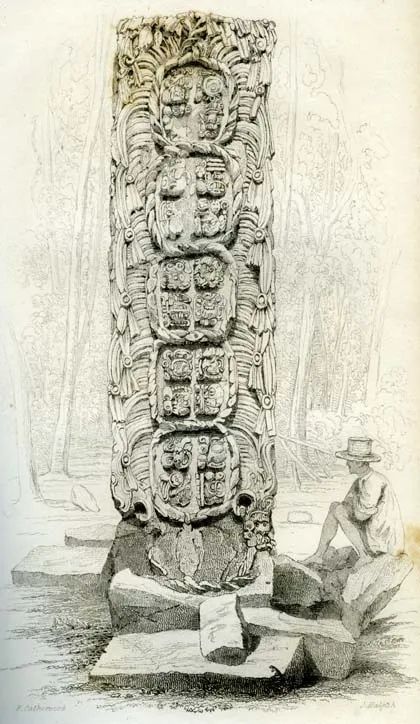
The 1841 engraving after Catherwood recording the glyph-covered back of Copán Stela F

The earlier engraving of Stela F, published in Stephens's travel book in 1841. Its copied signs later supplied evidence lost from the monument.

After Frederick Catherwood / reproduced by Maya Decipherment

Licence: Public domain. Format converted from downloaded WebP to JPEG.

View the original and source details
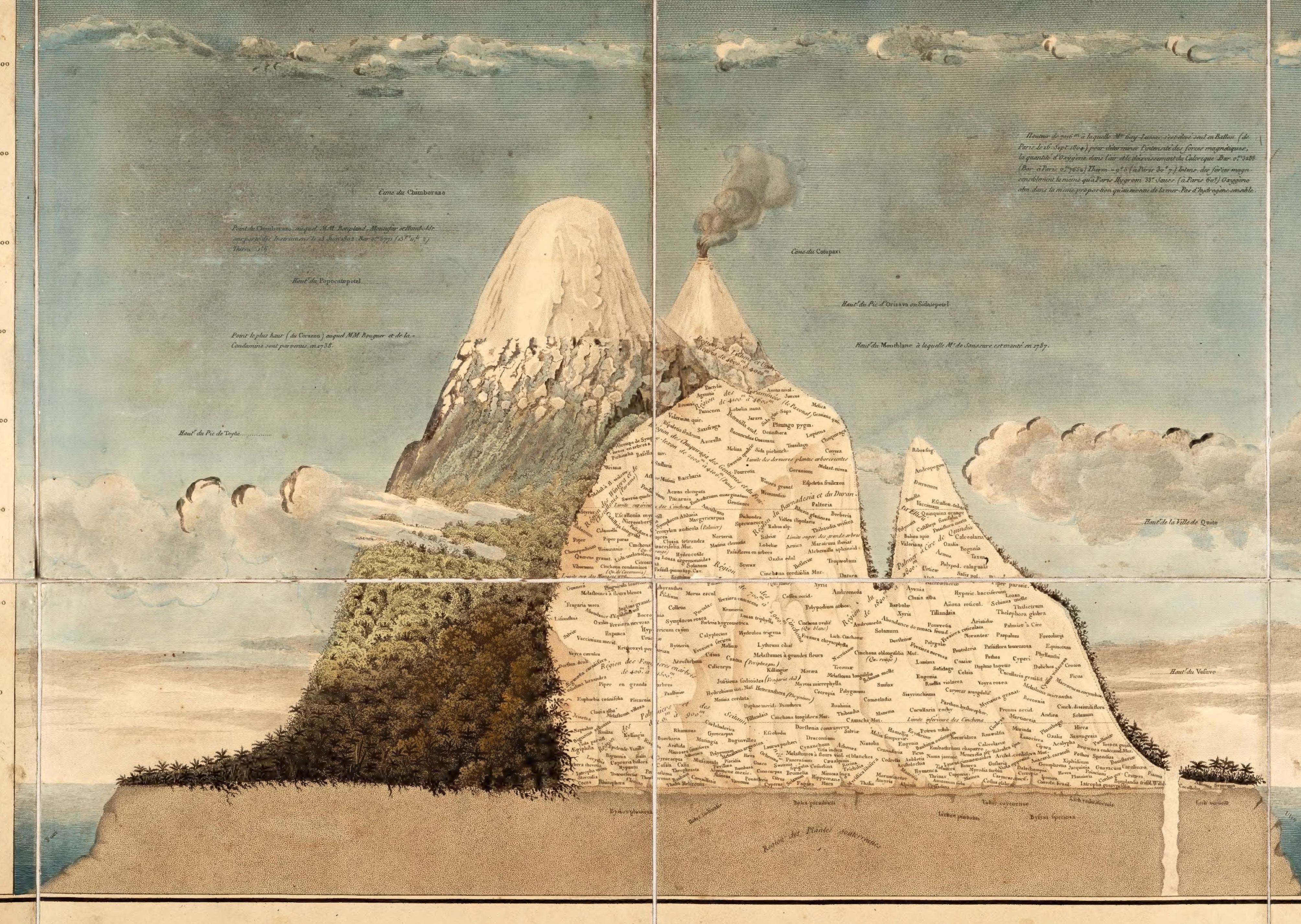
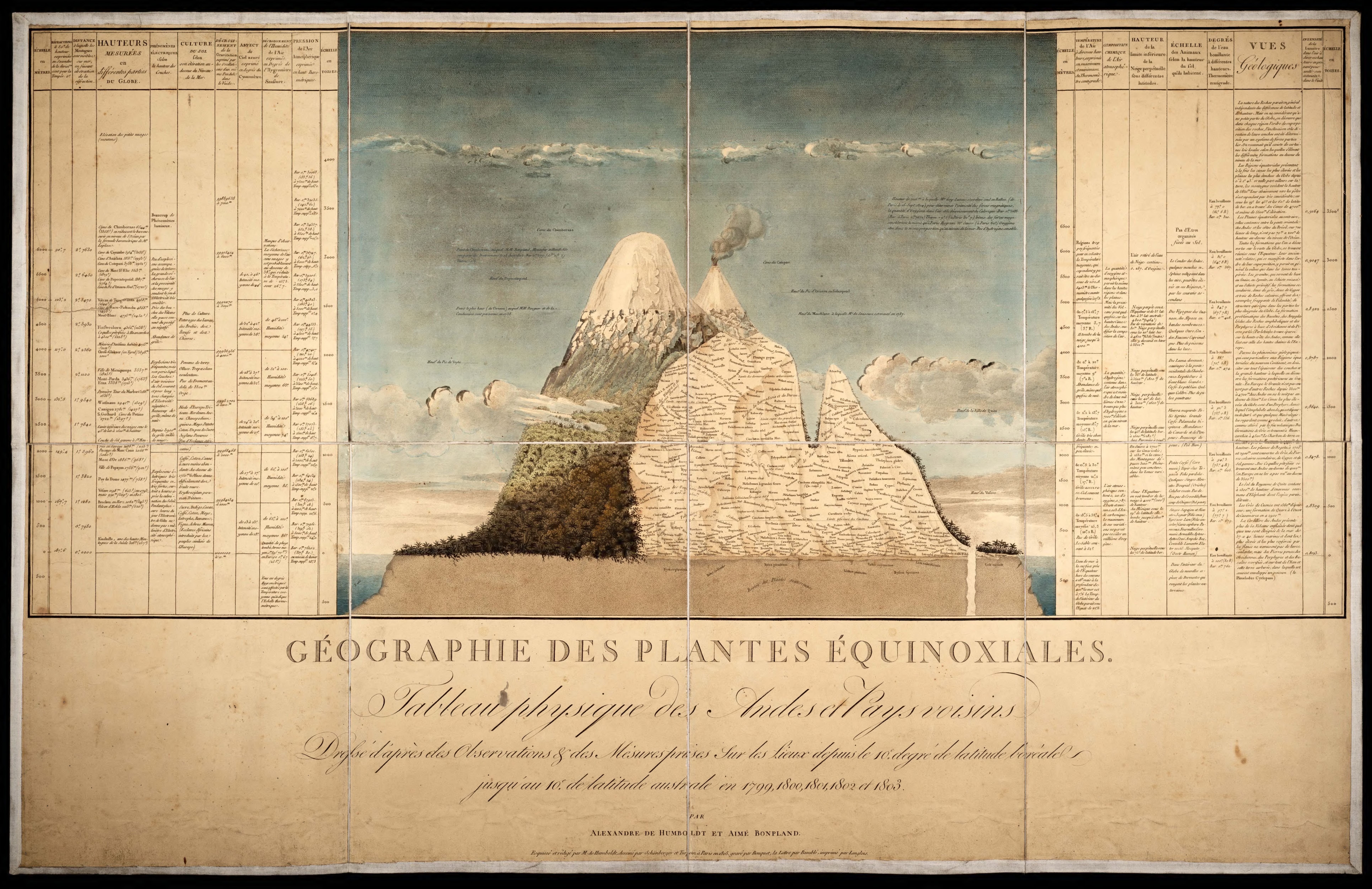
Humboldt and Bonpland’s French plant-geography plate, with a mountain cutaway filled with plant names

The French Tableau physique: Chimborazo's dome, Cotopaxi's smoking cone and plant names arranged against height. The surrounding columns belong to the argument as much as the landscape does.

Missouri Botanical Garden / Biodiversity Heritage Library

Licence: Public domain. Cover cropped for article cards and sharing.

View the original and source details
Humboldt and Bonpland’s French plant-geography plate, with a mountain cutaway filled with plant names

The French Tableau physique: Chimborazo's dome, Cotopaxi's smoking cone and plant names arranged against height. The surrounding columns belong to the argument as much as the landscape does.

Missouri Botanical Garden / Biodiversity Heritage Library

Licence: Public domain. Original image, unchanged.

View the original and source details
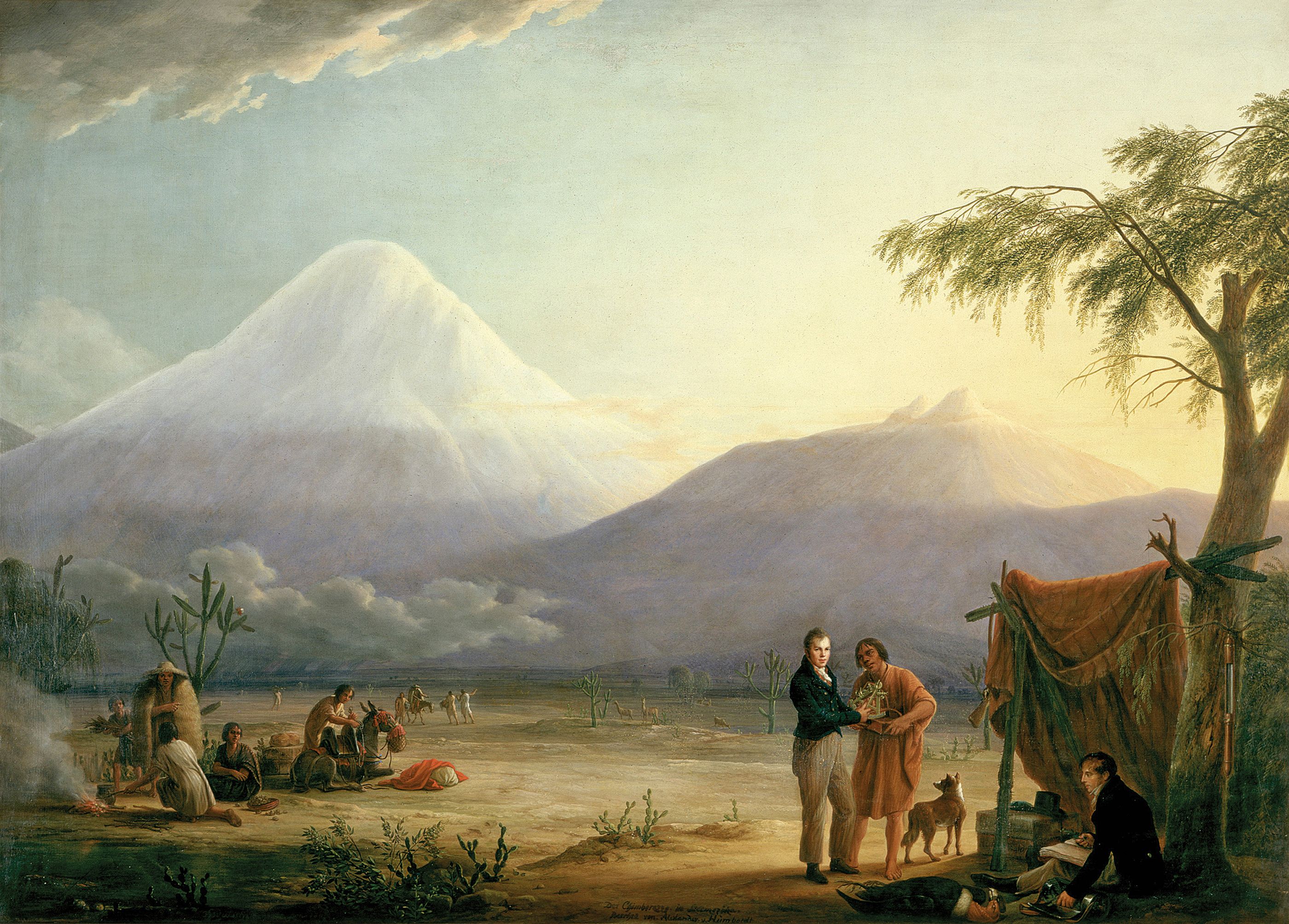
Humboldt standing and Bonpland seated with plants and collecting equipment in a painted Andean landscape

Friedrich Georg Weitsch's later composition places Humboldt standing and Bonpland seated at the lower right, among plants and collecting equipment. This is a constructed expedition portrait, rather than an eyewitness record of a day's work.

Friedrich Georg Weitsch / Stiftung Preußische Schlösser und Gärten

Licence: Public domain. Original image, unchanged.

View the original and source details
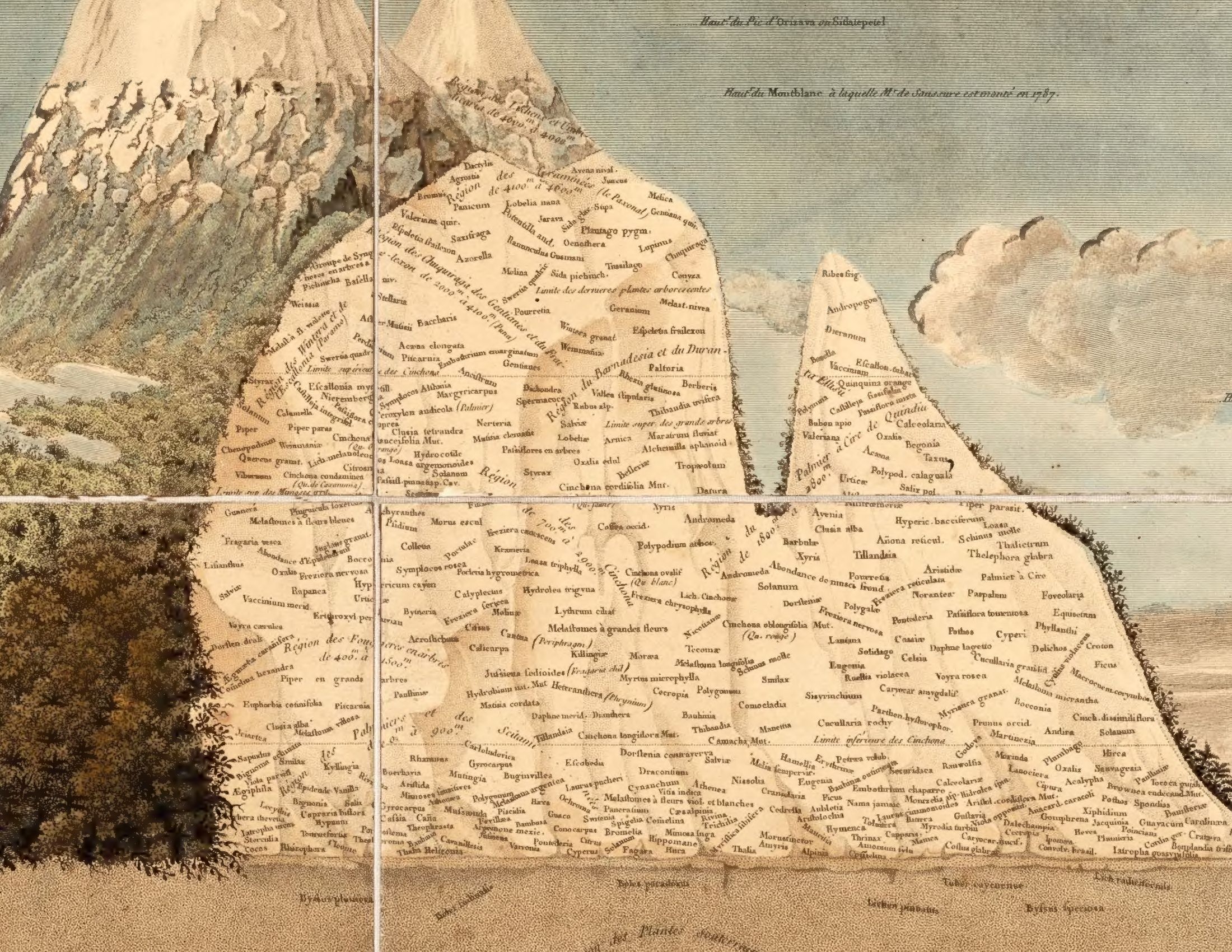
An enlarged portion of the French plate, showing Latin plant names and diagonal vegetation-zone labels inside the mountain

Detail of the French plate. Plant names, larger regional labels and the drawn surface share the mountain's interior. The paper's folds pass through the information.

Missouri Botanical Garden / Biodiversity Heritage Library

Licence: Public domain. Detail cropped from the complete plate.

View the original and source details
The deflated balloon Örnen spread across the pack ice, with equipment in the foreground

Örnen after the landing on 14 July 1897. Strindberg exposed the film on the ice; Hertzberg developed it in 1930. This paper copy was made in 1931–32.

Nils Strindberg / Tekniska museet

Licence: Public domain. Original image, unchanged.

View the original and source details
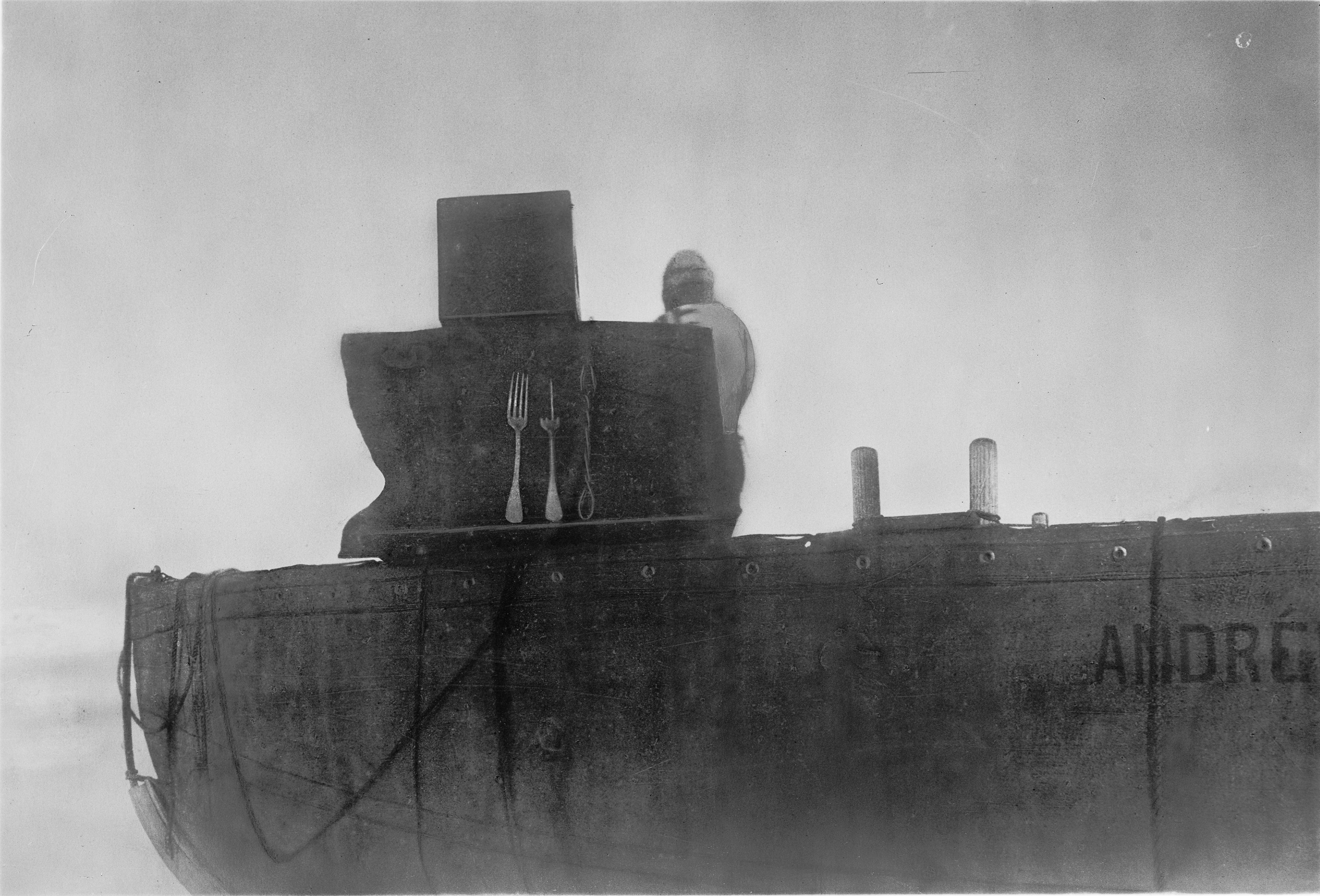
Three men working around the loaded boat and sledge at a ridge in the ice

Frænkel, left, Strindberg, centre, and Andrée, right, with the boat and sledge at a pressure ridge. The camera appears to have used an automatic release.

Nils Strindberg / Tekniska museet

Licence: Public domain. Original image, unchanged.

View the original and source details
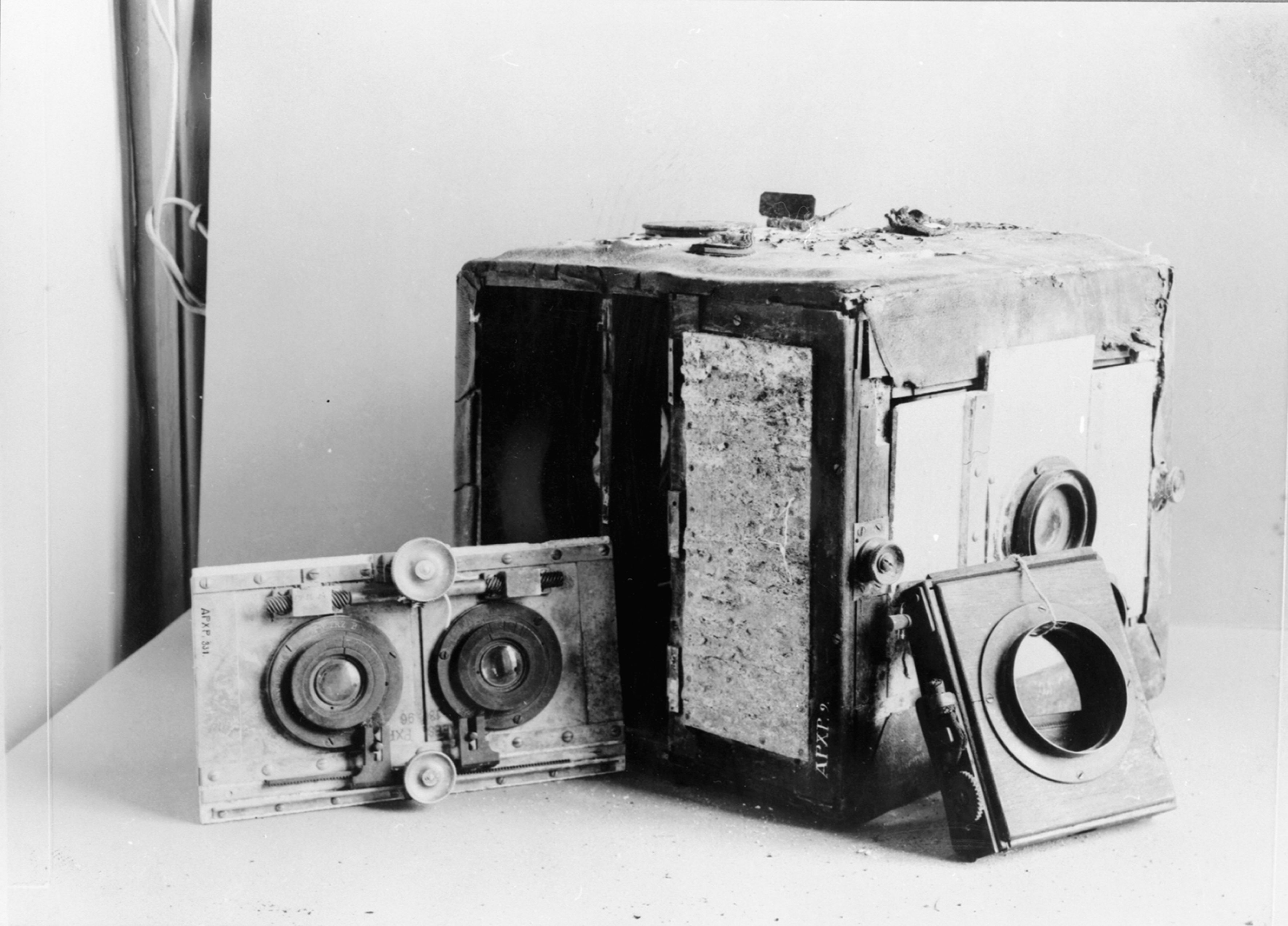
The recovered camera with a two-lens board beside it and its shutter leaning against the front

Hertzberg's photograph of the recovered apparatus, 1931–32. The separate board on the left carries the paired stereoscopic lenses; the shutter leans against the camera.

John Hertzberg / Tekniska museet

Licence: Public domain. Original image, unchanged.

View the original and source details
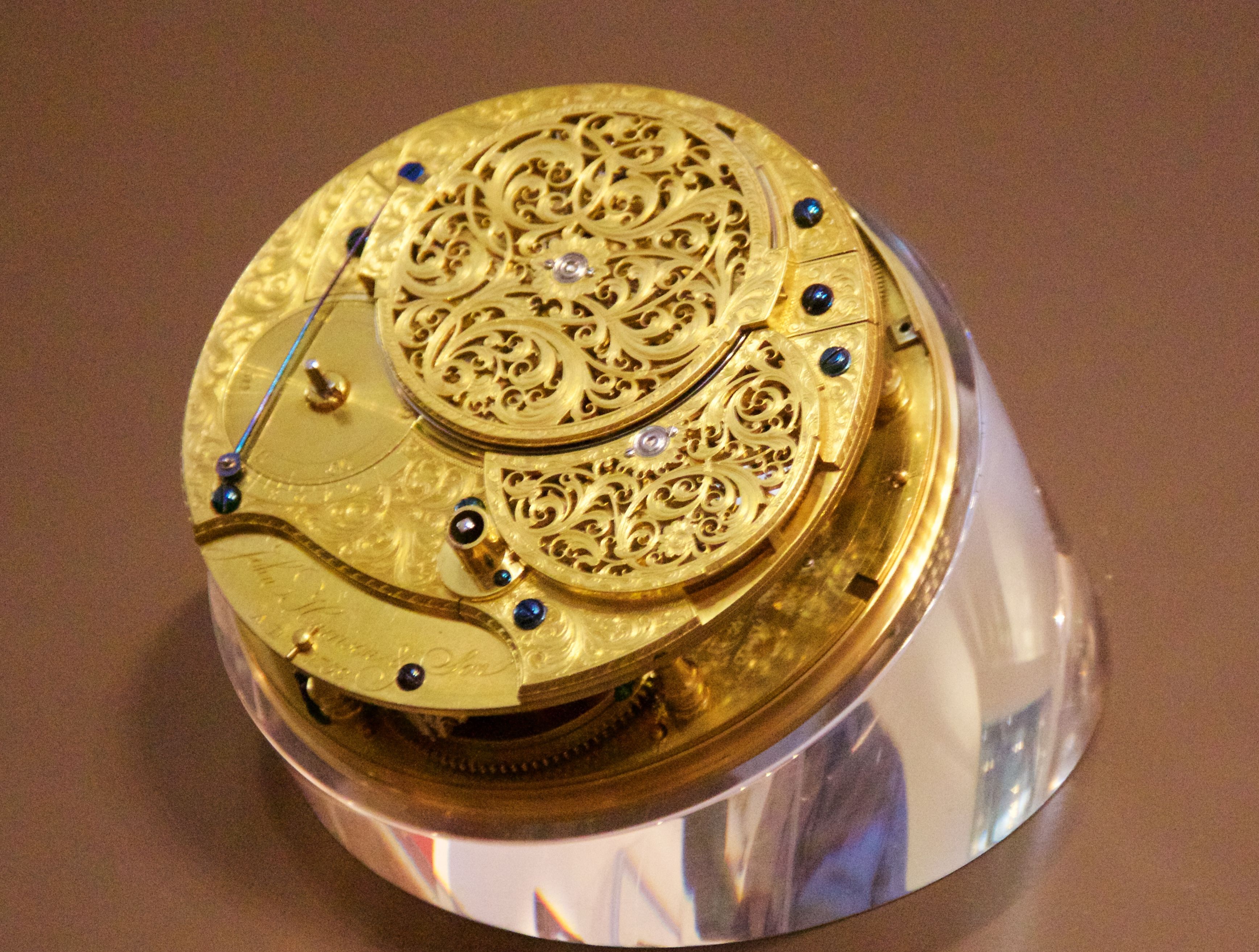
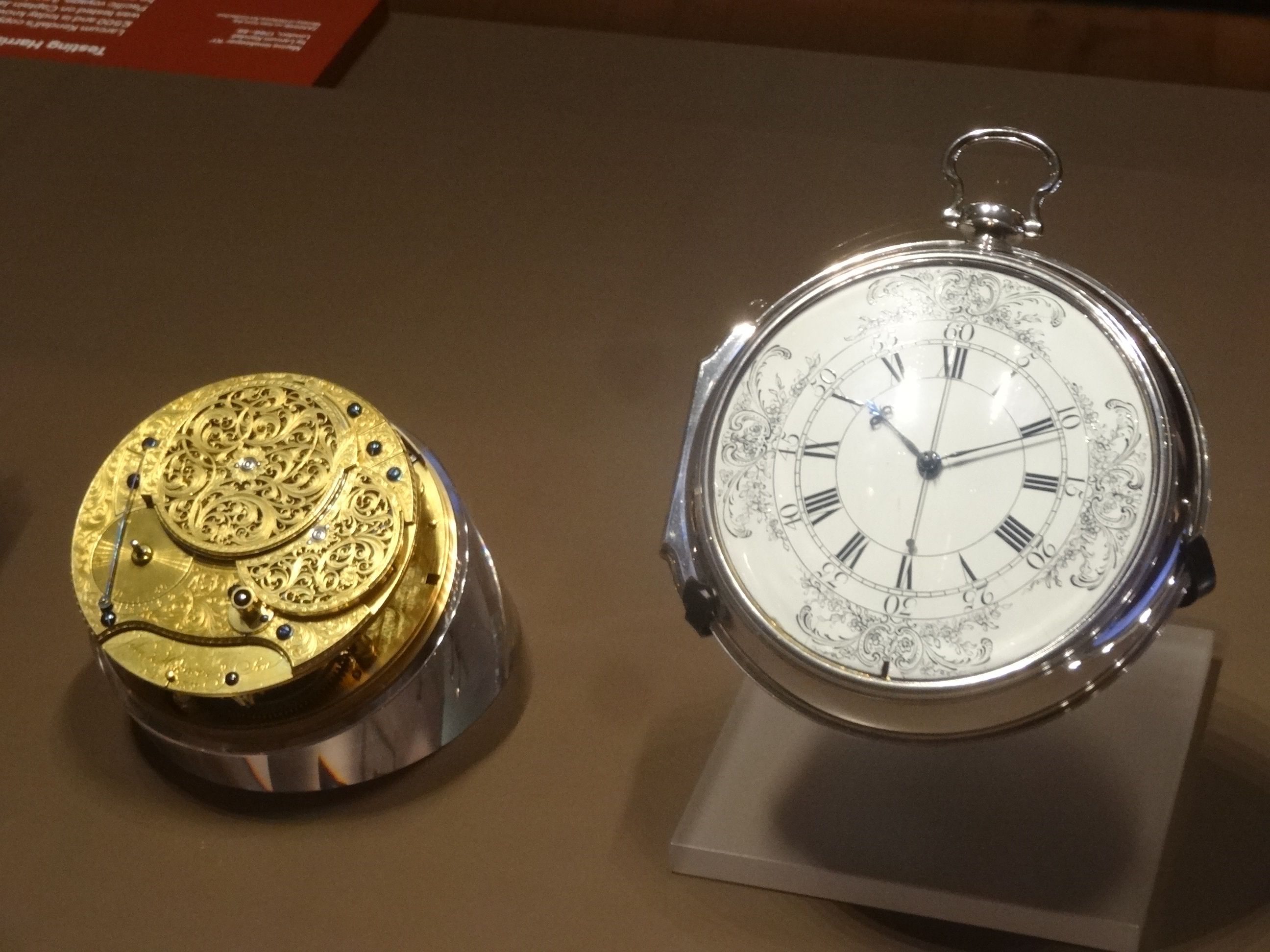
The rear of H4's gilded movement, with pierced and engraved metalwork over its mechanism

H4's movement. Its pierced and engraved metalwork covers a mechanism with separate arrangements for keeping power steady, sustaining the balance and correcting temperature changes.

Photograph by Mike Peel (www.mikepeel.net)

Licence: CC BY-SA 4.0. Cover cropped for article cards and sharing.

View the original and source details
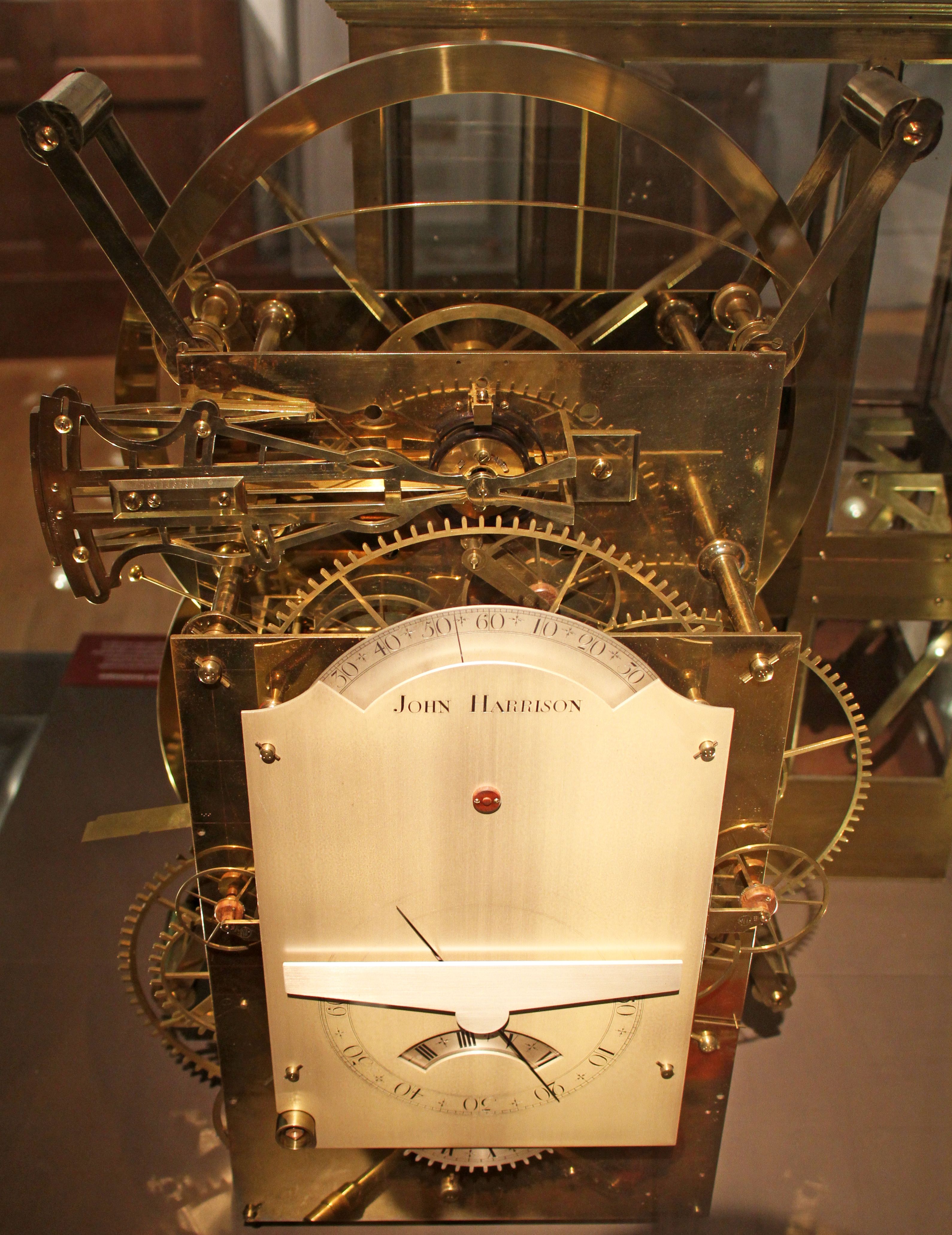
Harrison's H3, with exposed brass wheels and large circular balances above its dial

H3, the large marine timekeeper Harrison worked on from 1740. Its two circular balances belonged to a different approach from H4's fast watch balance.

Tony Hisgett

Licence: CC BY 2.0. Original image, unchanged.

View the original and source details
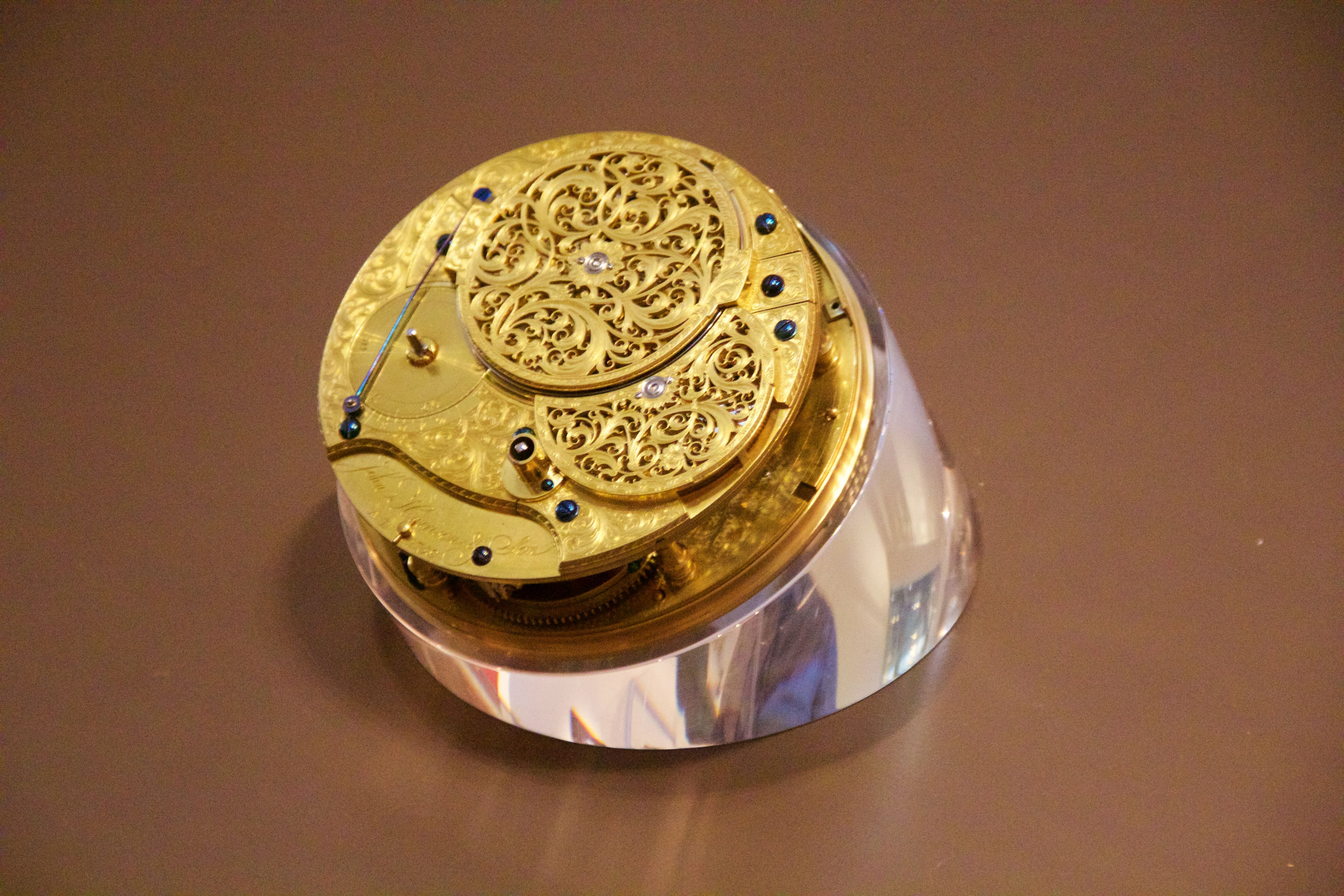
The rear of H4's gilded movement, with pierced and engraved metalwork over its mechanism

H4's movement. Its pierced and engraved metalwork covers a mechanism with separate arrangements for keeping power steady, sustaining the balance and correcting temperature changes.

Photograph by Mike Peel (www.mikepeel.net)

Licence: CC BY-SA 4.0. Original image, unchanged.

View the original and source details
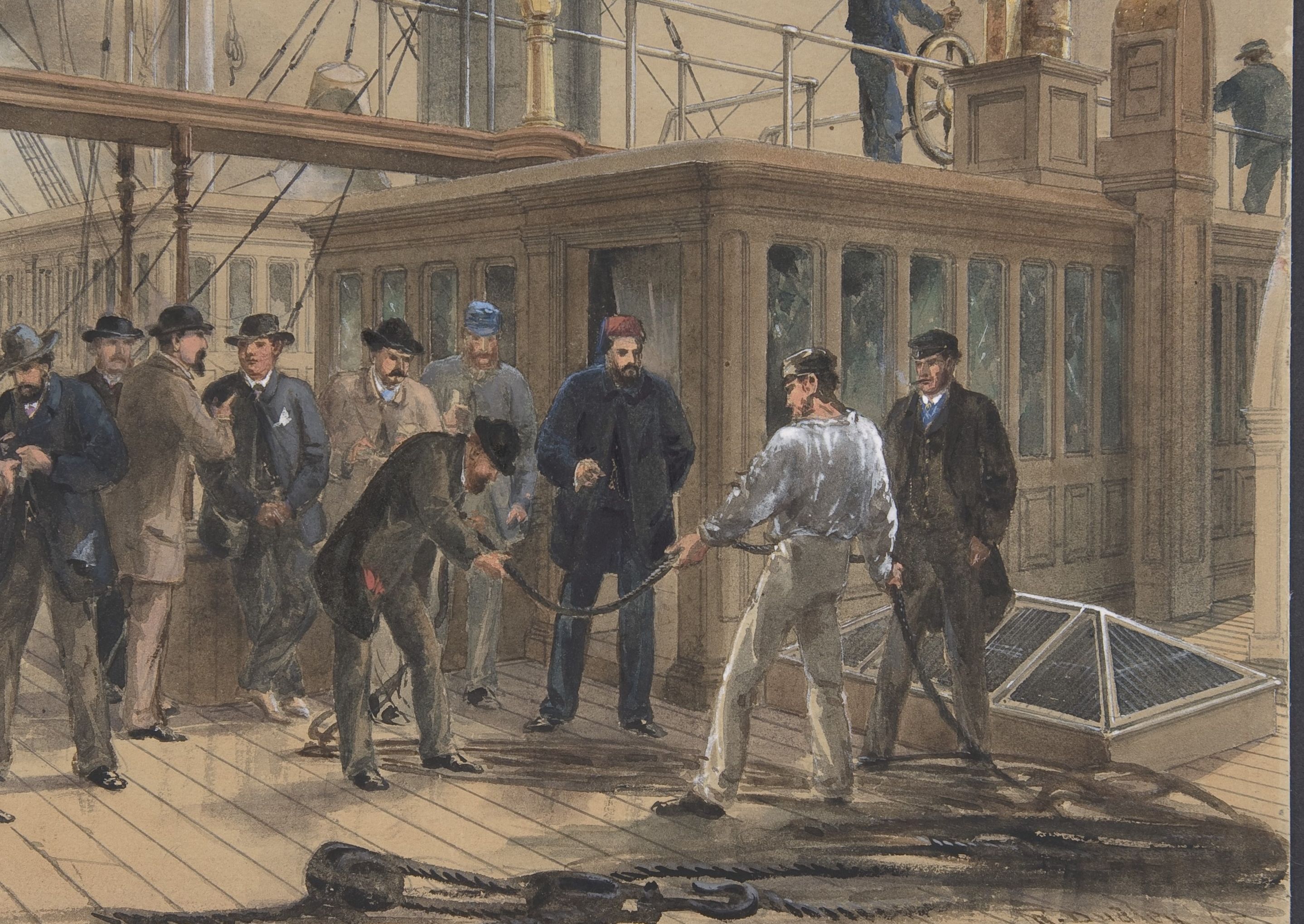
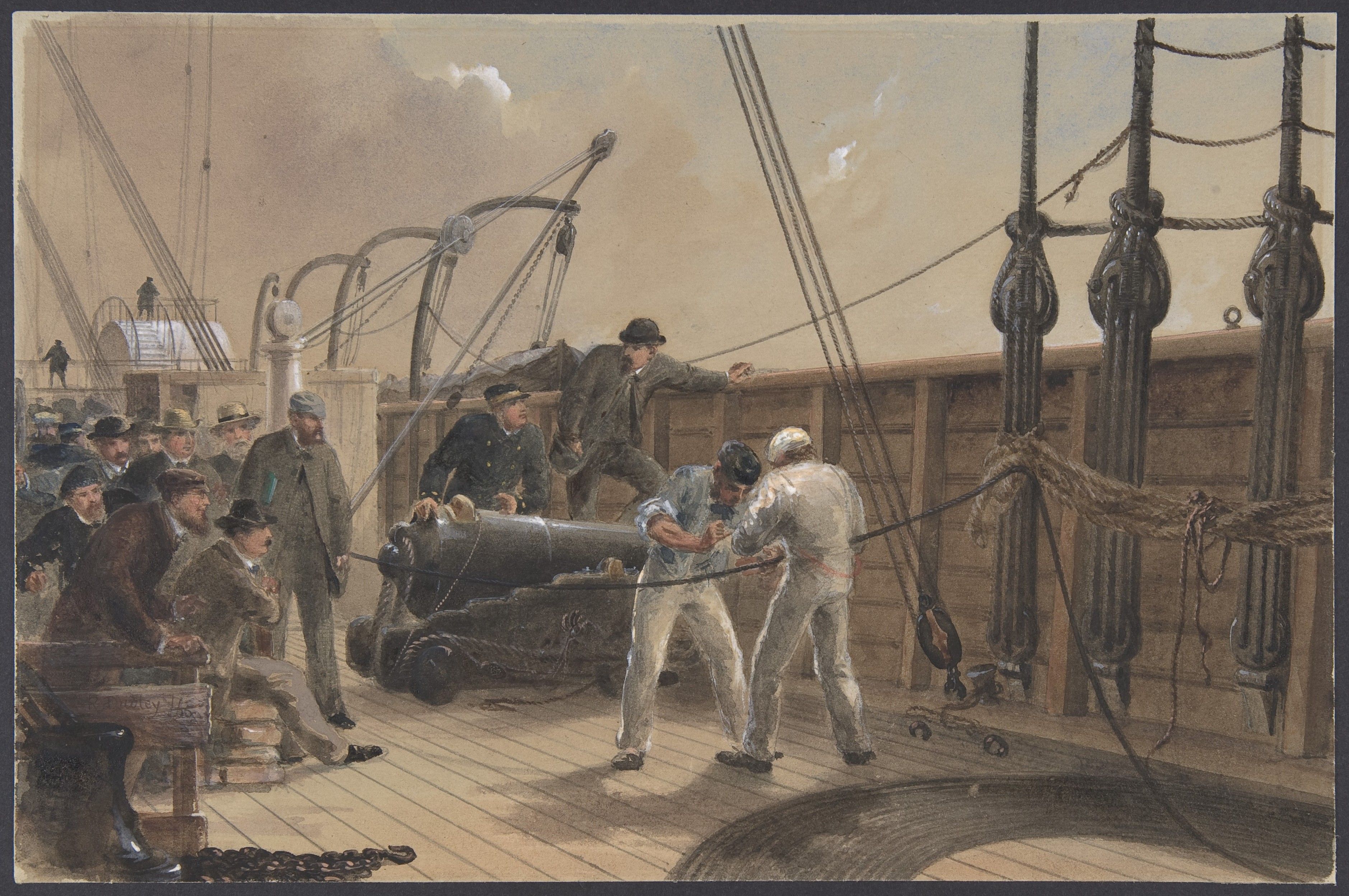
Men examining a length of cable on Great Eastern's deck beside the ship's cabins and rigging

Searching for a fault aboard Great Eastern, 31 July 1865, in Robert Charles Dudley's watercolour. Cable recovered from the sea could be examined and cut open on deck.

Robert Charles Dudley / The Metropolitan Museum of Art

Licence: Public domain. Cover cropped for article cards and sharing.

View the original and source details
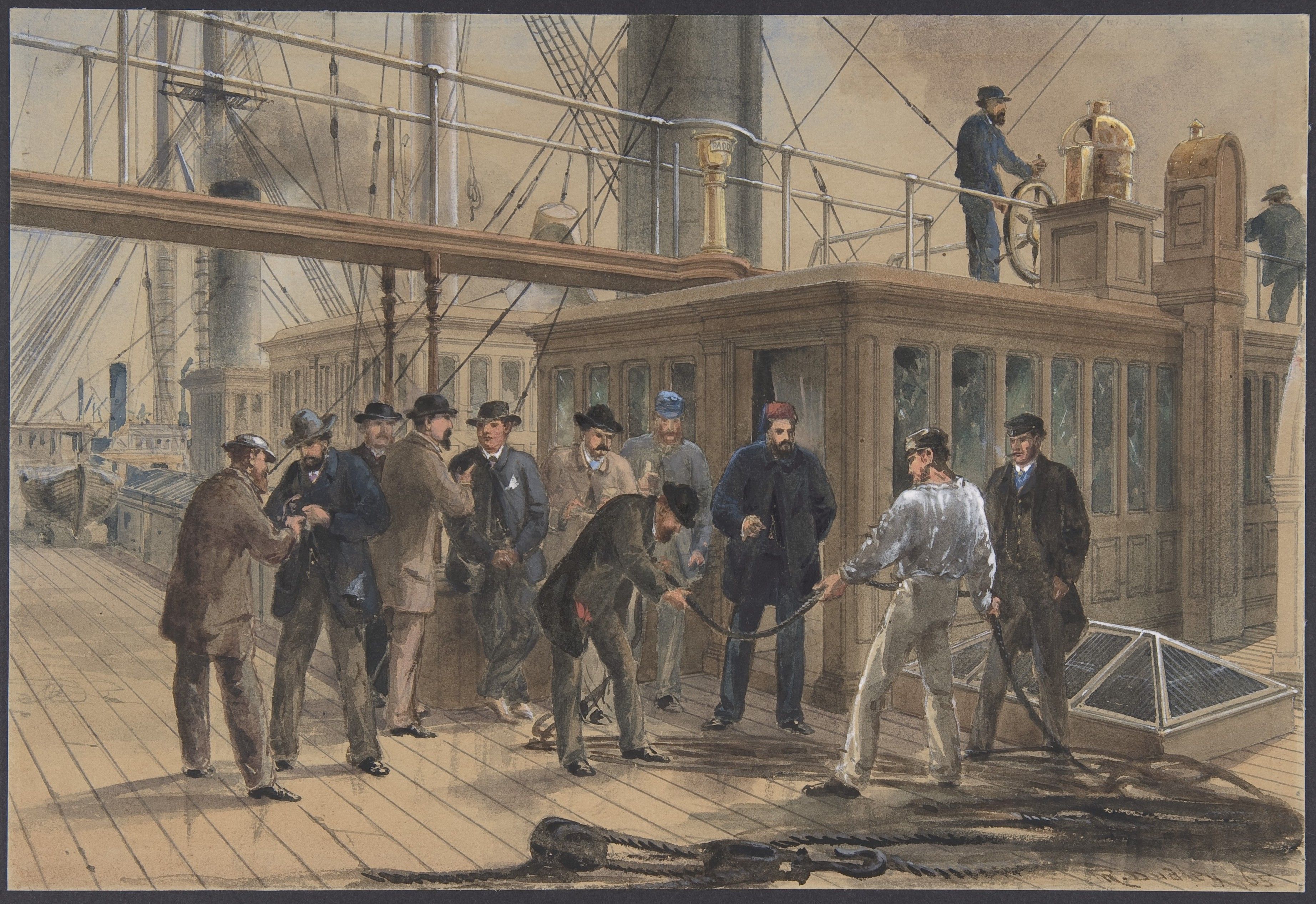
Men examining a length of cable on Great Eastern's deck beside the ship's cabins and rigging

Searching for a fault aboard Great Eastern, 31 July 1865, in Robert Charles Dudley's watercolour. Cable recovered from the sea could be examined and cut open on deck.

Robert Charles Dudley / The Metropolitan Museum of Art

Licence: Public domain. Original image, unchanged.

View the original and source details
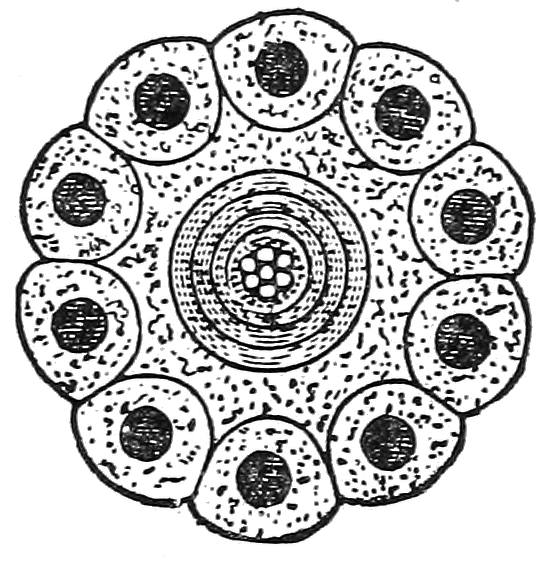
Cross-section drawing with seven central copper wires, concentric insulation and ten individually wrapped outer wires

The main Atlantic cable type of 1865–66, illustrated in Charles Bright's 1903 history. Seven central copper wires sit inside the insulation; ten separately wrapped armouring wires surround it.

Charles Bright, The Story of the Atlantic Cable

Licence: Public domain. Original image, unchanged.

View the original and source details
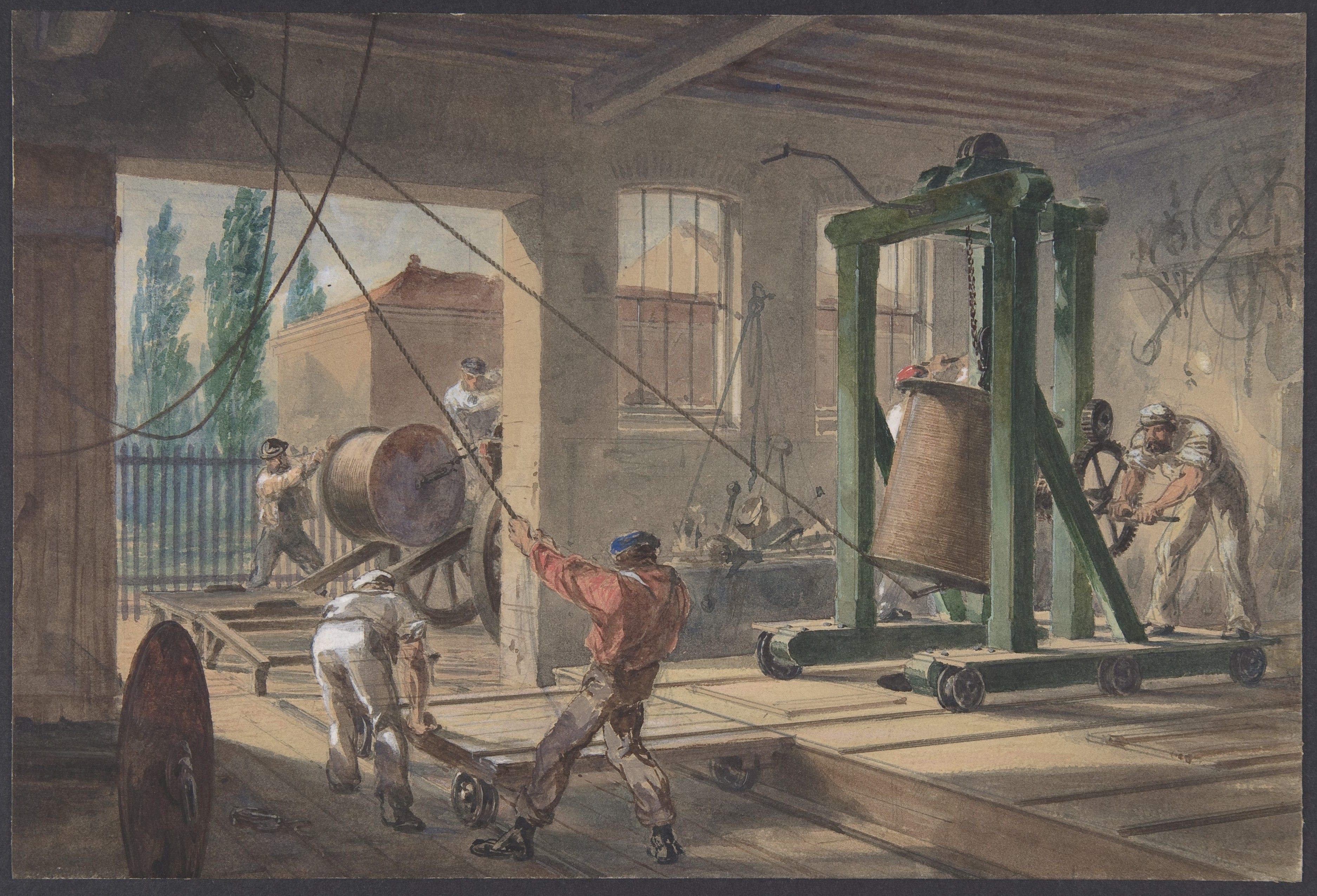
Factory workers moving large reels with ropes and a wheeled gantry at Greenwich

Reels of gutta-percha-covered conducting wire at the Greenwich works, 1865–66. This was the insulated core, awaiting its external protection.

Robert Charles Dudley / The Metropolitan Museum of Art

Licence: Public domain. Original image, unchanged.

View the original and source details
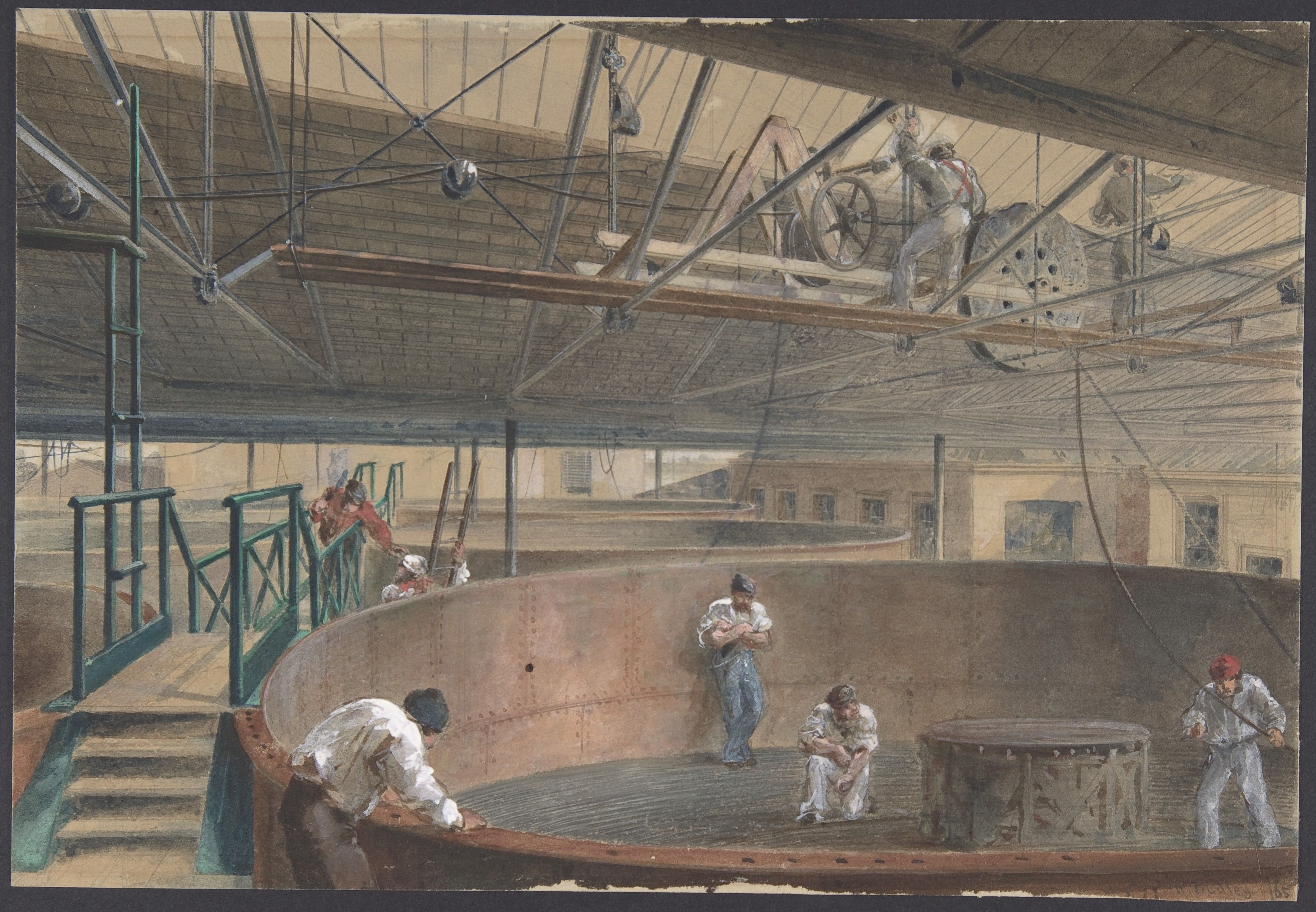
Men handling and coiling cable inside a large circular iron tank beneath a factory roof

Coiling cable at Greenwich in 1865. Large tanks allowed the finished line to be stored under water and tested before shipment.

Robert Charles Dudley / The Metropolitan Museum of Art

Licence: Public domain. Original image, unchanged.

View the original and source details
Workmen joining a cable on Great Eastern's deck while other men observe beside machinery

Splicing after the first fault, 25 July 1865. Dudley placed the working cablemen beside the machinery and the watching group.

Robert Charles Dudley / The Metropolitan Museum of Art

Licence: Public domain. Original image, unchanged.

View the original and source details
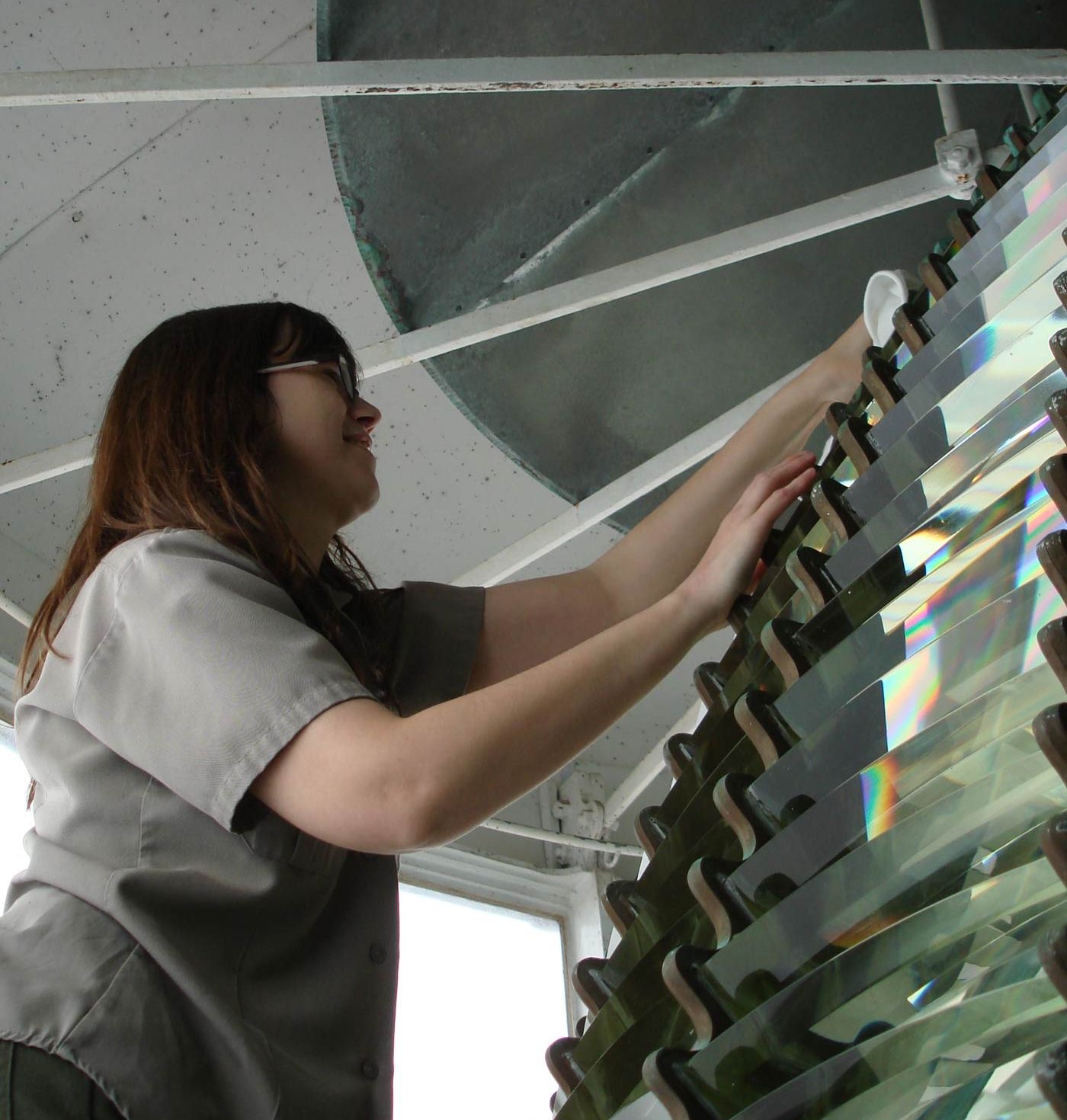
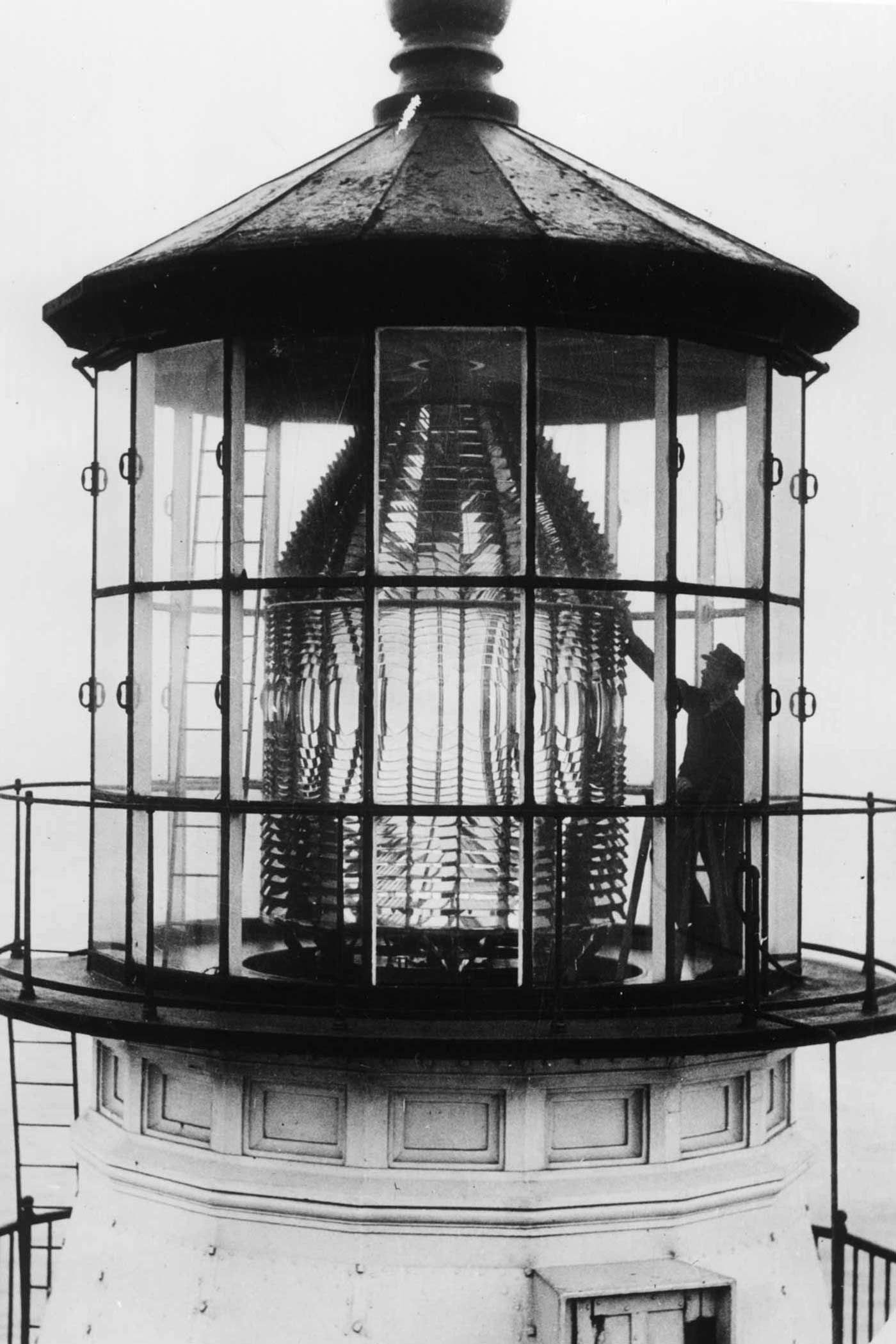
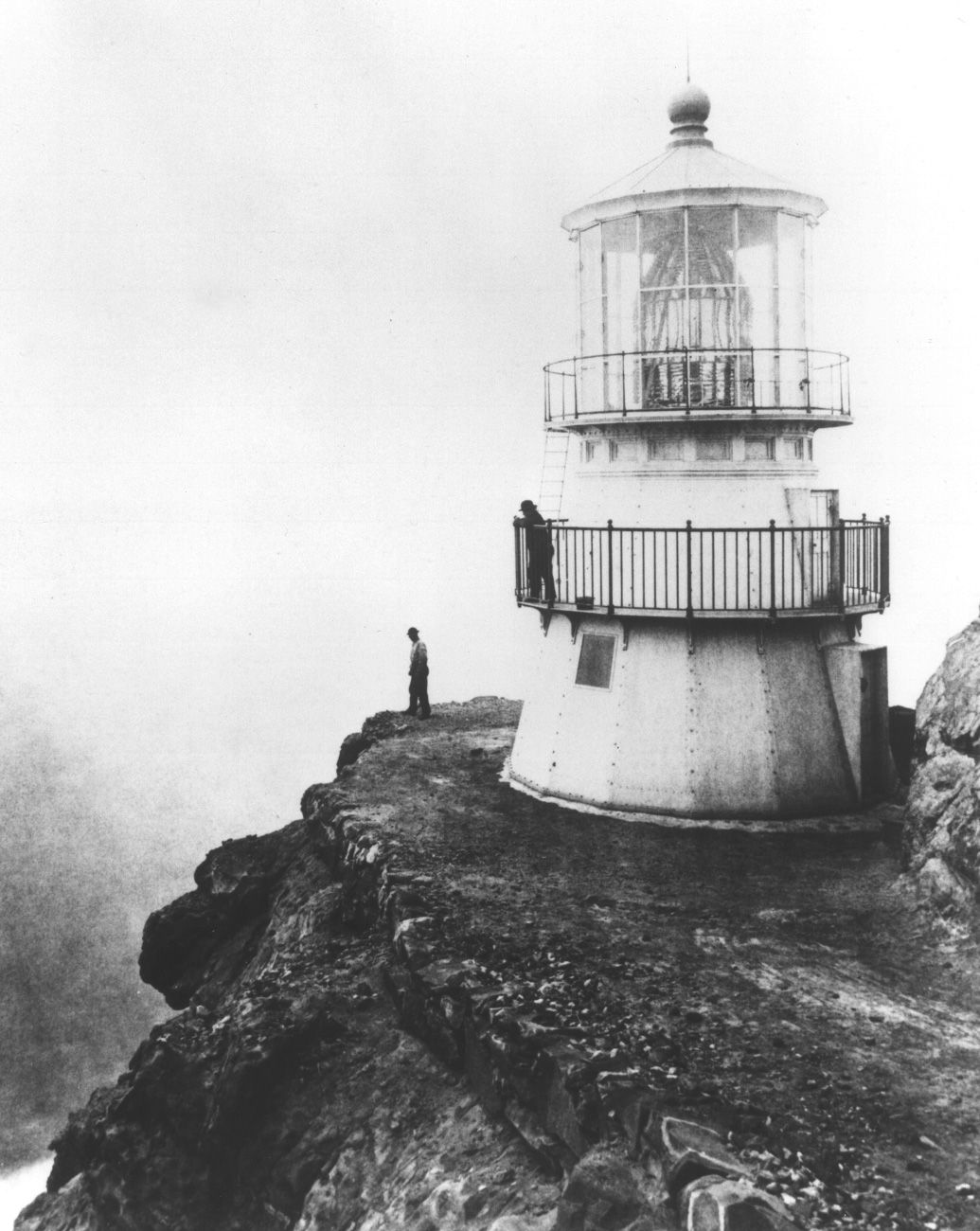
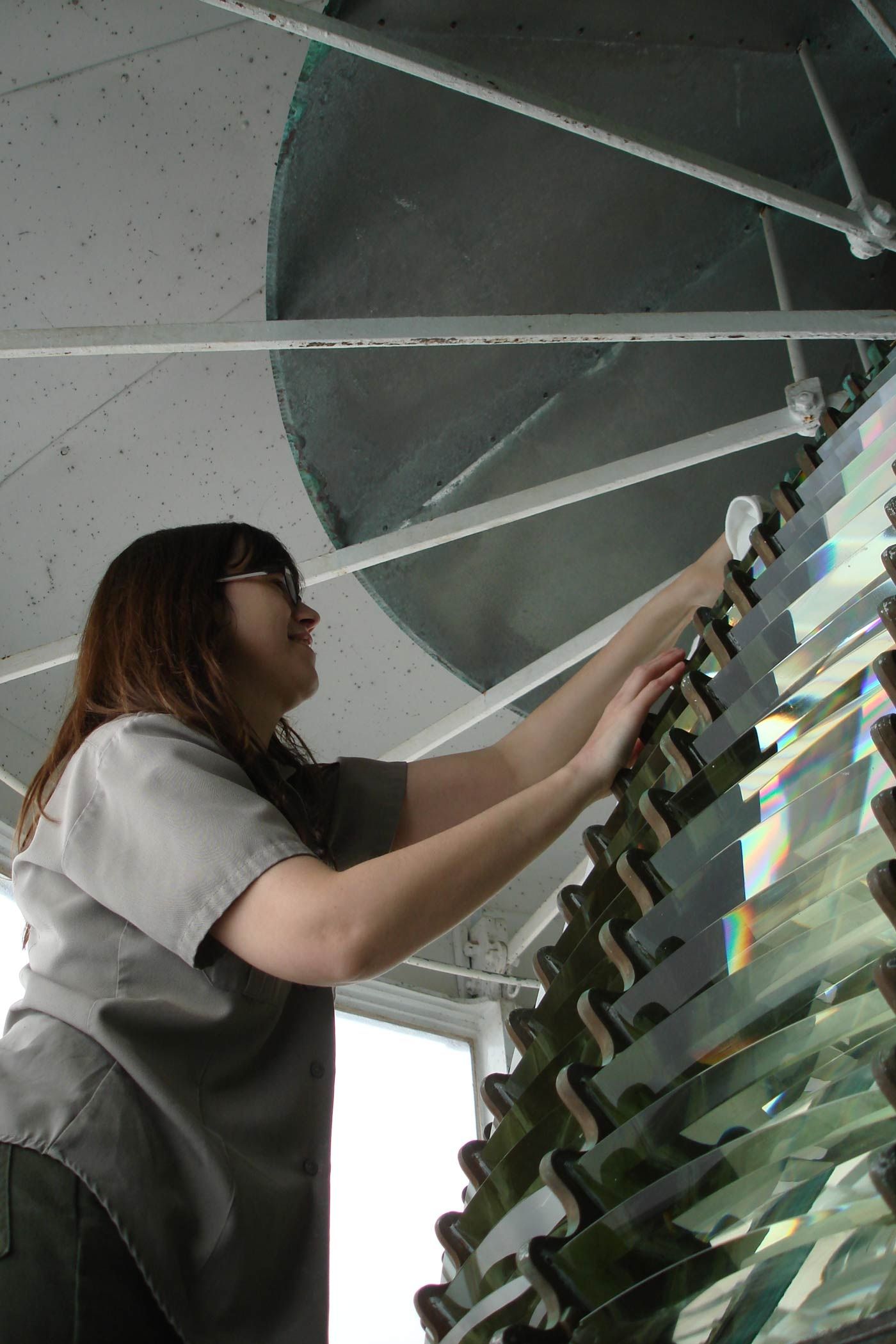
George Jaehne reaching up to clean the large glass lens inside the Point Reyes lantern

Keeper George Jaehne cleaning the Point Reyes lens in 1927. The figure beside the glass gives the first-order apparatus its human scale.

Point Reyes National Seashore, Howard B. Underhill Collection

Licence: Public domain. Original image, unchanged.

View the original and source details
The newly built Point Reyes Lighthouse standing on a narrow rocky ledge above the sea, with two people beside it

Point Reyes in 1870, photographed by Eadweard Muybridge. The short tower stood on a shelf below the headland, with little ground between its base and the sea.

Eadweard Muybridge / National Archives / Point Reyes National Seashore

Licence: Public domain. Original image, unchanged.

View the original and source details
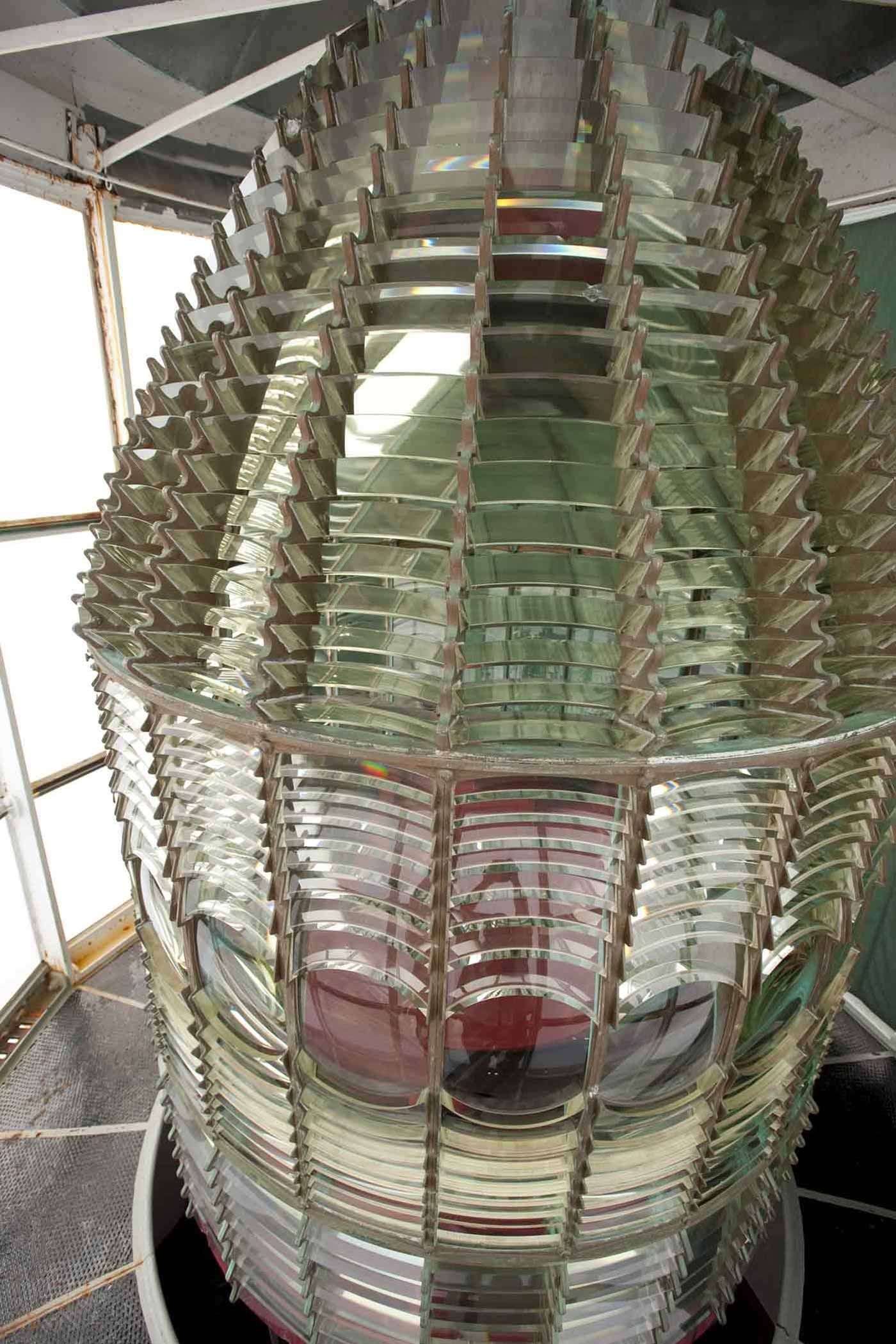
The central bull's-eye, surrounding rings and upper banks of prisms in the Point Reyes lens

Different zones of the Point Reyes optic collect light leaving the source at different angles. The central bull's-eye and surrounding rings form part of one of its twenty-four panels.

National Park Service

Licence: Public domain. Original image, unchanged.

View the original and source details
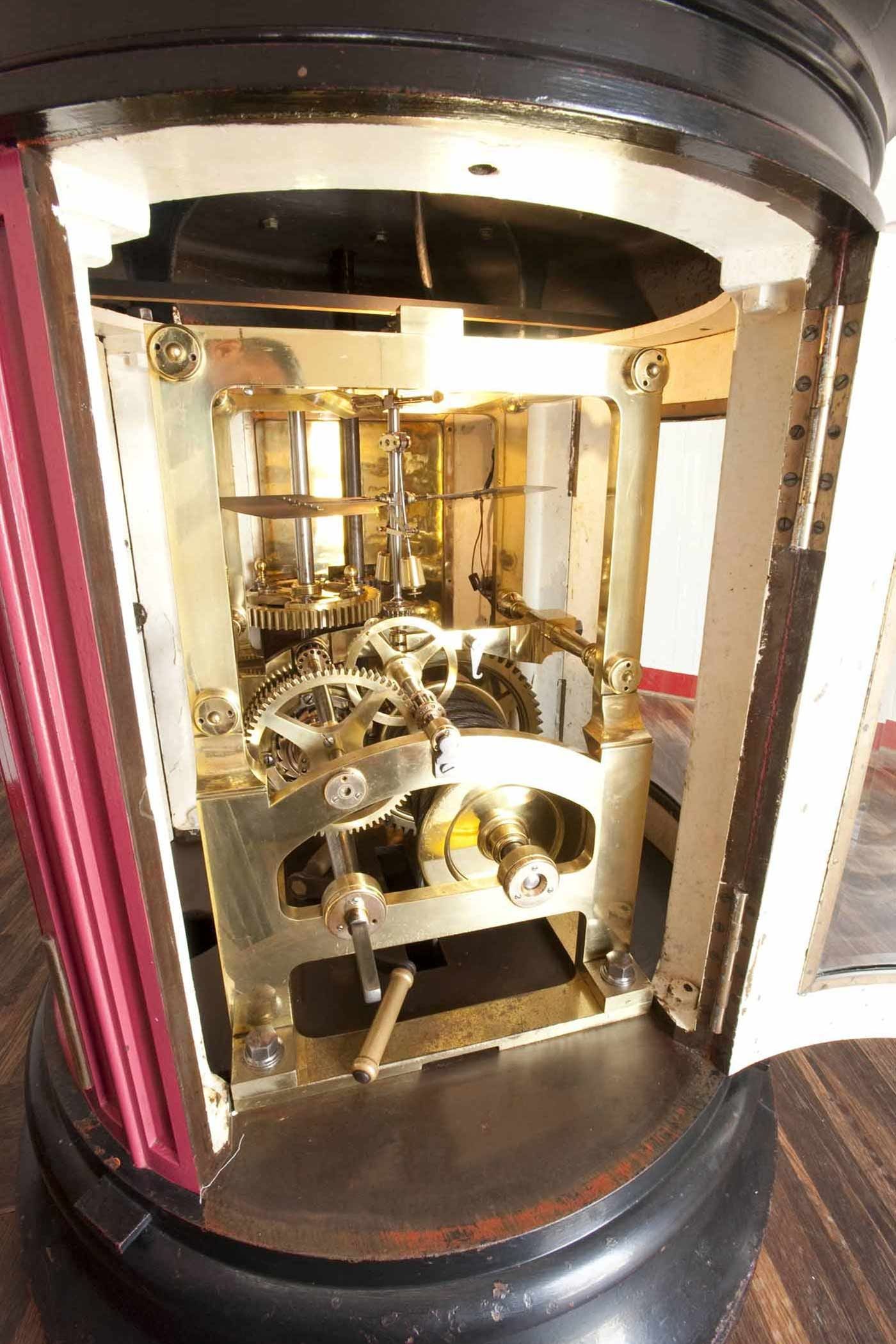
The open brass clockwork case beneath the Point Reyes lens, revealing gears and shafts

The clockwork below the lens. A falling weight supplied power; the gearing and governor controlled the rotation that produced the lighthouse's identifying flashes.

National Park Service

Licence: Public domain. Original image, unchanged.

View the original and source details
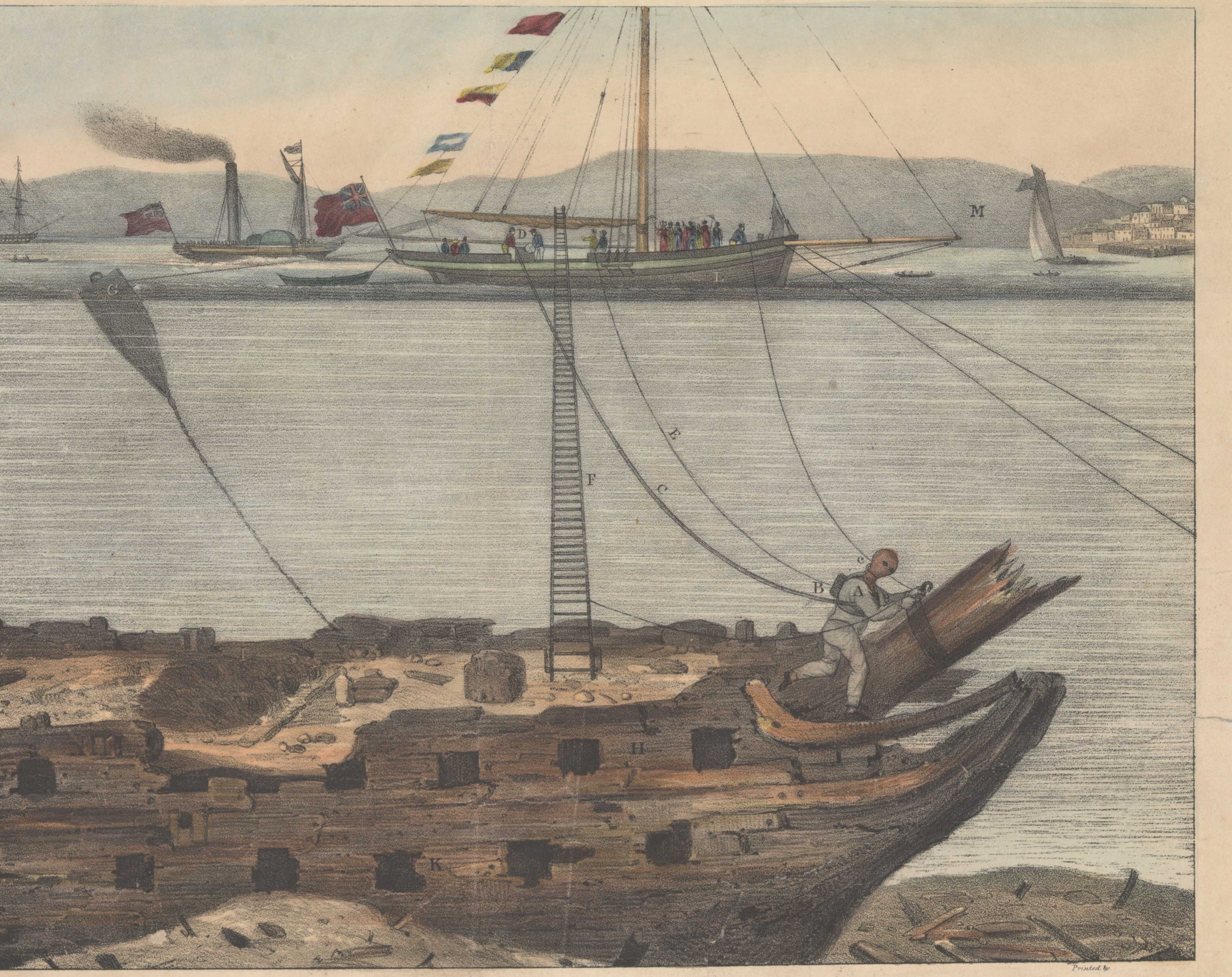
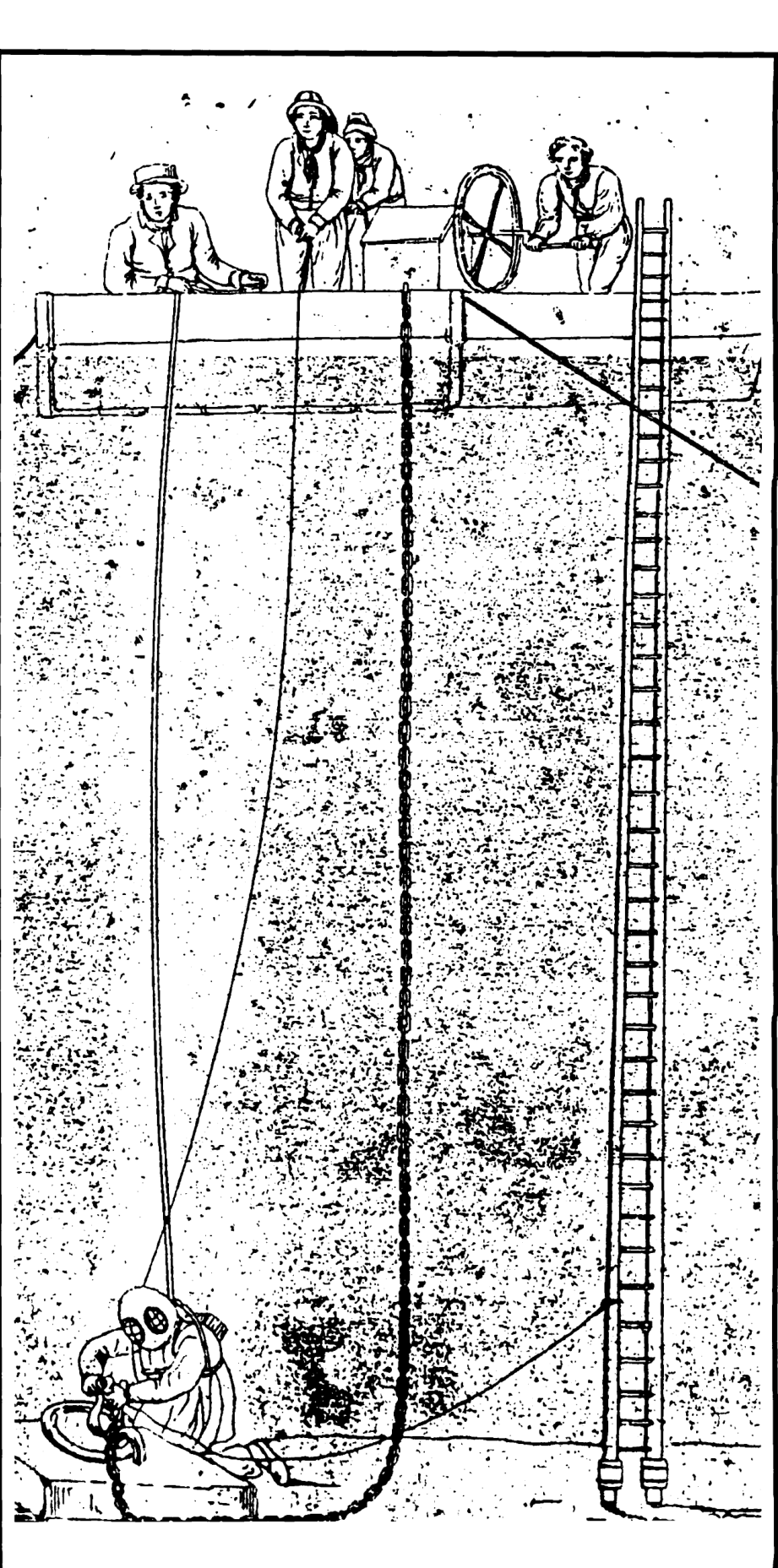
A cutaway view of a helmet diver on the wreck of Royal George, connected by hose and lines to a vessel above

Deane working on Royal George in August 1832, in a lithograph published the following May. The cutaway connects the diver, air pump, signal line and weighted ladder. This depicts the earlier salvage work, before Pasley's clearance operation.

National Maritime Museum, Greenwich

Licence: Public domain. Cropped to remove a modern colour scale. Cover cropped for article cards and sharing.

View the original and source details
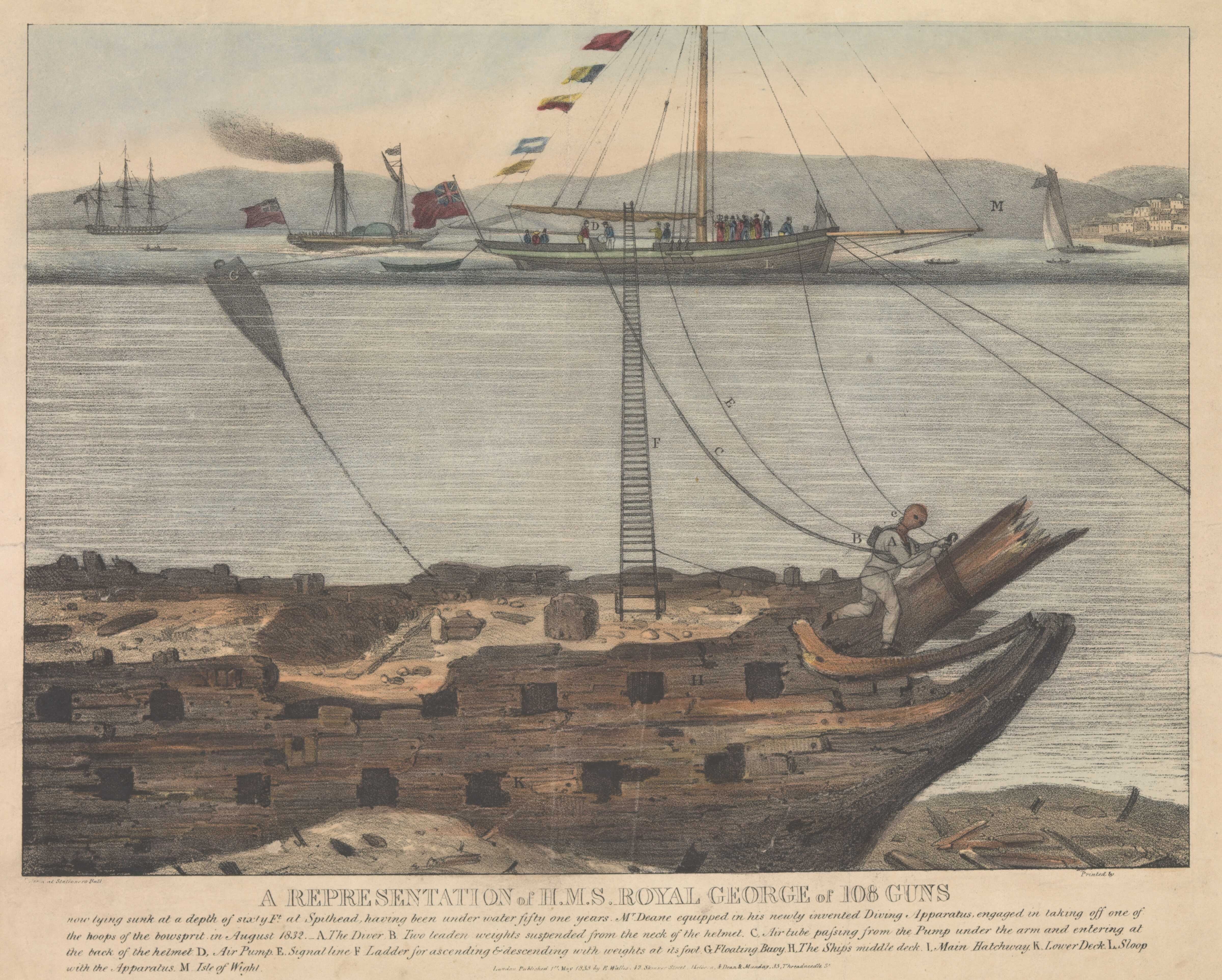
A cutaway view of a helmet diver on the wreck of Royal George, connected by hose and lines to a vessel above

Deane working on Royal George in August 1832, in a lithograph published the following May. The cutaway connects the diver, air pump, signal line and weighted ladder. This depicts the earlier salvage work, before Pasley's clearance operation.

National Maritime Museum, Greenwich

Licence: Public domain. Cropped to remove a modern colour scale.

View the original and source details
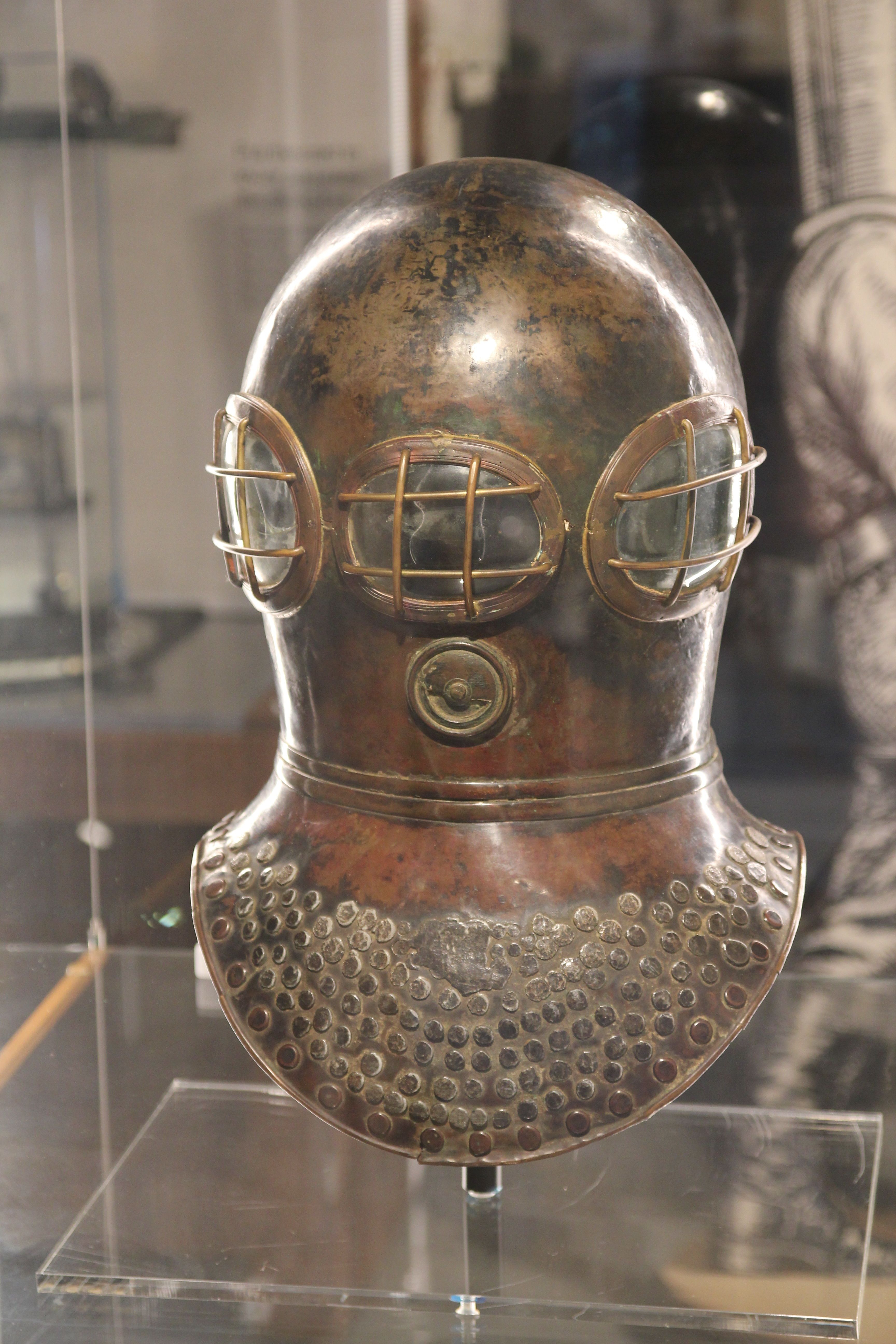
A surviving copper Deane smoke and diving helmet with three guarded windows and a broad perforated shoulder plate

The early Deane smoke/diving helmet, made by Augustus Siebe in the late 1820s. Its guarded windows and broad shoulder plate survive; the air supply came from a pump above.

Tim Sheerman-Chase

Licence: CC BY 4.0. Orientation adjusted.

View the original and source details
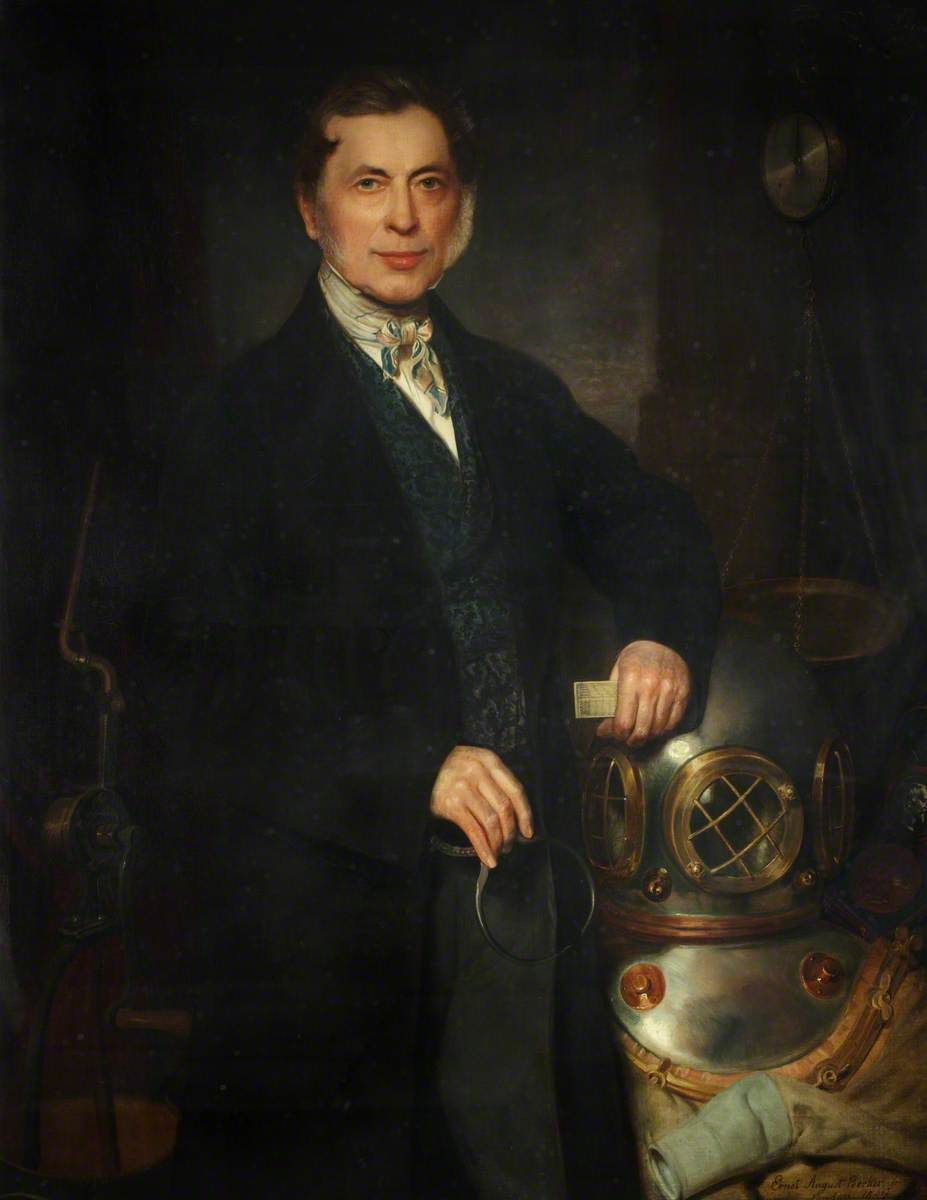
Augustus Siebe holding a slide rule beside a diving helmet, suit and workshop equipment

Augustus Siebe beside diving equipment in Ernest August Becker's portrait of 1859. The painting places the maker with a later closed helmet and dress.

Ernest August Becker / Science Museum, London

Licence: Public domain. Original image, unchanged.

View the original and source details
A contemporary illustration of men turning an air pump and tending lines while Deane fixes a chain to a submerged stone mooring

Deane shackling a chain to a stone mooring at the Commercial Dock, September 1833. An illustration from his Submarine Researches, published in 1836, connects the hands at the pump with the work below.

Charles A. Deane, Submarine Researches

Licence: Public domain. Historical illustration extracted from the later reproduction.

View the original and source details
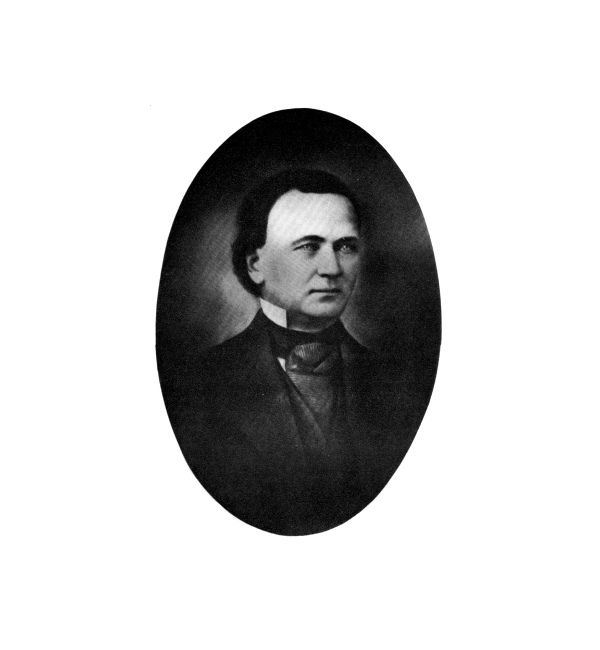
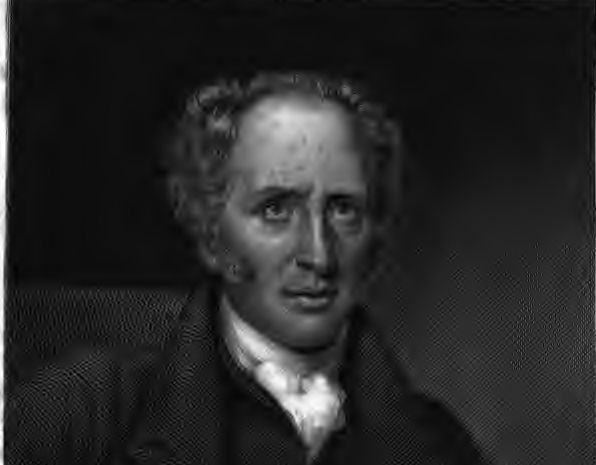
John Hodgson in a dark coat and white neckcloth

John Hodgson, the clergyman who carried lamps into Hebburn Colliery and reported their use to Davy. Frontispiece to James Raine's 1857 memoir.

James Raine, A Memoir of the Rev. John Hodgson

Licence: Public domain. Cover cropped for article cards and sharing.

View the original and source details
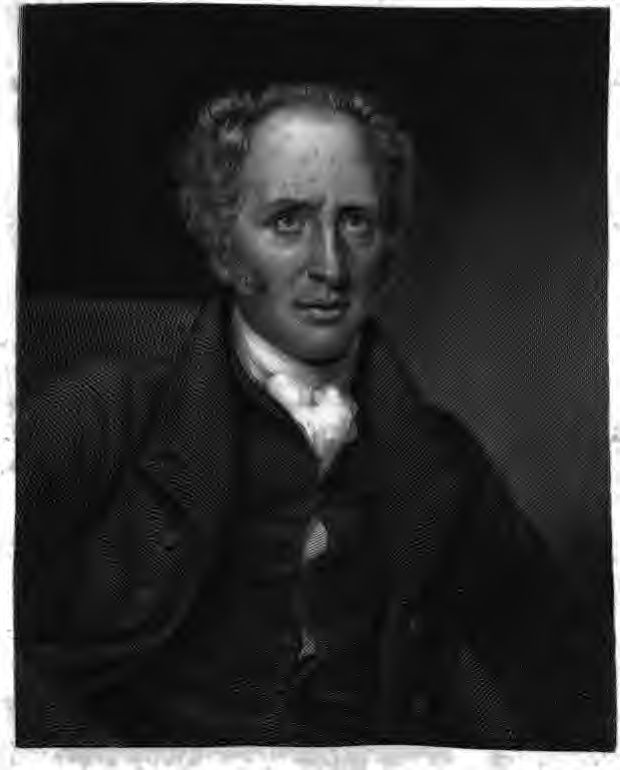
John Hodgson in a dark coat and white neckcloth

John Hodgson, the clergyman who carried lamps into Hebburn Colliery and reported their use to Davy. Frontispiece to James Raine's 1857 memoir.

James Raine, A Memoir of the Rev. John Hodgson

Licence: Public domain. Original image, unchanged.

View the original and source details
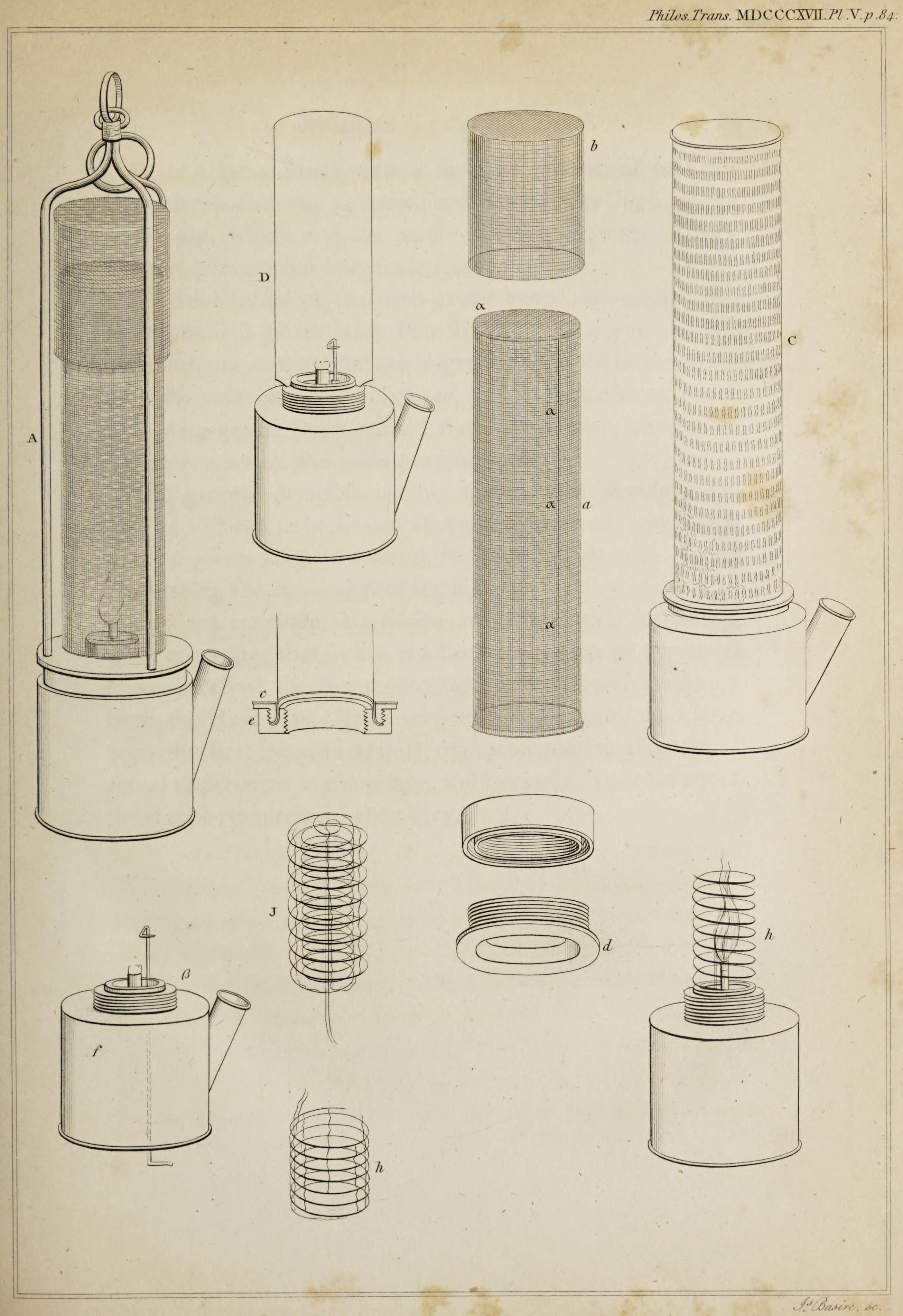
An assembled gauze lamp and its separate cylinders, reservoir and experimental wire attachments

Davy's lamp and refinements, published in 1817. At left, the assembled lamp has strong outer supports around its fine gauze; separate cylinders and other experimental fittings occupy the rest of the plate.

J. Basire / Philosophical Transactions

Licence: Public domain. Original image, unchanged.

View the original and source details
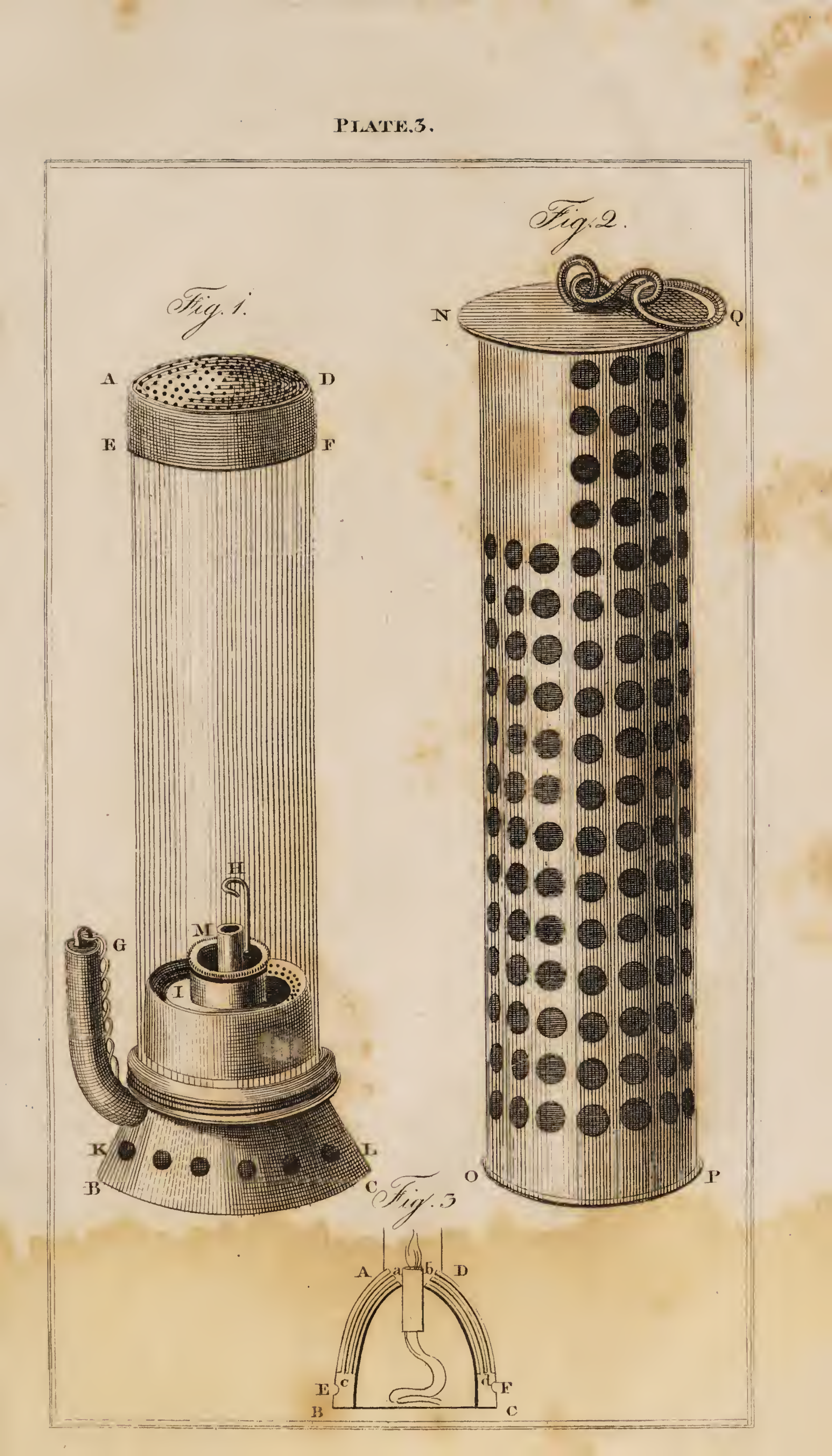
Stephenson's glass chimney lamp, its perforated protective cover and a section through the air chamber
Stephenson's third design in his 1817 publication. The glass chimney is shown separately from its protective cover; below, a section explains the air passages around the reservoir.

George Stephenson, A Description of the Safety Lamp

Licence: Public domain. Original image, unchanged.

View the original and source details
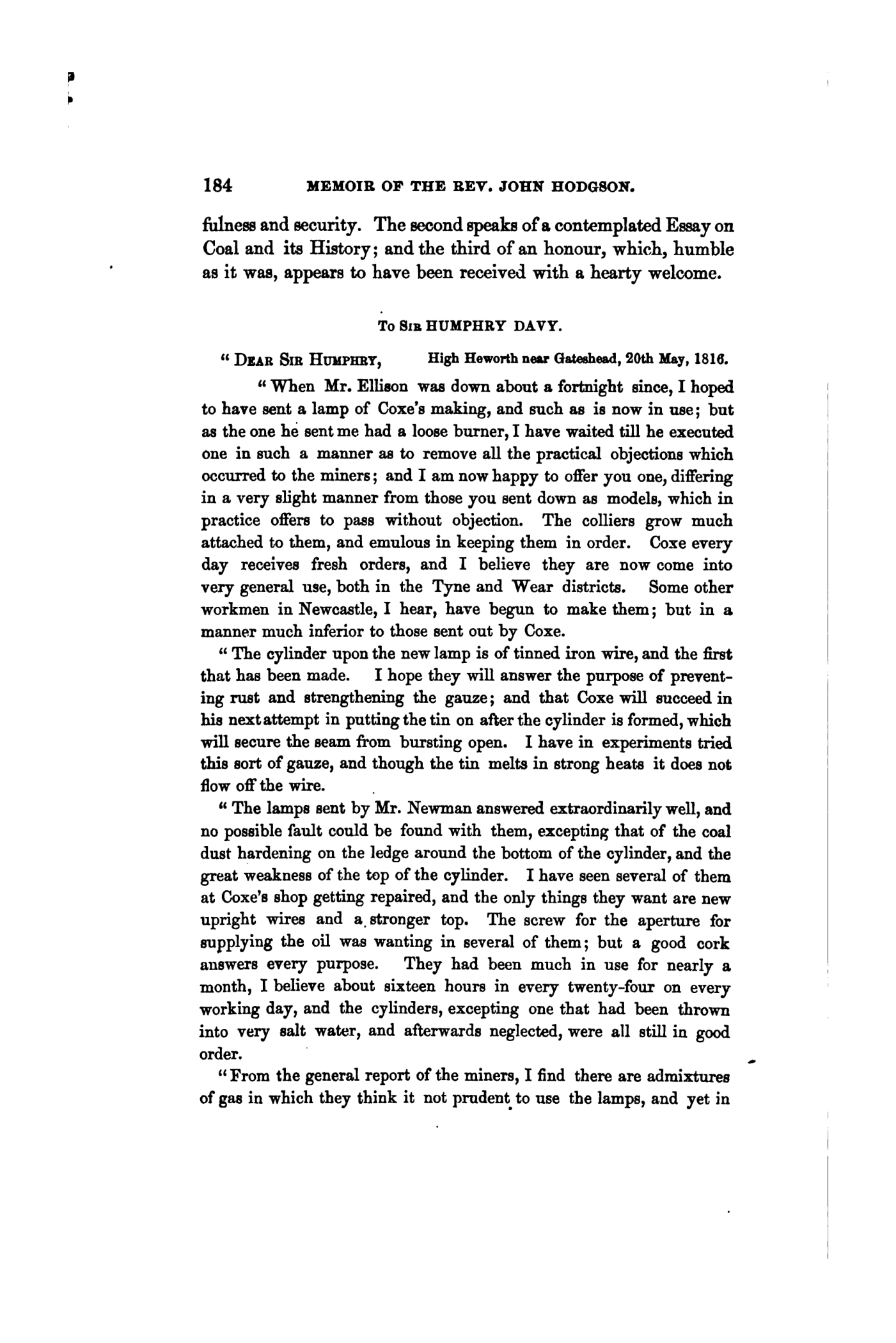
The first printed page of Hodgson's letter of 20 May 1816, describing Coxe's alterations and lamps returned for repair

Hodgson's letter of 20 May 1816, reproduced in Raine's memoir. A loose burner had delayed the specimen he wanted to send Davy; the replacement answered the miners' practical objections.

James Raine, A Memoir of the Rev. John Hodgson

Licence: Public domain. Original image, unchanged.

View the original and source details
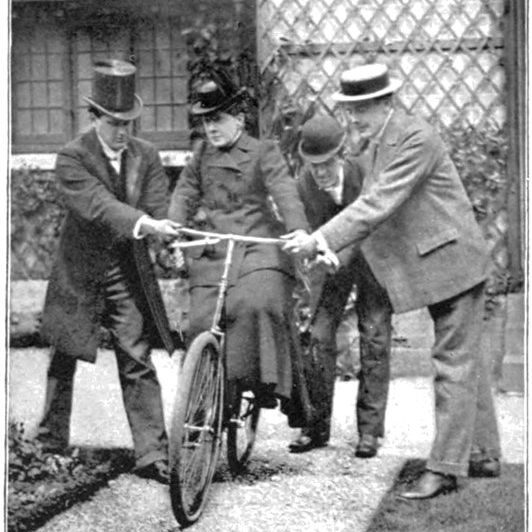
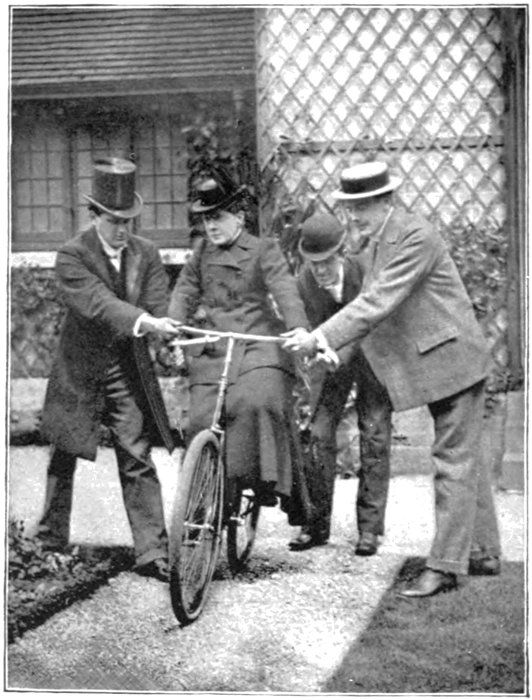
Willard seated on a low bicycle while three men steady it

“A Lack of Balance”, a photograph published in Willard's A Wheel within a Wheel, 1895. The book describes helpers gradually withdrawing their support.

Fleming H. Revell Company

Licence: Public domain. Cover cropped for article cards and sharing.

View the original and source details
Willard seated on a low bicycle while three men steady it

“A Lack of Balance”, a photograph published in Willard's A Wheel within a Wheel, 1895. The book describes helpers gradually withdrawing their support.

Fleming H. Revell Company

Licence: Public domain. Original image, unchanged.

View the original and source details
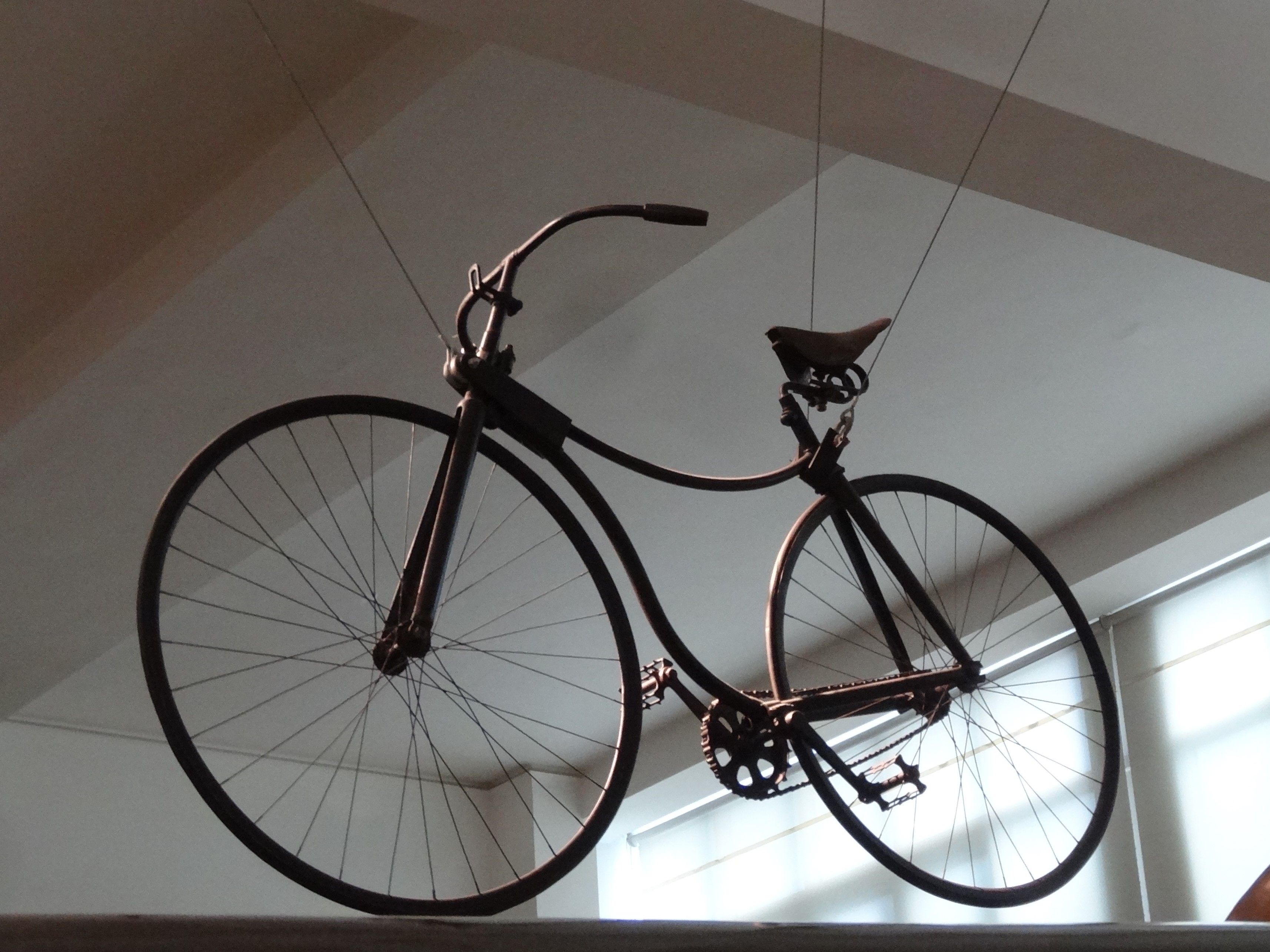
An early Rover bicycle with curved frame tubes, solid tyres and a chain driving the rear wheel

An 1885 Rover in London's Science Museum, photographed in 2016. The chain drives the rear wheel; the handlebar turns the front fork directly. Its saddle was remade in 1961.

Jonathan Cardy

Licence: CC BY-SA 3.0. Original image, unchanged.

View the original and source details
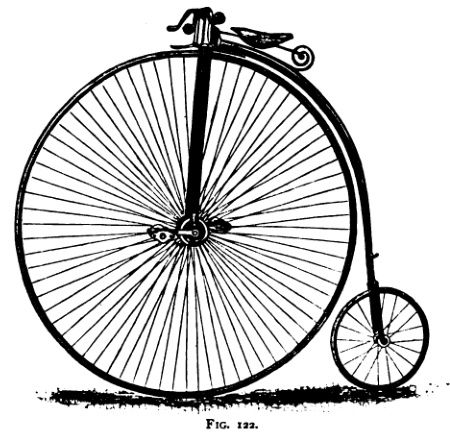
An ordinary bicycle with pedals fixed to the large front wheel

An ordinary illustrated in Archibald Sharp's Bicycles & Tricycles, 1896. Direct drive made the front wheel's diameter a measure of the distance travelled per pedal turn.

Longmans, Green, and Co.

Licence: Public domain. Cropped from the book page to isolate the bicycle.

View the original and source details
Two Rover advertisements labelled May and November 1885, showing a change in steering

Starley & Sutton advertised the early Rover as “as safe as any Tricycle”. By November they were selling road records as well as safety. The steering arrangements differ between the two drawings.

Starley & Sutton

Licence: Public domain. Original image, unchanged.

View the original and source details
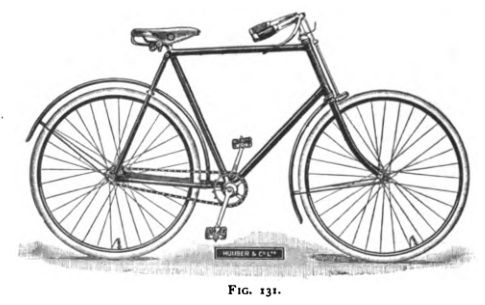
A Humber safety bicycle with straight frame tubes and two wheels of similar size

A Humber safety illustrated in 1896. The straight tube from saddle to crank axle distinguishes this frame from the curved early Rover.

Longmans, Green, and Co.

Licence: Public domain. Cropped from the book page to isolate the bicycle.

View the original and source details
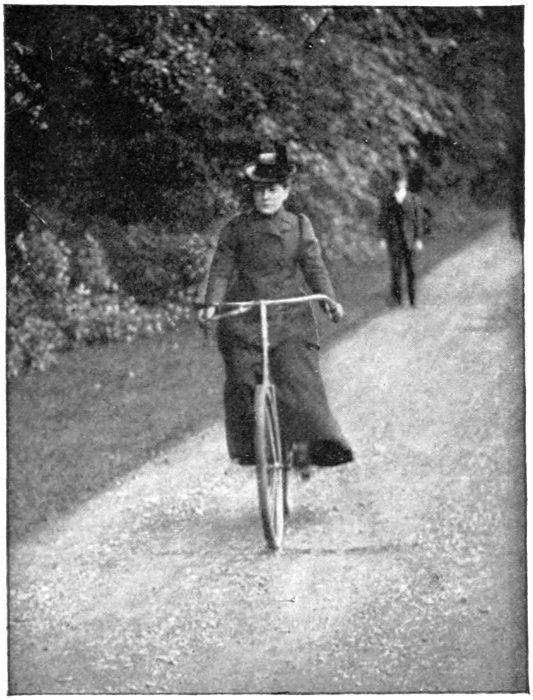
Willard riding along a path with another person farther behind

“At Last”, the closing riding photograph in Willard's 1895 book. The bicycle preserved today at her house museum is a later gift, Gladys III, given in September 1896.

Fleming H. Revell Company

Licence: Public domain. Original image, unchanged.

View the original and source details
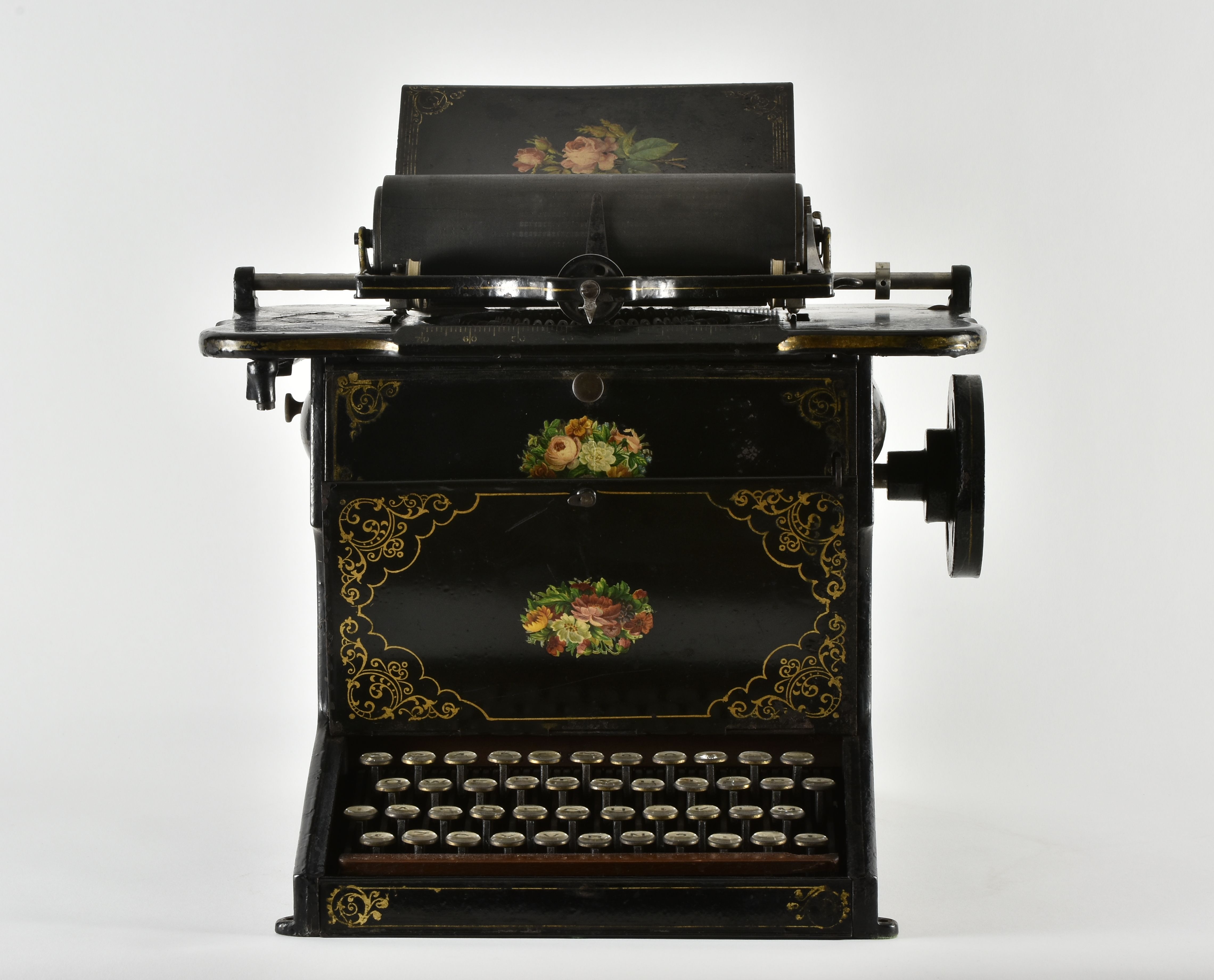
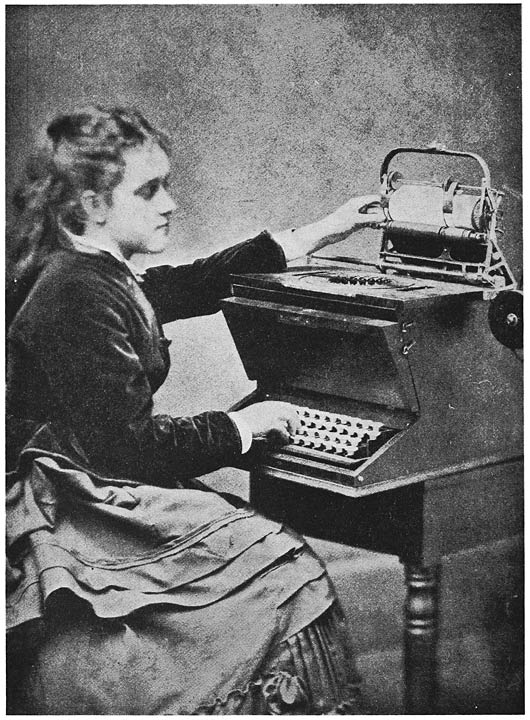
A black Sholes & Glidden typewriter with gold floral decoration, round keys and a paper roller above the mechanism

The commercial Sholes & Glidden placed its typebars beneath the paper roller. Its flowers and gold decoration arrived after years of experiments with much plainer machines.

Tony Casillo

Licence: CC BY-SA 4.0. Body photograph unchanged; cover cropped. The cropped version is shared under CC BY-SA 4.0. Cover cropped for article cards and sharing.

View the original and source details
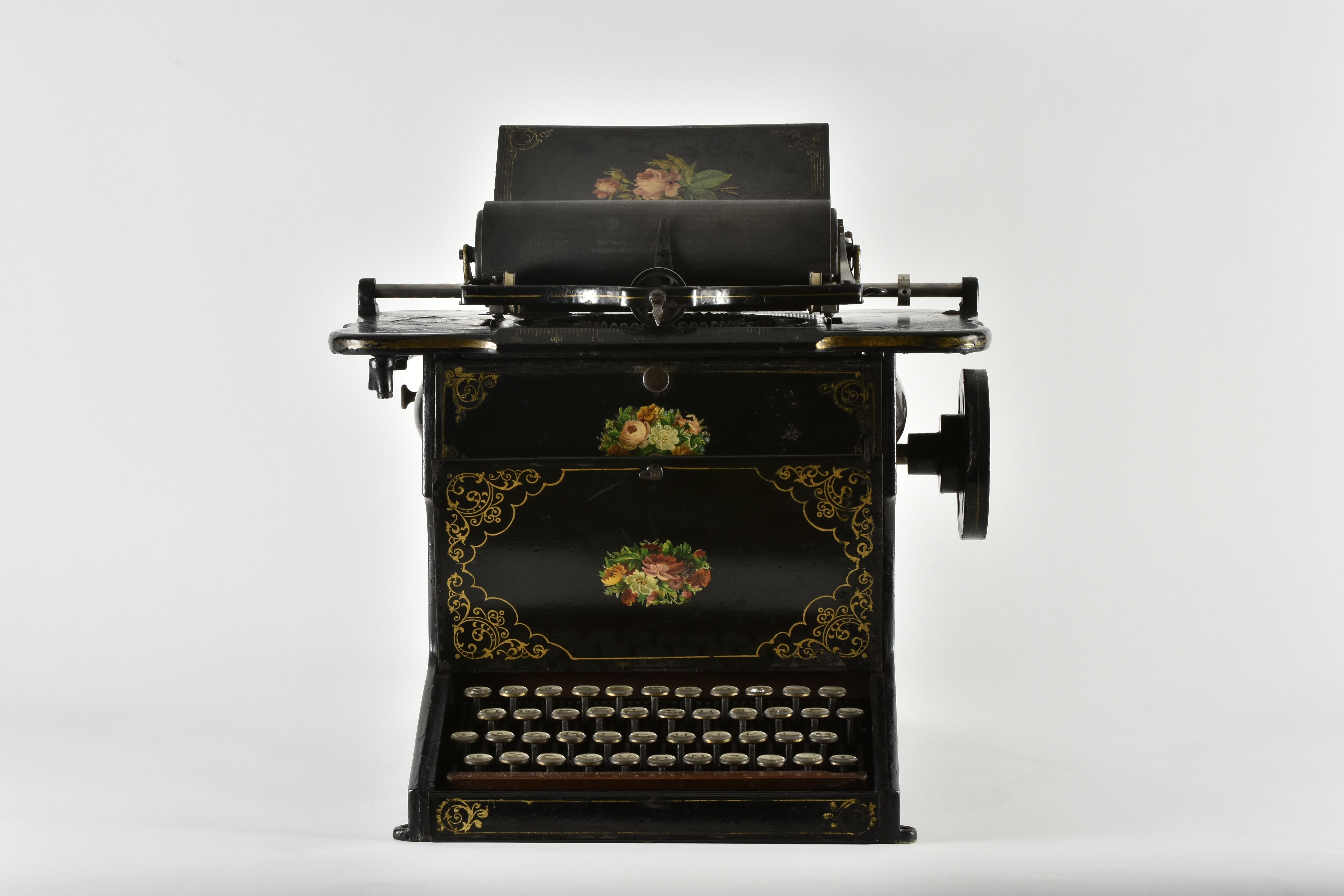
A black Sholes & Glidden typewriter with gold floral decoration, round keys and a paper roller above the mechanism

The commercial Sholes & Glidden placed its typebars beneath the paper roller. Its flowers and gold decoration arrived after years of experiments with much plainer machines.

Tony Casillo

Licence: CC BY-SA 4.0. Body photograph unchanged; cover cropped. The cropped version is shared under CC BY-SA 4.0.

View the original and source details
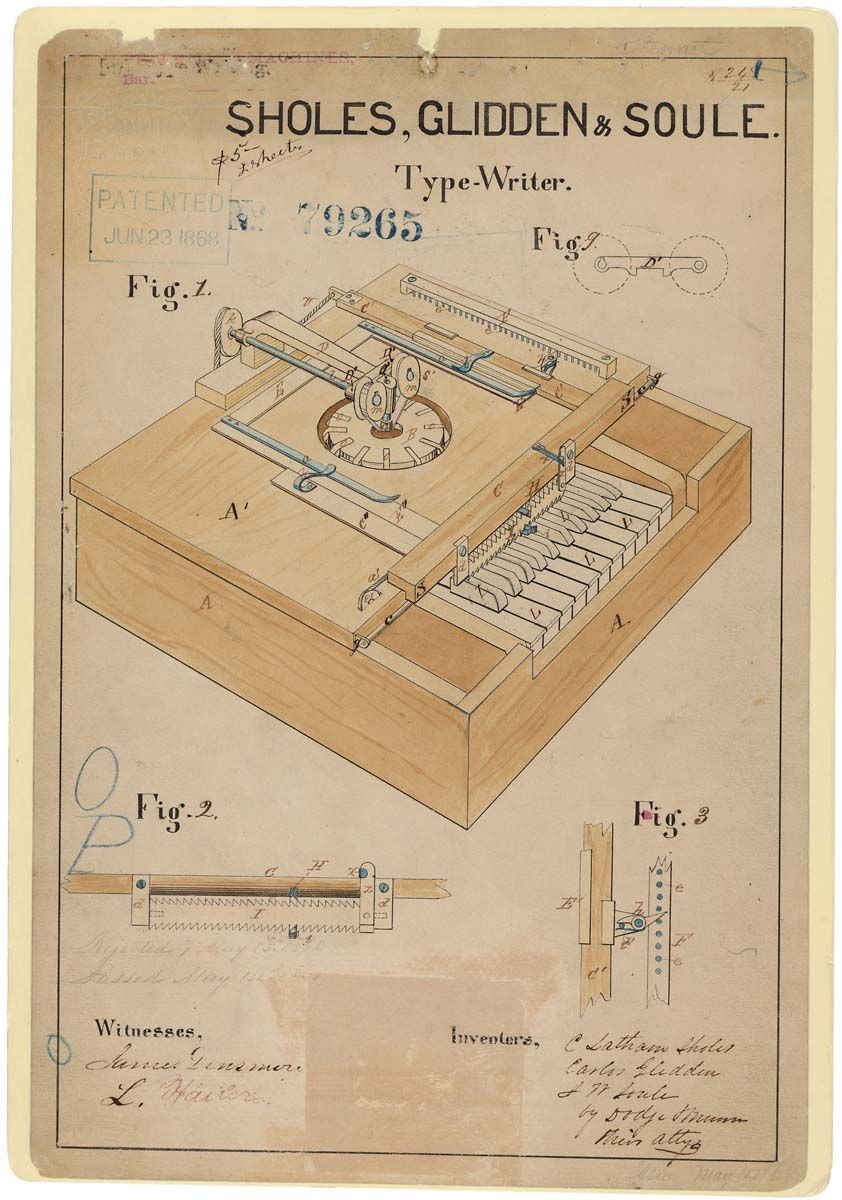
An 1868 coloured patent drawing of a writing machine, with piano-like keys, circular type mechanism and a flat paper frame

The June 1868 design used a flat paper frame and piano-like keys. The circular mechanism brought separate pieces of type to a common printing point.

US National Archives

Licence: Public domain. Original image, unchanged.

View the original and source details
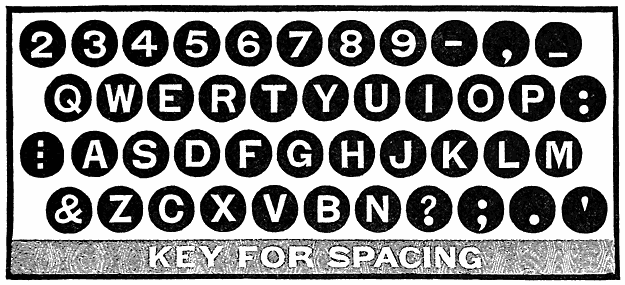
Diagram of an early Sholes & Glidden keyboard, with QWERTY across the upper letter row, M beside L and C before X on the bottom row

An early keyboard arrangement reproduced in 1923. It already has QWERTY, while other letter positions differ from the modern layout.

Herkimer County Historical Society

Licence: Public domain. Original image, unchanged.

View the original and source details
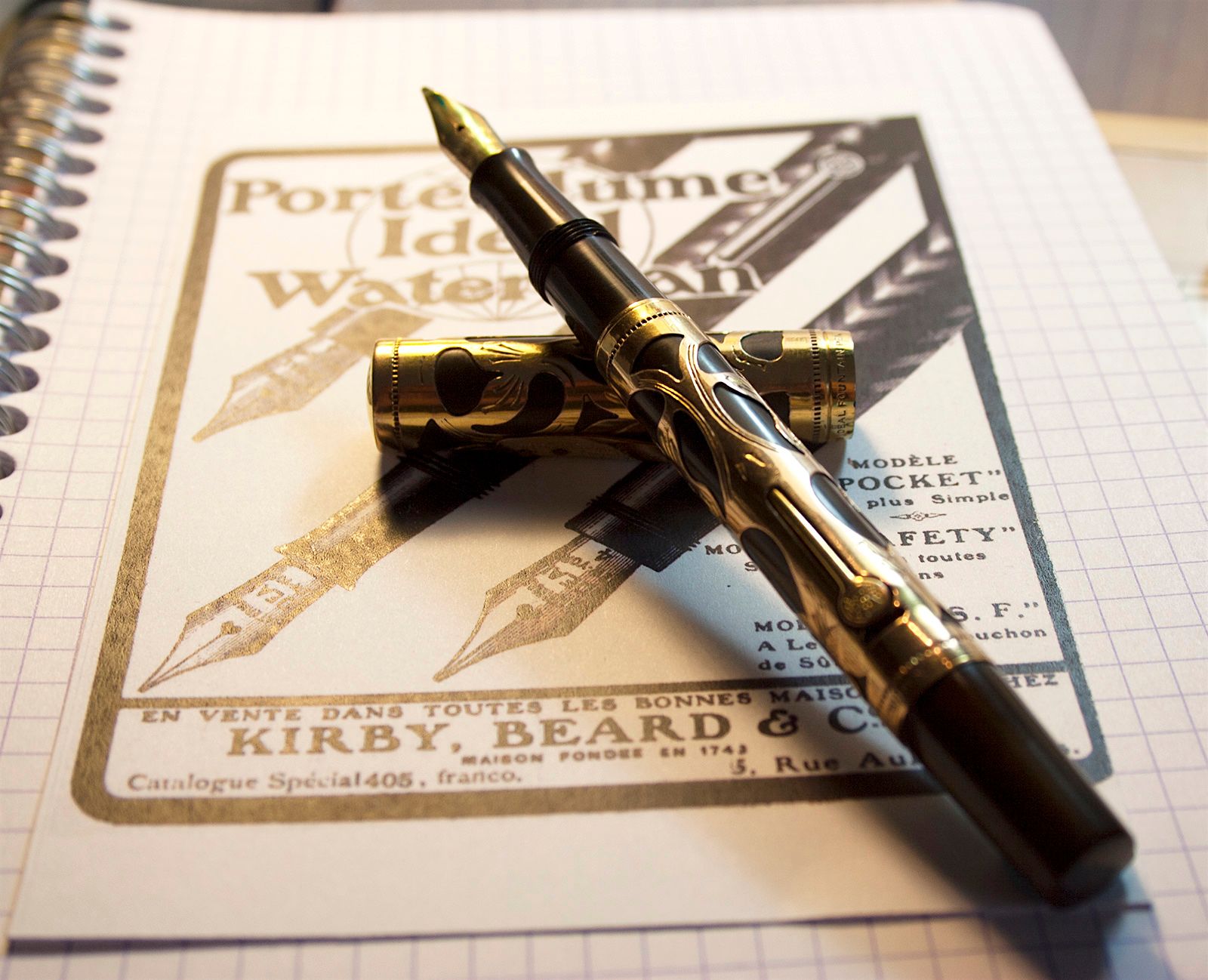
Uncapped black and gold Waterman 0514 PSF fountain pen, with its separate cap resting behind it

A later Waterman 0514 PSF with its cap removed. This decorated lever-filling model belongs to a later stage of the pen’s development; the first Watermans were filled with a separate dropper.

HalloweenHJB

Licence: CC BY-SA 4.0. Cover cropped for article cards and sharing.

View the original and source details
Uncapped black and gold Waterman 0514 PSF fountain pen, with its separate cap resting behind it

A later Waterman 0514 PSF with its cap removed. This decorated lever-filling model belongs to a later stage of the pen’s development; the first Watermans were filled with a separate dropper.

HalloweenHJB

Licence: CC BY-SA 4.0. Original image, unchanged.

View the original and source details
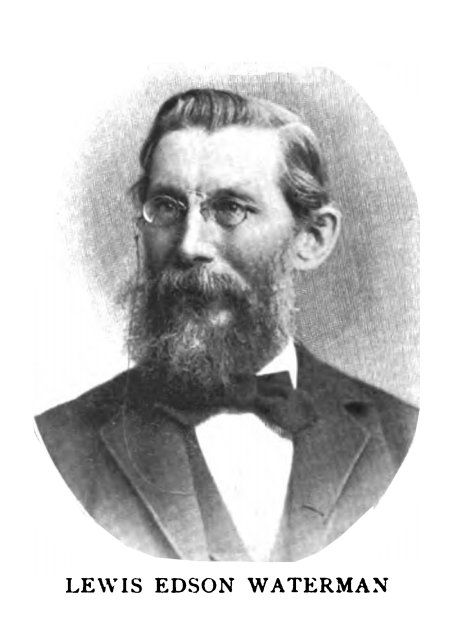
Lewis Edson Waterman in a portrait published in 1899, wearing spectacles and a dark suit

Lewis Edson Waterman, in a portrait published in 1899.

Notable New Yorkers / Wikimedia Commons

Licence: Public domain. Existing Commons version has uploader crop, contrast enhancement and small background repair; no additional body edits.

View the original and source details
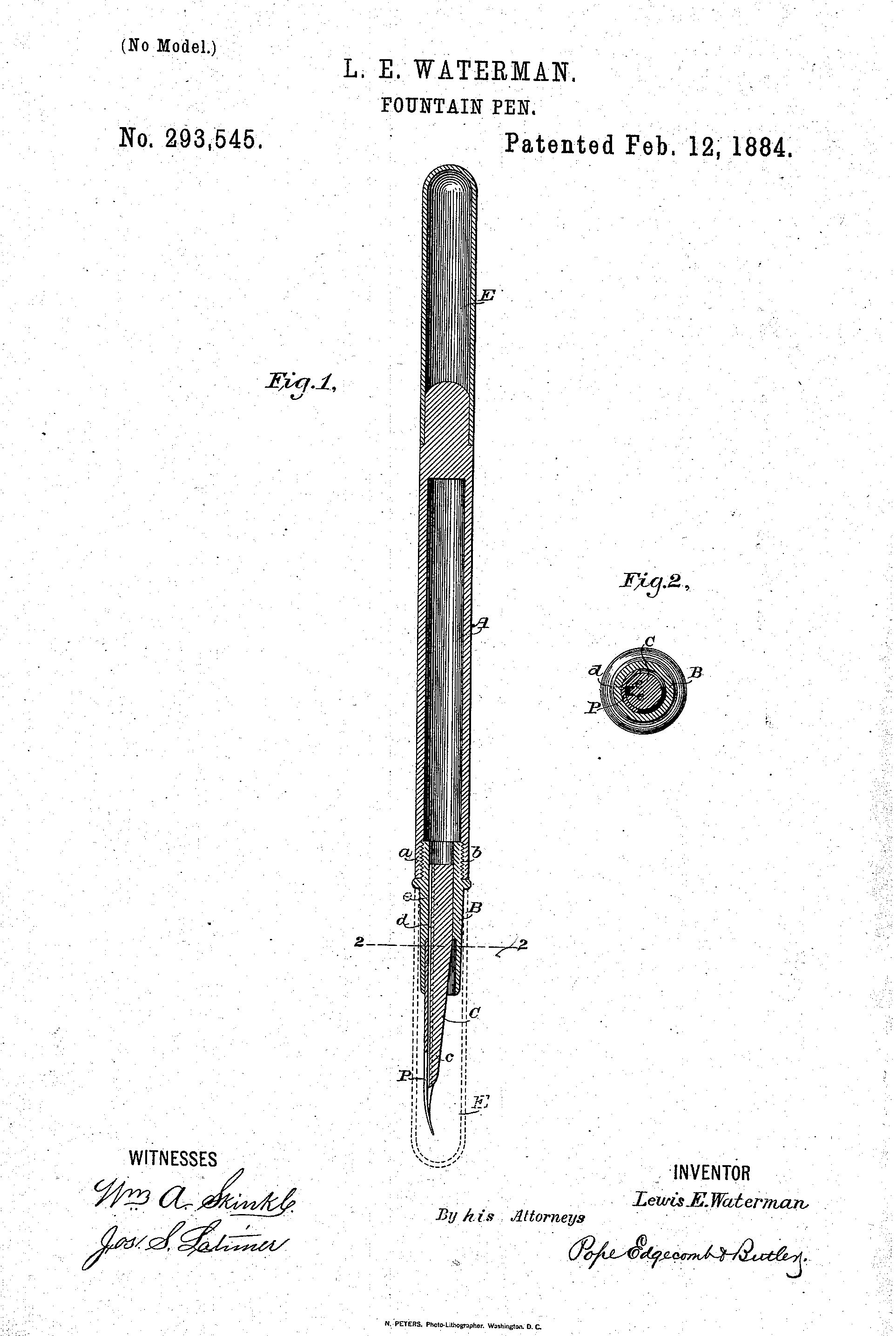
Waterman’s 1884 patent drawing, showing the reservoir, feed bar and nib in longitudinal and cross-section

Waterman’s 1884 design put a grooved feed bar beneath the nib. The small cross-section shows the narrow passages through which ink and replacement air had to travel.

US Patent Office

Licence: Public domain. Trimmed outer page margins; full drawing, date and signatures retained.

View the original and source details
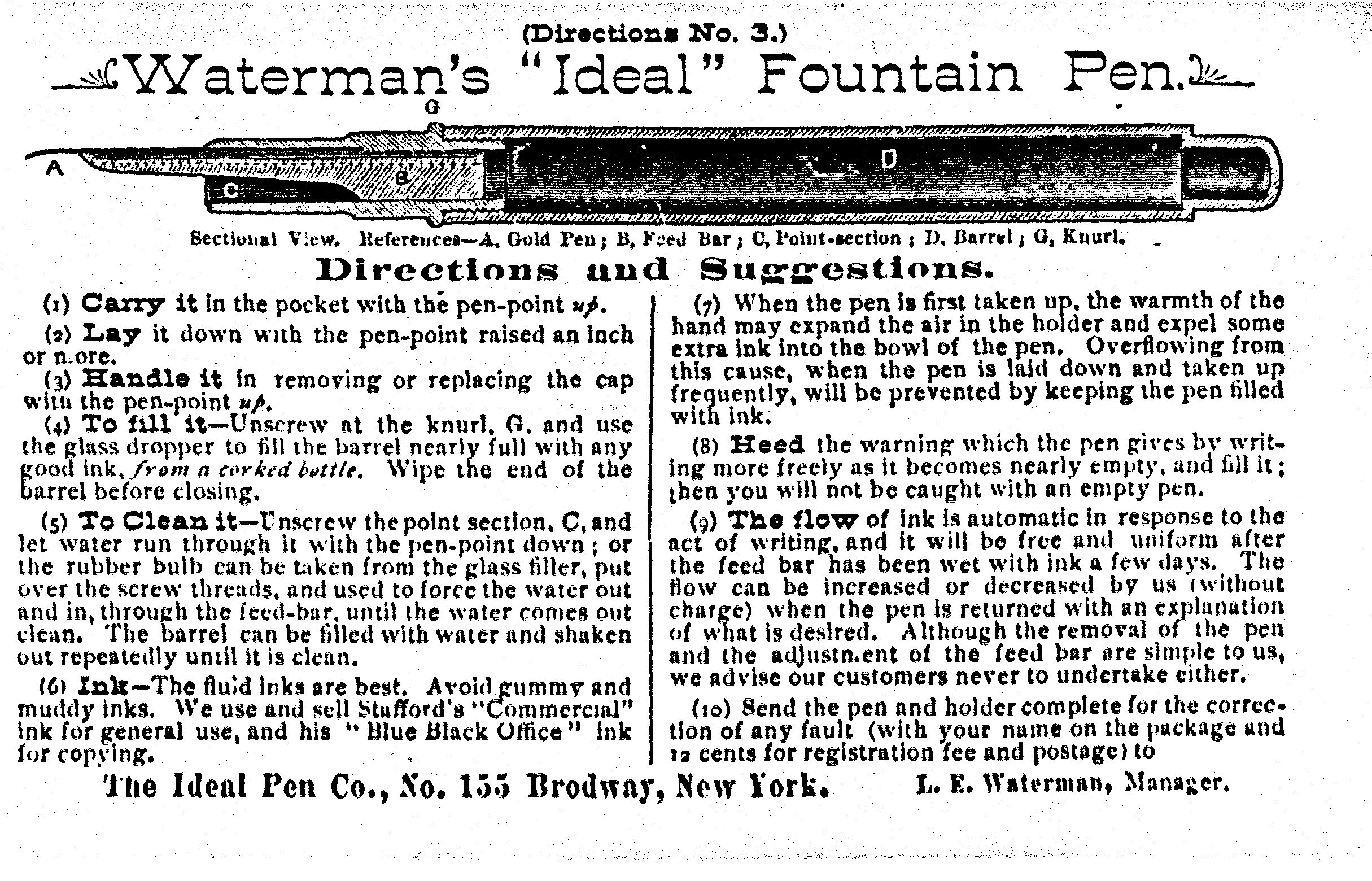
Waterman’s 1885 Directions and Suggestions, with a sectional drawing above ten numbered instructions

Instructions sent out in 1885 explain carrying, filling, cleaning and returning a pen for adjustment. The cross-section identifies the nib, feed, section and ink-holding barrel.

The Ideal Pen Company / Pen Collectors of America

Licence: Public domain. Trimmed blank margins around the complete instruction panel.

View the original and source details
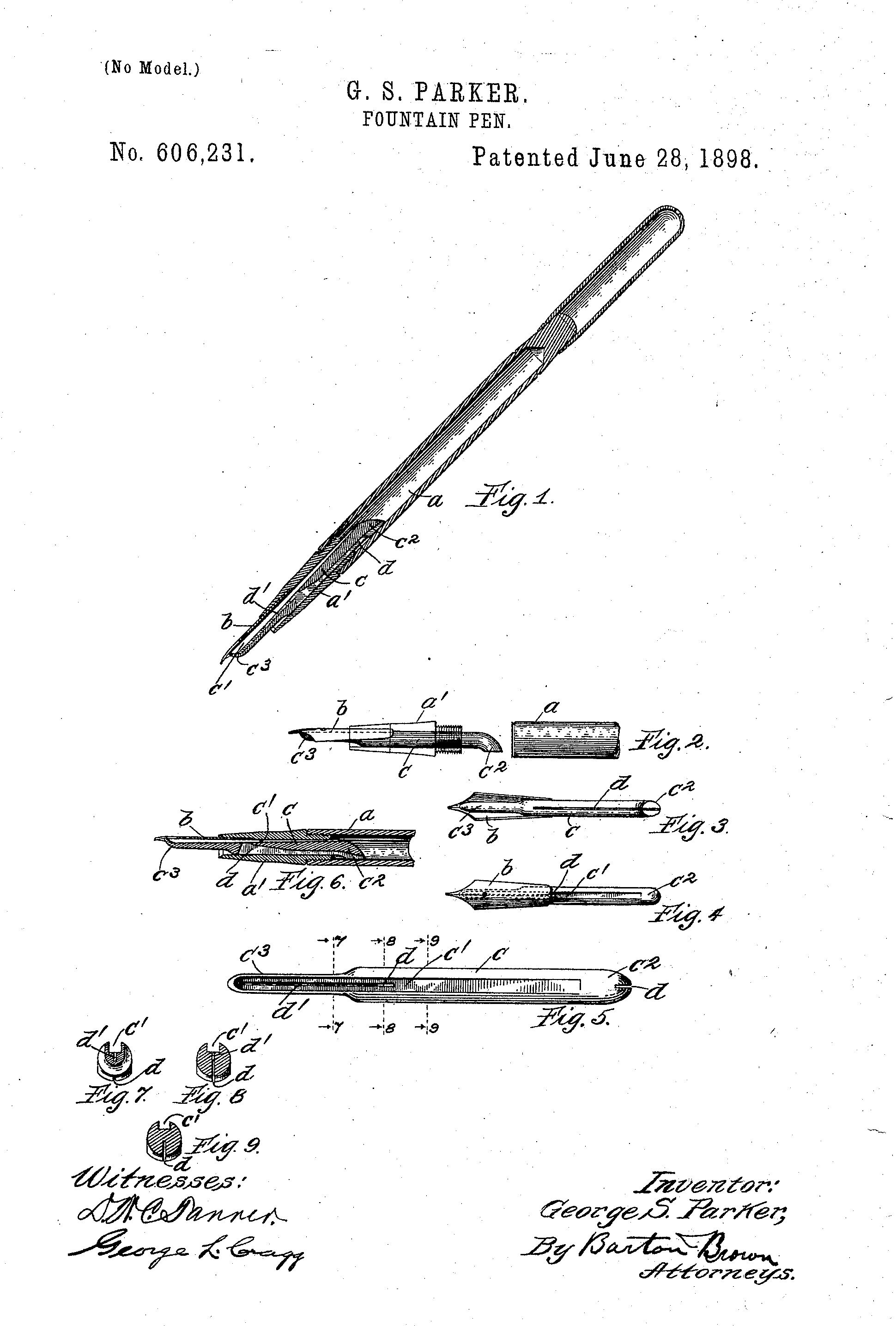
Parker’s 1898 patent drawings, with a curved inner feed end reaching towards the reservoir wall

Parker’s 1898 drawings show the curved inner end of the feed and several views of its channels. His proposed arrangement supplied ink during writing and returned surplus towards the reservoir when the pen was inverted.

US Patent Office

Licence: Public domain. Trimmed outer margins only; full sheet of figures retained. Earlier detail candidates clipped adjacent figures and were rejected.

View the original and source details
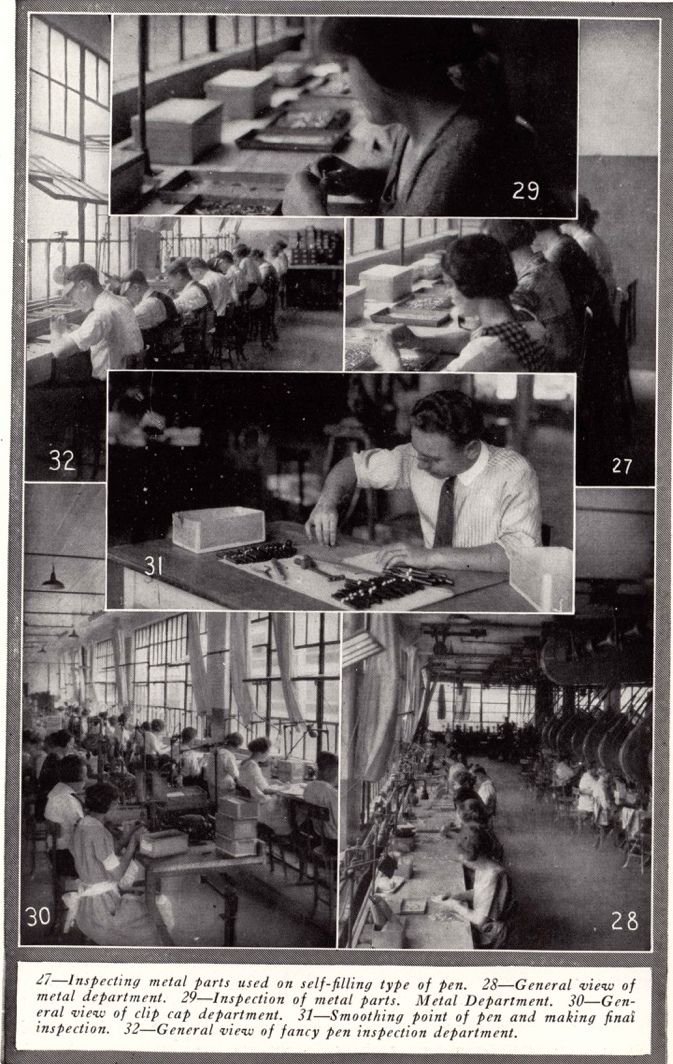
Montage of Waterman factory workers inspecting parts and testing pens, with a man adjusting a writing point in the centre

Inspection at Waterman’s Newark works, in a company brochure from around 1925. The central photograph shows a worker smoothing a point and making the final inspection.

L. E. Waterman Company / Pen Collectors of America

Licence: Public domain. Extracted original photographic montage and its printed caption from page18/PDF19; surrounding blank margins and page furniture omitted. No retouching.

View the original and source details
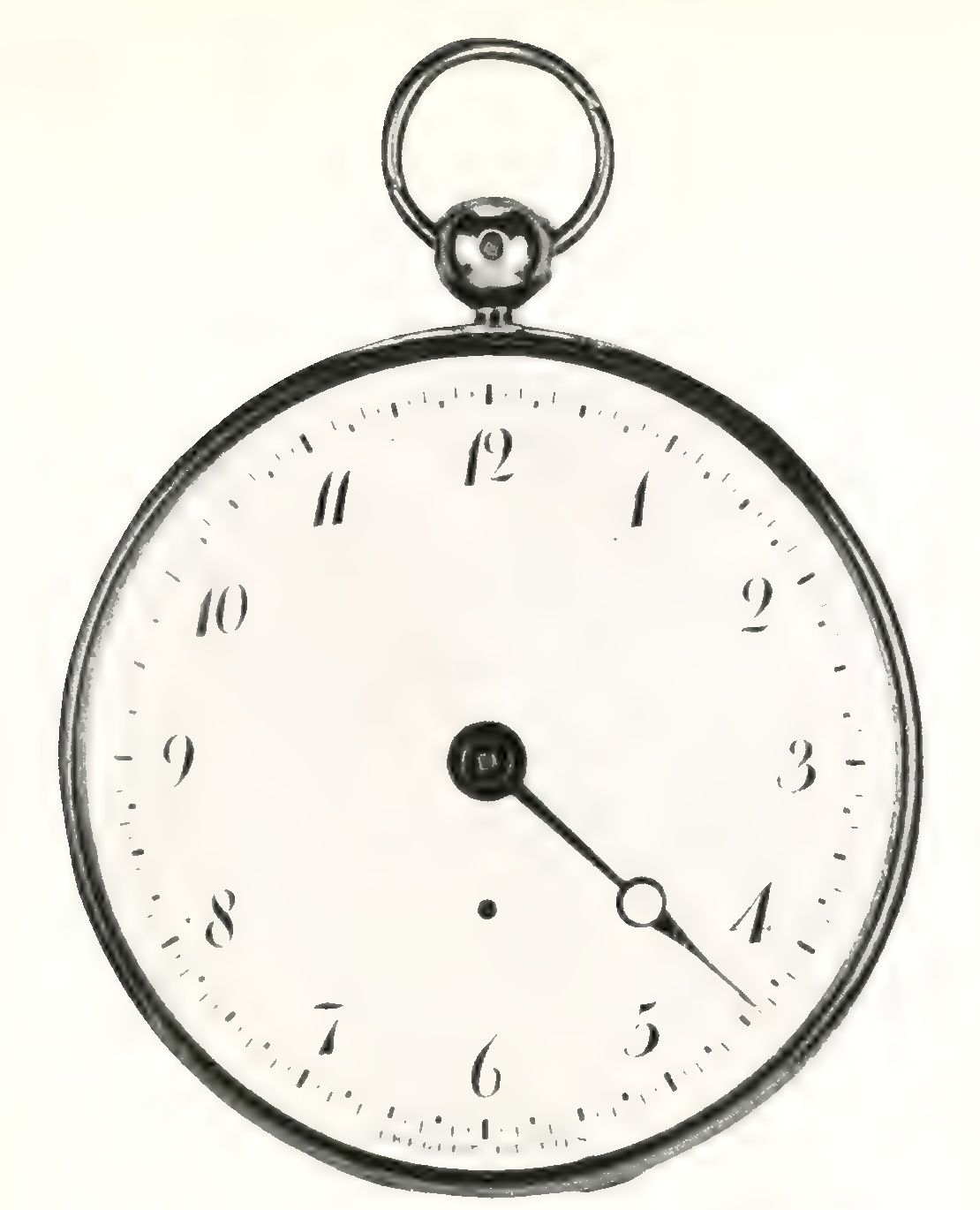
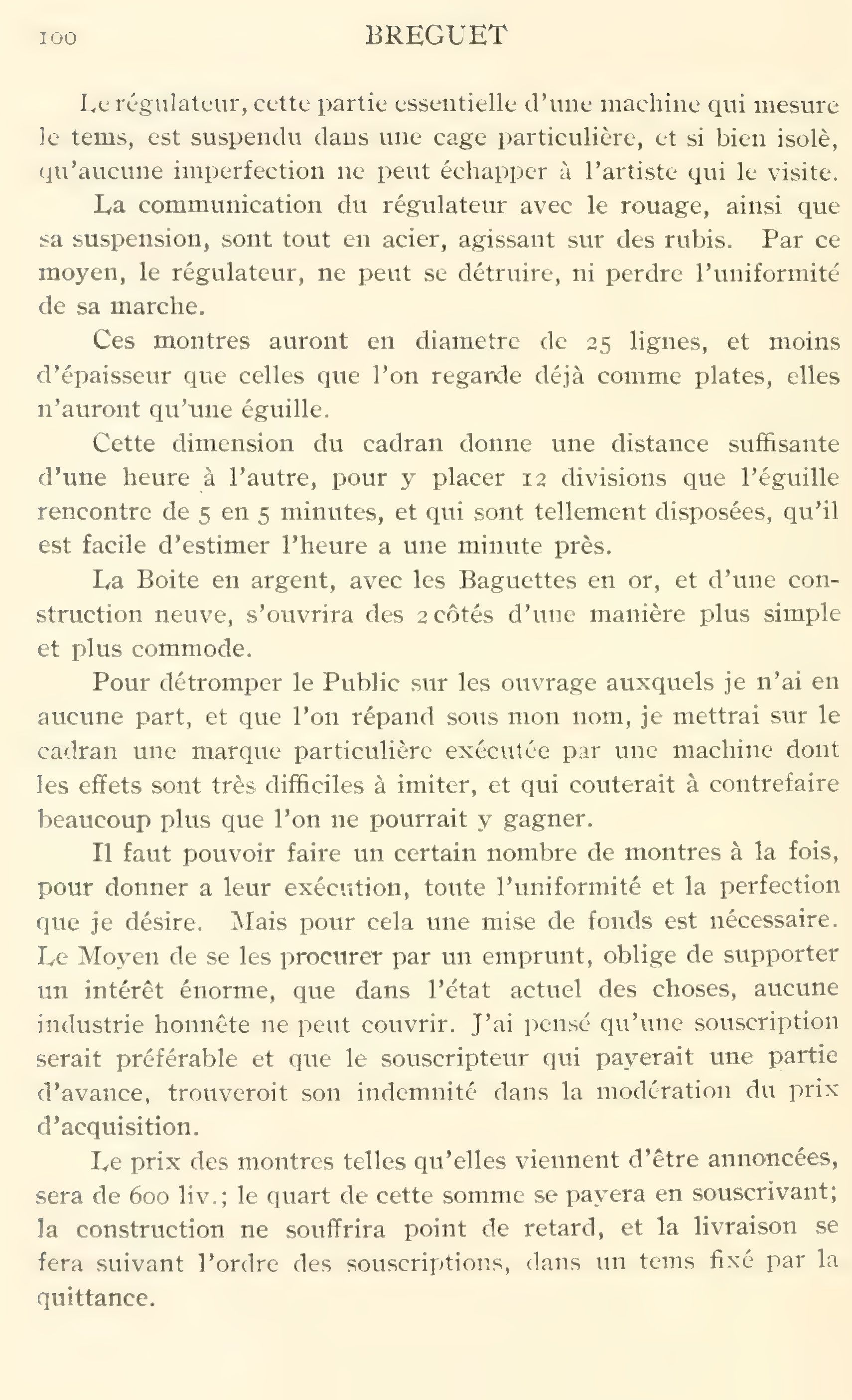
A Breguet pocket watch with a single eye-tipped hand, twelve hour numerals and small divisions between them

A later souscription watch, sold to Mr Demidoff in 1821. One hand indicates the hour and its progress towards the next; the small marks divide each hour into five-minute intervals.

Photograph published by David Salomons, 1921

Licence: Public domain. Cropped front photograph from the1921plate; surrounding page text omitted. No retouching.

View the original and source details
The second page of Breguet’s subscription prospectus as reprinted in 1921, ending with the price of 600 livres and a quarter payable on subscription

The prospectus’s terms, reprinted in 1921: 600 livres for the watch, with one quarter paid in advance. Delivery would follow the order of subscriptions within the time stated on the receipt.

David Salomons, Breguet, 1921

Licence: Public domain. Trimmed outer page margins; full reprinted page text retained. No retouching.

View the original and source details
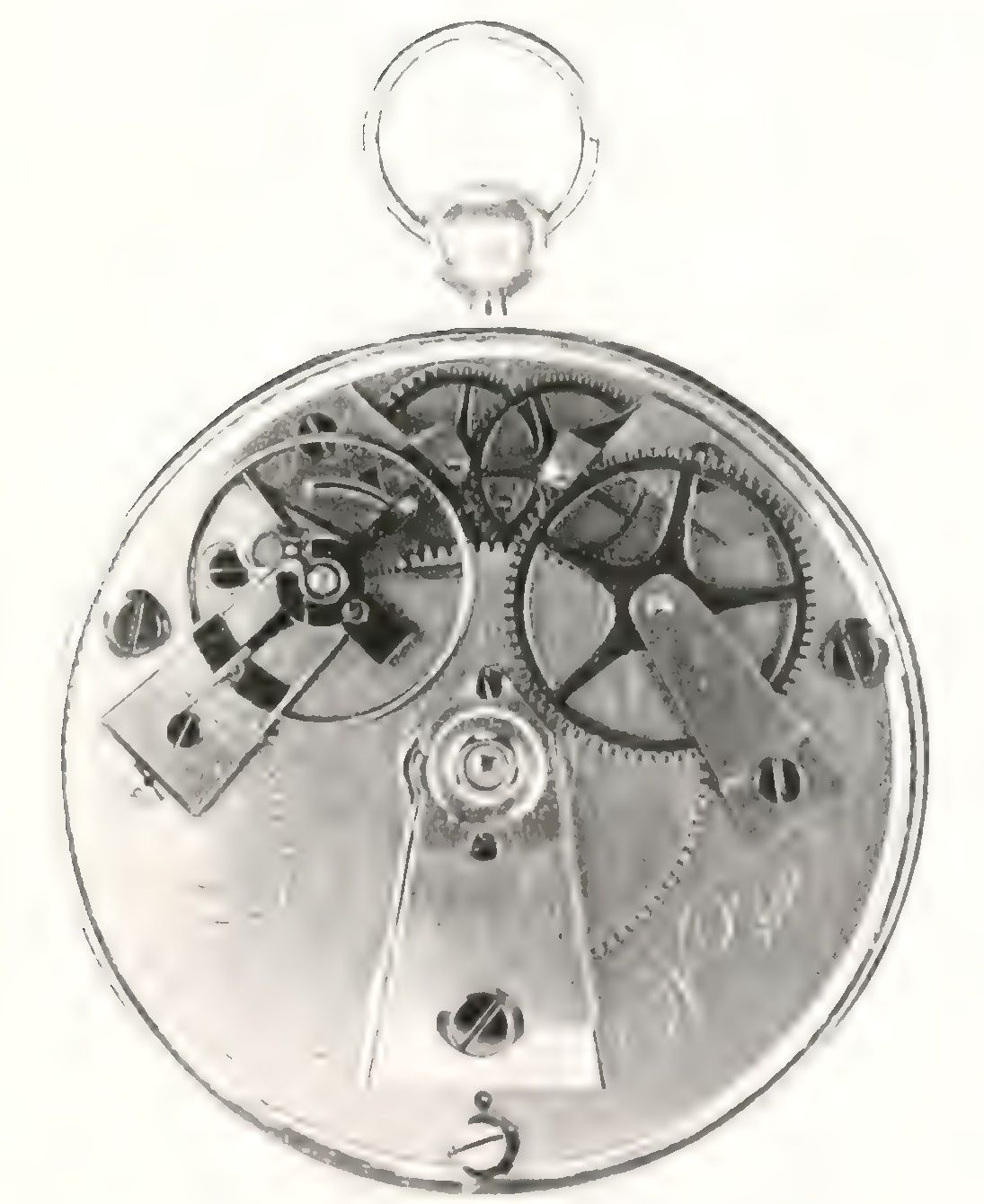
The back of the same 1821 Breguet watch, with its central winding position, large barrel and wheels visible beneath separate bridges

The back of the Demidoff watch. It could be wound at the centre from either side; separate bridges leave the wheels accessible.

Photograph published by David Salomons, 1921

Licence: Public domain. Cropped back photograph from the1921plate; surrounding page text omitted. No retouching.

View the original and source details
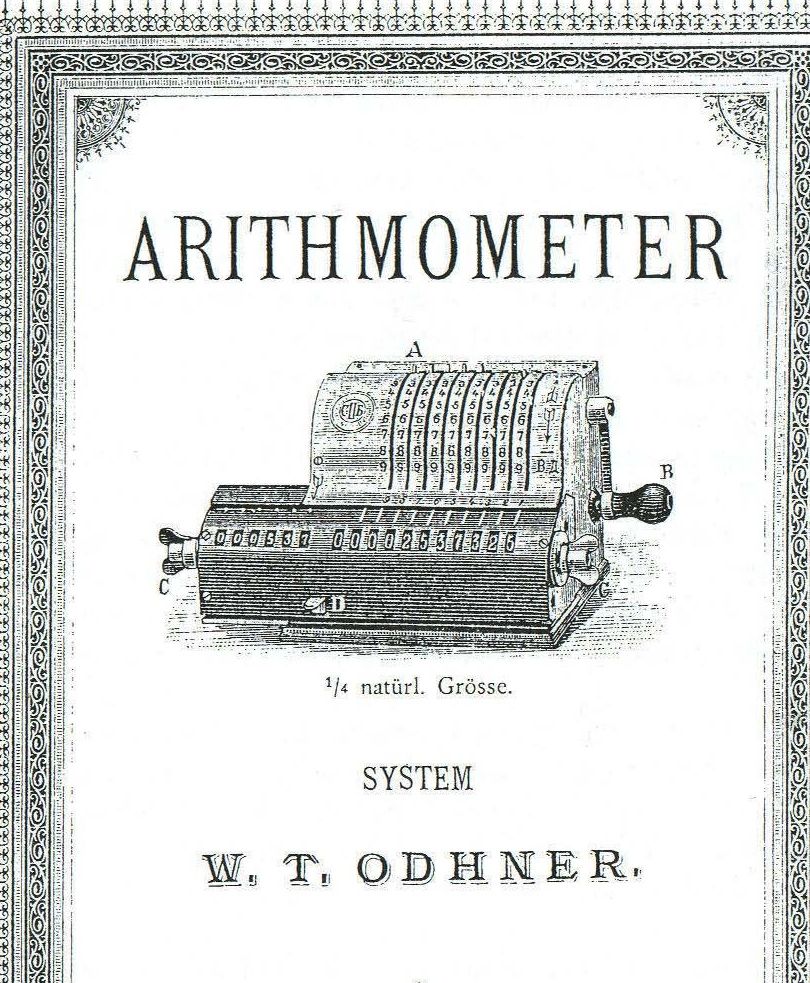
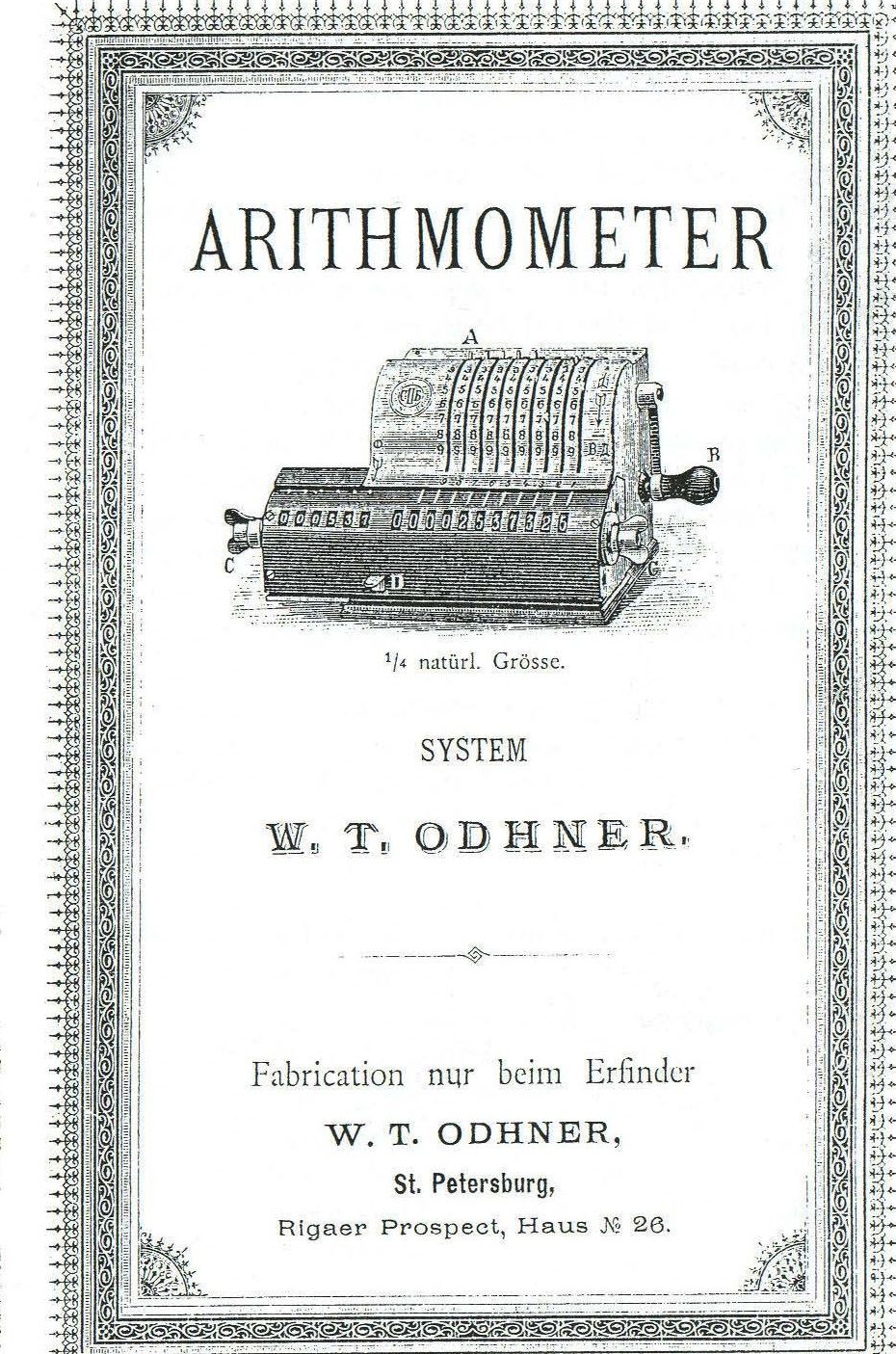
Title page of Odhner’s 1890 booklet, with an engraving of the complete calculator and the maker’s St. Petersburg address

Odhner’s 1890 booklet offered instructions as well as a machine for sale. Its title page gives his St. Petersburg address and shows the complete instrument.

W. T. Odhner / Rechnerlexikon

Licence: Public domain. Trimmed blank facing sheet, modern copy label and outer margins; no retouching. Cover cropped for article cards and sharing.

View the original and source details
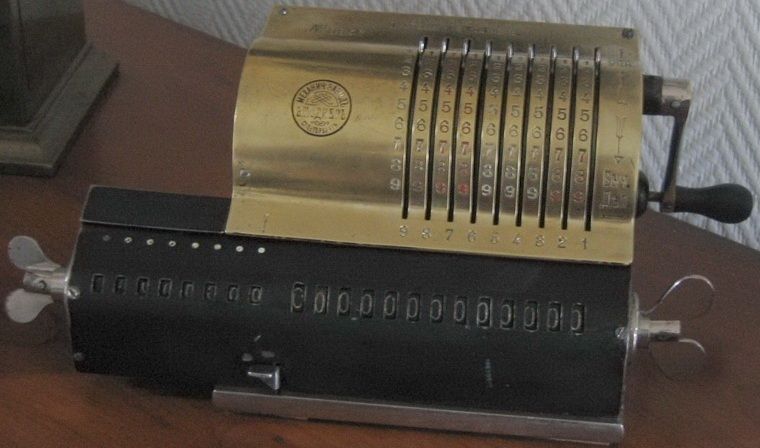
Brass-covered Odhner calculator with nine setting levers, two rows of number windows and a crank on the right

An Odhner calculator made in St. Petersburg before 1900. The curved cover carries the number settings; the sliding carriage below holds the result and the count of turns.

Ezrdr / Wikimedia Commons

Licence: CC BY-SA 3.0. Original image, unchanged.

View the original and source details
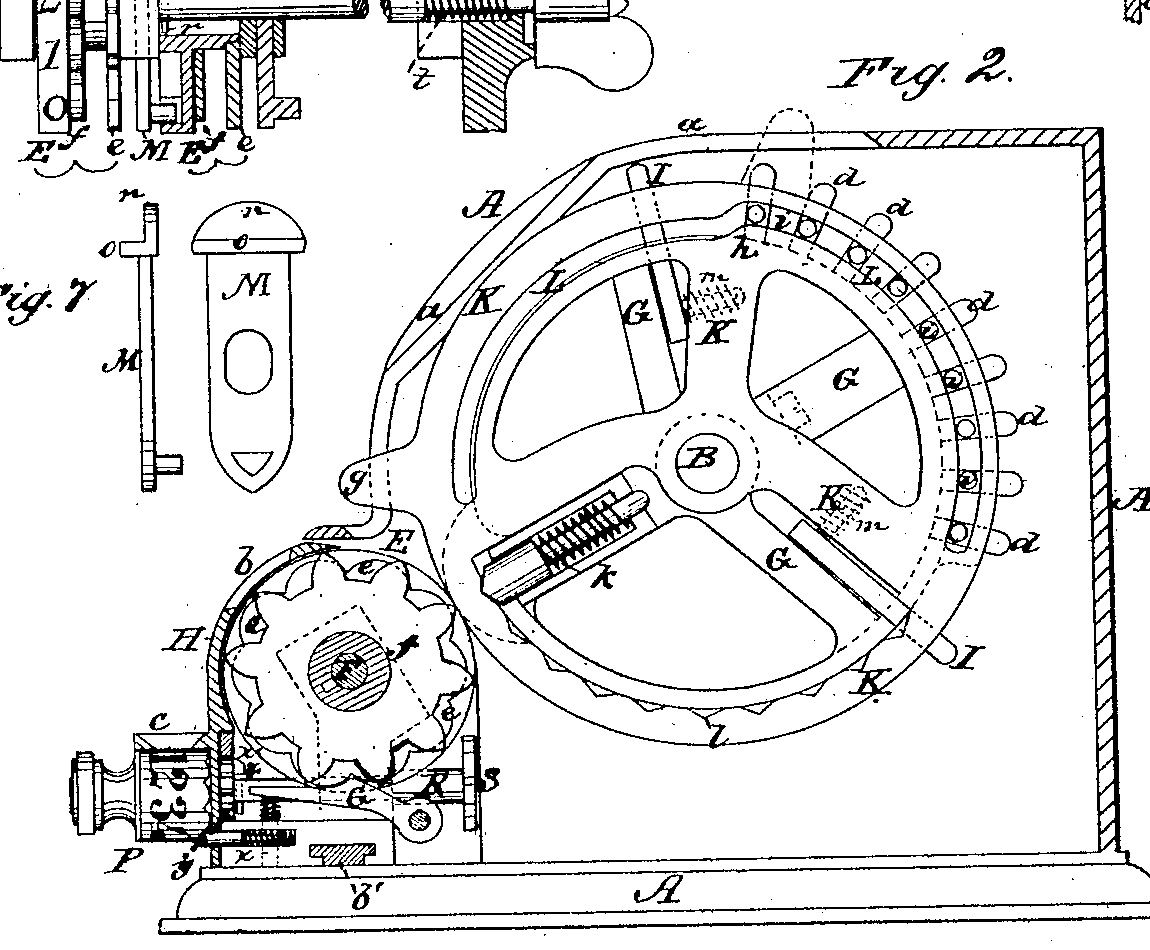
Cross-section from Odhner’s 1878 patent, with projecting teeth around a large wheel engaging the smaller number-wheel gear below

Odhner’s 1878 patent drawing. The adjustable teeth project from the large wheel’s rim; the smaller gear drives a numbered wheel. This is the early design, before the production model introduced in 1890.

United States Patent Office

Licence: Public domain. Detail from sheet2, rotated90degrees clockwise for legibility; no retouching.

View the original and source details
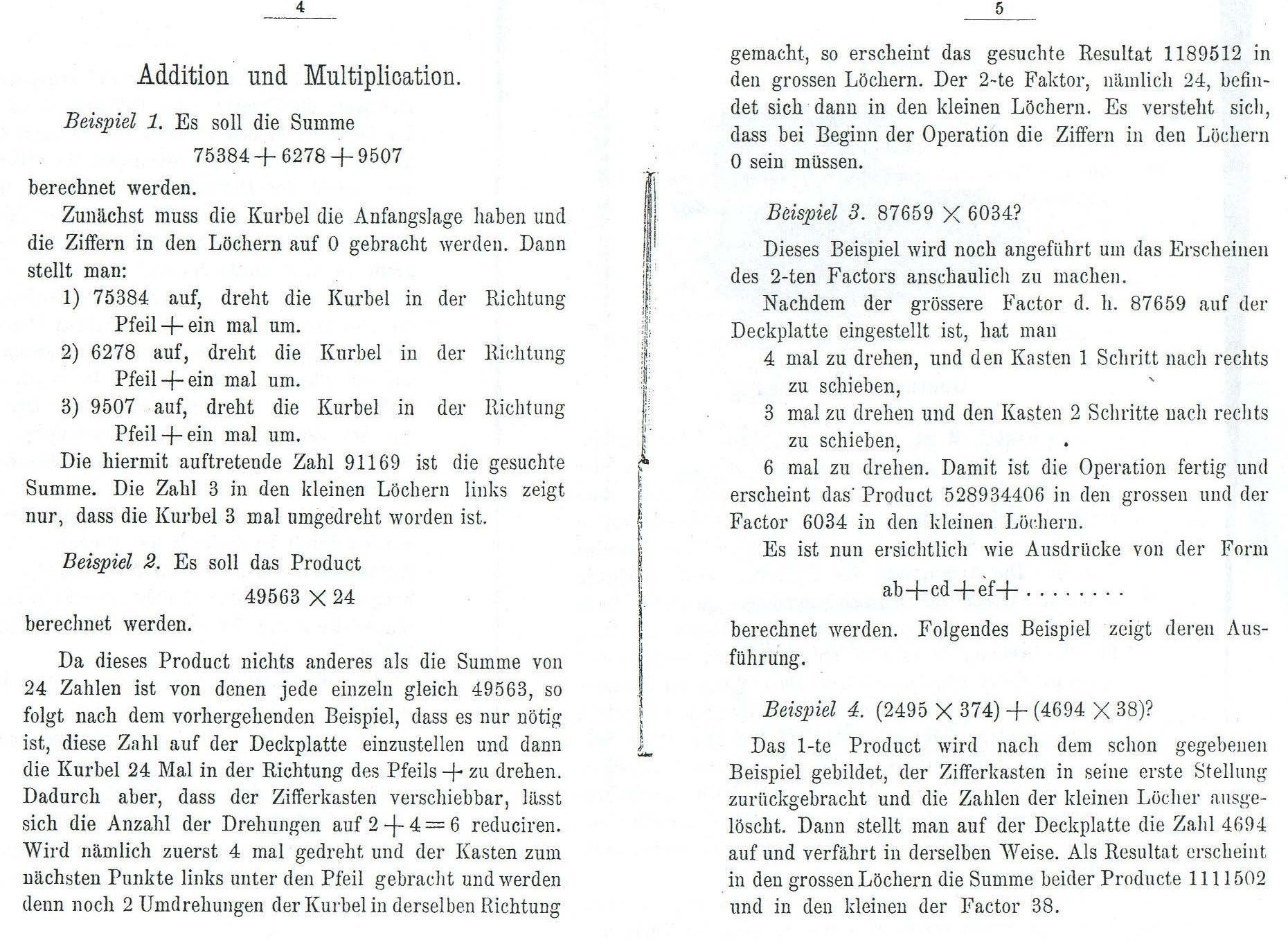
The 1890 German manual’s addition and multiplication pages, including the examples 49563 times 24 and 87659 times 6034

The original worked examples. Multiplying by 24 takes four turns at units and two at tens; the next example uses a multiplier with a zero in the hundreds place.

W. T. Odhner / Rechnerlexikon

Licence: Public domain. Trimmed outer scan margins; whole two-page example spread retained.

View the original and source details
Title page of Odhner’s 1890 booklet, with an engraving of the complete calculator and the maker’s St. Petersburg address

Odhner’s 1890 booklet offered instructions as well as a machine for sale. Its title page gives his St. Petersburg address and shows the complete instrument.

W. T. Odhner / Rechnerlexikon

Licence: Public domain. Trimmed blank facing sheet, modern copy label and outer margins; no retouching.

View the original and source details
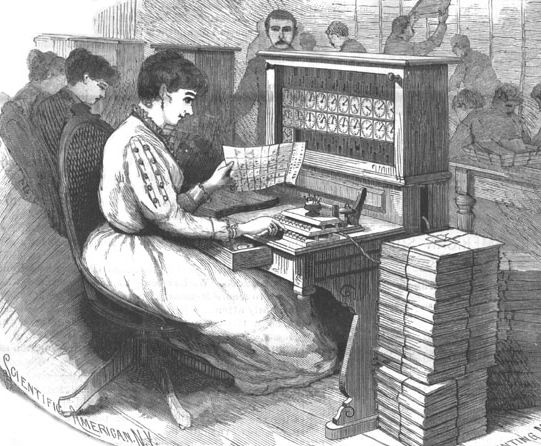
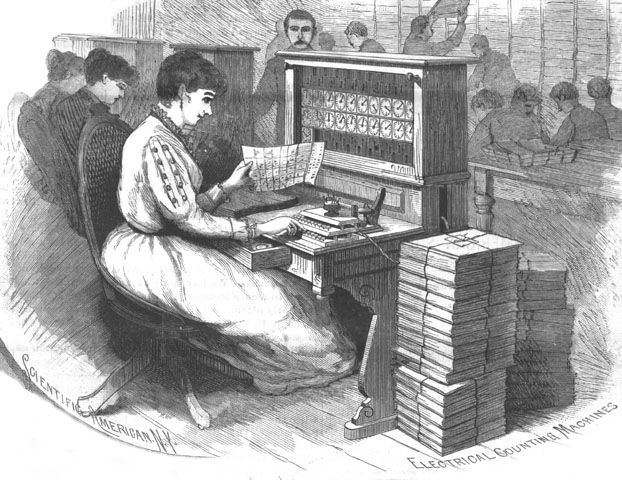
An engraved office scene shows a woman seated at a Hollerith press, with counters in front, cards beside her and other clerks behind.

Electrical counting at the Census Office, illustrated in Scientific American on 30 August 1890. The operator is not identified.

Scientific American / Wikimedia Commons

Licence: Public domain. Cover cropped for article cards and sharing.

View the original and source details
An engraved office scene shows a woman seated at a Hollerith press, with counters in front, cards beside her and other clerks behind.

Electrical counting at the Census Office, illustrated in Scientific American on 30 August 1890. The operator is not identified.

Scientific American / Wikimedia Commons

Licence: Public domain. Original image, unchanged.

View the original and source details
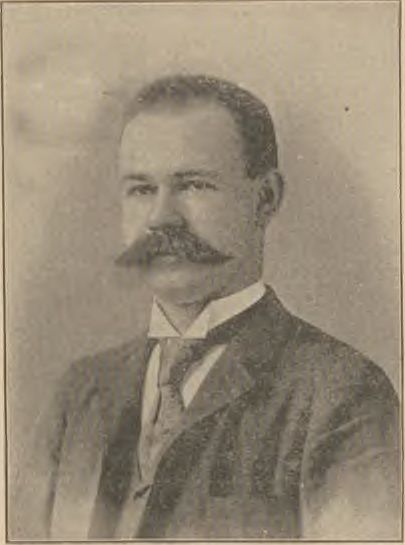
Herman Hollerith, with a moustache and dark suit, in a portrait printed with the 1891 account of his system.

Herman Hollerith in the portrait accompanying Martin’s 1891 report.

National Library of Medicine

Licence: Public domain. Extracted historical illustration from the scanned page; surrounding article text omitted. No retouching.

View the original and source details
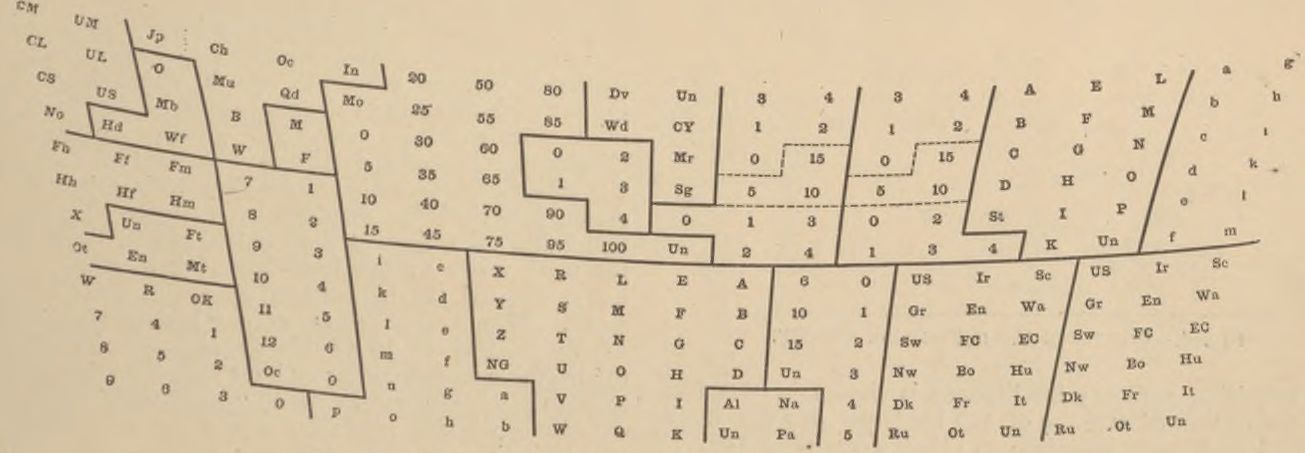
A wide curved keyboard diagram is divided into labelled groups of letters and numbers for different census characteristics.

The labelled board for the census keyboard punch, published in 1891. Its positions supplied the meaning of the holes in an otherwise unlabelled card.

National Library of Medicine

Licence: Public domain. Extracted historical illustration from the scanned page; surrounding article text omitted. No retouching.

View the original and source details
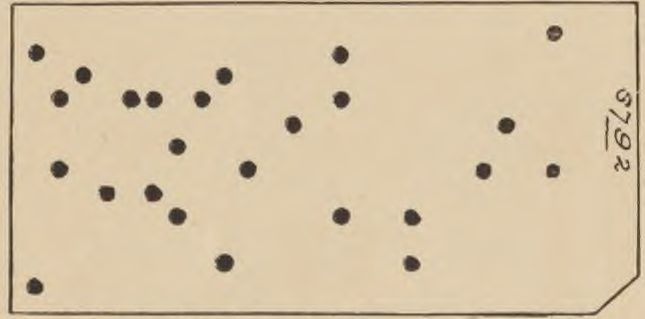
A nearly blank card has scattered round holes, the handwritten number 6792 and a clipped lower right corner.

Martin’s facsimile of a completed card for a Chicago head of household. The clipped corner helped orient it; the holes carried the coded particulars.

National Library of Medicine

Licence: Public domain. Extracted historical illustration from the scanned page; surrounding article text omitted. No retouching.

View the original and source details
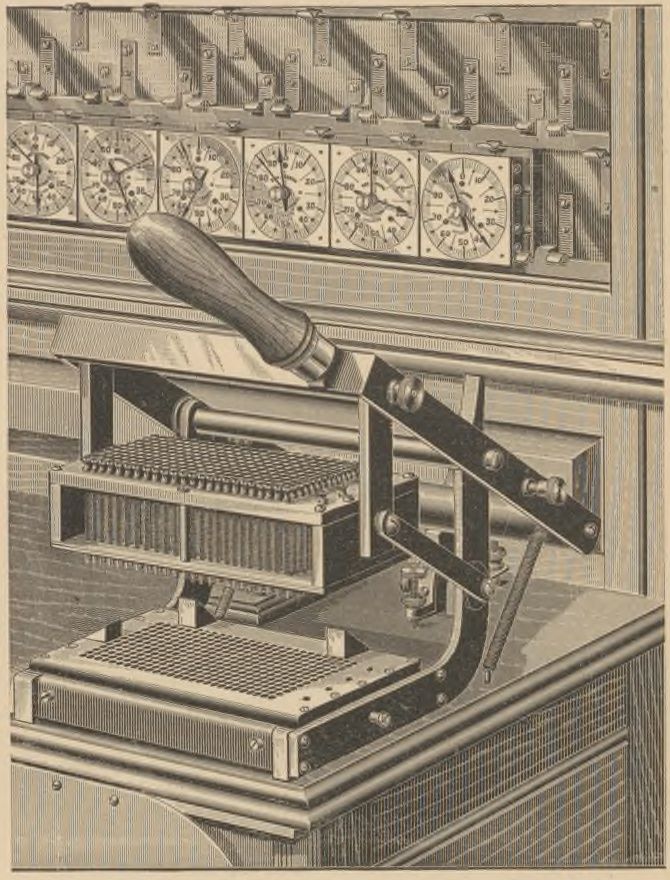
An open Hollerith press has a raised box of metal pins above a perforated bed, with dial counters visible behind.

The open circuit-closing press. Spring-loaded pins descended towards mercury contacts beneath the card.

National Library of Medicine

Licence: Public domain. Extracted historical illustration from the scanned page; surrounding article text omitted. No retouching.

View the original and source details
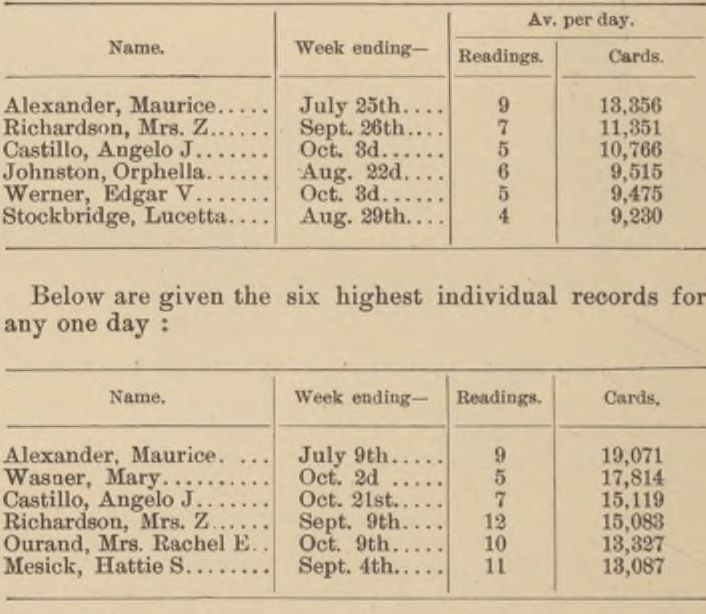
Two printed tables name machine clerks and compare their weekly averages and highest single-day card counts.

The clerks’ performance tables supplied to Martin by census official H. Sutherland. The upper table gives best weekly averages; the lower gives single-day records.

National Library of Medicine

Licence: Public domain. Extracted historical illustration from the scanned page; surrounding article text omitted. No retouching.

View the original and source details
Joseph-Marie Jacquard sits holding compasses beside a model loom and punched cards in a detailed woven workshop portrait.

Jacquard's portrait in silk, after Claude Bonnefond. This copy names Michel-Marie Carquillat as the weaver in the line at the foot of the textile.

Library of Congress

Licence: Public domain. Cover cropped for article cards and sharing.

View the original and source details
Joseph-Marie Jacquard sits holding compasses beside a model loom and punched cards in a detailed woven workshop portrait.

Jacquard's portrait in silk, after Claude Bonnefond. This copy names Michel-Marie Carquillat as the weaver in the line at the foot of the textile.

Library of Congress

Licence: Public domain. Original image, unchanged.

View the original and source details
A wooden Jacquard attachment stands over a handloom, with laced cards passing around its upper mechanism and harness cords hanging below.

The upper part of a handloom with a Jacquard attachment at the Colegio del Arte Mayor de la Seda in Valencia, photographed in 2016. The card belt passes through the mechanism above the hanging cords.

Photograph: Jerónimo Roure Pérez / Dorieo, Wikimedia Commons

Licence: CC BY-SA 4.0. Original image, unchanged.

View the original and source details
A nineteenth-century diagram connects eight horizontal needles, springs at the right and long upright hooks with bent heads.

Needles, springs and hooks in E. A. Posselt's 1888 explanation of a Jacquard machine. A needle pushed backwards moves its hook out of the lifting frame's path.

The Jacquard Machine Analyzed and Explained

Licence: Public domain. Original image, unchanged.

View the original and source details
A large bank of laced punched cards hangs beside the spreading harness cords of a Jacquard loom in a museum.

Laced cards and harness cords on a Jacquard loom at the National Museum of Scotland, photographed in 2019. Each card controls a selection of threads; the belt preserves the sequence.

Photograph: Stephencdickson

Licence: CC BY-SA 4.0. Original image, unchanged.

View the original and source details
In a woven workshop scene, Carquillat presents the Jacquard portrait to the duc d'Aumale beneath a large loom, with other visitors and a woman and child nearby.

Carquillat presents the Jacquard portrait during the duc d'Aumale's 1841 visit, in a woven picture dated 1844. Claude Bonnefond designed the scene; A. Manin prepared the weaving design.

The Metropolitan Museum of Art

Licence: Public domain. Cropped to the historical textile, excluding modern registration marks.

View the original and source details
A painted Gothic nave recedes behind the altar of a small church, framed by real statues, marbled walls and a red curtain.

Daguerre's diorama in the church at Bry-sur-Marne, photographed in 2019 after its restoration. The painted architecture continues beyond the real altar and surrounding decoration.

Photograph: Pierre Tribhou

Licence: CC BY-SA 4.0. Cover cropped for article cards and sharing.

View the original and source details
A painted Gothic nave recedes behind the altar of a small church, framed by real statues, marbled walls and a red curtain.

Daguerre's diorama in the church at Bry-sur-Marne, photographed in 2019 after its restoration. The painted architecture continues beyond the real altar and surrounding decoration.

Photograph: Pierre Tribhou

Licence: CC BY-SA 4.0. Original image, unchanged.

View the original and source details
A handwritten and printed Diorama share certificate promises a portion of net profits and bears the signatures of Daguerre and Bouton.

A Diorama share certificate dated 3 August 1822, signed by Daguerre and Bouton. It records a payment of a thousand francs and an entitlement to a share of net profits.

Julie Ceccaldi / Sammlung Commodore, Rüdiger K. Weng

Licence: CC0 1.0. Original image, unchanged.

View the original and source details
A ground plan of the London Diorama places a circular spectator room between two angled picture chambers.

The London Diorama's ground plan: the round audience room could turn towards either of the two picture chambers.

Historical plan / Wikimedia Commons

Licence: Public domain. Cropped historical ground plan at (340,270,1660,1445) from2072x3128 modern reproduction page, excluding modern heading and caption. No retouching.

View the original and source details
A historical cross section places the painted surface on the left and the audience room on a pivot to the right, beneath roof lighting.

A section through the London theatre separates the spectators, on the right, from the painting and the space needed to illuminate it.

Historical diagram / Wikimedia Commons

Licence: Public domain. Cropped historical cross section at (100,1590,1930,2705) from2072x3128 reproduction page, excluding modern captions. No retouching.

View the original and source details
A nineteenth-century engraving depicts workers beside a large painted landscape and above it among screens and lighting apparatus.

A later explanation of the diorama's lighting, published in Louis Figuier's Les Merveilles de la science in 1869. The working space extends above and behind the painted surface.

Les Merveilles de la science / Wikimedia Commons

Licence: Public domain. Original image, unchanged.

View the original and source details
A circular blue, yellow and green pattern sits inside a brass ring in a wooden slide frame.

A chromatrope in Museums Victoria. Turning the side handle drives two patterned glass discs in opposite directions.

Photograph: Benjamin Healley / Museums Victoria

Licence: CC BY 4.0. Cover detail cropped to the brass ring and patterned glass; full original photograph retained in the article. Cover cropped for article cards and sharing.

View the original and source details
A circular blue, yellow and green pattern sits inside a brass ring in a wooden slide frame.

A chromatrope in Museums Victoria. Turning the side handle drives two patterned glass discs in opposite directions.

Photograph: Benjamin Healley / Museums Victoria

Licence: CC BY 4.0. Cover detail cropped to the brass ring and patterned glass; full original photograph retained in the article.

View the original and source details
Black paper silhouettes depict a lantern operator, a seated organ player, adults and children watching a large projected scene in a domestic room.

Auguste Edouart's The Magic Lantern, about 1835, made from cut paper and wash. A musician accompanies the domestic show while children gather around the projection.

Auguste Edouart / The Metropolitan Museum of Art

Licence: Public domain. Original image, unchanged.

View the original and source details
An engraving shows a patterned circular slide connected by a crossed band to a large wheel and hand crank.

A pulley-driven chromatrope in an 1874 guide. The band transmits movement from the handwheel to the patterned glass.

The Magic Lantern / Getty Research Institute

Licence: Public domain. Rendered printed page60/PDF68 at4x; cropped (140,740,1010,1150) from1112x1844, retaining complete figure39 and its label. No retouching.

View the original and source details
Two mahogany lantern projectors stand beside each other, with brass lens barrels and a fan-shaped metal shutter in front.

Newton & Co. lanterns, probably from the 1880s, with the fan-shaped shutter used for dissolving views. The two projectors were aimed at the same part of the screen.

Museums Victoria

Licence: CC BY 4.0. Original image, unchanged.

View the original and source details
A circular coloured scene contains a bridge over water, a tall central tower and buildings among green trees and mountains.

Summer in a Newton & Co. dissolving-view pair, probably from the 1880s. The bridge, tower and buildings provide fixed points for the change of season.

Museums Victoria

Licence: Public domain. Original image, unchanged.

View the original and source details
Frank Eugene sits at a table with a newspaper, cups, a beer stein and a vase of flowers; a red patterned cloth fills the foreground.

Frank Eugene at a table, in an Autochrome attributed to Alfred Stieglitz, about 1907. The red cloth and flowers were recorded through the plate's microscopic colour screen.

Attributed to Alfred Stieglitz / Beinecke Rare Book and Manuscript Library

Licence: Public domain. Cover cropped for article cards and sharing.

View the original and source details
Frank Eugene sits at a table with a newspaper, cups, a beer stein and a vase of flowers; a red patterned cloth fills the foreground.

Frank Eugene at a table, in an Autochrome attributed to Alfred Stieglitz, about 1907. The red cloth and flowers were recorded through the plate's microscopic colour screen.

Attributed to Alfred Stieglitz / Beinecke Rare Book and Manuscript Library

Licence: Public domain. Original image, unchanged.

View the original and source details
A metal rolling machine with gears, upright supports, a working bed and wire guards, displayed in a museum.

An Autochrome rolling machine at the Institut Lumière in Lyon, photographed in 2023. Rolling helped flatten the coloured starch screen.

Photograph: Benoît Prieur

Licence: CC0. Original image, unchanged.

View the original and source details
A magnified random mosaic of orange-red, green and violet-blue grains, separated by dark spaces.

The coloured screen of an Autochrome under magnification. The irregular grains act as tiny filters; the dark material between them blocks unwanted light.

Microphotograph: Janke

Licence: CC0. Original image, unchanged.

View the original and source details
Four photographers lean towards prints spread on a table in a softly rendered black-and-white photograph.

Frank Eugene, Alfred Stieglitz, Heinrich Kühn and Edward Steichen examining Eugene's work in 1907. This is a platinum print, made in a different process from their colour experiments.

Frank Eugene / Royal Photographic Society Collection

Licence: No known copyright restrictions. Original image, unchanged.

View the original and source details
A man and woman in pale clothes sit among ivy, with flowers and a straw hat between them.

Frank Eugene's Stieglitz and Emmy, 1907. The Autochrome measures about 13 × 18 cm.

Frank Eugene / The Metropolitan Museum of Art

Licence: CC0. Original image, unchanged.

View the original and source details
A dark box labelled Plaques Autochromes, with French instructions, the Lumière company name and an indication of four plates.

A box of four Lumière Autochrome plates. The label warns against heat and humidity and tells the buyer to read the instructions before opening it.

Photograph: Anne Jea.

Licence: CC BY-SA 4.0. Original image, unchanged.

View the original and source details
A 1907 advertisement headed Color Photography at Last announces Lumière Autochrome plates and an expected first American shipment.

The American Lumière company's advertisement in Camera Work, October 1907, promised a first shipment within fifteen days and urged advance orders.

Lumière N. A. Co. / Camera Work

Licence: Public domain. Rendered PDF page 72 at 2x; crop (222,128,1034,1405) from 1112x1597 whole page, removing outer blank margins and keeping complete advertisement border. JPEG quality96; no retouching.

View the original and source details
A folding black diascope with a colour portrait of a hooded man visible in its mirror.

Arnold Genthe's 1913 Autochrome portrait of Percy MacKaye as Alwyn, seen in a folding diascope. The viewer uses a mirror to present the illuminated image.

Arnold Genthe / Library of Congress

Licence: Public domain. Original image, unchanged.

View the original and source details
Bright threads of smoke bend around an inclined plate and break into curls in its wake, against a black background.

An inclined plane interrupts the downward flow in Marey's 1901 smoke apparatus. This instantaneous photograph preserves the separate curls behind it.

Étienne-Jules Marey / La Cinémathèque française

Licence: Public domain. Cover cropped for article cards and sharing.

View the original and source details
Bright threads of smoke bend around an inclined plate and break into curls in its wake, against a black background.

An inclined plane interrupts the downward flow in Marey's 1901 smoke apparatus. This instantaneous photograph preserves the separate curls behind it.

Étienne-Jules Marey / La Cinémathèque française

Licence: Public domain. Original image, unchanged.

View the original and source details
Étienne-Jules Marey in a dark coat and tie, with a grey beard and moustache.

Étienne-Jules Marey, photographed by Nadar. His investigations ranged from the movements of the body to the behaviour of the fluids around it.

Nadar / Wellcome Collection

Licence: Public domain. Original image, unchanged.

View the original and source details
A contemporary engraving of a tall glass-fronted chamber, connected by pipes to a furnace, flash enclosure and electric fan.

Marey's apparatus in La Nature, 1901. The chamber stands at the left; the fan draws the current down through it, and the flash enclosure is marked E.

Poyet / La Nature

Licence: Public domain. Original image, unchanged.

View the original and source details
Marey's printed photograph of an inclined plate, with small regular ripples along the smoke threads and a bright scale beside them.

Timing ripples travel along the threads in this short-exposure illustration. Their spacing, read against the scale, allowed Marey to estimate speed.

Étienne-Jules Marey / La Nature

Licence: Public domain. Original image, unchanged.

View the original and source details
Smoke threads separate around the broad upper face of a triangular prism, leaving an irregular wake below its downward point.

The broad face of a triangular prism meets the incoming current. The illuminated smoke traces the disturbance around and behind it.

Étienne-Jules Marey / La Cinémathèque française

Licence: Public domain. Original image, unchanged.

View the original and source details
A triangular prism points upward into the incoming smoke, which divides along its sides and curls beneath its broad lower face.

The prism with its point foremost. The threads divide along its sides, and the wake starts below the broad trailing face.

Étienne-Jules Marey / La Cinémathèque française

Licence: Public domain. Original image, unchanged.

View the original and source details
Pale smoke threads bend around a bright curved surface inside a dark modern reconstruction of Marey's chamber.

A later reconstruction working at the Centre Pompidou–Metz in 2014. The curved surface interrupts the descending smoke threads.

Photograph: Paralacre

Licence: CC0 1.0. EXIF orientation6 normalised in a separate derivative, then JPEG saved at quality95. No crop, contrast change or retouching. Original4320×3240source retained separately.

View the original and source details
John James Audubon rests his head on one hand, with a gun across his body.

Audubon in a reproduction of George P. A. Healy's 1838 portrait. His collecting supplied specimens for the pictures and observations for the accompanying accounts.

From Francis Hobart Herrick, Audubon the Naturalist, 1917

Licence: Public domain. Cover cropped for article cards and sharing.

View the original and source details
A white heron holds a striped fish in its open bill, with green water and the small buildings of Key West behind it.

Great White Heron, published in 1835. The finished print sets the bird against a dark sky and a distant view of Key West.

Robert Havell after John James Audubon / National Gallery of Art, Washington

Licence: Public domain. Original image, unchanged.

View the original and source details
John James Audubon rests his head on one hand, with a gun across his body.

Audubon in a reproduction of George P. A. Healy's 1838 portrait. His collecting supplied specimens for the pictures and observations for the accompanying accounts.

From Francis Hobart Herrick, Audubon the Naturalist, 1917

Licence: Public domain. Original image, unchanged.

View the original and source details
A detail of the heron's green-yellow legs and long toes, with pale lines separating the scales.

The heron's legs and feet, enlarged from the finished print. Audubon asked for the divisions between their scales to remain white in the engraving, allowing for the colouring that followed.

Robert Havell after John James Audubon / National Gallery of Art, Washington

Licence: Public domain. Mechanical detail crop at pixel box(1680,1280,4030,2700), original4096×2816retained; no retouching.

View the original and source details
A whole, tall sheet with wide blank margins around a small group of marsh wrens and their nest; the number 98 appears above the picture.

Marsh Wren, 1830, on its full sheet. The small subject occupies only part of the paper. This impression bears the erroneous number 98; the plate became number 100.

Robert Havell after John James Audubon / The Metropolitan Museum of Art

Licence: CC0 1.0. Original image, unchanged.

View the original and source details
Lucy Bakewell Audubon in a bonnet and dark dress.

Lucy Bakewell Audubon. Her paid teaching helped support the family during the years in which her husband pursued his bird project.

From Francis Hobart Herrick, Audubon the Naturalist, 1917

Licence: Public domain. Original image, unchanged.

View the original and source details
Wilson Bentley standing behind a long bellows camera mounted on a wooden table beside a window.

Bentley beside his camera, about 1910. The long bellows enlarged the microscope's image on the photographic plate.

Wilson Bentley / The Metropolitan Museum of Art

Licence: CC0 1.0. Cropped source at pixel box (120,134,3234,2420) to remove modern colour target and outer mount. Original 4000×2577 file retained. No retouching. Cover cropped for article cards and sharing.

View the original and source details
A pale six-branched snow crystal with intricate internal lines, surrounded by a dark circular field.

A snow crystal photographed by Bentley between the 1890s and 1920s. The dark field isolates the branches and their fine internal markings.

Wilson Bentley / The Metropolitan Museum of Art

Licence: CC0 1.0. Original image, unchanged.

View the original and source details
Wilson Bentley standing behind a long bellows camera mounted on a wooden table beside a window.

Bentley beside his camera, about 1910. The long bellows enlarged the microscope's image on the photographic plate.

Wilson Bentley / The Metropolitan Museum of Art

Licence: CC0 1.0. Cropped source at pixel box (120,134,3234,2420) to remove modern colour target and outer mount. Original 4000×2577 file retained. No retouching.

View the original and source details
Three contemporary illustrations of Bentley holding the collecting board, the camera with its focusing cord, and Bentley inserting a slide.

Bentley's 1922 illustrations follow the work from collecting board to camera. The middle view shows the cord and wheels used for focusing.

Wilson Bentley / Smithsonian Institution Archives

Licence: Public domain. Original p. 311 illustration cropped at pixel box (44,53,539,798); full scan retained.

View the original and source details
A horizontal column-like snow crystal with plates at its ends, set within a dark circular field.

A different form in Bentley's collection: a column-like crystal with plates at its ends. His subjects extended well beyond six-branched stars.

Wilson Bentley / The Metropolitan Museum of Art

Licence: CC0 1.0. Original image, unchanged.

View the original and source details
Bentley working on a photographic plate above three views of a crystal at different stages of blocking out.

A 1922 illustration pairs Bentley's knife work with an original negative, a partly blocked example and the completed result. He explained that the work was done indoors; this demonstration was photographed outside for light.

Wilson Bentley / Smithsonian Institution Archives

Licence: Public domain. Original magazine illustration cropped from p. 310 image at pixel box (29,214,273,547); full scan retained.

View the original and source details
Twelve numbered snow-crystal photographs on a published plate, including branched forms, compact plates and irregular clusters.

A plate accompanying Bentley's study of the winter of 1901–02 includes compact and branched crystals as well as irregular and clustered forms.

Wilson Bentley / Smithsonian Institution Archives

Licence: Public domain. Original image, unchanged.

View the original and source details
A compact hexagonal snow crystal with layered internal markings, surrounded by a dark circular field.

A compact plate from Bentley's photographs of the 1890s–1920s. Similar outer outlines could contain different internal markings.

Wilson Bentley / The Metropolitan Museum of Art

Licence: CC0 1.0. Original image, unchanged.

View the original and source details
An arrangement of patterned leaves, yellow fruits, red plant parts and small bright blue berries.

Curious Plants from the Forest of Matang, 1876. The blue-fruited plant near the centre was later identified as Chassalia northiana.

Marianne North / Royal Botanic Gardens, Kew

Licence: Public domain. Cover cropped for article cards and sharing.

View the original and source details
Tall forest trees overlooking a broad blue expanse of swamp and distant hills.

View of the Matang over the Great Swamp, 1876. North’s Sarawak pictures move between close plant studies and extensive landscapes.

Marianne North / Royal Botanic Gardens, Kew

Licence: Public domain. Original image, unchanged.

View the original and source details
Tall pale tree trunks rising through dense vegetation beneath misty mountains.

Road Making in the Tegora Forest, 1876. North’s journeys through this landscape depended on paths, carriers and the mining settlements.

Marianne North / Royal Botanic Gardens, Kew

Licence: Public domain. Original image, unchanged.

View the original and source details
An arrangement of patterned leaves, yellow fruits, red plant parts and small bright blue berries.

Curious Plants from the Forest of Matang, 1876. The blue-fruited plant near the centre was later identified as Chassalia northiana.

Marianne North / Royal Botanic Gardens, Kew

Licence: Public domain. Original image, unchanged.

View the original and source details
A blue butterfly and its brown underside above a pomegranate branch.

A pomegranate branch with the blue butterfly whose wing scales Merian examined through a magnifying glass.

Maria Sibylla Merian / Smithsonian Libraries and Archives

Licence: Public domain. Cover cropped for article cards and sharing.

View the original and source details
A flowering branch with seedpods, yellow caterpillars and butterflies.

The tree whose leaves defeated Merian’s rearing attempts: they hardened after cutting, leaving her caterpillars unable to eat them.

Maria Sibylla Merian / Smithsonian Libraries and Archives

Licence: Public domain. Original image, unchanged.

View the original and source details
A thorny plant with yellow fruit and several insects.

An enslaved woman brought Merian one of the creatures on this sheet and told her what it would become. Merian recorded that her own attempt to observe the change failed.

Maria Sibylla Merian / Smithsonian Libraries and Archives

Licence: Public domain. Original image, unchanged.

View the original and source details
Yellow-and-red peacock flowers on a branch with divided leaves.

The peacock flower. Merian’s accompanying text records what Indigenous and enslaved women told her about reproduction under slavery.

Maria Sibylla Merian / Smithsonian Libraries and Archives

Licence: Public domain. Original image, unchanged.

View the original and source details
A guava branch with caterpillars, a cocoon and adult insects.

On the guava plate, cocoons, caterpillars and adult insects compress observations made over several months.

Maria Sibylla Merian / Smithsonian Libraries and Archives

Licence: Public domain. Original image, unchanged.

View the original and source details
A blue butterfly and its brown underside above a pomegranate branch.

A pomegranate branch with the blue butterfly whose wing scales Merian examined through a magnifying glass.

Maria Sibylla Merian / Smithsonian Libraries and Archives

Licence: Public domain. Original image, unchanged.

View the original and source details
A ripe pineapple with butterflies and a caterpillar.

The ripe pineapple shares its sheet with insects assembled from separate observations. Merian found the caterpillar in grass.

Maria Sibylla Merian / Smithsonian Libraries and Archives

Licence: Public domain. Original image, unchanged.

View the original and source details
An aquatic flower with frogs, tadpoles and water insects.

Frogs at successive stages, from eggs and tadpoles to animals able to leave the water, share a sheet with water insects and an aquatic flower.

Maria Sibylla Merian / Smithsonian Libraries and Archives

Licence: Public domain. Original image, unchanged.

View the original and source details
Bananas beside a blue lizard, eggs, a caterpillar and butterflies.

Merian added a lizard and its eggs beside the banana. She carried the eggs aboard ship; the hatchlings did not survive.

Maria Sibylla Merian / Smithsonian Libraries and Archives

Licence: Public domain. Original image, unchanged.

View the original and source details
A wooden travelling plant case with a sloping glazed upper section, displayed among plants.

A Wardian case displayed at Chelsea Physic Garden in London. The deep wooden base held the roots and soil; glass admitted light while sheltering the plants.

Daderot / Chelsea Physic Garden

Licence: CC0. Cover cropped; full photograph retained in the article. Cover cropped for article cards and sharing.

View the original and source details
A wooden travelling plant case with a sloping glazed upper section, displayed among plants.

A Wardian case displayed at Chelsea Physic Garden in London. The deep wooden base held the roots and soil; glass admitted light while sheltering the plants.

Daderot / Chelsea Physic Garden

Licence: CC0. Cover cropped; full photograph retained in the article.

View the original and source details
A planted wooden-and-glass travelling case illustrated in Ward's book.

A travelling case in Ward's 1852 book. The deep base, carrying handle and glazed superstructure belong to equipment meant to move a planted bed.

N. B. Ward / Biodiversity Heritage Library

Licence: Public domain. Illustration cropped from page 71.

View the original and source details
Joseph Dalton Hooker as a young man, portrayed in a lithograph.

Joseph Dalton Hooker, portrayed by Thomas Herbert Maguire in 1851. His New Zealand packing account describes the drainage and soil hidden beneath the plants.

Thomas Herbert Maguire / Wellcome Collection

Licence: CC BY 4.0. Original image, unchanged.

View the original and source details
An elaborate glazed plant enclosure illustrated in Ward's book.

The Tintern Abbey case, illustrated in Ward's book on closely glazed cases. Gothic ruins furnish a miniature landscape for the plants.

Wellcome Collection

Licence: CC BY 4.0. Original image, unchanged.

View the original and source details
A botanical plate of red-bark cinchona with flowers, leaves and bark.

Red-bark cinchona, historically called Cinchona succirubra, in Köhler's medicinal plant atlas. The bark made living trees and seed valuable cargo.

Köhler's Medizinal-Pflanzen

Licence: Public domain. Original image, unchanged.

View the original and source details
Workers collecting cinchona bark at the Munsong plantation.

Collecting cinchona bark at the Munsong plantation in India. This later photograph records the plantation work at the destination of botanical transfers.

Wellcome Collection

Licence: CC BY 4.0. Original image, unchanged.

View the original and source details
An empty wooden Wardian travelling case with its glass upper cover displayed in a museum.

A surviving travelling case displayed at the Jenisch Haus in Hamburg. The removable glazed cover gave access to the planted bed.

Uwe Rohwedder / Botanischer Garten Hamburg

Licence: CC BY-SA 4.0. Original image, unchanged.

View the original and source details
The curved top of a marquetry desk is raised, exposing a writing surface and rows of compartments.

The same desk opened for writing, with its leather-lined slide extended and internal compartments exposed.

The Metropolitan Museum of Art

Licence: CC0. Original image, unchanged.

View the original and source details
A silhouette scene with men negotiating at a table, a craftsman at a strongbox and imperial portraits above.

Johann Friedrich Anthing’s cut-paper scene of a furniture negotiation in St. Petersburg, about 1784–86. Roentgen stands second from the right.

The Metropolitan Museum of Art

Licence: CC0. Original image, unchanged.

View the original and source details
A life-size silver swan with a long curved neck standing on a bed of clear glass rods.

The Silver Swan with its glass stream exposed at The Bowes Museum.

The Bowes Museum / Read and Wicaksono (2023)

Licence: CC BY 4.0. Embedded figure extracted from the openly licensed PDF; no crop, retouching, recolouring or added annotation. Cover cropped for article cards and sharing.

View the original and source details
A life-size silver swan with a long curved neck standing on a bed of clear glass rods.

The Silver Swan with its glass stream exposed at The Bowes Museum.

The Bowes Museum / Read and Wicaksono (2023)

Licence: CC BY 4.0. Embedded figure extracted from the openly licensed PDF; no crop, retouching, recolouring or added annotation.

View the original and source details
The Swan’s brass clockwork movement removed from its supporting frame.

The main driving movement: spring barrels, gears and the cam assembly that controls the bird.

Read and Wicaksono (2023)

Licence: CC BY 4.0. Embedded figure extracted from the openly licensed PDF; no crop, retouching, recolouring or added annotation.

View the original and source details
A brass cam drum and gear wheel, with shaped tracks screwed around its edge.

The cam assembly. The shaped brass surfaces determine when the neck, bill and fish move.

Read and Wicaksono (2023)

Licence: CC BY 4.0. Embedded figure extracted from the openly licensed PDF; no crop, retouching, recolouring or added annotation.

View the original and source details
A labelled coloured diagram showing the cam barrel, zig-zag track, sector and neck pinion.

A schematic of the neck mechanism. A pin follows the track around the rotating drum, rocking a toothed sector that turns the neck.

Eliott Colinge / Read and Wicaksono (2023)

Licence: CC BY 4.0. Embedded figure extracted from the openly licensed PDF; no crop, retouching, recolouring or added annotation.

View the original and source details
A studio portrait of the young Mark Twain with curly hair and a moustache.

Mark Twain in 1871, four years after his visit to the Paris exhibition.

Brady–Handy Collection / Library of Congress

Licence: Public domain. Previously cropped portrait as supplied by Wikimedia Commons; no further modification.

View the original and source details
A close view of a brass cam track beside a narrow iron lever, with white arrows marking their contact.

The later cam track pressing against an older iron lever. The arrows identify the contact found during examination.

Read and Wicaksono (2023)

Licence: CC BY 4.0. Embedded figure extracted from the openly licensed PDF; no crop, retouching, recolouring or added annotation.

View the original and source details
A plywood test machine with a simplified wooden swan neck and visible gears.

The Swanulator, a test rig built in 2009 to investigate changes to the neck movement without experimenting on the historic automaton.

Read and Wicaksono (2023)

Licence: CC BY 4.0. Embedded figure extracted from the openly licensed PDF; no crop, retouching, recolouring or added annotation.

View the original and source details
An enlarged eye with its outer shells opened, exposing the transparent lens and labelled interior.

The same eye opened into its separate parts. Enlargement made the structures easier to handle and examine.

Wellcome Collection

Licence: CC BY 4.0. Resized by Wikimedia; no crop, filter or overlay.

View the original and source details
An enlarged eye with its outer shells opened, exposing the transparent lens and labelled interior.

The same eye opened into its separate parts. Enlargement made the structures easier to handle and examine.

Wellcome Collection

Licence: CC BY 4.0. Resized by Wikimedia; no crop, filter or overlay.

View the original and source details
A catalogue page listing large and small anatomical men, their prices and instructions for taking them apart.

The 1841 Albany catalogue priced the large man at 3,200 francs and promised that its 129 parts could be put back in less than ten minutes.

National Library of Medicine

Licence: Public domain. Full page rendered from the public-domain 1841 catalogue PDF.

View the original and source details
A nineteenth-century catalogue cover with an anatomical man and the words Anatomie clastique.

The cover of Auzoux’s 1869 catalogue, presenting the anatomical man as a product to be ordered and used.

Wellcome Collection

Licence: CC BY 4.0. Resized by Wikimedia; no crop, filter or overlay.

View the original and source details
Three early Brendel botanical models on pale wooden stands, including a tall pink Colchicum flower.

Early Brendel models of meadow saffron, hemlock and prickly poppy, from the first series introduced in 1866.

Matthias Svojtka / University of Vienna

Licence: CC BY 4.0. Complete figure extracted from PDF; no crop, filter or overlay.

View the original and source details
Three early Brendel botanical models on pale wooden stands, including a tall pink Colchicum flower.

Early Brendel models of meadow saffron, hemlock and prickly poppy, from the first series introduced in 1866.

Matthias Svojtka / University of Vienna

Licence: CC BY 4.0. Complete figure extracted from PDF; no crop, filter or overlay.

View the original and source details
A beech model and close details of painted nasturtium, sundew, cacao and henbane models.

Brendel’s model of beech, with details of nasturtium, sundew, cacao and henbane from the Madrid collection.

Luis Castelo and the Flora Artefacta research team / Complutense University of Madrid

Licence: CC BY 4.0. Complete figure extracted from PDF; no crop, filter or overlay.

View the original and source details
Digital models of historic botanical objects used to test the positions of detachable parts and possible repairs.

Virtual restoration trials in Madrid tested the placement of detached parts, cleaning and retouching before treatment of the originals.

Alicia Sánchez Ortiz, Óscar Hernández-Muñoz and Emanuel Sterp Moga / Complutense University of Madrid

Licence: CC BY 4.0. Complete figure extracted from PDF; no crop, filter or overlay.

View the original and source details
Conservation photographs showing lifting paint being secured and painted surfaces being repaired.

Conservation of the Madrid models: consolidating lifting paint and retouching losses.

Alicia Sánchez Ortiz, Óscar Hernández-Muñoz and Emanuel Sterp Moga / Complutense University of Madrid

Licence: CC BY 4.0. Complete figure extracted from PDF; no crop, filter or overlay.

View the original and source details
The Writer viewed from behind with its back open, exposing stacked cams, rods and a lower disc.

Inside the Writer: the cam assembly and selection mechanism fit into the figure’s body.

Maciej Czepiel / Musée d’art et d’histoire, Neuchâtel

Licence: CC BY-SA 4.0. Resized by Wikimedia; no crop, filter or overlay.

View the original and source details
Two wax left hands, one intact and one with exposed nerves and muscles, beside enlarged finger and thumb models.

The organ of touch, made for Cagliari in 1803–05: intact and dissected hands beside enlarged fingertip preparations.

Sailko

Licence: CC BY 3.0. Resized by Wikimedia; no crop, filter or overlay.

View the original and source details
A museum room with glass-topped cases, full-length wax figures and anatomical drawings covering the walls.

La Specola’s anatomical galleries in Florence, photographed in 2025. Models, drawings and written keys form a single teaching collection.

Daniel Mietchen

Licence: CC0. Resized by Wikimedia; no crop, filter or overlay.

View the original and source details
An engraved portrait of Paolo Mascagni seated beside anatomical books and drawings.

Paolo Mascagni, whose investigations of the lymphatic vessels informed work in the Florentine workshop. Engraving by Luigi Rados after R. Focosi.

Luigi Rados after R. Focosi / Wellcome Collection

Licence: CC BY 4.0. Resized by Wikimedia; no crop, filter or overlay.

View the original and source details
Two wax feet viewed from their soles, one with a pale covering sheet and one dissected to expose tendons and muscles.

Two views beneath the foot in the Cagliari collection: the sheet of tissue supporting the sole and a deeper view of the muscles.

Sailko

Licence: CC BY 3.0. Resized by Wikimedia; no crop, filter or overlay.

View the original and source details
A dissected wax head with the tongue and throat exposed, beside separate tongue preparations.

The organ of taste in Cagliari. Beside the human head and tongue is a model based on a boiled calf’s tongue, with part of its covering removed to reveal the layers.

Sailko

Licence: CC BY 3.0. Resized by Wikimedia; no crop, filter or overlay.

View the original and source details
A bright museum room containing rows of glass-covered wooden stands with anatomical wax models.

The Cagliari collection in its museum setting, photographed in 2019. Its twenty-three cases were made for a specific Sardinian commission.

Sailko

Licence: CC BY 3.0. Resized by Wikimedia; no crop, filter or overlay.

View the original and source details
A pale translucent glass jellyfish with branching mouth arms below its bell.

A glass jellyfish, catalogued as Polyclonia frondosa, from the Blaschka collection in Berlin.

Eran Wolff / Museum für Naturkunde Berlin

Licence: CC BY-SA 4.0. Resized by Wikimedia thumbnail service; no crop, filter or overlay.

View the original and source details
A pale translucent glass jellyfish with branching mouth arms below its bell.

A glass jellyfish, catalogued as Polyclonia frondosa, from the Blaschka collection in Berlin.

Eran Wolff / Museum für Naturkunde Berlin

Licence: CC BY-SA 4.0. Resized by Wikimedia thumbnail service; no crop, filter or overlay.

View the original and source details
A pale preserved jellyfish suspended in a tall glass jar, with the jar rim and liquid surface visible.

A jellyfish preserved in a glass jar at Berlin’s Museum für Naturkunde, photographed in 2012.

Thom Quine

Licence: CC BY 2.0. Resized by Wikimedia thumbnail service; no crop, filter or overlay.

View the original and source details
An oval studio portrait of Leopold Blaschka, seated with his arms folded.

Leopold Blaschka, whose work in jewellery, glass eyes and naturalistic models developed into a specialist scientific business.

Corning Museum of Glass

Licence: Public domain. Resized by Wikimedia thumbnail service; no crop, filter or overlay.

View the original and source details
An oval studio portrait of Rudolf Blaschka, with a beard and dark suit.

Rudolf Blaschka joined his father’s workshop as a young man and became his collaborator in glass and natural history.

Corning Museum of Glass

Licence: Public domain. Resized by Wikimedia thumbnail service; no crop, filter or overlay.

View the original and source details
A coloured nineteenth-century plate of sea anemones with a large pale plumose anemone at the centre.

Sea anemones in Philip Henry Gosse’s Actinologia Britannica, 1860. The large pale animal is the plumose anemone, shown with its tentacles expanded.

Philip Henry Gosse / Biodiversity Heritage Library

Licence: Public domain. Resized by Wikimedia thumbnail service; no crop, filter or overlay.

View the original and source details
A living plumose anemone with a long orange column and pale feathery crown, underwater.

A living plumose anemone with its feeding crown expanded. This is a modern aquarium view of the posture a preserved specimen can lose.

Emőke Dénes

Licence: CC BY-SA 4.0. Resized by Wikimedia thumbnail service; no crop, filter or overlay.

View the original and source details
Two glass anemones on one base, with fine threads extending between an expanded animal and a contracted one.

A Blaschka model of an anemone encounter: Sagartia troglodytes directs stinging threads towards a neighbouring Actinia.

Amgueddfa Cymru – Museum Wales

Licence: CC BY-SA 4.0. Resized by Wikimedia thumbnail service; no crop, filter or overlay.

View the original and source details
A museum mannequin at a wooden glassworking bench with a bellows beneath it.

A reconstruction of the Blaschka workshop in Geneva, with a replica bench and a figure representing Leopold. The bellows supplied air to the working flame.

Eveha via Totodu74 / Muséum d’histoire naturelle de Genève

Licence: CC BY-SA 3.0. Resized by Wikimedia thumbnail service; no crop, filter or overlay.

View the original and source details
A small translucent glass jellyfish with a clear rounded bell and thin trailing tentacles against black.

A glass medusa catalogued as Geryonia proboscidalis. Separate fine tentacles hang below the transparent bell.

Amgueddfa Cymru – Museum Wales

Licence: CC BY-SA 4.0. Resized by Wikimedia thumbnail service; no crop, filter or overlay.

View the original and source details
Glass stalked jellyfish on a green base, with branching arms tipped by clusters of tentacles.

Stalked jellyfish, catalogued as Lucernaria auricula, modelled with their branching, tentacled arms.

Eran Wolff / Museum für Naturkunde Berlin

Licence: CC BY-SA 4.0. Resized by Wikimedia thumbnail service; no crop, filter or overlay.

View the original and source details
A spherical lattice of glass with fine rays, displayed above a museum label.

Aulosphaera elegantissima, made around 1885 and enlarged about a hundred times, in the University of Tübingen’s zoological collection.

NearEMPTiness / Museum der Universität Tübingen

Licence: CC BY-SA 3.0. Resized by Wikimedia thumbnail service; no crop, filter or overlay.

View the original and source details
A pale glass squid with two long tentacles and shorter arms beneath an elongated body.

A Blaschka squid in the Welsh collection. Models like this had to reach their customers with the fine arms intact.

Amgueddfa Cymru – Museum Wales

Licence: CC BY-SA 4.0. Resized by Wikimedia thumbnail service; no crop, filter or overlay.

View the original and source details
A glass model of Canada wild ginger with green leaves and enlarged flower details on a white museum display.

Canada wild ginger in Harvard’s Glass Flowers collection, with enlarged details beside the plant.

Rhododendrites / Harvard Museum of Natural History

Licence: CC BY-SA 4.0. Resized by Wikimedia thumbnail service; no crop, filter or overlay.

View the original and source details
A long museum gallery with wooden display cases of botanical glass models.

The Glass Flowers gallery at Harvard: the botanical commission eventually occupied the workshop for the rest of both men’s careers.

Scott Edmunds / Harvard Museum of Natural History

Licence: CC BY 2.0. Resized by Wikimedia thumbnail service; no crop, filter or overlay.

View the original and source details

Typography: Cormorant Garamond and Manrope, distributed under the SIL Open Font License. Fonts are served locally.

Letters from Vanguard Chronicles

A little more to discover.

New stories, remarkable objects and the people behind them. Join our newsletter list for occasional letters from the chronicles.

The journal’s index

What sparks your curiosity?