Back to the Lampmaker
In 1816, John Hodgson sent Humphry Davy news of the safety lamp underground. The miners had objections, the maker had alterations, and some of the lamps were already back for repair.
What's the deal?
Miners needed light in places where a naked flame could cause an explosion. Davy's 1815–16 safety lamp enclosed the flame in fine wire mesh, which could stop it igniting the surrounding gas. This made flame lighting possible in dangerous conditions, within strict limits. Damaged mesh or strong air currents could defeat the protection; ventilation and careful use still mattered.
John Hodgson had meant to send the lamp a fortnight earlier. A Newcastle maker called Coxe had supplied it, but the burner was loose. Hodgson waited for another example, made to answer the objections of the men who were using these new lights in the coal mines of north-east England. On 20 May 1816, he could at last offer Humphry Davy a satisfactory lamp.
It differed only slightly from the models Davy had sent north. Those differences had occupied the maker while the colliers carried the lamps through their working day. Other examples, supplied by a Mr Newman, had come into Coxe's shop needing stronger tops and new upright wires. Coal dust had hardened around the ledge below the gauze. Some oil-filling screws had gone missing and been replaced with corks.
The safety lamp had reached the repair shop within months of reaching the mine.
News from the coalfield
Hodgson was a clergyman at Heworth, near Gateshead, with a close interest in the collieries around him. After the Felling explosion of 1812, he had helped bring the disaster before the public. When Davy came north in August 1815, Hodgson and the colliery director John Buddle met him at Wallsend to discuss underground lighting.
The problem joined two necessities that could become lethal together. Miners needed light to work. Coal seams released firedamp, a gas rich in methane which could form an explosive mixture with air. A naked candle could ignite it. Ventilation diluted and carried away the gas, but a lamp might have to enter a place where the atmosphere was uncertain.
Davy could investigate that gas in London because men in the coalfield supplied it. Mr Dunn, the resident viewer at Hebburn—a manager responsible for the mine—procured firedamp which Hodgson sent south in October. The same source of gas would later be used to test the lamp returned from the laboratory.
Fire inside a sieve
Davy worked at the Royal Institution, assisted by Michael Faraday. Their experiments concerned the conditions in which flame could travel from one body of gas into another. Narrow passages could stop its progress. Metal did this more effectively than glass under comparable conditions because it conducted heat away.
His early arrangements controlled the routes through which air entered a lantern and burnt gases escaped. The form that became familiar as the Davy lamp simplified the enclosure into a cylinder of fine wire gauze around the light. Gas could pass through it. The protection depended on preventing flame from doing the same.
Why the gas could enter
A flame keeps travelling only while it can heat the next part of the combustible mixture enough to ignite it. The fine metal mesh takes heat from the flame at its many small openings, interrupting that progress. It is a flame barrier, not a filter that removes firedamp from the air.
This allowed the gas to burn inside the cylinder without necessarily setting fire to the atmosphere outside. It also made the lamp change its appearance as the surrounding mixture changed. The ordinary wick flame might lengthen, then become lost within a larger body of burning gas. The light was giving information about the air as well as illuminating the work.
The metal's temperature mattered. A sufficiently strong current could press flame against the gauze and heat it until protection failed. Davy's subsequent work examined ways of increasing the cooling surface or sheltering the lamp from the current. The open mesh was a working part with limits.
A flame stopped by gauze
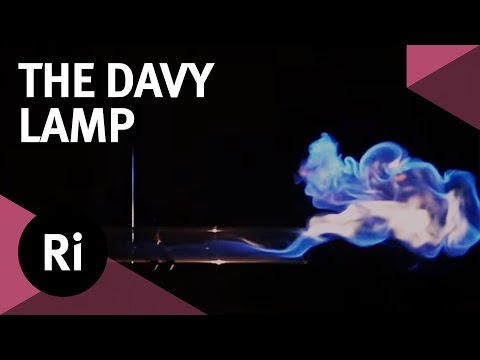
In this modern Royal Institution demonstration, Andy uses a gas-filled tube to show how wire gauze interrupts a travelling flame.
The Royal InstitutionWatch on YouTube ↗On 9 January 1816, Hodgson descended Hebburn with Dunn, the under-viewer Mr Seymour and some of the workmen. The gauze lamps had arrived the day before. The party began beside a pipe carrying gas from the blower which had supplied Davy's experiments—a persistent discharge from the seam.
As the lamp approached the gas, Hodgson saw its flame enlarge. Flashes followed inside the gauze, then the gas burnt steadily within it without communicating flame to the gas outside. When the lamp was drawn back into a suitable supply of ordinary air, the flame settled on its wick again.
During a later visit, Hodgson, Buddle and Dunn took a lamp into a working place where a man was hewing coal by the sparks of a steel mill, a small device using flint against steel. There, the roof supports stood almost side by side and the broken ground made ventilation difficult. Near the roof the wick flame lengthened slightly, while the copper plate and top ring became noticeably warm. The new light was being compared with the equipment a miner actually had beside his work.
Stephenson's three lamps
George Stephenson had been working on the same difficulty at Killingworth Colliery, where he supervised engines and underground machinery. In his own account, published in 1817, he dated a trial of his first lamp to 21 October 1815. Its flame stood behind glass, with air admitted through a narrow tube.
The next version used three smaller tubes. Tried on 4 November, it burnt better, but still did not satisfy him. He considered a ring of fine tubes around the oil vessel, then altered the arrangement to admit air through small holes in plates. A third lamp was tested on 30 November and shown to Newcastle's Literary and Philosophical Society on 5 December.
A mechanic's account
Stephenson was willing to describe what he had made more confidently than why it worked. His habits as a practical mechanic, he wrote, made him afraid of publishing theories. He was not satisfied that his own explanation, or those he had seen from others, was the true one. He was defending an experimentally useful result while leaving its explanation open.
The glass let through more light than a surrounding cage of gauze. Small passages controlled communication between the flame and the mine atmosphere, though the glass brought its own vulnerability to breakage. Stephenson's successive versions were attempts to reconcile those demands in a portable object.
Neither man had begun the search. William Reid Clanny, a physician in Sunderland, had presented a safety-light design to the Royal Society in May 1813. His apparatus supplied air with bellows and used water to separate the flame from the mine atmosphere. It was cumbersome equipment for a working miner. Stephenson nevertheless acknowledged that Clanny had constructed his original lamp long before Stephenson put his own ideas into practice.
By 1817, public rewards had made the competing claims especially sharp. Stephenson's pamphlet recalled that he had received a vote of 100 guineas. He did not object to a separate testimonial thanking Davy for his successful work. What brought him into the dispute, he said, was a change in wording: praise for the invention of “his Safety Lamp” became praise for “his invention of the Safety Lamp”. One possessive had given way to an article, and the claim had grown considerably.
What came back
While the inventors' supporters argued over precedence, Hodgson's May letter had a lampmaker's problems to convey. Coxe's new cylinder used tinned iron wire. Hodgson hoped this would resist rust and strengthen the gauze. He also hoped the next attempt would put the tin on after the cylinder was formed, helping secure its seam.
The Newman lamps needing repair had already been used heavily for nearly a month—Hodgson estimated about sixteen hours in every twenty-four on working days. He found most cylinders still in good order. The exception was one which had been thrown into very salty water and then neglected. His letter could praise the invention and list its damaged parts on the same page.
Heat was harder to settle. Hodgson relayed reports that miners distrusted the lamps in some mixtures where they could still breathe and work with steel mills. Mr Hill had seen a cylinder become red hot almost immediately in South Shields Colliery; on another occasion, apparently similar conditions had produced a much slower response. Hodgson's explanation of the difference remained speculative.
He tried his own regulator to restrict the air reaching the gauze. It produced a dull, unsteady light, and heat melted the soft-soldered joints of the experimental sleeve. He sent the unsuccessful contrivance with the working lamp. It had never been tried in a mine.
The colliers were acquiring less conspicuous methods of getting more light. Hodgson reported that they carried small brushes to remove soot and dust from the gauze while at work. They were learning to trim the wicks so that less smoke obscured the mesh. He was told of their pride in keeping the lamps bright.
After work, the gauze cylinders went home with them. They were unscrewed and set on the hearth stone until the soot and dust had dried. Then, Hodgson wrote, a few light taps with a fingernail knocked the dirt away.
Further reading
- John Hodgson's letters, reproduced in James Raine, A Memoir of the Rev. John Hodgson, vol. I (1857), pp. 178–186
- George Stephenson, A Description of the Safety Lamp (1817)
- Humphry Davy, An Account of an Invention for Giving Light in Explosive Mixtures of Fire-Damp in Coal Mines (1816)
- Humphry Davy, Some New Experiments and Observations on the Combustion of Gaseous Mixtures (1817), including the explanation of Plate V
- John Meurig Thomas, Sir Humphry Davy and the Coal Miners of the World (Royal Society, 2015)
- Royal Institution: Humphry Davy's miners' safety lamp
- Science Museum Group: Flint-and-steel mill