The Glass Moves
Benjamin Franklin brought spinning glass bowls within reach of two hands. Marianna Kirchgässner turned that possibility into a career, with music by Mozart and a new instrument made for her in London.
What's the deal?
The sound of rubbing a wet finger around a glass became an instrument that could play melodies and chords. Around 1761, Franklin arranged tuned glass bowls on a rotating shaft, leaving both hands free to choose notes. Professional musicians could perform complex music on glass, and composers including Mozart wrote for its distinctive sound.
Marianna Kirchgässner was advertising a new instrument to Vienna. Her printed announcement for a concert on 23 February 1806 described an English harmonica made for her during a long stay in London. She would play solos and music with accompaniment, including works written especially for her. She also hoped to overcome the prejudice that audiences held against her instrument.
The announcement recalled her earlier appearances in the city fifteen years before, as a young blind woman. By 1806 she was selling a long-established skill, supported by an instrument she had commissioned and music composed for her hands. Among that music was a quintet by Mozart. Its performing instructions required glass to do considerably more than sustain a mournful chord.
An armonica's bowls turn together on a horizontal shaft. Each has its own pitch, fixed by the glass itself. The player touches their exposed rims with wet fingers while the glass moves underneath. Larger bowls nest around smaller ones, gathering a succession of notes into a compact, tapering row.
That arrangement began with a practical dissatisfaction. Benjamin Franklin liked the sound of musical glasses. He wanted to bring more of them within reach.
Bringing the rims together
Franklin was an American printer and experimenter serving colonial interests in London when he developed the armonica around 1761. The pleasure of rubbing a wet finger around a drinking glass was already familiar. Performers arranged glasses on a table and adjusted their pitches with water. Franklin heard an improved set played by Edward Delaval, a fellow member of the Royal Society.
Separate vessels occupied space, and sustaining their notes meant moving fingers around their rims. Franklin instead made the vessels turn. A seated player could keep the shaft moving with a foot treadle, leaving both hands available to touch several bowls. Their notes could sound together, and pressure from the fingers could make a tone swell or soften.
The Franklin Institute identifies an early surviving example as the work of Charles James, made in London in 1761 to Franklin's instructions. The materials had different jobs: glass for the vibrating bowls, iron for the shaft, cork for the fittings and mahogany for the case. A stable mounting had to let the glass keep sounding.
In July 1762 Franklin explained the construction to the Italian physicist Giambatista Beccaria. The bowls should be blown in several sizes, with at least six of each size available for selection. From that supply a maker might choose thirty-seven to cover three octaves and the intervening semitones. Thickness mattered as well as diameter: two bowls of the same size could give different notes.
Tuning required removal. Franklin described comparing a bowl with a well-tuned harpsichord, then grinding away glass to lower a note that was too high. Each trial needed a clean, dry bowl, because wet glass sounded slightly flatter. Taking away too much created another job: the maker would have to grind material from the rim to raise the pitch again, then polish it.
The foot supplied motion; the hands chose notes.
A flywheel helped steady the rotation. Cork fitted into each bowl's central neck held it on the shaft and kept neighbouring glasses from touching. Too tight a fitting risked splitting a neck; too loose a fitting allowed movement and unwanted contact.
The water no longer tuned the instrument. It helped fingers grip the turning glass. Franklin painted the bowls' inner surfaces to help a sighted player distinguish notes, using colours for the natural notes and white for the semitones between them. Finding one's way along the row was part of making the new arrangement playable.
The trouble at a customs house
Marianne Davies helped carry the armonica beyond Franklin's rooms. An English musician who also sang and played flute and harpsichord, she was performing publicly on the new instrument early in 1762. Her younger sister Cecilia became her musical partner as a singer. Their travels brought the glass instrument to Continental audiences and eventually to Vienna.
Travel exposed the machine's fragility. Writing to Franklin in 1783, Davies recalled both the expense of touring and her continual fear that the instrument would be damaged at customs houses. Her father had helped care for it on the earlier journeys. The practical advantage of putting so many notes in one case did not make that case an easy travelling companion.
Mozart encountered the armonica well before Kirchgässner's visit. In 1773 his father Leopold reported hearing Franz Anton Mesmer play it in Vienna. Mesmer later became famous for his theory of animal magnetism, but here he enters the story as a musician with a finely made glass instrument. Leopold wrote that Wolfgang had tried it too, and wished the family could have one.
Kirchgässner arrived in Vienna in 1791 as a professional virtuoso on an instrument with several decades of use behind it. Blind since childhood, she had developed a career in which the ability to find and control the glass by touch was central. Mozart completed his Adagio and Rondo for her on 23 May.
Glass among four colleagues
The quintet, now known as K. 617, joined the armonica to flute, oboe, viola and cello. Its autograph survives, along with a contemporary copy of the armonica part. Mozart wrote the word Harmonique beside the instrument's staves. Kirchgässner's Vienna concert on 19 August 1791 included the new work.
The opening page asks the glass player for several things at once. Notes rise above held harmony; short groups of quick notes move between the longer tones. The other instruments sometimes fall silent while the armonica continues. Both hands have work to do, beyond simply following one melody along the bowls.
The slow opening is in C minor. The following rondo moves into C major and bears the marking Allegretto. Its returning tune gives the glass player moving phrases to shape among the winds and strings. The machinery Franklin had compacted into a seated reach now supported an individual part in an ensemble of five people.
Keeping that part responsive took preparation. In separate playing directions, Franklin began with washing the hands and rinsing away the soap. Even a little grease on a bowl could interfere with its response. He recommended rainwater, a wet sponge and fine chalk kept in a teacup. The fingertips needed some soaking, rather than a quick surface wetting.
Too much water on the turning bowls also made the notes reluctant to start. Wind or direct sunshine dried them too quickly, so a window might need shutting or a curtain drawing. For a long session, Franklin suggested thin slices of sponge held between strips of wood, their loose ends touching the backs of the glasses to maintain the moisture.
He advised learning each bowl's response through trial. Some needed contact nearer the edge; others responded better farther onto the rim's flat surface. A large bowl might need two fingers. The player had to find the note and the touch that would bring it out.
The modern performance below makes that work visible. William Zeitler plays his arrangement of Tchaikovsky's Dance of the Sugar Plum Fairy, music from The Nutcracker of 1892, with harp and bass clarinet. It is later music on a modern instrument; the close views show fingers moving between the turning rims.
Fingers on the turning glass
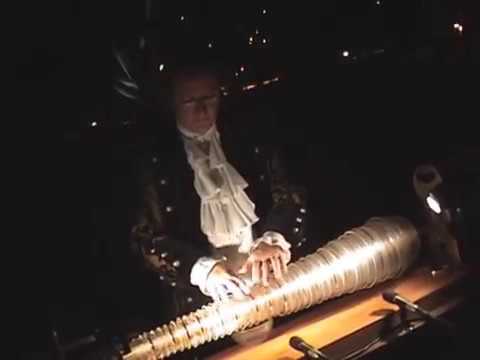
William Zeitler performs his arrangement of Tchaikovsky's Dance of the Sugar Plum Fairy for glass armonica, harp and bass clarinet. A modern performance, with close views of the hands and rotating bowls.
William Zeitler / GrailHeartWatch on YouTube ↗An invitation to judge
Admiration for the glass tone did not rule out discomfort with it. In 1778 Leopold Mozart compared an oboist's frequent swelling of notes to the armonica's effect on him: melancholy. This was a listener's response to a sound, rather than a limit on the music a skilled player could attempt.
Kirchgässner's 1806 announcement offered an English instrument developed beyond the early Franklin type. It did not explain the new mechanism in enough detail to reconstruct it. What it did establish was her part in choosing it: she had had it made during her stay in London, and she was presenting its possibilities to an audience.
The public invitation addressed prejudice through a promised performance. She would demonstrate the instrument in solos and with accompaniment, playing music written for her by well-known composers. Her experience and the new construction stood together in the advertisement. Tickets were offered at two florins, available from the performer herself as well as at the address printed on the notice.
Further reading
- Benjamin Franklin to Giambatista Beccaria, 13 July 1762
- Franklin's later directions for playing the armonica, in Bigelow's collected edition
- The Franklin Institute: the 1761 Charles James armonica
- The Metropolitan Museum of Art: Glass Harmonica
- MozartDocuments: the glass harmonica in Vienna and Leopold Mozart's letters
- Köchel catalogue: Mozart's Adagio and Rondo, K. 617
- British Library: Mozart's autograph score and the contemporary armonica part
- Kirchgässner's concert announcement for 23 February 1806
- Breitkopf & Härtel's printed score, 1883