H4, Taken Apart
John Harrison spent years making large clocks for the sea. A watch made by John Jefferys helped him change direction. Inside H4, four springs and a fast-moving balance carried the experiment across the Atlantic; explaining it to other makers required another kind of work.
What's the deal?
An accurate clock could help sailors work out how far east or west they were, reducing uncertainty about their position at sea. Harrison's H4, completed in 1759, carried reference time across the Atlantic despite movement and changing temperatures. Comparing that time with local time found from the Sun turned a watch reading into navigational information.
In 1765, John Harrison and his son William had to explain their watch with the watch in pieces. They supplied drawings and a written account under oath, answered questions and demonstrated its construction before a group that included astronomers, an instrument maker and several watchmakers. One of those watchmakers, Larcum Kendall, would be expected to put the knowledge to use.
The object under examination was H4, Harrison's fourth marine timekeeper. Completed in 1759, it had already crossed the Atlantic on two official trials. It looked like a very large silver pocket watch. Its dial alone measured just over ten centimetres across; with its case it weighed about 1.45 kilograms. It was compact beside Harrison's earlier machines, though a substantial thing to carry in a pocket.
Britain's longitude commissioners wanted to know whether other people could make such a timekeeper. Harrison wanted the reward he believed his watch had earned. Taking it apart exposed the wheels and springs, but it also exposed a difficulty that the successful voyages had left open: a working object could contain adjustments and judgements that were harder to put on paper than a drawing of a wheel.
For a navigator, the watch had a simple purpose. Earth turns through fifteen degrees of longitude in an hour. Compare local time, established by observing the Sun, with the time at a known reference meridian, and the difference gives an east–west position. If the Sun reaches local noon while the reference clock reads two in the afternoon, the ship is thirty degrees west of that meridian.
The arithmetic could fit on a small piece of paper. Keeping the reference time through weeks of changing temperature and shipboard movement was the expensive part.
Two experiments at once
Harrison was a carpenter turned clockmaker who had come from Lincolnshire to seek support in London. Astronomers and instrument makers encouraged him, and public money supported successive attempts. His first large marine timekeeper, H1, went to Lisbon in 1736. Instead of a pendulum, it used two connected balances arranged to resist disturbance from the ship's motion. An encouraging voyage brought money for further work.
H2 followed, then H3. Harrison began the third machine in 1740 and spent nearly nineteen years building and adjusting it. Its two large circular balances would not keep time as well as he required. H3 nevertheless contained useful solutions to other problems, including a strip of two metals that responded to heat and a bearing in which rollers reduced friction. The difficulty lay in getting the whole machine to perform consistently.
The watch experiment began while the large clock was still occupying him.
In the early 1750s Harrison asked the London watchmaker John Jefferys to make a watch to his design. It kept time well enough to suggest that the smaller instrument might do more than assist the clock. Work on H4 began in 1755.
The change was gradual. Even in early 1761 Harrison proposed a sea trial of both H3 and H4. He subsequently withdrew the large machine and put forward the watch alone. For a time, the two designs were competing possibilities in the same workshop.
Thomas King's portrait of Harrison, painted around 1767, preserves the relationship unusually well. Harrison holds the Jefferys watch in his right hand. H3 stands behind him, while drawings lie on the table. The little watch in the portrait is often taken for the famous H4. It is the precursor that helped make H4 possible.
Four springs, four jobs
An ordinary watch was an unpromising instrument for carrying a reference time across an ocean. A spring supplied its power, wheels passed that power onwards, and an escapement released the train in small steps while sustaining the balance. The balance swung back and forth against a fine spring. Its repeated swings governed the watch's rate.
Those parts influenced one another. Changes in the force reaching the balance could change its swing. Friction consumed power, and position altered the way moving parts bore on their supports. Temperature changed the behaviour of the balance spring. Making the case smaller did not remove any of these problems.
Harrison gave H4 a large, fast balance for a watch: it made five beats each second. In his published explanation he compared the distance travelled by his balance with that of a common watch and argued for obtaining motion through speed. A disturbance then had a smaller influence in relation to the balance's own vigorous movement. The watch's rapid beat was part of its means of resisting the sea.
He also reduced the influence of the power supply. H4 contained four springs with separate duties. The mainspring stored the energy supplied by winding. Another spring kept power flowing while the mainspring was being wound. A third, close to the balance end of the train, was replenished automatically eight times each minute. The fourth was the balance spring itself, returning the balance on every swing.
That third spring was the remontoire. It supplied the timekeeping mechanism for seven and a half seconds at a time, then received a fresh charge. The much longer train of wheels behind it was occupied with replenishing this small supply. Changes in the main drive therefore had less opportunity to disturb the balance directly.
Harrison's description compared the rest of the train to the person who wound the watch once a day. It provided energy; it should have as little say as possible in measuring time. The extra spring for maintaining power protected the same continuity during winding, when the normal drive would otherwise be interrupted.
The published notes name Maberley as the maker of the first three springs. Ruby holes supported pivots, with diamond endstones at their ends; the escapement's pallets, the surfaces engaging the escape wheel, were diamond too. The precious materials served working surfaces where small amounts of friction and wear could affect the rate.
Cold weather, then a fire
H4's temperature compensation also needed adjustment. Its brass-and-steel strip bent as the metals expanded by different amounts. Through two pins acting on the balance spring, this movement changed the spring's effective working length, compensating for the change in its behaviour with heat or cold.
The notes published after the disclosure describe Harrison's procedure. He required cold weather to establish the watch's rate, then placed it near a fire with a thermometer and adjusted the compensation until it went at the same rate in the different temperatures. A strip of metal supplied the response, but comparison told the maker whether the response was right.
The adjustment could be misleading if the parts warmed at different speeds. The compensating strip took up heat faster than the balance spring. Time had to be allowed for the mechanism to reach the conditions being measured. These instructions were part of what another maker needed to know beyond the strip's outline and dimensions.
H4 continued to change after its first Atlantic trial. The published notes specify that a pin acting on the balance spring was added after the Jamaica voyage to help equalise the timing of different-sized swings. The configuration described to the examiners was the product of further adjustment after a successful journey.
William takes the watch to sea
William accompanied H4 to Jamaica in 1761 and to Barbados in 1764. His father's machine needed a custodian who understood its habits. On the Barbados voyage, the disclosure notes record, one end of the watch was kept higher than the other because it had not been adjusted to keep exactly the same rate in every position. A movable box with a divided arc allowed its angle to be changed when the ship changed tack.
Handling mattered even when winding it. The notes warn against a rapid circular movement in the plane of the balance: a pocket watch of this sort had once been stopped that way. They describe turning the watch about a diameter of its dial to bring it into a convenient winding position. William's practical knowledge travelled with the instrument.
The Jamaica result also required calculation. The familiar claim that H4 was only about five seconds wrong after an eighty-one-day passage allowed for its daily rate of gain or loss. A steady daily error could be corrected; uncertainty about how that rate had been established helped make the trial disputed. It was not simply a reading of five seconds accumulated on an untouched watch.
On the outward voyage William used H4 to predict an earlier landfall at Madeira than the crew expected. According to the Royal Museums Greenwich account, the captain was sufficiently impressed to ask to buy the next timekeeper. The Barbados trial supplied the firmer official result: the commissioners accepted that H4 had kept longitude comfortably within the strictest accuracy limit set by the 1714 Act.
Putting the workmanship on paper
Success brought the Harrisons back to the problem of explanation. The commissioners required a useful navigational method that could be communicated and reproduced. The telescope maker James Short supported Harrison through the dispute; he knew a trade in which a description of polishing could leave much of the decisive skill unexplained.
The 1767 publication, The Principles of Mr. Harrison's Time-Keeper, records John and William delivering the account together. Among those examining it were the watchmakers Thomas Mudge, Larcum Kendall and William Matthews, the instrument maker John Bird, the natural philosophers John Michell and William Ludlam, and Nevil Maskelyne, the Astronomer Royal. They asked questions while the watch was taken apart.
Maskelyne then supervised the engraving of its drawings. His preface said that the engraved lines corresponded closely to the originals. The printed sheets presented a further problem: ordinary paper shrank after passing wet through the press. A craftsman taking dimensions from a dried print could be working from a drawing that had changed size.
For makers who wanted to construct another watch, Maskelyne had a few impressions printed on India paper. Slightly dampened between wet sheets, it could take the impression without shrinking in the drying. After the balances, springs, jewels and sea trials came a final adjustment to the material carrying the instructions.
Making H4 again
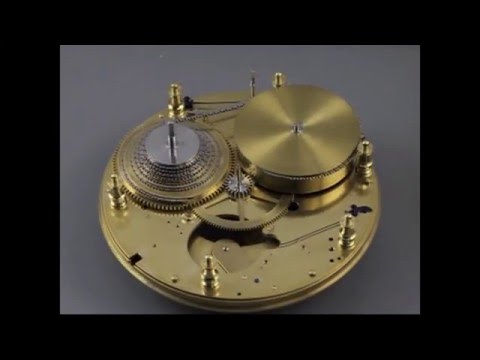
A short extract from Barbara Darby's film follows the modern reconstruction begun by Derek Pratt and completed by Charles Frodsham & Co. Case making, engraving, polishing and jewel work show some of the craft needed to turn drawings into another watch.
Barbara DarbyWatch on YouTube ↗Further reading
- John Harrison and Nevil Maskelyne, The Principles of Mr. Harrison's Time-Keeper (1767)
- Royal Museums Greenwich: H4
- Royal Museums Greenwich: H3
- Royal Museums Greenwich: Longitude found — the story of Harrison's timekeepers
- Katy Barrett, Science Museum: A portrait of Mr Harrison and his timekeepers
- Jonathan R. Siegel: Law and Longitude
- Jim Bennett: James Short and John Harrison — personal genius and public knowledge