A Million Points in Granite
A walking transport frame, a bargain with the city and thirteen years of carving: how Gustav Vigeland’s Monolith reached the centre of an extraordinary park.
What's the deal?
An entire crowd of children and adults rises from one piece of granite. Vigeland's Monolith made human bodies into a seventeen-metre column at the centre of an Oslo public park. Three carvers spent thirteen years turning his model into stone. Its remarkable scale rests on keeping 121 figures joined within one block, through a huge undertaking in transport, measurement and carving.
Haakon Eeg-Henriksen proposed to move a granite block weighing about 270 tonnes through Oslo. To demonstrate his method, the engineer built a model with empty fish-ball tins and inflatable footballs.
According to a later account of the transport, he cast a miniature Monolith in cement at one-tenth scale. Wooden pistons sat in the tins, resting on the deflated footballs. As he pumped them up, the frame lifted and advanced the model. His tender was the cheapest of twelve: 74,000 kroner, against a highest bid of 285,000. He won the job.
In 1926 the full-sized machinery began moving the stone towards Frogner Park. Hydraulic jacks replaced the footballs. The block progressed along temporary rails in steps of roughly a metre and a half; even its best day’s journey covered only about fifty metres.
The load was destined to become 121 interlocking human figures, carved from a single piece of granite. Today the seventeen-metre column stands above a circular arrangement of stone groups in Oslo’s Vigeland sculpture park. Children climb, adults carry one another, and bent backs and folded limbs fill the column almost to its tip. Getting the block there was one contract. Giving it this surface took three stone carvers thirteen years.
Vigeland’s bargain with the city
Gustav Vigeland was born in Mandal, on Norway’s south coast, in 1869. He trained as a woodcarver before turning to sculpture and made his exhibition debut in 1889. Travel brought him into contact with European sculpture, including Auguste Rodin’s work in Paris. Back in Norway, he made portraits and public monuments; his bronze memorial to the mathematician Niels Henrik Abel, unveiled in 1908, established him as a major sculptor.
By then he had begun the project that would occupy the rest of his life. In a model exhibited in 1906, six men supported the huge bowl of a fountain, with trees and human figures around it. Around 30,000 people came to see the model. The city commissioned the fountain the following year, intending to put it near the Norwegian parliament. That location never materialised.
A second negotiation gave Vigeland the resources to keep enlarging his plans. In 1921 he agreed to leave his works to the city in exchange for a purpose-built studio, which would eventually become a museum. He moved into the new complex at Frogner in 1924. It provided room for modelling and for the plaster workers, stone carvers and other specialists who helped turn his designs into permanent works.
Frogner was already a public park: the municipality had bought the estate in 1896 and opened its older parkland in 1904. Vigeland’s sculpture garden grew within it. On 27 November 1924, the city council approved land west of the ponds for the fountain, the Monolith and its granite groups. Later plans extended the scheme across the bridge towards the main entrance. Vigeland designed the layout as well as the sculptures, eventually filling it with more than 200 works in bronze, granite and wrought iron.
The people in them have no uniforms or fashionable clothes to date them. Vigeland returned to birth, ageing, desire, quarrels, play and death. The fountain’s men bear their bowl together; the bridge includes the furious small boy now known as Sinnataggen. The Monolith packs bodies of different ages into one rising column. Its name comes from the Greek for a single stone.
A block from the Swedish border
Vigeland had already committed himself to the stone before the council committed itself to the site. In 1922 a huge piece of granite was extracted at Hov beside the Iddefjord, near Halden, NorwayA town in south-eastern Norway, close to the Swedish border. The Monolith’s granite was quarried at nearby Hov, beside the Iddefjord.Open in Google Maps on the Norwegian–Swedish border. He had ordered the quarrying on his own initiative and at his financial risk.
The rough stone is reported at about 470 tonnes. Squaring it for transport reduced it to roughly 270; after carving, the finished column would weigh about 180. The first reduction took place at the quarry, years before the human figures began to emerge in Oslo.
Granite offered durability outdoors, but the size of the block ruled out ordinary transport. It had to reach the waterfront, cross the Oslofjord and then cover about five kilometres from Bestumkilen to Frogner. Eeg-Henriksen, who had founded his contracting company in 1922, took responsibility for moving and raising it.
At the water’s edge, two barges were filled with water to lower them beneath the load. Pumping the water out restored their buoyancy and lifted the stone. Tugs could then tow it towards Oslo. On arrival, the operation was reversed to put the block ashore.
The land journey required a temporary track laid on sleepers. Eeg-Henriksen’s frame combined a lift with a forward movement: the hydraulic cylinders extended, the frame tilted and the stone advanced. The equipment was reset for the next stroke, while track was laid ahead. A small hut on top of the block housed the engine and pump.
Reidar Martinsen’s later history of the journey records an obstacle at Skøyen: the railway bridge was too low for the lifting frame. A Chevrolet truck, loaded with a tonne of scrap iron, pulled the stone through using ropes and pulleys. Elsewhere, overhead tram wires had to be disconnected to let the apparatus pass.
The block reached the park in 1927 and was raised in 1928. A tall timber house then went up around it. The stone would stay inside until December 1944.
Finding 121 figures inside the granite
Vigeland had modelled the full-size composition in clay in 1924–25, working on it for about ten months. It was cast in plaster, in sections, to provide the durable model needed for carving. Inside the timber house, model and granite stood beside one another, with scaffolding giving access to their upper surfaces.
Carving began in the summer of 1929. The men worked downwards from the top of the column, using the model to establish the position and depth of the figures before cutting away the surrounding stone.
The transfer method was called pointing. The museum describes a movable frame with three legs and adjustable measuring devices. Set against the plaster model, it recorded the position of a point on the surface. Transferred to corresponding reference positions on the stone, it showed where that same point had to lie in the granite. The carvers could remove material towards it, then take another measurement.
On a composition this crowded, a measurement concerned more than the outline of the column. A knee projected in front of another body; an arm crossed a torso; a head emerged between surrounding limbs. The depth of each feature had to be established as well as its height and width. Cutting too far would remove stone needed for the adjacent figure.
The Vigeland Museum estimates that approximately a million measurement points were transferred from plaster to granite. The apparatus supplied positions, while the carvers shaped the surfaces between them with hammer and chisel: rounding a shoulder, separating limbs and bringing the figures to their final contours.
The timber building allowed work to continue through the seasons, but a heater did not make it a comfortable winter workshop. NRK’s account describes the men in woollen hats and sheepskin coats. They worked six-day weeks, moving between the plaster, the measuring equipment and the granite.
The three carvers
Nils Jönsson was the experienced member of the team. Born in Sweden in 1886, he had worked for Vigeland since 1915. His two principal colleagues came from Denmark and from the district that supplied the stone.
Karl Kjær was twenty-five when he applied to Vigeland in 1929. He wanted to travel and gain experience, as his application letter makes clear. He had served an apprenticeship in Nykøbing Mors and attended technical school. He would work for Vigeland until 1947, carving the Monolith and other granite sculptures while also developing his own work as a sculptor.
Ivar Broe, born in 1892, came from an Iddefjord family of stone workers. After moving to Oslo, he attended evening classes in modelling alongside his job. His training combined stonework with the making of forms in clay—the two processes brought together inside the Monolith house.
Stone dust damaged lungs. Kjær was diagnosed with silicosis in the 1960s, after a career that extended well beyond this commission.
The Monolith, with its museum keepers
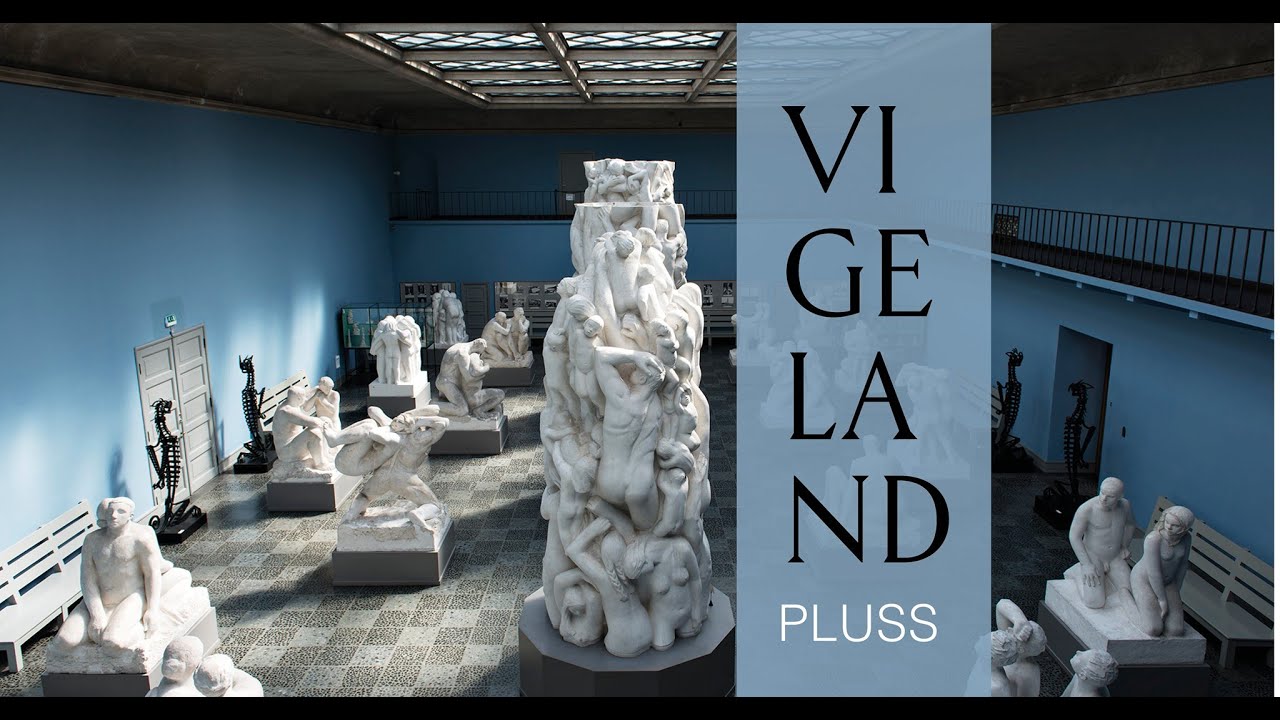
Museum director Jarle Strømodden and historian Unni Irmelin Kvam discuss the Monolith in the park, including the stone’s journey and the years of carving.
Vigeland Museum · film by Alex Asensi and Jon GorospeWatch on YouTube ↗The park after the workshop
The carving was finished in 1942. Vigeland died on 12 March 1943, aged seventy-three. That year the public could enter the Monolith house to see the sculpture; the building itself was removed in December 1944. He had lived to see the figures completed, but never the column standing under open sky.
Work on the surrounding park continued after his death. The fountain began running in 1947, when sixteen of the thirty-six granite groups around the Monolith were also installed. Wrought-iron gates were added to the plateau in 1952. The monument emerged from its shed into a landscape still being built around it.
The fountain that had once been intended for a square by parliament became part of a long garden axis, with the Monolith above it and the bridge leading towards the city. The six bronze men, the column and the surrounding stone groups could now be seen together among lawns, trees and flower beds.
Kjær remained a familiar presence near the finished park. In the 1960s he ran a kiosk by the entrance, selling chocolates and postcards. His granddaughter remembered how proudly he told visitors that he had helped carve the Monolith.
Further reading
- Gustav Vigeland’s life
- museum’s history
- park overview
- park timeline
- Monolith Hall
- sculpture teaching booklet
- Store norske leksikon on the Monolith
- Haakon Eeg-Henriksen
- Reidar Martinsen’s transport history
- Idd history society
- Visit Østfold’s Halden account
- NRK’s investigation of the carvers
- published research account
- Karl Kjær’s biography
- account of the hydraulic transport