Fresh Leaves for the Caterpillars
Maria Sibylla Merian’s pictures of Suriname began with the difficult business of keeping small animals alive. The leaves could fail, the wrong creature could emerge, and a beautiful plate could conceal a broken connection.
What's the deal?
A butterfly specimen could not show which caterpillar it had been or what that caterpillar ate. Merian observed insects developing in Suriname and brought different life stages together with plants in her 1705 book. Readers could follow relationships that a collection of dead insects left unexplained. Some pairings were wrong, but the pictures made growth, feeding and transformation central to understanding insects.
In Suriname, Maria Sibylla Merian tried to rear yellow caterpillars from a tree with white, threadlike flowers and twisted seedpods. The caterpillars ate its leaves. Once cut, however, those leaves quickly hardened and withered. Her animals could no longer eat them.
She recorded losing more than a hundred. In the same entry she also noted a successful transformation: one caterpillar became a PupaAn insect in the stage between larva and adult, when its body changes form. For a butterfly or moth, this is the stage after the caterpillar.Merriam-Webster · pupa on 16 June 1700, and a butterfly emerged at the end of the month. The finished illustration contains flowers, pods, larvae and two views of the adult. Its accompanying paragraph preserves the feeding problem behind the arrangement.
A finished plate could bring together observations made months apart.
During that interval somebody had to supply suitable food, watch for changes and keep the animal alive. Merian’s Metamorphosis insectorum Surinamensium, published in Amsterdam in 1705, gathered that work into sixty large illustrated plates. A caterpillar and a butterfly could finally occupy the same sheet, though they had never occupied the same moment.
The missing information in a cabinet
Merian already knew how to make pictures sell. Born in Frankfurt in 1647, into a family of engravers and publishers, she trained in the household of her stepfather, the flower painter Jacob Marrel. Later, in Nuremberg, she and her husband, Johann Andreas Graff, earned money through pictures, prints, art materials and teaching. Her women pupils brought insects and gave her access to gardens.
She had begun observing silkworms as a girl. Other caterpillars produced butterflies and moths more beautiful than the silkworm’s adult, and she collected them to follow the changes. Her European caterpillar books appeared in 1679 and 1683. The animal’s food belonged in the account alongside its successive forms.
Amsterdam offered magnificent specimens and an unanswered question.
After moving there in 1691, Merian saw the collections of the physician Frederik Ruysch, the merchant Levinus Vincent and the city’s mayor Nicolaes Witsen, among others. Their imported insects astonished her. But the preserved animals did not explain their beginnings: which caterpillar produced which adult, and how the changes occurred. In her account, that gap prompted the expensive journey to Suriname.
In June 1699 she sailed with her younger daughter, Dorothea Maria. Merian was fifty-two. Their destination was a Dutch plantation colony on the north-eastern coast of South America, where access to land, transport and other people’s labour was shaped by slavery.
The two women collected and reared animals, made drawings and visited plantations. In April 1700 Merian was at Providentia, where she found the striped caterpillar that would appear beneath an immense pale moth. Elsewhere, a promising specimen could fail before it supplied an answer. Finding the animal was only the beginning of the work.
Other people’s knowledge
Indigenous and enslaved people brought Merian plants and animals and supplied names and explanations. She acknowledged this help, although the book generally leaves its providers unnamed. Their information enters the text at particular points, where it can sometimes be distinguished from what she managed to observe herself.
An enslaved Black woman brought her an orange creature and told her what winged insect would emerge. Merian tried to follow the transformation, but the pupa died. Other inhabitants confirmed the woman’s explanation. Merian included it, explicitly saying that she had been unable to witness the change and leaving further investigation to others.
Beside the peacock flower, the account moves beyond insects. Merian reported that Indigenous women badly treated in Dutch service used its seeds to end pregnancies rather than bear children into slavery. She also wrote of enslaved African women from Guinea and Angola, their treatment and their refusal to have children in that condition. The passage preserves testimony about colonial violence inside a natural-history book. It does not establish the safety or effectiveness of the reported plant use.
The woman who brought the orange creature remains unnamed in Merian’s account. Her contribution survives because Merian recorded what she was told, including the experiment that failed to confirm it.
Putting time onto paper
Her entries often record the interval between finding a caterpillar and seeing the adult. On a guava branch, a large caterpillar spun its covering in October 1699; moths emerged the following January. From some caterpillars, however, white maggots appeared, later becoming green flies. The expected moth was not guaranteed. In modern terms, an insect developing inside another insect can interrupt the host’s life cycle.
The blue butterfly on a pomegranate sheet offered a different kind of observation. Merian recorded a pupa forming on 22 April and the adult emerging on 8 May. Through a magnifying glass, the blue surface resolved into overlapping scales, arranged like tiles on a roof. Her attention passed from the whole animal to the construction of its colour.
The relationships on a sheet need reading carefully. Beside a ripe pineapple, Merian placed a butterfly and its earlier stages, but her text says she found the caterpillar in grass. The pineapple was not thereby established as its food plant. She even identified another small addition to that composition as ornamental.
A shared page did not always mean a shared diet.
Merian composed her pictures from material gathered at different times. Some combinations expressed observed feeding relationships; others brought together an attractive plant, an insect’s recorded changes and an additional animal. Her explanations allow those different purposes to be separated.
One particularly convincing arrangement was wrong. The enormous adult on the Providentia sheet is the white witch moth, Thysania agrippina. The caterpillar beneath it is not its larva. Merian’s account gives a place, feeding observations, a colour change before pupation and an emergence date of 3 June. The finished image nevertheless joins incompatible stages.
Exactly how the mismatch occurred is unknown. Separate drawings or specimens may have become confused as the material was assembled; that remains an explanation, not a recovered event. The published association cannot be accepted simply because the details around it are precise.
The frog account makes the intended method especially clear. Merian described keeping spawn in a pot of water with turf at the bottom, renewing the water and vegetation and supplying food. Dark specks began to move; tails developed, then hind legs and forelegs. Eventually the small frogs could leave the water. The plate arranges those changes around an adult. It gives the reader a sequence that required repeated attention to living animals.
The return cargo
The climate was harder on Merian than she had expected. She blamed the heat for forcing an earlier return, and she and Dorothea Maria left in June 1701. Later accounts suggest malaria, but that diagnosis is uncertain. They reached the Netherlands on 23 September.
Among the things Merian took aboard were lizard eggs from a nest in her house. The young hatched at sea. Without suitable food, she recorded, they died. A blue lizard, eggs and a hatchling nevertheless entered the banana plate, where she said she had included them chiefly for decoration.
In Amsterdam, the drawings became a book.
Notes, specimens and drawings could be worked into larger compositions. Those images then had to pass through another set of skilled hands before buyers could turn the pages of a book.
Merian engraved three of its sixty plates herself. Jozef Mulder, Pieter Sluyter and Daniel Stoopendael made the others. The botanist Caspar Commelin helped supply plant names. Both daughters, Dorothea Maria and Johanna Helena, assisted with colouring. The family workshop extended from collecting and drawing to the preparation of copies for sale.
Copperplate printing produced the outlines. Ink held in the incised lines transferred under pressure to a sheet; colour was added by hand. Expensive counterproof versions added another transfer: a fresh sheet was pressed against a still-wet print, producing a reversed, fainter image whose fine outlines could almost disappear beneath the colouring. A volume could consequently vary in printing, orientation and painted finish from another copy of the same work.
Paying for sixty plates
Merian published the book at her own financial risk, selling through her household and the Amsterdam bookseller Gerard Valck. Buyers could obtain Dutch or Latin text. In the preface she emphasised the quality of the paper and the cost of employing skilled engravers, saying she would be satisfied to recover her expenses.
Her daughters continued the work beyond her death in 1717. Later editions expanded the book to seventy-two plates, so an image in a later volume need not belong to the original sixty. The pictures also acquired a market separate from the explanations Merian had written for them.
Turning the pages of a later edition
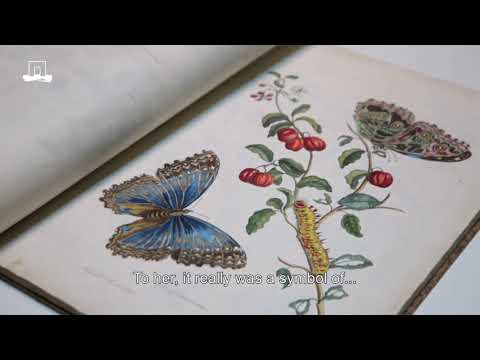
WUR Library opens a later pirate edition of Merian’s work and examines its hand-coloured illustrations. Dutch speech with English text in the film.
Wageningen University & Research LibraryWatch on YouTube ↗One later Paris edition, now in Wageningen’s university library, reused the plates under the title Recueil de plantes des Indes. Its emphasis had shifted to plants. The illustrations survived; the descriptive text had been left out. A purchaser could admire the pineapple without learning that its caterpillar had been found in grass.
Further reading
- Maria Sibylla Merian, Metamorphosis insectorum Surinamensium, 1705: original Dutch text and plates — DBNL
- The 1705 volume digitised by Smithsonian Libraries and Archives — Biodiversity Heritage Library
- Merian’s artistic training, household business and rearing practice — Science History Institute
- Metamorphosis: engravers, colouring and counterproofs — Utrecht University Library
- Maria Sibylla Merian: voyage, Indigenous knowledge and printing — Rijksmuseum
- Merian and Metamorphosis — Royal Collection Trust
- The white witch moth and the mistaken caterpillar — Kaunas Tadas Ivanauskas Zoological Museum
- The later pirate edition in Special Collections — Wageningen University & Research Library