Rome at Hand
Giacomo Raffaelli rebuilt an ancient Roman favourite in a circle of glass just twelve centimetres wide. His doves belonged to a trade that let travellers take the city's monuments home, one tiny piece at a time.
What's the deal?
Visitors could carry a miniature picture of Rome home in a box lid or other small object. Eighteenth-century mosaicists made these images from tiny pieces of coloured glass, fine enough to suggest feathers, water and distant buildings. A craft associated with large architectural decoration now supplied portable souvenirs for travellers, joining admiration for ancient art to the business of tourism.
Four doves balance around a drinking bowl. One bends its head towards the water; another turns back into its own feathers. Below them, a curved band of light gives the bowl its rounded body. Everything, including the water, is solid.
Giacomo Raffaelli made this little picture in Rome in 1783. Its bronze backing carries his name, the place and the year. The whole circle measures 12.1 centimetres across. A pattern famous from an ancient mosaic had become small enough to hold in a hand.
Raffaelli preserved the birds' different occupations and the bowl's deep curve. He also changed the shape of the picture. The rectangular ancient panel became a roundel, its subject gathered inside a narrow geometric border. There was room for the drinking bird's long descending neck, the tails reaching sideways and a suggestion of the surface beneath the vessel. There was no need to carry the surrounding floor.
These were the kinds of objects visitors could bring home from Italy: familiar Roman subjects made through a specialist Roman craft. The pleasure depended partly on distance. Step back and the pieces gather into a bird. Come closer and its feathers separate into glass.
A bird with a written history
The subject already had a distinguished recommendation. In his Natural History, the Roman writer Pliny described the mosaicist Sosus of Pergamum making a floor that appeared to be strewn with scraps from a meal. He then singled out a drinking dove whose head cast a shadow on the water. Other birds rested and preened on the edge of a vessel. The hard surface persuaded the eye to see something yielding and momentary.
In 1737, excavations at Hadrian's Villa near Tivoli brought to light an ancient panel with four doves around a bowl. The association with Pliny's account helped make it celebrated. It is now in Rome's Capitoline Museums, which describe it as deriving from a Hellenistic original attributed to Sosus. The surviving panel's connection with that earlier composition does not establish that Sosus himself made it.
The ancient picture is 85 by 98 centimetres. Its birds have space to spread along the rim of the vessel, against a dark ground. Light pieces pick out the front bird's breast and the drinking bird's back; warmer bands pass through the feathers. The handles and the fluted lower bowl make the vessel substantial enough to support its four visitors.
Raffaelli's version keeps that recognisable arrangement while compressing it into a different outline. The two images share a composition, but their parts do not coincide like a tracing. His border is different, the space below the bowl is reduced and the vessels have different profiles. The modern name Doves of Pliny identifies a subject with an ancient literary pedigree; it does not make every later example an exact facsimile of one surviving object.
Drawing the palette
Rome's mosaic workers could draw on skills developed for much larger images, including the decoration of St Peter's. Small portable pictures gave those skills another market. Raffaelli was an important early practitioner, alongside makers such as Cesare Aguatti. Their material allowed a degree of control that ordinary floor tiles could not provide.
Opaque coloured glass was heated and drawn into narrow rods, or filati. Shaping a rod while it was hot determined the outline of the small pieces cut from it. A mosaicist could therefore choose a piece for its shape as well as its shade, then turn it to follow the form being built.
A feather needed more than the right colour.
In the drinking dove, lines of pieces sweep down the neck and change direction across the wing. The dark gaps make those courses easy to follow in this monochrome photograph. Around the basin, the courses turn again, running along its curved rim. Shape and direction help distinguish feather, water and metal before colour is considered.
The pieces were set into a bedding material on a support, then the surface was finished with abrasives and wax. Recipes and actual surviving materials need not agree exactly. Conservator Elizabeth La Duc's study of a later Italian tabletop found a calcium-rich bedding whose organic component remained uncertain, while red material between glass pieces contained wax and red ochre. Those findings describe that tabletop; they are not a chemical analysis of Raffaelli's roundel.
The operation is easier to follow when the glass moves. In the V&A film below, craftspeople at SICIS recreate a section of Michelangelo Barberi's nineteenth-century table The Flora of the Empire of the Two Sicilies. Hot glass stretches into thin lengths. A small segment is cut off and placed with tweezers; another is selected to continue the image. New rods are prepared as the picture grows.
From glass rod to tiny picture
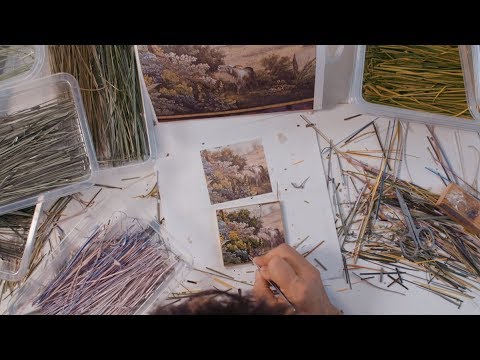
At SICIS, craftspeople recreate a section of Michelangelo Barberi's nineteenth-century table for the V&A. Modern tools and materials demonstrate drawing, cutting, setting and polishing glass.
Victoria and Albert Museum / SICISWatch on YouTube ↗The demonstration also shows colours being combined in the hot glass itself. A tiny cut piece can contain variation before it joins its neighbours. At the end, the surface is pressed, worked with successively finer abrasives and polished. The reconstructed section took three months. That is a record of this modern exercise, rather than a timetable for an eighteenth-century workshop.
Two views for an earl
Buyers did not have to discover these workshops unaided. Thomas Jenkins, a British painter, dealer and banker established in Rome, helped visitors and clients choose works. A successful purchase involved his judgement as well as the maker's dexterity.
In 1775 Jenkins bought two mosaic views in Rome for Brownlow Cecil, 9th Earl of Exeter. Their gilt frames name Cesare Aguatti and date them to 1774. The subjects were the Colosseum and the Temple of Vesta. In a letter to the earl on 11 March 1775, transcribed in Burghley's collection record, Jenkins called Aguatti “the best workman that ever was in Mosaick”.
The Grand Tour brought wealthy travellers to Italy to encounter its art and ancient remains. Here the record gives that broad habit a particular form: a named craftsman, two selected monuments, a dealer's recommendation and an English client. The dates also complicate a tidy invention story. Aguatti's signed pictures were already being made in 1774, before the year commonly attached to Raffaelli's introduction of micromosaic.
The pair survived at Burghley. Its 1867 inventory described them as “Florentine marble mosaic pictures”, a label that blurred both their Roman identity and their technique. The distinction matters. A picture assembled from tiny glass pieces asks different things of its maker from one composed of larger fitted shapes of coloured stone.
A name around the view
Raffaelli's work could give a traveller a landscape as well as an antique subject. A box he made in 1804, now in the Walters Art Museum, carries a view of Tivoli. Its circular temple stands high above the water, with a small figure and animals below. The scene fills the lid; the dark body of the box provides an object to open, close and carry.
Across the sky, the small glass pieces are relatively regular. In the foliage they become more irregular, following clumps of leaves and patches of light. Fine dark divisions construct the temple's columns. Water occupies a pale vertical opening between darker banks, so that the landscape retains its depth inside a shallow lid.
The setting reserves another strip of space for words. Around the view, engraved into the metal band, run Raffaelli's name, Rome and the date 1804. The place the buyer might remember and the place where the picture was made were carried away together.
Further reading
- The Metropolitan Museum of Art: Raffaelli's Doves of Pliny, 1783
- Pliny, Natural History, Book 36, section 184
- Capitoline Museums: Mosaic of the Doves
- Elizabeth La Duc: conservation and materials of an Italian micromosaic tabletop
- V&A: How was it made? Micromosaics
- Burghley: Cesare Aguatti's two mosaic views and Jenkins's purchase
- National Portrait Gallery: Thomas Jenkins
- Walters Art Museum: Box with a View of Tivoli