The Fish Was Already There
All seven fish remain after the Silver Swan has apparently swallowed one. The Bowes Museum’s bird has a concealed catch, an altered movement and a wooden understudy built to test how a silver neck should turn.
What's the deal?
In the 1770s, craftsmen built a silver swan that turned its head, preened and appeared to catch a fish. Clockwork controlled the movements and a concealed trick supplied the catch. The bird had no intelligence, but could imitate a living creature convincingly. Long before electronic robots, makers were already demonstrating how machinery could reproduce animal behaviour.
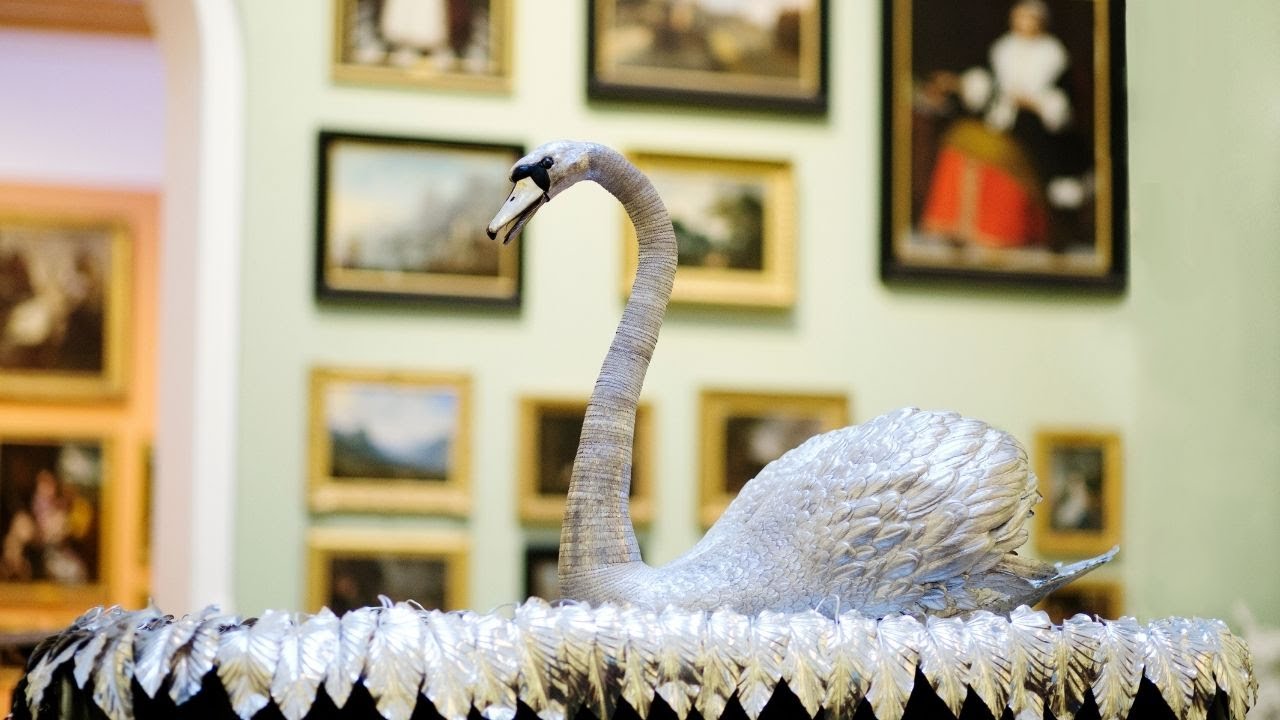
Seven silver fish swim in the water beneath the Silver Swan. The bird turns its long neck, attends to its feathers, then lowers its head towards the stream. A fish appears in its bill. The head rises, the bill works, and the fish disappears.
The seven fish below have not lost a companion. The one apparently caught was waiting inside the swan’s own bill. A mechanism pushes it into view and draws it back again. The fishing expedition is a substitution trick, performed by a bird made of silver over water made of glass.
The Swan belongs to The Bowes Museum in Barnard Castle, EnglandA market town in County Durham, northern England. The Bowes Museum houses the Silver Swan.Open in Google Maps , a market town in County Durham in northern England. Its first secure documentary setting is very different: the 1773–74 catalogues of James Cox’s London museum, where precious materials and moving machinery were offered as an expensive public spectacle.
A business in mechanical wonders
Cox sold objects in which a watch might be only one attraction among enamel, jewels, gilded metal and moving figures. From the mid-1760s, his enterprise supplied luxury goods to India and China. A restriction on shipments to China helped turn his attention towards a London audience. He opened the Spring Gardens Museum in 1772; plans to dispose of its contents by lottery followed.
His name did not mean that he had personally made every movement. In the early 1770s, Cox claimed between eight hundred and a thousand workmen. Many belonged to London’s network of independent suppliers. Most left no signature. The enterprise depended on separate skills being brought together in an object that a customer would recognise as Cox’s.
John Joseph Merlin, born near Liège in 1735, was Cox’s chief mechanician until about 1773. The design and supervision of the Swan’s mechanism have long been attributed to him. The surviving evidence does not establish a sole inventor or identify everyone who worked on the bird. Its exact production date and intended customer remain uncertain.
The object required more than clockwork. Its silver body carried closely worked feathers; the articulated neck had to bend without losing the outline of a swan. Glassworkers supplied an artificial stream. The finished performance brought those different materials into motion together.
The stage that disappeared
Cox’s catalogue placed the Swan within a much larger construction. Mirrors multiplied the bird. Beneath it, an animated crystal rock imitated falling water, with further reflections extending the effect. Jewellery ornamented the setting. Above stood a large dome, topped by a rising sun. The whole was described as nearly eighteen feet high.
This was advertising, written to sell the exhibition’s splendour. It is also evidence of the spectacle the enterprise intended to present. The great architectural setting is lost. The silver bird and its glass stream are survivors of a display that once extended far above and below them.
Water without a current
The stream does not flow from one end of the table to the other. Its twisted glass rods turn in place. Neighbouring rods rotate in opposite directions, shifting the pattern of reflections across the surface. Beneath and between them, arms move the seven jointed fish backwards and forwards.
The apparent water and the swimming fish therefore come from different movements. The glass makes a restless surface; the fish travel through that visual field.
Three independent clockwork drives divide the work. One powers the music, another the glass rods. The largest drives the bird’s actions and the visible fish. Wound springs store the energy, and gear trains carry it to the parts that turn a release of power into a particular sequence.
At the centre of the bird’s programme is a brass drum about twenty-four centimetres across. Shaped pieces called cams are fixed to it. As the drum rotates, their contours meet followers connected to rollers, levers, chains and lines. Those connections lift and lower the neck, work the lower bill and reveal or withdraw the concealed fish.
The order is built into the metal. A follower reaches a rising part of its cam and a lever moves; later, the contour lets it return. Several actions can be arranged around the same revolution. The bird does not select a fish or judge when to swallow. The mechanisms reach those moments because the relevant shapes have arrived under their followers.
A further track runs around the drum’s edge. A pin follows its changes of direction, rocking a toothed sector backwards and forwards. The sector engages a gear attached to the neck, making the head turn from side to side. The shape of that track determines much of the difference between a neck that merely changes direction and one that seems to belong to a bird.
The fish in the bill has its own place in this sequence. The seven fish below establish what the Swan appears to be hunting. When its head dips, the separate gilt-metal fish emerges at the expected moment. As the head rises, the fish retracts. The audience supplies the connection between the prey it has been watching and the object now apparently being swallowed.
The Swan, above and below the glass
The Bowes Museum’s film follows the Silver Swan’s performance and the specialists examining its fish, glass stream and clockwork during the conservation study.
The Bowes MuseumWatch on YouTube ↗Paris, and a distracted admirer
By the Paris Exposition of 1867, the Swan had passed through other owners and lost its great architectural setting. The London jeweller Harry Emanuel exhibited it among the British jewellery displays. A contemporary report described crowds around his stand and noted that the old automaton had been refitted.
Mark Twain saw it there. In The Innocents Abroad, published in 1869, he gave the bird “a living grace about his movements and a living intelligence in his eyes”. He followed the apparent catch through the motions of swallowing.
Twain and his companions spent nearly two hours at the enormous exhibition, then left. He admitted that the people repeatedly distracted him from the things on display. Immediately after the fish disappeared, a group of tattooed visitors from the South Seas drew him away.
A collector checks the story
When John Bowes considered buying the Swan, it came with a history that needed examining. In 1871, the Paris jewellers Briquet and Félix Samper sought information from Emanuel. His reply made a clockmaker called Weeks its creator and claimed that, after litigation, the machine had spent more than a hundred years at the Bank of England.
Bowes had reason to doubt that account. His stepfather, Sir William Hutt, remembered visiting Weeks’s museum as a young man and thought he had seen the Swan there. A century in the bank did not fit that memory. A later inscription of the name Weeks inside the mechanism was evidence of an association, but did not by itself make him the original maker.
HorologistSomeone who studies or makes clocks and watches.Merriam-Webster · horologist T. P. Camerer Cuss reconstructed this correspondence in 1965. The purchase went ahead for £200, and the Swan was delivered to Bowes’s Paris home in 1872.
John and his wife Joséphine were assembling a collection for a public museum in Barnard Castle. She was a Paris clockmaker’s daughter, an actress and a painter. He had bought the Théâtre des Variétés in Paris, where she worked under the name Mademoiselle Delorme. Their collecting brought paintings and decorative arts from France to the museum they were building in northern England.
Construction began in 1869. Neither founder lived to see the museum open in 1892. Its French-style building provided a permanent home for the collection, including a mechanical bird that had already spent a century in exhibitions, shops and other people’s museums.
The shape of a repair
Keeping the Swan working required more than winding its springs. It was largely a static exhibit after the museum opened, before an attendant returned it to working order in the late 1940s. Later overhauls left further generations of work inside it.
A major programme between 1968 and 1972 supplied a new supporting frame and remade mechanical components, including the track that controls the neck’s sideways movement. When conservator Matthew Read dismantled and documented the Swan in 2008, the distinction between older material and those replacements became clearer. Some new parts carried the restorer Tom Bryson-Smith’s name and date.
Part of the replacement track was rubbing against an older lever.
That contact put an extra load into a mechanism whose actions already depended on many connected parts. The Swan’s start counter recorded 33,259 operations between 1972 and September 2008. A small obstruction had been encountered repeatedly over decades of demonstrations.
Changing this part would also change the performance. A cam carries the timing and character of a movement in its shape. Read and researcher Rachel Wicaksono argued that the later, angular track might differ from a more flowing earlier arrangement. That is a reconstruction from mechanical evidence, rather than a surviving record of exactly how the eighteenth-century neck moved.
In 2009, the investigation acquired a wooden bird. The Swanulator was a plywood test rig with a simplified neck and a drum matching the historic cam’s size. Modern gears reproduced the relevant gear ratio.
A wooden neck could take the risks that the silver one could not.
The test rig showed that a smoother track could reduce local loads. It did not settle whether the later track should be replaced. That part, too, had acquired a history: for decades, it had supplied the movement visitors knew. Altering it meant choosing between different accounts of how the Swan should perform.
The practical work continued. The Swan stopped operating during the museum’s pandemic closure, and a study in 2021 brought conservators and clock specialists back around its dismantled parts. The subsequent 2023–24 project involved the Cumbria Clock Company, the museum’s conservation team and trainees from clockmaking courses. The museum reported more than 1,500 hours of work.
On 19 March 2024, after roughly four years out of operation, the Swan returned to public performance. The glass stream turned again, the neck bent, and the fish waiting in the bill had another appearance to make.
Further reading
- Matthew Read and Rachel Wicaksono, Modelling a cam track for the Silver Swan automaton at Bowes Museum, 2023, open-access study
- T. P. Camerer Cuss, The Silver Swan, 1965, reprinted in the Musical Box Society journal, 1966
- J. H. Leopold and Clare Vincent, James Cox: Goldsmith and Entrepreneur, Metropolitan Museum of Art
- Mark Twain, The Innocents Abroad, chapter XIII
- The Bowes Museum, The Silver Swan Story
- The Bowes Museum, Joséphine and John Bowes
- The Bowes Museum, Silver Swan Maintenance, 2012
- The Bowes Museum, the Swan’s return to performance in March 2024