Permission to Improve
Josiah Wedgwood borrowed the Portland Vase, a celebrated Roman glass vessel, in 1786. Copying its figures in pottery required new colours, different ways of making shade and a decision about which imperfections to keep.
What's the deal?
Collectors could study and display a version of a celebrated Roman masterpiece without owning the rare glass original. Wedgwood's Portland Vase recreated its figures in fine, unglazed pottery. Making several copies carried the antique's design into other collections, while demonstrating how closely an English pottery workshop could imitate carved glass using clay.
On 24 June 1786, Josiah Wedgwood asked Sir William Hamilton whether he should copy the shape of the Portland Vase as well as its figures. He did not think the shape as elegant as it might have been. Perhaps, he suggested, the ancient maker had been constrained by the way the glass was made.
Hamilton was the diplomat and collector who had brought the vase from Italy to Britain. The dark glass vessel, covered with pale classical figures, was an admired work of antiquity. Wedgwood had borrowed it from its new owner, the Duke of Portland, to reproduce it in his own ceramic material. He was considering whether a copy should improve on the original.
He had already found that the original was more difficult than its printed likeness. Working from an illustration published by the antiquarian Bernard de Montfaucon, he had felt confident of equalling or surpassing what he saw. Repeated examination of the glass had reduced that confidence. He admitted to Hamilton that his “crest is much fallen”.
The copy that emerged from the project could look remarkably like the antique at a distance. Its white figures stood against a blue-black body, with trees spreading above them and two bent handles at the neck. Making those forms in clay meant changing almost everything about how they were produced.
Keep the form
Wedgwood was already an established manufacturer when he undertook the copy. At Etruria, his factory in Staffordshire, England's pottery district, ornamental vases were part of the business alongside tableware. Engravings of objects in Hamilton's collections had supplied designs before the Portland project began.
The sculptor John Flaxman had urged him to see Hamilton's newly arrived glass vase in February 1784. Later that year, Hamilton sold it to the Duchess of Portland. After her death, her collection went to auction in 1786; her son bought the vase and lent it to Wedgwood.
Hamilton's advice was conservative. Damaged surfaces could be restored in the copy, but Wedgwood should keep the form. The modern potter's judgement of elegance was not sufficient reason to redesign an object whose reputation depended on its ancient workmanship.
The handles presented a small test of that intention. They were not perfectly symmetrical. The workshop modelled their unevenness rather than giving the vase a newly regular pair. The makers were copying a particular vessel, with a history and irregularities, rather than borrowing a decorative scheme for another shape.
Its scenes offered no secure explanation of themselves. Figures sit and recline among rocks, columns and trees; a winged child flies above one group. Their identities and the meaning of their encounters remain disputed. Wedgwood could study the carving closely without settling the story it told.
Making the white
The Roman vessel is cameo glass. A dark blue glass body carries a layer of white glass, cut away to leave figures and landscape in relief. Cutting deeper changes more than the outline. Where the white becomes sufficiently thin, the dark ground influences its appearance. Thickness can supply gradations of tone.
Wedgwood's material was jasper, the fine, unglazed stoneware he had developed in the 1770s. It could take colour and retain sharply modelled ornament. The factory had already tested many mixtures; surviving numbered pieces link colours and bodies to entries in his experiment book.
The familiar pale blue of much later Wedgwood ware was not the target here. The antique's glass could look almost black, but its underlying colour was deep blue. Wedgwood's existing black jasper had a brownish cast. He worked towards a blue-black composition that would keep its colour and form through firing.
The vase body was thrown on a potter's wheel and then turned to refine its profile and remove excess material. Its handles and white figures were made separately and attached. Instead of removing a white layer to expose a darker one, the workshop was adding white forms to a dark surface.
Henry Webber, William Hackwood and William Wood were among the modellers associated with the work. Wedgwood's son Josiah also took part in the experiments. Wax models supplied a stage from which working moulds could be made. The figures still needed finishing and careful placement on a curved vessel; producing a mould did not complete the sculpture.
Webber did not remain at the factory throughout the undertaking. He went to Rome in 1787, returning in 1789, as part of Wedgwood's wider effort to obtain models and designs from antiquity. Work on the vase continued while that artistic network extended abroad.
Making the relief very thin seemed one route towards the glass's delicacy. It was not enough to make clay behave optically like the original. On the early copy now in the Fitzwilliam Museum, a thin black slip—a liquid ceramic mixture—was painted onto parts of the white decoration. The dark wash supplied shading where the material alone did not give the desired effect.
That was a practical departure from the antique's method. A shaded passage could resemble the effect of carved glass while being made with applied ceramic relief and surface colour. The workshop sought a resemblance in what the viewer saw, using operations available to a potter.
Turning and applying
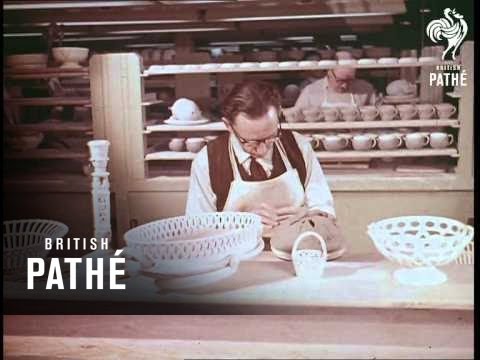
At the later Wedgwood factory in Barlaston, turners and ornamenters work on new ceramic pieces. British Pathé's factory film opens here at a turning sequence, before showing moulding and the application of relief decoration.
British PathéWatch on YouTube ↗What survived the oven
A model could be examined and adjusted on the workbench. The assembled vase then had to survive a firing whose result could not be inspected while it was happening.
Two full-size trials dated about 1789 preserve different failures. On one, gases expanding inside the clay raised bubbles in the surface. On another, the white reliefs failed to hold and broke away. The second failure exposed a particular risk of the ceramic construction: the decoration had been attached to the body, and the join had to endure the firing with it.
Smaller surviving relief trials tested the resemblance to translucent glass. These let the workshop examine an effect on a part of the design without making an entire finished vase each time. Full-size attempts still tested whether the parts and the body would work together.
Wedgwood had developed a pyrometer that used the shrinkage of standard clay pieces to measure high heat. An unheated piece fitted the wide end of a brass gauge; after firing, it fitted further along the narrowing gap. A scale marked its reduction in size. The instrument helped him compare firings, although its reliability as a measure of temperature was later questioned. It did not remove the uncertainty he described to Hamilton: the action of fire could neither be commanded completely nor watched as it altered his materials.
Accuracy also depended on what was being copied. In Wedgwood's time, a round piece of cameo glass served as the antique's base. It carried a profile head, traditionally identified as Paris or Priam. The British Museum now treats it as a separate ancient object, cut down from a larger composition. Its colour, composition and style differ from the vase.
The pieces had been associated since at least the early seventeenth century. The early copy now at the Fitzwilliam reproduces the head on its base. A maker following the borrowed object faithfully would carry that old addition into the new pottery as well.
A case for the buyer
By autumn 1789, Wedgwood had a copy good enough to send to his friend Erasmus Darwin, the physician and botanist. Darwin was instructed to keep it within his family. He admitted showing it to a few friends in Derby, distinguishing these philosophers from connoisseurs.
The Fitzwilliam's vase is probably this early copy. It retains its fitted travelling case.
In 1790, Wedgwood displayed a copy at his Greek Street showroom in London. He had 1,900 engraved admission cards printed. Queen Charlotte received a private view; Joshua Reynolds endorsed its fidelity. Josiah junior then took his father's copy to Continental cities, including Rotterdam, Amsterdam and Berlin, seeking subscribers.
Public admiration did not produce a large run of flawless objects. The early production continued through the remaining years of Wedgwood's life, until his death in 1795. The Fitzwilliam estimates that forty to fifty copies were made before then, including defective ones. A first edition was a succession of difficult firings, with variations in the results.
One buyer was Thomas Hope, the wealthy collector who saw the copy Josiah junior had brought to Amsterdam. On 13 June 1793, Hope took delivery of a vase for thirty guineas. The case cost another two.
Further reading
- V&A: Josiah Wedgwood's Portland Vase and its surviving trials
- Fitzwilliam Museum: Copy of the Portland Vase
- Fitzwilliam Museum: Erasmus Darwin's probable copy, detailed catalogue
- British Museum: The Roman Portland Vase
- British Museum: The separate cameo disc
- Cleveland Museum of Art: An early Wedgwood Portland Vase
- Milo Keynes: The Portland Vase, Sir William Hamilton, Josiah Wedgwood and the Darwins, 1998
- Royal Society: Degrees Wedgwood and the pyrometer