Forty Characters of Clockwork
In the 1770s, Jaquet-Droz’s mechanical boy could write a newly chosen message of up to forty characters. His makers were selling Swiss watchmaking, while giving a remarkably familiar vision of a writing assistant its human form.
What's the deal?
By 1774, Swiss clockmakers had built a mechanical boy that dipped a pen in ink and wrote a message of up to forty characters. An operator chose the words beforehand. Long before electronic computers, a machine could be programmed to carry out a recognisably human task. It understood none of the words, but could reproduce the coordinated movements of handwriting.
In London in 1777, an advertisement offered a small boy who could write words proposed by his audience. It called him the “Magical Boy”. The promise went beyond watching a figure repeat a familiar trick: someone could supply the words, and the boy would set them down in a legible hand.
The boy was an AutomatonMerriam-Webster defines it as “a machine that can move by itself”. Here, a clockwork figure. The plural is automata.Merriam-Webster · automaton . Seated at a desk, dressed in a coat and breeches, he held a goose quill in his right hand. The words came from an operator’s preparation; the movement came from machinery inside his body. Changing the message was part of what his makers had built him to do.
Pierre Jaquet-Droz began constructing the Writer in 1768, with help from Jean-Frédéric Leschot. By 1774, the enterprise had produced three figures: the Writer, the Draughtsman and the Musician. Pierre’s son Henri-Louis took a leading role in the companion figures. Their work came out of La Chaux-de-Fonds, SwitzerlandA watchmaking town in the Swiss Jura, near the French border. Jaquet-Droz and his collaborators built their figures here.Open in Google Maps , in the watchmaking country of the Swiss Jura, and soon travelled far beyond it.
Before the boy, the clocks
Pierre had already found a royal customer for moving machinery. Born in 1721, he had studied philosophy at Basel before turning to mechanical clockmaking. In 1758 he went to Spain, where Ferdinand VI bought his clocks, including examples with animated parts. The sales helped establish an international business in expensive watches and clocks. They also supplied money for the much more elaborate figures that followed.
Building the figures required considerable investment. A working automaton could attract people who might otherwise never have examined a watchmaker’s products. The figures became travelling advertisements for the enterprise’s command of small, coordinated movements.
Henri-Louis, born in 1752, studied mathematics at Nancy before joining his father’s mechanical work. He was still a young man when the figures went on exhibition. Leschot contributed to their construction and later helped keep the wider business running. Around the named makers stood a network of specialised workers supplying the skills and components that luxury watchmaking required.
The figures drew attention to a business whose customers bought clocks and watches. Its international trade developed after Pierre’s Spanish journey, bringing the expense of the automata within reach.
The scale of a human figure allowed the makers to display movements that a customer could follow: an arm reaching towards an inkwell, a hand lowering a quill. Their watchmaking work had acquired a public performance.
Forty places for a message
The Writer’s capacity was a short text of up to forty characters. Two different tasks had to be coordinated: forming each letter and choosing which letter came next. A new message could change the order of the letters without requiring the maker to cut a new handwriting mechanism.
For the letterforms, the machine used cams: shaped pieces whose outlines controlled movement as they turned against followers connected to levers. Their profiles carried the changes of direction needed to make a written stroke. A bank of cams supplied the movements of the hand, including the quill’s contact with the paper.
The text was set separately, on a disc with forty adjustable stops. Before a performance, an operator removed the disc and arranged those stops to select the required sequence. Their differing heights controlled levers that moved the cam assembly into position for each letter. The disc advanced under clockwork power. There was considerable preparation behind the advertisement’s promise that the audience could propose the words.
A 1954 technical catalogue from the Conservatoire national des arts et métiers describes a deliberate sequence of controls. One lever sent the quill into the inkwell; the figure withdrew it and shook it twice. A second lever started the writing. The cam plates were cut from brass only seven-tenths of a millimetre thick, and their regulation required fine adjustment.
The paper moved too. As each letter was completed, the sheet shifted from right to left beneath the writing hand, making room for the next. The boy could therefore appear to write across a page while much of the spacing was managed by the desk beneath his quill.
The adjustable message had limits. Its letter shapes were already embodied in the mechanism. An operator could choose their sequence, but asking for a different style of handwriting would mean changing the machinery that traced them.
A surprisingly familiar vision
Today, technology leaders envision intelligent humanoid robots capable of acting on their own. Yet more than 250 years ago, Jaquet-Droz and his collaborators were already giving physical form to a remarkably similar vision. They built a mechanical boy who sat at a desk, held a pen and wrote without anyone guiding his hand.
The technology could hardly be more different, but the ambition is strikingly familiar: to create a machine in our own image that can perform human tasks independently. The dream was much older than Jaquet-Droz. What is extraordinary is how convincingly he and his collaborators brought it to life.
The Writer at work
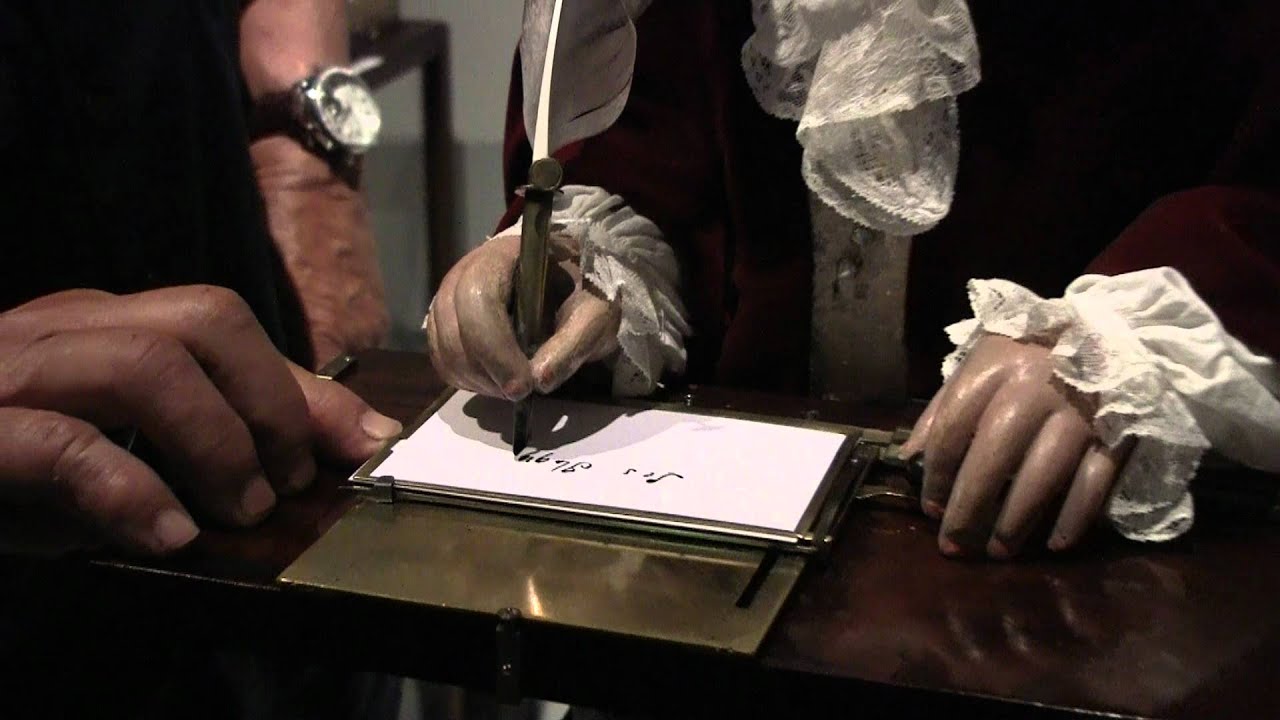
A close view of the Writer in action at Neuchâtel: the quill touches the sheet, and the paper moves beneath the hand as the prepared message takes shape.
aBlogtoWatchWatch on YouTube ↗A pencil and an organ
The other figures offered different performances. The Draughtsman, constructed in 1772–74 by Henri-Louis with Leschot’s assistance, worked over a sheet that stayed in place. His hand moved across it with a pencil. He could also blow dust from his drawing.
His repertoire contained four drawings, supplied by three interchangeable sets of cams. One set served both a profile of Louis XV and a dog accompanied by the words “Mon Toutou”. The others produced a double portrait of George III and Queen Charlotte, and Cupid driving a chariot drawn by a butterfly. Changing the drawing required selecting the mechanism for an existing design.
The Musician’s repertoire consisted of five pieces played on an organ. Her mechanism extended beneath her seat, where it could coordinate the movements of her hands and body.
Her fingers actually depressed the organ keys. A pinned cylinder, driven by a spring, controlled them through rods and levers, supplying the final movement between the machinery and the instrument.
Other movements lifted her chest, inclined her body and turned her head; she bowed after an air. The movement that produced the music and the movements that made her resemble a performer were built into the same figure.
The makers also offered articulated hands for people. London advertising placed this work beside the automata, bringing two very different uses of mechanical limbs into the same business.
A hand made for a customer
A London advertisement in 1776 claimed that artificial hands supplied by Jaquet-Droz allowed a man born without hands to write, eat and handle a hat or cane. These were the seller’s claims. A more practical trace survives in Leschot’s correspondence: in 1795 he requested a cast of a customer’s surviving arm to help make an artificial one. The individual body supplied measurements that a repeated stage performance did not require.
The price of admission
The figures went to paying audiences as well as distinguished private spectators. At the Hôtel Lubert in Paris, the advertised prices were six livres for a first place and three for a second. Servants were excluded.
The travelling spectacle also included a Grotto, a mechanical pastoral scene populated with smaller moving figures. An eighteenth-century engraved prospectus places the three performers around this elaborate display. It offered several kinds of movement within one exhibition, from the small activities of the landscape to the hand working over a page.
In Geneva in 1785, the family directed exhibition proceeds towards hospitals in Geneva and La Chaux-de-Fonds. The city’s council connected the gift with Henri-Louis’s skills and the useful industry he could bring to Geneva when it proposed granting him citizenship without the usual payment. He became a citizen that year. The touring figures had helped secure a place for their maker as well as revenue for the business.
The family’s own exhibitions ended at Geneva in 1785. Leschot had taken responsibility for the European tour after the automata left London in 1777; he subsequently joined Henri-Louis in Geneva, where they established another workshop. The travelling show and the production of luxury mechanisms had begun to move along separate paths.
The figures passed into other hands. Historian Sandrine Girardier’s reconstruction distinguishes the Writer, probably sold earlier, from the other automata, which went to the Gendre brothers, French merchants established in Madrid, in 1788. Writing in 1806, Leschot recalled that the revolutionary upheavals had disrupted the buyers’ undertaking. The Grotto disappeared; the three large figures survived.
Pierre died in 1790. Henri-Louis, whose health had deteriorated, travelled to warmer climates and died at Naples in 1791, aged thirty-nine. Leschot continued the business. Its correspondence preserves the work of finding customers, arranging repairs and adapting mechanisms long after the first exhibitions.
Back in Neuchâtel
By the early twentieth century, the three belonged to a collector in Berlin. Their return to Neuchâtel required a purchase supported by the local historical society, donors and public funds. On 1 May 1909, they were donated to the city. They are now housed together in its Musée d’art et d’histoire.
Keeping them on exhibition also means deciding when they can operate. In October 2026, the museum reported that a defective part and a technical problem had stopped demonstrations of the Writer. Repair involved several specialists. The Musician and Draughtsman continued their performances; the boy remained on display beside them.
Further reading
- Musée d’art et d’histoire, Neuchâtel: the Jaquet-Droz automata and current conservation notice
- Museum collection: the Writer
- Museum collection: the Draughtsman
- Conservatoire national des arts et métiers: Horloges et automates, 1954, entries 94–96
- Automates & Merveilles: the museums’ 2012 exhibition dossier
- Sandrine Girardier: Automates, prothèses et utilité publique, 2012
- Sandrine Girardier: L’entreprise Jaquet-Droz, 2020
- Historical Dictionary of Switzerland: Pierre Jaquet-Droz
- Historical Dictionary of Switzerland: Henri-Louis Jaquet-Droz
- Google DeepMind: language, action and humanoid robotics
- Homer: Iliad, Book 18, the golden attendants of Hephaestus (Samuel Butler translation)