The Cost of a Clean Sheet
Alois Senefelder wanted to print his own plays. Music brought him a partner and paying work, but a better press began ruining the paper. Making lithography useful took more than a mark on limestone.
What's the deal?
Artists could print many copies of a drawing while keeping the character of their own pencil-like or ink marks. Lithography used a prepared stone instead of requiring every line to be cut into metal or wood. It also offered publishers a practical way to reproduce handwritten music, maps and documents.
The cheap press had split wooden cylinders. Alois Senefelder had learnt to start each pull with the damaged part out of the way, and the machine produced satisfactory impressions from his printing stones. Then he acquired a better press. The new sheets came out smeared.
This was Munich in the 1790s, and there was paid work to deliver. Senefelder and his partner, the court musician Franz Gleißner, had begun printing music from limestone. A commission for a cantata had encouraged them to improve their equipment. Instead, the new machine consumed paper while they searched for the fault. In Senefelder’s later account, only two or three impressions in a twenty-sheet trial were tolerable.
He eventually understood what the crack had done for him. His habitual starting position allowed the old press to grip the stone before applying full pressure. The replacement dragged the covering material before the stone was properly engaged. The paper shifted across the wet ink. He had been relying on an operating sequence imposed by a broken cylinder.
By the time his handbook appeared in English in 1819, Senefelder could offer artists several ways to make a drawing printable. Samuel Prout’s cottage, one of its specimens, preserves the broken texture of chalk-like strokes. Producing such a sheet required the printer to keep the drawing sharp and the surrounding stone clean through repeated dampening and inking. The failed music press belonged to the long effort to make that repetition dependable.
A playwright’s printing bill
Senefelder had wanted a career in the theatre. His father was an actor, and Alois wrote plays while studying law. After his father’s death he could no longer continue his studies. Acting proved unsuccessful; selling a play did not necessarily make printing it affordable. He spent time watching commercial printers and considered acquiring a press and type of his own. He lacked the money.
His account of what followed is unusually detailed about the things he tried. It is also a recollection written roughly two decades afterwards, when other people were disputing his claim to the invention. He was explaining his work and defending his priority. Its mishaps and expenses need to be read in that light.
He experimented with making printing types, with casts in sealing wax and with etching copper. Writing backwards was another job to learn: an impression reverses the image on its printing surface. He devised a dark mixture containing wax, soap and lampblack so that he could correct errors in an acid-resistant coating. A limestone slab, initially acquired for grinding colours, offered a cheap place to practise.
The often-told laundry list enters his account at this stage. His mother needed a list for the washerwoman; he had no paper or ordinary ink to hand and wrote it on the stone with his experimental mixture. Afterwards he tried acid on the uncovered surface. The stone around the writing was eaten away, leaving the letters slightly raised and able to take printing ink.
That was printing in relief, like the raised surface of a woodcut. It was not yet the essentially flat, chemically differentiated surface now meant by lithography. The distinction matters more than the neatness of the anecdote. Senefelder’s early relief experiments are generally dated to 1796; the chemical method developed later. His own retrospective dates vary between 1798 and 1799.
Twelve songs, then spoiled paper
Music gave him a market before artists’ prints did. Senefelder recalled seeing a poorly printed piece of music and thinking he might do better. An acquaintance mentioned that Gleißner wanted some music printed. When Senefelder first called, the musician was out. Gleißner’s wife heard the explanation and encouraged him to return with his little demonstration press.
Gleißner agreed to finance the work. In Senefelder’s telling, the musician composed twelve songs with keyboard accompaniment; Senefelder copied them onto stones and printed with a day labourer. They completed 120 copies within a fortnight. The music dealer Falter bought a hundred. Senefelder remembered a cost of thirty florins and receipts of a hundred: an encouraging margin for a partnership buying stone, paper and ink.
His mother had already provided the rough, carpenter-made press, which cost six florins. Senefelder emphasised its cheapness when he sent specimens and an explanation to the Electoral Academy of Sciences. The response disappointed him. Instead of the public recognition he wanted, he received twelve florins, with the explanation that this was twice the expense he had reported.
The cantata commission and the troublesome replacement press followed. Trying to apply pressure straight down instead brought another difficulty. Uneven loading broke stones. Rubbing the back of the paper by hand could produce fine proofs when Senefelder did it himself, but six hired men could not reproduce his even pressure. A weak patch could spoil a sheet on which other pages had printed correctly.
Falter eventually paid for another cylinder press. Senefelder began printing a quartet arrangement of Mozart’s The Magic Flute at the dealer’s house, assisted by Mrs Gleißner. Her husband became seriously ill and needed her care. Senefelder instructed two soldiers in printing and supplied Falter with the prepared stones. Their waste of paper made the dealer return to copperplate printing.
Mrs Gleißner’s part in the work is easy to lose between the inventor and the composer. She had encouraged the first demonstration, then worked at the press herself. The two replacement printers were given the procedure. That did not make their sheets worth selling.
Keeping the blank stone blank
Writing music backwards also consumed time. Gleißner became skilled at preparing reversed musical notation in pencil for Senefelder to finish. A more convenient possibility was to write normally on paper, then transfer the design onto stone. The transfer would reverse it once; printing would reverse it again, returning the notes or letters to their intended direction.
Experiments with transfer materials led Senefelder towards the chemical method. He described writing on polished stone with soap, washing it with a solution of gum arabic and applying oily colour. The greasy marks accepted the colour while the damp surrounding surface stayed clean. Rewetting and inking allowed another impression.
The working distinction was now between areas that accepted oily ink and areas that retained water and resisted it. The letters did not have to stand above the surface, nor did every line have to be cut into it. Gum treatment helped keep the non-image stone receptive to water. Controlled acid treatment and adjustments to the drawing mixture made the process more manageable.
It still left plenty of ways to ruin a print. If the stone dried during rolling, the background could take ink. Too much water interfered with the fine marks and the roller. Drawing material that spread on a polished stone blurred the work before it reached the press. Greasing the whole surface, once useful in an earlier method, would now make the supposed blank areas print as well.
Printing from a prepared stone
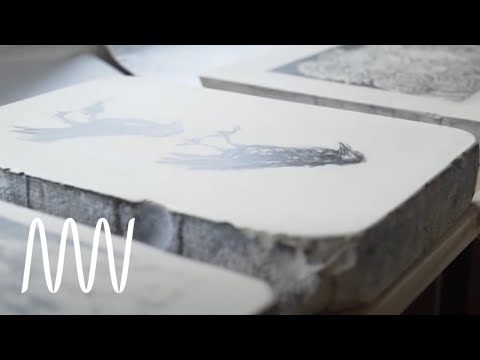
Nora Hammenberg of Stone Tree Press demonstrates modern stone lithography, from preparing the drawing to inking and pulling an impression.
National Museums LiverpoolWatch on YouTube ↗Artists could draw directly with greasy ink or a chalk-like material. A finely grained surface broke the dry drawing material into dots, giving a different texture from a pen line. The printer had to preserve those small marks through treatment and rolling. Prout’s cottage belongs to this chalk manner; its soft foliage and coarse thatch were printed from the same kind of prepared surface.
What André bought
By September 1799, the partners could offer something substantial enough to sell. Johann Anton André, a music publisher from Offenbach, saw a demonstration in Munich. On 28 September he contracted with Senefelder and Gleißner for the secret of printing music and pictures on stone, at a price of 2,000 guilders.
The agreement required Senefelder to go to Offenbach, supervise the necessary equipment and look for suitable stone. People had to be trained to write and print properly. In December the partners travelled there to establish the operation. André’s publishing connections subsequently carried the process to other cities.
In London, his brother Philipp supplied artists with lithographic materials. With the engraver and publisher James Heath, he issued twelve prints in 1803 under the title Specimens of Polyautography. Artists made their original drawings on stone. Georg Jacob Vollweiler later expanded the publication to thirty-six prints, but public response was weak and the London press eventually closed.
The 1819 handbook also offered a route that began away from the stone. Prout’s other specimen, labelled A Transfer, has the firm lines of a pen drawing: timbers, posts and coils of rope beside water. Specially prepared drawing material carried the design from paper onto the printing surface. Senefelder devoted a section to the uses of this method, from music and commercial papers to government orders. The writer could make the marks in the ordinary direction. Reversal could be left to the transfer and the press.
Further reading
- Alois Senefelder, A Complete Course of Lithography, English edition, 1819
- Senefelder’s original German handbook, 1818
- The Invention of Lithography, J. W. Muller’s English translation, 1911
- Haus der Stadtgeschichte, Offenbach: Die Erfindung des Steindrucks, including the 1799 agreement
- The Metropolitan Museum of Art: Specimens of Polyautography, 1803–7
- The Metropolitan Museum of Art: Robert Ker Porter, Charge, 1803
- Colta Feller Ives: Lithography in the Nineteenth Century
- The Metropolitan Museum of Art: Winterhalter’s portrait of Alois Senefelder